
Articles | Volume 16, issue 12
https://doi.org/10.5194/se-16-1493-2025
© Author(s) 2025. This work is distributed under
the Creative Commons Attribution 4.0 License.
the Creative Commons Attribution 4.0 License.
Special issue:
https://doi.org/10.5194/se-16-1493-2025
© Author(s) 2025. This work is distributed under
the Creative Commons Attribution 4.0 License.
the Creative Commons Attribution 4.0 License.
Research article
| 
12 Dec 2025
Research article |
| 12 Dec 2025
| 12 Dec 2025
Seismic data acquisition to combine high-resolution seismic reflection and full-waveform inversion – a case study for overdeepened valleys
Federal Institute for Geosciences and Natural Resources (BGR), Hannover, 30655, Germany
Daniel Köhn
Kiel University, Kiel, 24118, Germany
Matthias Körbe
LIAG Institute for Applied Geophysics, Hannover, 30655, Germany
Gerald Gabriel
LIAG Institute for Applied Geophysics, Hannover, 30655, Germany
Institute of Earth System Sciences, Section Geology, Leibniz University, Hannover, 30655, Germany
Johannes Großmann
Bavarian Environment Agency (LfU), Hof, 95030, Germany
Gustav Firla
Department of Landscape, Water and Infrastructure, BOKU University, Vienna, 1190, Austria
Markus Fiebig
Department of Landscape, Water and Infrastructure, BOKU University, Vienna, 1190, Austria
Related authors
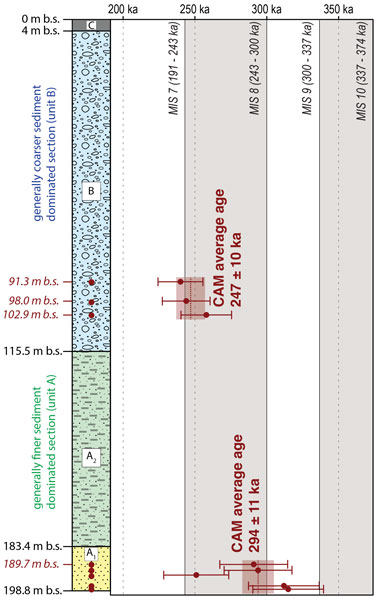
Gustav Firla, Christopher Lüthgens, Thomas Burschil, Stephanie Neuhuber, Roberta Pini, Oscar Marchhart, Alexander Wieser, Clemens Schmalfuss, Ernst Kroemer, and Markus Fiebig
E&G Quaternary Sci. J., 75, 85–105, https://doi.org/10.5194/egqsj-75-85-2026, https://doi.org/10.5194/egqsj-75-85-2026, 2026
Short summary
Short summary
Depositional single-grain feldspar luminescence ages reveal the filling of a glacially overdeepened basin during Marine Isotope Stage 8, representing rare evidence of this time frame in the northern Alpine foreland. Reflection seismic surveys revealed two cross-cutting glacial basins. The dated sediments reveal significantly younger ages than previously assumed. This represents a first step in a re-evaluation of the established Quaternary depositional chronology of the Bavarian Alpine foreland.
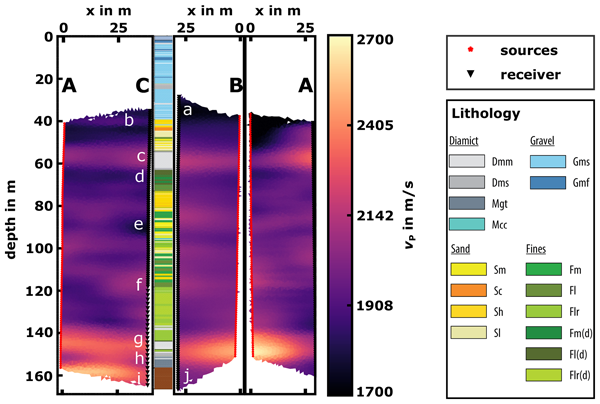
Sarah Beraus, Thomas Burschil, Hermann Buness, Daniel Köhn, Thomas Bohlen, and Gerald Gabriel
Sci. Dril., 33, 237–248, https://doi.org/10.5194/sd-33-237-2024, https://doi.org/10.5194/sd-33-237-2024, 2024
Short summary
Short summary
We conducted seismic crosshole experiments with a sparker source in order to obtain a high-resolution subsurface velocity model in the glacially overdeepened Tannwald Basin (ICDP site 5068_1). The data show complex wave fields that contain a lot of information but also present challenges. Nevertheless, isotropic first-arrival travel-time tomography provides the first high-resolution subsurface models that correlate well with the sonic logs and the core recovered from one of the three boreholes.
Gustav Firla, Christopher Lüthgens, Thomas Burschil, Stephanie Neuhuber, Roberta Pini, Oscar Marchhart, Alexander Wieser, Clemens Schmalfuss, Ernst Kroemer, and Markus Fiebig
E&G Quaternary Sci. J., 75, 85–105, https://doi.org/10.5194/egqsj-75-85-2026, https://doi.org/10.5194/egqsj-75-85-2026, 2026
Short summary
Short summary
Depositional single-grain feldspar luminescence ages reveal the filling of a glacially overdeepened basin during Marine Isotope Stage 8, representing rare evidence of this time frame in the northern Alpine foreland. Reflection seismic surveys revealed two cross-cutting glacial basins. The dated sediments reveal significantly younger ages than previously assumed. This represents a first step in a re-evaluation of the established Quaternary depositional chronology of the Bavarian Alpine foreland.
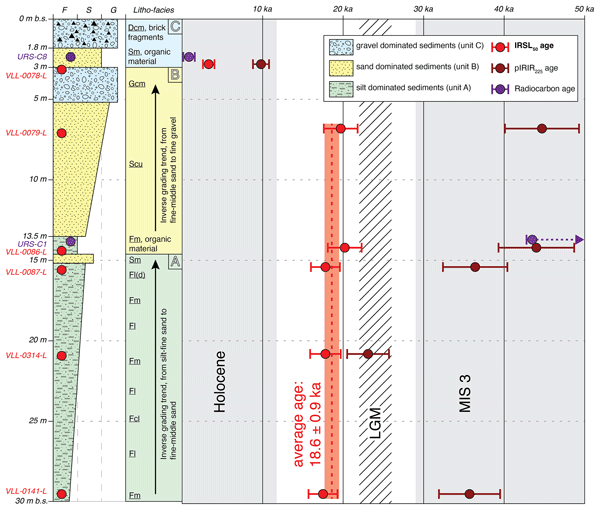
Gustav Firla, Markus Fiebig, Titus Rauter, and Christopher Lüthgens
E&G Quaternary Sci. J., 74, 213–218, https://doi.org/10.5194/egqsj-74-213-2025, https://doi.org/10.5194/egqsj-74-213-2025, 2025
Short summary
Short summary
Glacio-lacustrine sediments from the overdeepened lower Salzach Valley were investigated. A 30 m long core retrieved sediments that could be identified as the “Salzburger Seeton”. Single-grain luminescence dating methods were applied on six samples spread over the whole depth of the core. The depositional age of these sediments was calculated to be 18.6 ± 0.9 ka. This time frame suggests that at least some shallow parts were filled by post-LGM (Last Glacial Maximum) lacustrine fine sediments.
Sarah Beraus, Thomas Burschil, Hermann Buness, Daniel Köhn, Thomas Bohlen, and Gerald Gabriel
Sci. Dril., 33, 237–248, https://doi.org/10.5194/sd-33-237-2024, https://doi.org/10.5194/sd-33-237-2024, 2024
Short summary
Short summary
We conducted seismic crosshole experiments with a sparker source in order to obtain a high-resolution subsurface velocity model in the glacially overdeepened Tannwald Basin (ICDP site 5068_1). The data show complex wave fields that contain a lot of information but also present challenges. Nevertheless, isotropic first-arrival travel-time tomography provides the first high-resolution subsurface models that correlate well with the sonic logs and the core recovered from one of the three boreholes.
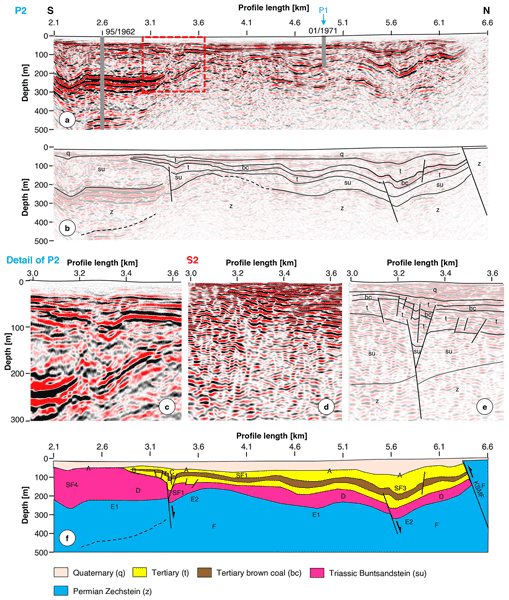
Sonja H. Wadas, Hermann Buness, Raphael Rochlitz, Peter Skiba, Thomas Günther, Michael Grinat, David C. Tanner, Ulrich Polom, Gerald Gabriel, and Charlotte M. Krawczyk
Solid Earth, 13, 1673–1696, https://doi.org/10.5194/se-13-1673-2022, https://doi.org/10.5194/se-13-1673-2022, 2022
Short summary
Short summary
The dissolution of rocks poses a severe hazard because it can cause subsidence and sinkhole formation. Based on results from our study area in Thuringia, Germany, using P- and SH-wave reflection seismics, electrical resistivity and electromagnetic methods, and gravimetry, we develop a geophysical investigation workflow. This workflow enables identifying the initial triggers of subsurface dissolution and its control factors, such as structural constraints, fluid pathways, and mass movement.
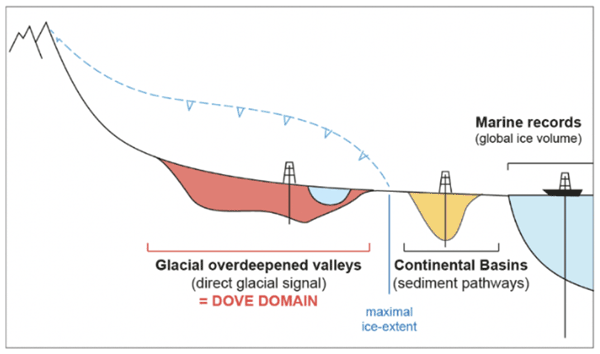
Flavio S. Anselmetti, Milos Bavec, Christian Crouzet, Markus Fiebig, Gerald Gabriel, Frank Preusser, Cesare Ravazzi, and DOVE scientific team
Sci. Dril., 31, 51–70, https://doi.org/10.5194/sd-31-51-2022, https://doi.org/10.5194/sd-31-51-2022, 2022
Short summary
Short summary
Previous glaciations eroded below the ice deep valleys in the Alpine foreland, which, with their sedimentary fillings, witness the timing and extent of these glacial advance–retreat cycles. Drilling such sedimentary sequences will thus provide well-needed evidence in order to reconstruct the (a)synchronicity of past ice advances in a trans-Alpine perspective. Eventually these data will document how the Alpine foreland was shaped and how the paleoclimate patterns varied along and across the Alps.
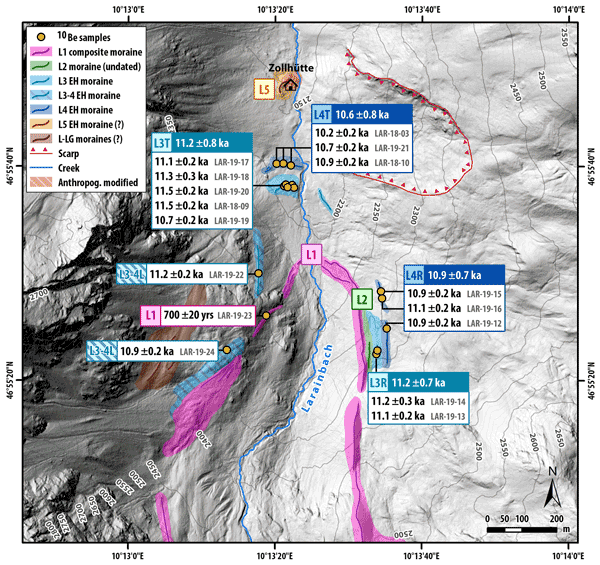
Sandra M. Braumann, Joerg M. Schaefer, Stephanie M. Neuhuber, Christopher Lüthgens, Alan J. Hidy, and Markus Fiebig
Clim. Past, 17, 2451–2479, https://doi.org/10.5194/cp-17-2451-2021, https://doi.org/10.5194/cp-17-2451-2021, 2021
Short summary
Short summary
Glacier reconstructions provide insights into past climatic conditions and elucidate processes and feedbacks that modulate the climate system both in the past and present. We investigate the transition from the last glacial to the current interglacial and generate beryllium-10 moraine chronologies in glaciated catchments of the eastern European Alps. We find that rapid warming was superimposed by centennial-scale cold phases that appear to have influenced large parts of the Northern Hemisphere.

Tommaso Pivetta, Carla Braitenberg, Franci Gabrovšek, Gerald Gabriel, and Bruno Meurers
Hydrol. Earth Syst. Sci., 25, 6001–6021, https://doi.org/10.5194/hess-25-6001-2021, https://doi.org/10.5194/hess-25-6001-2021, 2021
Short summary
Short summary
Gravimetry offers a valid complement to classical hydrologic measurements in order to characterize karstic systems in which the recharge process causes fast accumulation of large water volumes in the voids of the epi-phreatic system. In this contribution we show an innovative integration of gravimetric and hydrologic observations to constrain a hydrodynamic model of the Škocjan Caves (Slovenia). We demonstrate how the inclusion of gravity observations improves the water mass budget estimates.
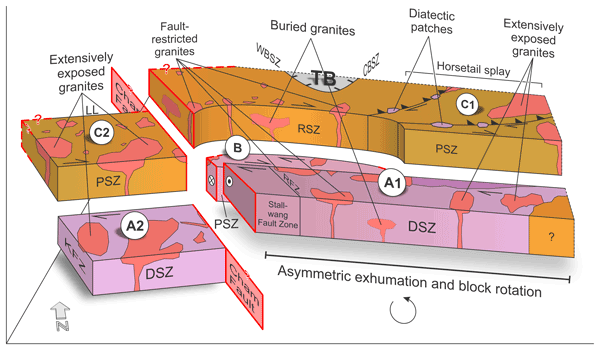
Andreas Eberts, Hamed Fazlikhani, Wolfgang Bauer, Harald Stollhofen, Helga de Wall, and Gerald Gabriel
Solid Earth, 12, 2277–2301, https://doi.org/10.5194/se-12-2277-2021, https://doi.org/10.5194/se-12-2277-2021, 2021
Short summary
Short summary
We combine gravity anomaly and topographic data with observations from thermochronology, metamorphic grades, and the granite inventory to detect patterns of basement block segmentation and differential exhumation along the southwestern Bohemian Massif. Based on our analyses, we introduce a previously unknown tectonic structure termed Cham Fault, which, together with the Pfahl and Danube shear zones, is responsible for the exposure of different crustal levels during late to post-Variscan times.
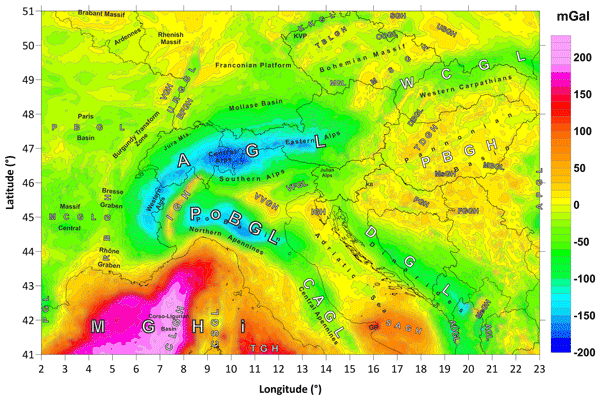
Pavol Zahorec, Juraj Papčo, Roman Pašteka, Miroslav Bielik, Sylvain Bonvalot, Carla Braitenberg, Jörg Ebbing, Gerald Gabriel, Andrej Gosar, Adam Grand, Hans-Jürgen Götze, György Hetényi, Nils Holzrichter, Edi Kissling, Urs Marti, Bruno Meurers, Jan Mrlina, Ema Nogová, Alberto Pastorutti, Corinne Salaun, Matteo Scarponi, Josef Sebera, Lucia Seoane, Peter Skiba, Eszter Szűcs, and Matej Varga
Earth Syst. Sci. Data, 13, 2165–2209, https://doi.org/10.5194/essd-13-2165-2021, https://doi.org/10.5194/essd-13-2165-2021, 2021
Short summary
Short summary
The gravity field of the Earth expresses the overall effect of the distribution of different rocks at depth with their distinguishing densities. Our work is the first to present the high-resolution gravity map of the entire Alpine orogen, for which high-quality land and sea data were reprocessed with the exact same calculation procedures. The results reflect the local and regional structure of the Alpine lithosphere in great detail. The database is hereby openly shared to serve further research.
Cited articles
Anselmetti, F. S., Bavec, M., Crouzet, C., Fiebig, M., Gabriel, G., Preusser, F., Ravazzi, C., and DOVE scientific team: Drilling Overdeepened Alpine Valleys (ICDP-DOVE): quantifying the age, extent, and environmental impact of Alpine glaciations, Sci. Dril., 31, 51–70, https://doi.org/10.5194/sd-31-51-2022, 2022.
Beraus, S., Köhn, D., Bohlen, T., Buness, H., Burschil, T., and Gabriel, G.: High-Resolution Shear Wave Crosshole Full-Waveform Inversion, in: Third EAGE Conference on Seismic Inversion, October 2024, Volume 2024, p. 1–5, Naples, Italy, https://doi.org/10.3997/2214-4609.202438039, 2024.
Brodic, B., Malehmir, A., Pugin, A., and Maries, G.: Three-component seismic land streamer study of an esker architecture through S-and surface-wave imaging, Geophysics, 83, B339–B353, https://doi.org/10.1190/geo2017-0747.1, 2018.
Brodic, B., Ras, P., de Kunder, R., Drijkoningen, G., and Malehmir, A.: Seismic imaging using an e-vib—A case study analyzing the signal properties of a seismic vibrator driven by electric linear synchronous motors, Geophysics, 86, B223-B235, https://doi.org/10.1190/geo2020-0181.1, 2021.
Buness, H., Tanner, D. C., Burschil, T., Gabriel, G., and Wielandt-Schuster, U.: Cuspate-lobate folding in glacial sediments revealed by a small-scale 3-D seismic survey, Journal of Applied Geophysics, 200, 104614, https://doi.org/10.1016/j.jappgeo.2022.104614, 2022.
Büker, F., Green, A. G., and Horstmeyer, H.: Shallow seismic reflection study of a glaciated valley, Geophysics, 63, 1395–1407, https://doi.org/10.1190/1.1444441, 1998.
Burschil, T.: Chatseis: Seismische Daten Schäftlarn, Geoportal der Bundesanstalt für Geowissenschaften und Rohstoffe [data set], https://doi.org/10.25928/960y-8w55, 2023.
Burschil, T.: Seismic measurements, DOVE site 5068_3 (Schäftlarn), Project Chatseis: Survey report, Federal Institute for Geosciences and Natural Resources, Hannover, Germany, Report, https://doi.org/10.25928/pet1-6838, 26 pp., 2024.
Burschil, T. and Buness, H.: S-wave seismic imaging of near-surface sediments using tailored processing strategies, Journal of Applied Geophysics, 173, 103927, https://doi.org/10.1016/j.jappgeo.2019.103927, 2020.
Burschil, T., Buness, H., Tanner, D. C., Wielandt-Schuster, U., Ellwanger, D., and Gabriel, G.: High-resolution reflection seismics reveal the structure and the evolution of the Quaternary glacial Tannwald Basin, Near Surface Geophysics, 16, 593–610, https://doi.org/10.1002/nsg.12011, 2018.
Burschil, T., Buness, H., Leineweber, P., and Polom, U.: Results of Performance Tests of Electrodynamic Vibratory Seismic Sources, in: NSG2021 27th European Meeting of Environmental and Engineering Geophysics, August 2021, Volume 2021, No. 1, p. 1–5, Hybrid, https://doi.org/10.3997/2214-4609.202120061, 2021.
Dehnert, A., Lowick, S. E., Preusser, F., Anselmetti, F. S., Drescher-Schneider, R., Graf, H. R., Heller, F., Horstmeyer, H., Kemna, H. A., Nowaczyk, N. R., and Furrer, H.: Evolution of an overdeepened trough in the northern Alpine Foreland at Niederweningen, Switzerland, Quaternary Science Reviews, 34, 127–145, https://doi.org/10.1016/j.quascirev.2011.12.015, 2012.
Denny, M. D. and Johnson, L. R.: The explosion seismic source function: Models and scaling laws reviewed, Explosion Source Phenomenology, 65, 1–24, https://doi.org/10.1029/GM065p0001, 1991.
Dokter, E., Köhn, D., Wilken, D., De Nil, D., and Rabbel, W.: Full waveform inversion of SH- and Love-wave data in near-surface prospecting, Geophysical Prospecting, 65, 216–236, https://doi.org/10.1111/1365-2478.12549, 2017.
Dragoset, B.: A historical reflection on reflections, Leading Edge, 24, S46–S71, https://doi.org/10.1190/1.2112392, 2005.
Ehlers, J., Gibbard, P. L., and Hughes, P. D. (Eds.): Quaternary Glaciations – Extent and Chronology, Elsevier, Amsterdam, Netherlands, ISBN: 9780444534477, 1126 pp., 2011.
Firla, G., Lüthgens, C., Preusser, F., and Fiebig, M.: Unravelling the chronology of the infill of glacially overdeepened structures in the northern foreland of the European Alps, in: 37th International Geological Congress, Busan, Republic of Korea, 25–31 August 2024, 2024.
Frei, W., Bauer, R., Corboz, P., and Martin, D.: Pitfalls in processing near-surface reflection-seismic data: Beware of static corrections and migration, Leading Edge, 34, 1382–1385, https://doi.org/10.1190/tle34111382.1, 2015.
Hunter, J. A., Pullan, S. E., Burns, R. A., Gagne, R. M., and Good, R. L.: Shallow seismic reflection mapping of the overburden-bedrock interface with the engineering seismograph—Some simple techniques, Geophysics, 49, 1381–1385, https://doi.org/10.1190/1.1441766, 1984.
Jerz, H.: Das Wolfratshausener Becken: seine glaziale Anlage und Übertiefung, E&G Quaternary Science Journal, 29, 63–70, https://doi.org/10.3285/eg.29.1.06, 1979.
Jerz, H.: Geologische Karte von Bayern 1:25 000 – 8034 Starnberg Süd, Map, Bayerisches Geologisches Landesamt, Augsburg, Germany, 1987.
Jerz, H.: Das Eiszeitalter in Bayern – Erdgeschichte, Gesteine, Wasser, Boden. – Geologie von Bayern, 2, E. Schweizerbart'sche Verlagsbuchhandlung oHG, Stuttgart, Germany, 243 pp., ISBN 9783510651573, 1993.
Köhn, D., De Nil, D., Kurzmann, A., Przebindowska, A., and Bohlen, T.: On the influence of model parametrization in elastic full waveform tomography, Geophysical Journal International, 191, 325–345, https://doi.org/10.1111/j.1365-246X.2012.05633.x, 2012.
Köhn, D., Wilken, D., De Nil, D., Wunderlich, T., Rabbel, W., Werther, L., Schmidt, J., Zielhofer, C., and Linzen, S.: Comparison of time-domain SH waveform inversion strategies based on sequential low and bandpass filtered data for improved resolution in near-surface prospecting, Journal of Applied Geophysics, 160, 69–83, https://doi.org/10.1016/j.jappgeo.2018.11.001, 2019.
Köhn, D., Kazei, V., Ovcharenko, O., Shuo, Z., and Wehner, D.: daniel-koehn/DENISE-Black-Edition: Release of DENISE Black-Edition v1.5, Version v1.5, Zenodo [software], https://doi.org/10.5281/zenodo.17791223, 2025.
Krohn, C. E.: Geophone ground coupling, Geophysics, 49, 722–731, https://doi.org/10.1190/1.1441700, 1984.
Lines, L. R. and Clayton, R. W.: A new approach to vibroseis deconvolution, Geophysical Prospecting, 25, 417–433, https://doi.org/10.1111/j.1365-2478.1977.tb01179.x, 1977.
Liu, D. C. and Nocedal, J.: On the limited memory BFGS method for large scale optimization, Mathematical Programming, 45, 503–528, https://doi.org/10.1007/BF01589116, 1989.
Malehmir, A., Saleem, M. U., and Bastani, M.: High-resolution reflection seismic investigations of quick-clay and associated formations at a landslide scar in southwest Sweden, Journal of Applied Geophysics, 92, 84–102, https://doi.org/10.1016/j.jappgeo.2013.02.013, 2013.
Manning, T., Ablyazina, D., and Quigley, J.: The nimble node – Million-channel land recording systems have arrived, Leading Edge, 38, 706–714, https://doi.org/10.1190/tle38090706.1, 2019.
Maraio, S., Bruno, P. P. G., Picotti, V., Mair, V., and Brardinoni, F.: High-resolution seismic imaging of debris-flow fans, alluvial valley fills and hosting bedrock geometry in Vinschgau/Val Venosta, Eastern Italian Alps, Journal of Applied Geophysics, 157, 61–72, https://doi.org/10.1016/j.jappgeo.2018.07.001, 2018.
Maries, G., Ahokangas, E., Makinen, J., Pasanen, A., and Malehmir, A.: Interlobate esker architecture and related hydrogeological features derived from a combination of high-resolution reflection seismics and refraction tomography, Virttaankangas, southwest Finland, Hydrogeology Journal, 25, 829–845, https://doi.org/10.1007/s10040-016-1513-9, 2017.
Mecking, R., Köhn, D., Meinecke, M., and Rabbel, W.: Cavity detection by SH-wave full-waveform inversion—A reflection-focused approach, Geophysics, 86, WA123-WA137, https://doi.org/10.1190/geo2020-0349.1, 2021.
Operto, S., Gholami, Y., Prieux, V., Ribodetti, A., Brossier, R., Métivier, L., and Virieux, J.: A guided tour of multiparameter full-waveform inversion with multicomponent data: From theory to practice, Leading Edge, 32, 1040–1054, https://doi.org/10.1190/tle32091040.1, 2013.
Ourabah, A. and Chatenay, A.: Unlocking ultra-high-density seismic for CCUS applications by combining nimble nodes and agile source technologies, Leading Edge, 41, 27–33, https://doi.org/10.1190/tle41010027.1, 2022.
Pan, Y., Gao, L., and Bohlen, T.: High-resolution characterization of near-surface structures by surface-wave inversions: from dispersion curve to full waveform, Research Report/Preprint, Karlsruher Institut für Technologie (KIT), Karlsruhe, Germany, https://doi.org/10.5445/IR/1000089310, 22 pp., 2019.
Pertuz, T. and Malehmir, A.: Ultrahigh-resolution shear-wave reflection imaging of vertical-component data in a quick-clay prone to landslide area in southwest Sweden, Geophysics, 88, B121-B133, https://doi.org/10.1190/geo2021-0832.1, 2023.
Preusser, F., Reitner, J. M., and Schlüchter, C.: Distribution, geometry, age and origin of overdeepened valleys and basins in the Alps and their foreland, Swiss Journal of Geosciences, 103, 407–426, https://doi.org/10.1007/s00015-010-0044-y, 2010.
Pugin, A. J. M., Pullan, S. E., and Hunter, J. A.: Multicomponent high-resolution seismic reflection profiling, Leading Edge, 28, 1248–1261, https://doi.org/10.1190/1.3249782, 2009.
Ren, Z. and Liu, Y.: Elastic full-waveform inversion using the second-generation wavelet and an adaptive-operator-length scheme, Geophysics, 80, R155-R173, https://doi.org/10.1190/geo2014-0516.1, 2015.
Roodaki, A., Janot, L., Peiro, M., Jiang, H., Gao, W., Prigent, H., Yu, Z., Masmoudi, N., Ratcliffe, A., Dhelie, P. E., Danielsen, V., Straith, K. R., and Kvilhaug, A.: Increasing P-wave and S-wave velocity resolution with FWI—a North Sea shallow water case study, First Break, 42, 37–42, https://doi.org/10.3997/1365-2397.fb2024037, 2024.
Sallas, J. J.: Seismic vibrator control and the downgoing P-wave, Geophysics, 49, 732–740, https://doi.org/10.1190/1.1441701, 1984.
Schaller, S., Buechi, M. W., Schuster, B., and Anselmetti, F. S.: Drilling into a deep buried valley (ICDP DOVE): a 252 m long sediment succession from a glacial overdeepening in northwestern Switzerland, Sci. Dril., 32, 27–42, https://doi.org/10.5194/sd-32-27-2023, 2023.
Schuster, B., Gegg, L., Schaller, S., Buechi, M. W., Tanner, D. C., Wielandt-Schuster, U., Anselmetti, F. S., and Preusser, F.: Shaped and filled by the Rhine Glacier: the overdeepened Tannwald Basin in southwestern Germany, Sci. Dril., 33, 191–206, https://doi.org/10.5194/sd-33-191-2024, 2024.
Schwardt, M., Köhn, D., Wunderlich, T., Wilken, D., Seeliger, M., Schmidts, T., Brücknet, H., Başaran, S., and Rabbel, W.: Characterization of silty to fine-sandy sediments with SH waves: full waveform inversion in comparison with other geophysical methods, Near Surface Geophysics, 18, 217–248, https://doi.org/10.1002/nsg.12097, 2020.
Sheriff, R. E. and Geldart, L. P.: Exploration seismology, 2nd edn., Cambridge University Press, Cambridge, UK, ISBN 9781139168359, https://doi.org/10.1017/CBO9781139168359, 592 pp., 1995.
Singh, B., Malinowski, M., Górszczyk, A., Malehmir, A., Buske, S., Sito, Ł., and Marsden, P.: 3D high-resolution seismic imaging of the iron oxide deposits in Ludvika (Sweden) using full-waveform inversion and reverse time migration, Solid Earth, 13, 1065–1085, https://doi.org/10.5194/se-13-1065-2022, 2022.
Sloan, S. D., Tyler Schwenk, J., and Stevens, R. H.: An example of extreme near-surface variability in shallow seismic reflection data, Interpretation, 4, SH1–SH9, https://doi.org/10.1190/INT-2015-0215.1, 2016.
Tanner, D. C., Musmann, P., Wawerzinek, B., Buness, H., Krawczyk, C. M., and Thomas, R.: Salt tectonics of the eastern border of the Leinetal Graben, Lower Saxony, Germany, as deduced from seismic reflection data, Interpretation, 3, T169–T13, https://doi.org/10.1190/INT-2014-0221.1, 2015.
Tarantola, A.: A strategy for nonlinear elastic inversion of seismic reflection data, Geophysics, 51, 1893–1903, https://doi.org/10.1190/1.1442046, 1986.
Ulugergerli, E. U. and Uyanik, O.: Statistical correlations between seismic wave velocities and SPT blow counts and the relative density of soils, Journal of Testing and Evaluation, 35, 187–191, https://doi.org/10.1520/JTE100159, 2007.
Vigh, D., Cheng, X., Jiao, K., Xu, Z., and Sun, D.: Essential steps for successful full-waveform inversion using land data, in: SEG Technical Program Expanded Abstracts 2018, Society of Exploration Geophysicists, 1128–1132, https://doi.org/10.1190/segam2018-2995966.1, 2018.
Virieux, J. and Operto, S.: An overview of full-waveform inversion in exploration geophysics, Geophysics, 74, WCC1–WCC26, https://doi.org/10.1190/1.3238367, 2009.
Wadas, S. H., Polom, U., and Krawczyk, C. M.: High-resolution shear-wave seismic reflection as a tool to image near-surface subrosion structures – a case study in Bad Frankenhausen, Germany, Solid Earth, 7, 1491–1508, https://doi.org/10.5194/se-7-1491-2016, 2016.
Wang, Z., Juhlin, C., Lü, Q., Ruan, X., Liu, Z., Yu, C., and Chen, M.: High-resolution seismic reflection surveying to delineate shallow subsurface geological structures in the karst area of Shenzhen, China, Solid Earth, 16, 761–773, https://doi.org/10.5194/se-16-761-2025, 2025.
Wei, Z. and Phillips, F.: Analysis of vibrator performance at low frequencies, First Break, 29, https://doi.org/10.3997/1365-2397.2011020, 2011.
Zhang, Q., Cheng, S., Chen, W., and Mao, W.: Generating Reliable Initial Velocity Models for Full-waveform Inversion with Well and Structural Constraints, arXiv [preprint], https://doi.org/10.48550/arXiv.2503.02815, 4 March 2025.
Short summary
The study investigates a glacially overdeepened basin near the town of Schäftlarn, Germany, to provide the datasets for the methodological developmonet of combining high-resolution seismic reflection (HRSR) and full-waveform inversion (FWI). Seismic data with different source and receiver configurations reveal detailed basin structures, including previously unknown internal reflectors. HRSR with S-waves show more details than P-waves. First FWI delivers consistent velocity models.
The study investigates a glacially overdeepened basin near the town of Schäftlarn, Germany, to...


Special issue