Articles | Volume 16, issue 10
https://doi.org/10.5194/se-16-1121-2025
© Author(s) 2025. This work is distributed under
the Creative Commons Attribution 4.0 License.
https://doi.org/10.5194/se-16-1121-2025
© Author(s) 2025. This work is distributed under
the Creative Commons Attribution 4.0 License.
Constraints on stress tensor from microseismicity at Decatur

Global Change Research Group (GCRG), Mediterranean Institute for Advanced Studies, Spanish National Research Council (IMEDEA-CSIC-UIB), Esporles, 07190, Spain
Department of Civil and Environmental Engineering (DECA), Universitat Politècnica de Catalunya (UPC – BarcelonaTech), Barcelona, 08034, Spain
Dmitry Alexandrov
Seismik s.r.o., Prague, 18200 Praha 8, Czech Republic
Leo Eisner
Seismik s.r.o., Prague, 18200 Praha 8, Czech Republic
Zuzana Jechumtalova
Seismik s.r.o., Prague, 18200 Praha 8, Czech Republic
Sherilyn Coretta Williams-Stroud
Department of Geology & Geophysics, Texas A&M University, College Station, Texas 77843-3315, United States
Umair Bin Waheed
Department of Geosciences, King Fahd University of Petroleum & Minerals, Dhahran 31261, Kingdom of Saudi Arabia
Víctor Vilarrasa
Global Change Research Group (GCRG), Mediterranean Institute for Advanced Studies, Spanish National Research Council (IMEDEA-CSIC-UIB), Esporles, 07190, Spain
Related authors
No articles found.
Denis Anikiev, Juan Esteban Mosquera, Korhan Ayranci, Judith Bott, and Umair Bin Waheed
EGUsphere, https://doi.org/10.5194/egusphere-2025-6545, https://doi.org/10.5194/egusphere-2025-6545, 2026
This preprint is open for discussion and under review for Geoscientific Model Development (GMD).
Short summary
Short summary
Geological cross sections are essential for understanding the Earth’s subsurface, but they are usually slow to create manually. We developed GeoSIRR 1.0, a new framework that converts plain geological descriptions into consistent cross section models using generative artificial intelligence. The approach allows interactive refinement through conversation and helps bridge expert geological reasoning with digital modeling for faster exploration, education, and scenario testing.
Haris Raza, George Sand França, Eveline Sayão, and Victor Vilarrasa
Solid Earth, 15, 1407–1417, https://doi.org/10.5194/se-15-1407-2024, https://doi.org/10.5194/se-15-1407-2024, 2024
Short summary
Short summary
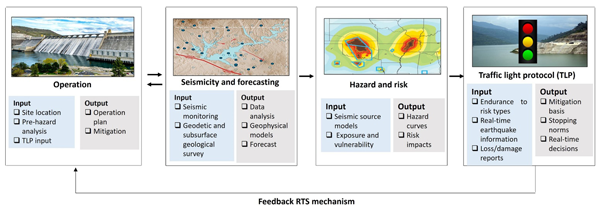
Hydropower dams associated with a large reservoir, a key renewable, face challenges like reservoir-triggered seismicity (RTS). Here, rock samples show 6.3 %–14.7 % porosity and a maximum permeability of 0.0098 mD. A 136 m reservoir rise causes a 0.61 MPa pore pressure increase. Vertical stress rises by 0.75 MPa, and horizontal stress falls by 0.48 MPa, which leads to fault destabilization, causing RTS. These facts urge the adoption of sustainable energy strategies and future dam development.
Iman R. Kivi, Auregan Boyet, Haiqing Wu, Linus Walter, Sara Hanson-Hedgecock, Francesco Parisio, and Victor Vilarrasa
Earth Syst. Sci. Data, 15, 3163–3182, https://doi.org/10.5194/essd-15-3163-2023, https://doi.org/10.5194/essd-15-3163-2023, 2023
Short summary
Short summary
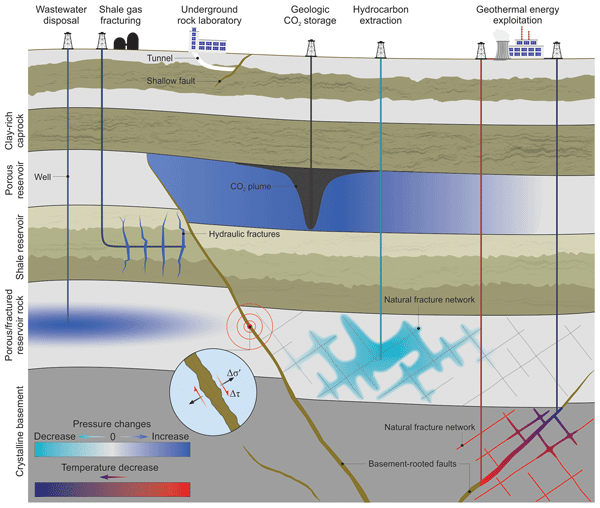
Induced seismicity has posed significant challenges to secure deployment of geo-energy projects. Through a review of published documents, we present a worldwide, multi-physical database of injection-induced seismicity. The database contains information about in situ rock, tectonic and geologic characteristics, operational parameters, and seismicity for various subsurface energy-related activities. The data allow for an improved understanding and management of injection-induced seismicity.
Estanislao Pujades, Laura Scheiber, Marc Teixidó, Rotman Criollo, Olha Nikolenko, Victor Vilarrasa, Enric Vázquez-Suñé, and Anna Jurado
Adv. Geosci., 59, 9–15, https://doi.org/10.5194/adgeo-59-9-2022, https://doi.org/10.5194/adgeo-59-9-2022, 2022
Short summary
Short summary
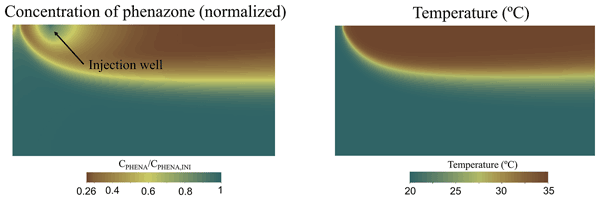
This paper explores the impact of low enthalpy geothermal energy (LEGE) on the behaviour of organic contaminants of emerging concern (CECs). Specifically, we investigate the impact of LEGE on phenazone that is an analgesic drug commonly reported in urban aquifers. CECs pose a risk for the environment and human health, and thus, they must be eliminated to increase the available fresh-water resources in urban areas, where water scarcity is a matter of concern due to the population growth.
Cited articles
Anderson, E. M.: The dynamics of faulting, TRNED, 8, 387–402, https://doi.org/10.1144/transed.8.3.387, 1905.
Angelier, J., Tarantola, A., Valette, B., and Manoussis, S.: Inversion of field data in fault tectonics to obtain the regional stress — I. Single phase fault populations: a new method of computing the stress tensor, Geophysical Journal International, 69, 607–621, https://doi.org/10.1111/j.1365-246X.1982.tb02766.x, 1982.
Bauer, R. A.: Compilation of In Situ Stress Measurements & Directions in Illinois, Illinois State Geological Survey, Illinois, 2018.
Bauer, R. A., Carney, M., and Finley, R. J.: Overview of microseismic response to CO2 injection into the Mt. Simon saline reservoir at the Illinois Basin-Decatur Project, International Journal of Greenhouse Gas Control, 54, 378–388, https://doi.org/10.1016/j.ijggc.2015.12.015, 2016.
Bauer, R. A., Will, R., E. Greenberg, S., and Whittaker, S. G.: Illinois Basin–Decatur Project, in: Geophysics and Geosequestration, edited by: Davis, T. L., Landrø, M., and Wilson, M., Cambridge University Press, https://doi.org/10.1017/9781316480724.020, 339–370, 2019.
Bott, M. H. P.: The Mechanics of Oblique Slip Faulting, Geological Magazine, 96, 109–117, https://doi.org/10.1017/S0016756800059987, 1959.
Dichiarante, A. M., Langet, N., Bauer, R. A., Goertz-Allmann, B. P., Williams-Stroud, S. C., Kühn, D., Oye, V., Greenberg, S. E., and Dando, B. D. E.: Identifying geological structures through microseismic cluster and burst analyses complementing active seismic interpretation, Tectonophysics, 820, 229107, https://doi.org/10.1016/j.tecto.2021.229107, 2021.
Finley, R. J.: An overview of the Illinois Basin – Decatur Project, Greenhouse Gases: Science and Technology, 4, 571–579, https://doi.org/10.1002/ghg.1433, 2014.
Gephart, J. W. and Forsyth, D. W.: An improved method for determining the regional stress tensor using earthquake focal mechanism data: Application to the San Fernando Earthquake Sequence, Journal of Geophysical Research: Solid Earth, 89, 9305–9320, https://doi.org/10.1029/JB089iB11p09305, 1984.
Goertz-Allmann, B. P., Kühn, D., Oye, V., Bohloli, B., and Aker, E.: Combining microseismic and geomechanical observations to interpret storage integrity at the In Salah CCS site, Geophysical Journal International, 198, 447–461, https://doi.org/10.1093/gji/ggu010, 2014.
Goertz-Allmann, B. P., Gibbons, S. J., Oye, V., Bauer, R., and Will, R.: Characterization of induced seismicity patterns derived from internal structure in event clusters, Journal of Geophysical Research: Solid Earth, 122, 3875–3894, https://doi.org/10.1002/2016JB013731, 2017.
Greenberg, S. E., Bauer, R., Will, R., Locke II, R., Carney, M., Leetaru, H., and Medler, J.: Geologic Carbon Storage at a One Million Tonne Demonstration Project: Lessons Learned from the Illinois Basin – Decatur Project, Energy Procedia, 114, 5529–5539, https://doi.org/10.1016/j.egypro.2017.03.1913, 2017.
Illinois State Geological Survey (ISGS), Illinois Basin – Decatur Project (IBDP, and US Department of Energy: Illinois Basin – Decatur Project Dataset, https://doi.org/10.11582/2022.00017, 2021.
Kaven, J. O., Hickman, S. H., McGarr, A. F., and Ellsworth, W. L.: Surface Monitoring of Microseismicity at the Decatur, Illinois, CO2 Sequestration Demonstration Site, Seismological Research Letters, 86, 1096–1101, https://doi.org/10.1785/0220150062, 2015.
Lahann, R. W., Rupp, J. A., Medina, C. R., Carlson, G., and Johnson, K. M.: State of stress in the Illinois Basin and constraints on inducing failure, Environ. Geosci., 24, 123–150, https://doi.org/10.1306/eg.0206171600817004, 2017.
Langet, N., Goertz-Allmann, B., Oye, V., Bauer, R. A., Williams-Stroud, S., Dichiarante, A. M., and Greenberg, S. E.: Joint Focal Mechanism Inversion Using Downhole and Surface Monitoring at the Decatur, Illinois, CO2 Injection Site, Bulletin of the Seismological Society of America, 110, 2168–2187, https://doi.org/10.1785/0120200075, 2020.
Leetaru, H. E. and Freiburg, J. T.: Litho-facies and reservoir characterization of the Mt Simon Sandstone at the Illinois Basin – Decatur Project, Greenhouse Gases, 4, 580–595, https://doi.org/10.1002/ghg.1453, 2014.
Leetaru, H. E., Smith, V., Will, R., Freiburg, J., and Brown, A. L.: The Application of an Integrated Earth Model in Reservoir Management of a CO2 Plume, Energy Procedia, 63, 2903–2910, https://doi.org/10.1016/j.egypro.2014.11.313, 2014.
Marone, C.: LABORATORY-DERIVED FRICTION LAWS AND THEIR APPLICATION TO SEISMIC FAULTING, Annu. Rev. Earth Planet. Sci., 26, 643–696, https://doi.org/10.1146/annurev.earth.26.1.643, 1998.
Reches, Z.: Determination of the tectonic stress tensor from slip along faults that obey the Coulomb yield condition, Tectonics, 6, 849–861, https://doi.org/10.1029/TC006i006p00849, 1987.
Smith, V. and Jaques, P.: Illinois Basin – Decatur Project pre-injection microseismic analysis, International Journal of Greenhouse Gas Control, 54, 362–377, https://doi.org/10.1016/j.ijggc.2015.12.004, 2016.
Staněk, F. and Eisner, L.: Seismicity Induced by Hydraulic Fracturing in Shales: A Bedding Plane Slip Model, Journal of Geophysical Research: Solid Earth, 122, 7912–7926, https://doi.org/10.1002/2017JB014213, 2017.
Tarantola, A. and Valette, B.: Generalized nonlinear inverse problems solved using the least squares criterion, Reviews of Geophysics, 20, 219–232, https://doi.org/10.1029/rg020i002p00219, 1982.
Wallace, R. E.: Geometry of Shearing Stress and Relation to Faulting, Journal of Geology, 59, 118–130, https://doi.org/10.1086/625831, 1951.
White, A., Traugott, M., and Swarbrick, R.: The use of leak-off tests as means of predicting minimum in-situ stress, Petroleum Geoscience, 8, 189–193, https://doi.org/10.1144/petgeo.8.2.189, 2002.
Will, R., El-Kaseeh, G., Jaques, P., Carney, M., Greenberg, S., and Finley, R.: Microseismic data acquisition, processing, and event characterization at the Illinois Basin – Decatur Project, International Journal of Greenhouse Gas Control, 54, 404–420, https://doi.org/10.1016/j.ijggc.2016.01.007, 2016.
Williams-Stroud, S., Bauer, R., Leetaru, H., Oye, V., Stanek, F., Greenberg, S., and Langet, N.: Analysis of Microseismicity and Reactivated Fault Size to Assess the Potential for Felt Events by CO2 Injection in the Illinois Basin, Bulletin of the Seismological Society of America, 110, 2188–2204, https://doi.org/10.1785/0120200112, 2020.
Yang, X.-S. and Deb, S.: Cuckoo Search via Lévy flights, in: 2009 World Congress on Nature & Biologically Inspired Computing (NaBIC), https://doi.org/10.1109/NABIC.2009.5393690, 210–214, 2009.
Yin, J. M. and Cornet, F. H.: Integrated stress determination by joint inversion of hydraulic tests and focal mechanisms, Geophysical Research Letters, 21, 2645–2648, https://doi.org/10.1029/94GL02584, 1994.
Zoback, M. D.: Reservoir Geomechanics, Cambridge University Press, Cambridge, https://doi.org/10.1017/CBO9780511586477, 2007.
Zoback, M. L.: State of stress and modern deformation of the Northern Basin and Range Province, Journal of Geophysical Research: Solid Earth, 94, 7105–7128, https://doi.org/10.1029/JB094iB06p07105, 1989.
Zoback, M. L. and Zoback, M. D.: Chapter 24: Tectonic stress field of the continental United States, in: Geological Society of America Memoirs, vol. 172, Geological Society of America, https://doi.org/10.1130/MEM172-p523, 523–540, 1989.
Short summary
We have studied the stress conditions at the Decatur CO2 storage site that would induce the observed microseismicity. Initial estimates suggested that faults required higher pressure to slip than the injection pressure, but refining pressure and friction assumptions led to more realistic scenarios. Our study highlights the importance of accurate stress state measurements and high-quality data to better predict reservoir response to injection and improve the safety and reliability of CO2 storage.
We have studied the stress conditions at the Decatur CO2 storage site that would induce the...