
Articles | Volume 17, issue 10
https://doi.org/10.5194/se-17-1167-2026
© Author(s) 2026. This work is distributed under
the Creative Commons Attribution 4.0 License.
the Creative Commons Attribution 4.0 License.
https://doi.org/10.5194/se-17-1167-2026
© Author(s) 2026. This work is distributed under
the Creative Commons Attribution 4.0 License.
the Creative Commons Attribution 4.0 License.
Method article
| 
19 Oct 2026
Method article |
| 19 Oct 2026
| 19 Oct 2026
Efficient Uzawa algorithms with projection strategies for geodynamic Stokes flow
Deok-Kyu Jang
KNU Research Institute of Mathematical Sciences, Kangwon National University, Chuncheon, Republic of Korea
Kyeong-Min Lee
Interdisciplinary Program in Earth Environmental System Science & Engineering, Kangwon National University, Chuncheon, Republic of Korea
Cedric Thieulot
Department of Earth Sciences, Utrecht University, Princetonlaan 8A, the Netherlands
Whan-Hyuk Choi
KNU Research Institute of Mathematical Sciences, Kangwon National University, Chuncheon, Republic of Korea
Department of Mathematics, Kangwon National University, Chuncheon, Republic of Korea

Interdisciplinary Program in Earth Environmental System Science & Engineering, Kangwon National University, Chuncheon, Republic of Korea
Department of Geophysics, Kangwon National University, Chuncheon, Republic of Korea
Related authors
Kyeong-Min Lee, Deok-Kyu Jang, Cedric Thieulot, and Byung-Dal So
Geosci. Model Dev., 19, 9781–9805, https://doi.org/10.5194/gmd-19-9781-2026, https://doi.org/10.5194/gmd-19-9781-2026, 2026
Short summary
Short summary
Geodynamic simulations of mantle flow repeatedly solve the Stokes equations at high memory and computational cost. We developed a Stokes solver for graphics processing units by coupling two open-source libraries. A single graphics processing unit solved the Stokes equations 6–11 times faster than a 32-core central processor, with the same accuracy. Two units further shortened the solution time of large problems. The doubled memory extended the maximum size of three-dimensional simulations.
Cedric Thieulot and Wolfgang Bangerth
Solid Earth, 16, 457–476, https://doi.org/10.5194/se-16-457-2025, https://doi.org/10.5194/se-16-457-2025, 2025
Short summary
Short summary
One of the main numerical methods in geodynamics is the finite element method. Many types of elements have been used in the past decades in hundreds of publications. They usually fall under two categories: quadrilaterals and triangles. For the first time we compare results obtained with the most-used elements of each type on a series of geodynamical benchmarks and draw conclusions as to which are the best ones and which are to be preferably avoided.
Erik van der Wiel, Cedric Thieulot, and Douwe J. J. van Hinsbergen
Solid Earth, 15, 861–875, https://doi.org/10.5194/se-15-861-2024, https://doi.org/10.5194/se-15-861-2024, 2024
Short summary
Short summary
Geodynamic models of mantle convection provide a powerful tool to study the structure and composition of the Earth's mantle. Comparing such models with other datasets is difficult. We explore the use of
configurational entropy, which allows us to quantify mixing in models. The entropy may be used to analyse the mixed state of the mantle as a whole and may also be useful to validate numerical models against anomalies in the mantle that are obtained from seismology and geochemistry.
Rene Gassmöller, Juliane Dannberg, Wolfgang Bangerth, Elbridge Gerry Puckett, and Cedric Thieulot
Geosci. Model Dev., 17, 4115–4134, https://doi.org/10.5194/gmd-17-4115-2024, https://doi.org/10.5194/gmd-17-4115-2024, 2024
Short summary
Short summary
Numerical models that use simulated particles are a powerful tool for investigating flow in the interior of the Earth, but the accuracy of these models is not fully understood. Here we present two new benchmarks that allow measurement of model accuracy. We then document that better accuracy matters for applications like convection beneath an oceanic plate. Our benchmarks and methods are freely available to help the community develop better models.
Su-Jeong Lim, Yi-Jeong Baek, and Byung-Dal So
EGUsphere, https://doi.org/10.5194/egusphere-2023-2987, https://doi.org/10.5194/egusphere-2023-2987, 2024
Preprint archived
Short summary
Short summary
1. The fluidity parameter (A) in Glen's law for n = 4 is widely ranged from 10-35 to 10-29 Pa-4s-1. 2. Critical A range that accurately represents Antarctic ice velocities when n = 4 is constrained from 4.0 × to 16.0 × 10⁻³² Pa-4s-1. 3. The modeling provides an accurate selection range of fluidity parameters in fast-flowing or high-stress regions.
Iris van Zelst, Cedric Thieulot, and Timothy J. Craig
Solid Earth, 14, 683–707, https://doi.org/10.5194/se-14-683-2023, https://doi.org/10.5194/se-14-683-2023, 2023
Short summary
Short summary
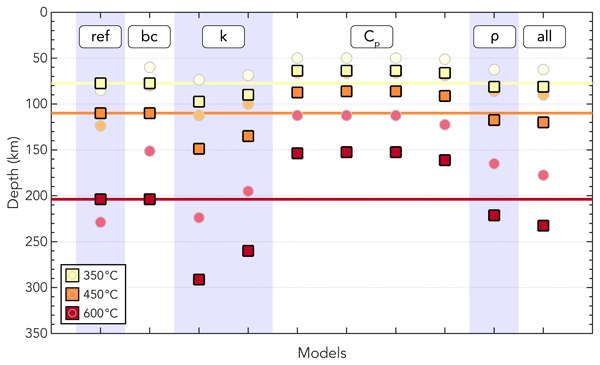
A common simplification in subduction zone models is the use of constant thermal parameters, while experiments have shown that they vary with temperature. We test various formulations of temperature-dependent thermal parameters and show that they change the thermal structure of the subducting slab. We recommend that modelling studies of the thermal structure of subduction zones take the temperature dependence of thermal parameters into account, especially when providing insights into seismicity.
Barend Cornelis Root, Josef Sebera, Wolfgang Szwillus, Cedric Thieulot, Zdeněk Martinec, and Javier Fullea
Solid Earth, 13, 849–873, https://doi.org/10.5194/se-13-849-2022, https://doi.org/10.5194/se-13-849-2022, 2022
Short summary
Short summary
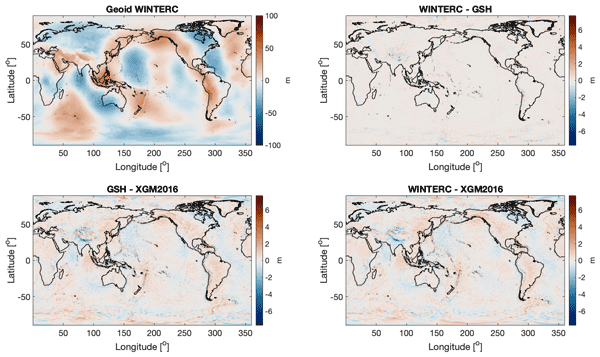
Several alternative gravity modelling techniques and associated numerical codes with their own advantages and limitations are available for the solid Earth community. With upcoming state-of-the-art lithosphere density models and accurate global gravity field data sets, it is vital to understand the differences of the various approaches. In this paper, we discuss the four widely used techniques: spherical harmonics, tesseroid integration, triangle integration, and hexahedral integration.
Iris van Zelst, Fabio Crameri, Adina E. Pusok, Anne Glerum, Juliane Dannberg, and Cedric Thieulot
Solid Earth, 13, 583–637, https://doi.org/10.5194/se-13-583-2022, https://doi.org/10.5194/se-13-583-2022, 2022
Short summary
Short summary
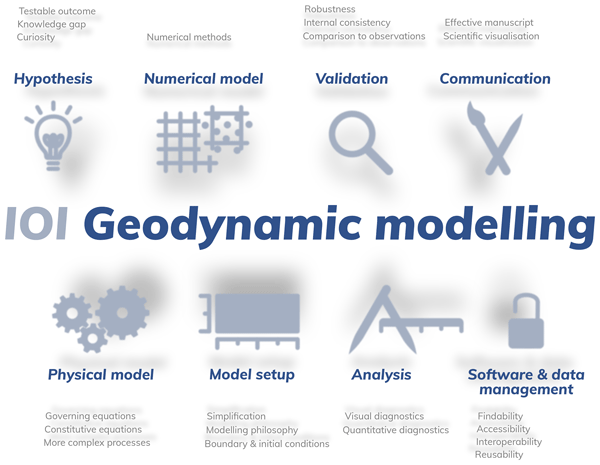
Geodynamic modelling provides a powerful tool to investigate processes in the Earth’s crust, mantle, and core that are not directly observable. In this review, we present a comprehensive yet concise overview of the modelling process with an emphasis on best practices. We also highlight synergies with related fields, such as seismology and geology. Hence, this review is the perfect starting point for anyone wishing to (re)gain a solid understanding of geodynamic modelling as a whole.
Cedric Thieulot and Wolfgang Bangerth
Solid Earth, 13, 229–249, https://doi.org/10.5194/se-13-229-2022, https://doi.org/10.5194/se-13-229-2022, 2022
Short summary
Short summary
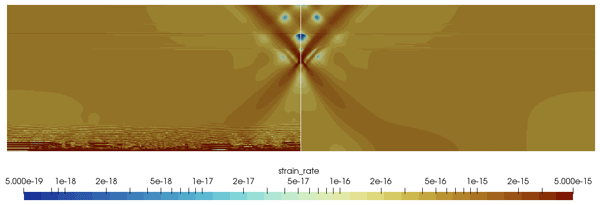
One of the main numerical methods to solve the mass, momentum, and energy conservation equations in geodynamics is the finite-element method. Four main types of elements have been used in the past decades in hundreds of publications. For the first time we compare results obtained with these four elements on a series of geodynamical benchmarks and applications and draw conclusions as to which are the best ones and which are to be preferably avoided.
Cited articles
Alnæs, M., Blechta, J., Hake, J., Johansson, A., Kehlet, B., Logg, A., Richardson, C., Ring, J., Rognes, M. E., and Wells, G. N.: The FEniCS project version 1.5, Archive of Numerical Software, 3, https://doi.org/10.11588/ans.2015.100.20553, 2015. a
Amestoy, P. R., Duff, I. S., L'Excellent, J.-Y., and Koster, J.: MUMPS: a general purpose distributed memory sparse solver, in: International Workshop on Applied Parallel Computing, Springer, 121–130, https://doi.org/10.1007/3-540-70734-4_16, 2000. a
Arrow, K. J., Hurwicz, L., Uzawa, H., Chenery, H. B., Johnson, S., and Karlin, S.: Studies in linear and non-linear programming, vol. 2, Stanford University Press Stanford, 229 pp., 1958. a
Babuška, I.: The finite element method with Lagrangian multipliers, Numer. Math., 20, 179–192, https://doi.org/10.1007/BF01436561, 1973. a
Bai, Z.-Z. and Wang, Z.-Q.: On parameterized inexact Uzawa methods for generalized saddle point problems, Linear Algebra Appl., 428, 2900–2932, https://doi.org/10.1016/j.laa.2008.01.018, 2008. a
Balay, S., Abhyankar, S., Adams, M. F., Benson, S., Brown, J., Brune, P., Buschelman, K., Constantinescu, E. M., Dalcin, L., Dener, A., Eijkhout, V., Faibussowitsch, J., Gropp, W. D., Hapla, V., Isaac, T., Jolivet, P., Karpeev, D., Kaushik, D., Knepley, M. G., Kong, F., Kruger, S., May, D. A., McInnes, L. C., Mills, R. T., Mitchell, L., Munson, T., Roman, J. E., Rupp, K., Sanan, P., Sarich, J., Smith, B. F., Suh, H., Zampini, S., Zhang, H., Zhang, H., and Zhang, J.: PETSc/TAO Users Manual Revision 3.22, Tech. rep., ANL-21/39 Rev. 3.22, Argonne National Laboratory (ANL), Argonne, IL, United States, 2024. a
Bell, J. B., Colella, P., and Glaz, H. M.: A second-order projection method for the incompressible Navier-Stokes equations, J. Comput. Phys., 85, 257–283, https://doi.org/10.1016/0021-9991(89)90151-4, 1989. a
Benzi, M., Golub, G. H., and Liesen, J.: Numerical solution of saddle point problems, Acta Numer., 14, 1–137, https://doi.org/10.1017/S0962492904000212, 2005. a, b
Blankenbach, B., Busse, F., Christensen, U., Cserepes, L., Gunkel, D., Hansen, U., Harder, H., Jarvis, G., Koch, M., Marquart, G., Moore, D., Olson, P., Schmeling, H., and Schnaubelt, T.: A benchmark comparison for mantle convection codes, Geophys. J. Int., 98, 23–38, https://doi.org/10.1111/j.1365-246X.1989.tb05511.x, 1989. a
Braess, D.: Finite elements: Theory, fast solvers, and applications in solid mechanics, 2nd edn., ISBN 978-0-521-01195-2, Cambridge University Press, 2001. a
Brezzi, F.: On the existence, uniqueness and approximation of saddle-point problems arising from Lagrangian multipliers, RAIRO Anal. Numér., 8, 129–151, https://doi.org/10.1051/m2an/197408R201291, 1974. a
Brown, D. L., Cortez, R., and Minion, M. L.: Accurate projection methods for the incompressible Navier–Stokes equations, J. Comput. Phys., 168, 464–499, https://doi.org/10.1006/jcph.2001.6715, 2001. a
Brune, S., Popov, A. A., and Sobolev, S. V.: Modeling suggests that oblique extension facilitates rifting and continental break-up, J. Geophys. Res.-Sol. Ea., 117, https://doi.org/10.1029/2011JB008860, 2012. a
Cahouet, J. and Chabard, J.-P.: Some fast 3D finite element solvers for the generalized Stokes problem, Int. J. Numer. Meth. Fl., 8, 869–895, https://doi.org/10.1002/fld.1650080802, 1988. a, b
Chen, X.: On preconditioned Uzawa methods and SOR methods for saddle-point problems, J. Computat. Appl. Math., 100, 207–224, https://doi.org/10.1016/S0377-0427(98)00197-6, 1998. a, b, c
Chorin, A. J.: The numerical solution of the Navier-Stokes equations for an incompressible fluid, B. Am. Math. Soc., 73, 928–931, https://doi.org/10.1090/S0002-9904-1967-11853-6, 1967. a
Do, S.-H., So, B.-D., Kim, Y.-G., and Kim, G.-B.: Lithospheric strength inferred from modeling of buckling structure: Implications for stress state of the East Sea (Japan Sea), Tectonophysics, 858, 229859, https://doi.org/10.1016/j.tecto.2023.229859, 2023. a
Duretz, T., May, D. A., Gerya, T., and Tackley, P.: Discretization errors and free surface stabilization in the finite difference and marker-in-cell method for applied geodynamics: A numerical study, Geochem. Geophy. Geosy., 12, https://doi.org/10.1029/2011GC003567, 2011. a
Elman, H. C. and Golub, G. H.: Inexact and preconditioned Uzawa algorithms for saddle point problems, SIAM J. Numer. Anal., 31, 1645–1661, https://doi.org/10.1137/0731085, 1994. a, b, c
Gerya, T.: Introduction to numerical geodynamic modelling, Cambridge University Press, https://doi.org/10.1017/9781316534243, 2019. a
Gerya, T.: Numerical modeling of subduction: State of the art and future directions, Geosphere, 18, 503–561, https://doi.org/10.1130/GES02416.1, 2022. a
Gmeiner, B., Huber, M., John, L., Rüde, U., and Wohlmuth, B.: A quantitative performance study for Stokes solvers at the extreme scale, J. Comput. Sci., 17, 509–521, https://doi.org/10.1016/j.jocs.2016.06.006, 2016. a
Guermond, J.-L. and Quartapelle, L.: On the approximation of the unsteady Navier–Stokes equations by finite element projection methods, Numer. Math., 80, 207–238, https://doi.org/10.1007/s002110050366, 1998. a
Hestenes, M. R. and Stiefel, E.: Methods of conjugate gradients for solving linear systems, J. Res. Nat. Bur. Stand., 49, 409–436, https://doi.org/10.6028/jres.049.044, 1952. a
Huismans, R. S., Podladchikov, Y. Y., and Cloetingh, S.: Dynamic modeling of the transition from passive to active rifting, application to the Pannonian basin, Tectonics, 20, 1021–1039, https://doi.org/10.1029/2001TC900010, 2001. a
Ismail-Zadeh, A., Schubert, G., Tsepelev, I., and Korotkii, A.: Three-dimensional forward and backward numerical modeling of mantle plume evolution: Effects of thermal diffusion, J. Geophys. Res.-Sol. Ea., 111, https://doi.org/10.1029/2005JB003782, 2006. a
Jang, D.-K., Lee, K.-M., Thieulot, C., Choi, W.-H., and So, B.-D.: Efficient Uzawa Algorithms with Projection Strategies for Geodynamic Stokes Flow, Zenodo [code], https://doi.org/10.5281/zenodo.22135967, 2026. a
Kim, D.-H. and So, B.-D.: Effects of rheology and mantle temperature structure on edge-driven convection: Implications for partial melting and dynamic topography, Phys. Earth Planet. In., 303, 106487, https://doi.org/10.1016/j.pepi.2020.106487, 2020. a
Kronbichler, M., Heister, T., and Bangerth, W.: High accuracy mantle convection simulation through modern numerical methods, Geophys. J. Int., 191, 12–29, https://doi.org/10.1111/j.1365-246X.2012.05609.x, 2012. a, b
Lee, K.-M., Kim, H.-I., Jang, D.-K., and So, B.-D.: A comparative study of 2D numerical simulations using vector and potential methods for extending 3D modeling of planetary evolution, Geosci. J., 28, 465–481, https://doi.org/10.1007/s12303-024-0013-5, 2024. a
Li, Y. and Gurnis, M.: A simple force balance model of subduction initiation, Geophys. J. Int., 232, 128–146, https://doi.org/10.1093/gji/ggac332, 2023. a
Logg, A., Mardal, K.-A., and Wells, G. (Eds.): Automated solution of differential equations by the finite element method: The FEniCS book, vol. 84, Springer Science & Business Media, https://doi.org/10.1007/978-3-642-23099-8, 2012. a, b
Mansour, J. A., Giordani, J., Moresi, L., Beucher, R., Kaluza, O., Velic, M., Farrington, R., Quenette, S., and Beall, A.: Underworld2: Python geodynamics modelling for desktop, HPC and cloud, Journal of Open Source Software, 5, 1797, https://doi.org/10.21105/joss.01797, 2020. a, b
May, D. A. and Moresi, L.: Preconditioned iterative methods for Stokes flow problems arising in computational geodynamics, Phys. Earth Planet. In., 171, 33–47, https://doi.org/10.1016/j.pepi.2008.07.036, 2008. a, b, c
Moresi, L. and Gurnis, M.: The accuracy of finite element solutions of Stokes flow with strongly varying viscosity, Phys. Earth Planet. In., 97, 83–94, https://doi.org/10.1016/0031-9201(96)03163-9, 1996. a
Moresi, L., Quenette, S., Lemiale, V., Meriaux, C., Appelbe, B., and Mühlhaus, H.-B.: Computational approaches to studying non-linear dynamics of the crust and mantle, Phys. Earth Planet. In., 163, 69–82, https://doi.org/10.1016/j.pepi.2007.06.009, 2007. a
Negredo, A. M., van Hunen, J., Rodríguez-González, J., and Fullea, J.: On the origin of the Canary Islands: Insights from mantle convection modelling, Earth Planet. Sc. Lett., 584, 117506, https://doi.org/10.1016/j.epsl.2022.117506, 2022. a
Pyo, J.-H. and Shen, J.: Gauge–Uzawa methods for incompressible flows with variable density, J. Computat. Phys., 221, 181–197, https://doi.org/10.1016/j.jcp.2006.06.013, 2007. a
Ramage, A. and Wathen, A. J.: Iterative solution techniques for the Stokes and Navier-Stokes equations, Int. J. Numer. Meth. Fl., 19, 67–83, https://doi.org/10.1002/fld.1650190106, 1994. a
Rudi, J., Stadler, G., and Ghattas, O.: Weighted BFBT preconditioner for Stokes flow problems with highly heterogeneous viscosity, SIAM J. Sci. Comput., 39, S272–S297, https://doi.org/10.1137/16M108450X, 2017. a, b
Saad, Y.: Iterative methods for sparse linear systems, SIAM, https://doi.org/10.1137/1.9780898718003, 2003. a
Saad, Y. and Schultz, M. H.: GMRES: A generalized minimal residual algorithm for solving nonsymmetric linear systems, SIAM J. Sci. Stat. Comp., 7, 856–869, https://doi.org/10.1137/0907058, 1986. a
Schubert, G., Turcotte, D. L., and Olson, P.: Mantle Convection in the Earth and Planets, Cambridge University Press, https://doi.org/10.1017/CBO9780511612879, 2001. a, b
Silvester, D. and Wathen, A.: Fast iterative solution of stabilised Stokes systems Part II: Using general block preconditioners, SIAM J. Numer. Anal., 31, 1352–1367, https://doi.org/10.1137/0731070, 1994. a, b
Sime, N., Wilson, C. R., and van Keken, P. E.: Thermal modeling of subduction zones with prescribed and evolving 2D and 3D slab geometries, Progress in Earth and Planetary Science, 11, 14, https://doi.org/10.1186/s40645-024-00611-4, 2024. a
So, B.-D. and Yuen, D. A.: Generation of tectonic over-pressure inside subducting oceanic lithosphere involving phase-loop of olivine–wadsleyite transition, Earth Planet. Sc. Lett., 413, 59–69, https://doi.org/10.1016/j.epsl.2014.12.048, 2015. a
Tan, E. and Gurnis, M.: Metastable superplumes and mantle compressibility, Geophys. Res. Lett., 32, https://doi.org/10.1029/2005GL024190, 2005. a
Thieulot, C. and Bangerth, W.: On the choice of finite element for applications in geodynamics – Part 2: A comparison of simplex and hypercube elements, Solid Earth, 16, 457–476, https://doi.org/10.5194/se-16-457-2025, 2025. a
van Keken, P.: Evolution of starting mantle plumes: a comparison between numerical and laboratory models, Earth Planet. Sc. Lett., 148, 1–11, https://doi.org/10.1016/S0012-821X(97)00042-3, 1997. a
Vynnytska, L., Rognes, M. E., and Clark, S.: Benchmarking FEniCS for mantle convection simulations, Comput. Geosci., 50, 95–105, https://doi.org/10.1016/j.cageo.2012.05.012, 2013. a
Wang, H., Agrusta, R., and van Hunen, J.: Advantages of a conservative velocity interpolation (CVI) scheme for particle-in-cell methods with application in geodynamic modeling, Geochem. Geophy. Geosy., 16, 4148–4166, https://doi.org/10.1002/2015GC005824, 2015. a
Wilson, C. R., Spiegelman, M., and van Keken, P. E.: Terra FERMA: The Transparent Finite Element Rapid Model Assembler for multiphysics problems in Earth sciences, Geochem. Geophy. Geosy., 18, 769–810, https://doi.org/10.1002/2016GC006702, 2017. a
Xie, R., Chen, L., Morgan, J. P., and Chen, Y. J.: Various lithospheric deformation patterns derived from rheological contrasts between continental terranes: insights from 2-D numerical simulations, Solid Earth, 15, 789–806, https://doi.org/10.5194/se-15-789-2024, 2024. a
Zhamaletdinov, A., Shevtsov, A., Korotkova, T., Kopytenko, Y. A., Ismagilov, V. S., Petrishev, M. S., Efimov, B. V., Barannik, M. B., Kolobov, V. V., Prokopchuk, P. I., Smirnov, M. Yu., Vagin, S. A., Pertel, M. I., Tereshchenko, E. D., Vasil’ev, A. N., Grigoryev, V. F., Gokhberg, M. B., Trofimchik, V. I., Yampolsky, Yu. M., Koloskov, A. V., Fedorov, A. V., and Korja, T.: Deep electromagnetic sounding of the lithosphere in the Eastern Baltic (Fennoscandian) shield with high-power controlled sources and industrial power transmission lines (FENICS experiment), Izvestiya, Physics of the Solid Earth, 47, 22, https://doi.org/10.1134/S1069351311010149, 2011. a
Zhao, X.-H., Kwek, K.-H., Li, J.-B., and Huang, K.-L.: Chaotic and resonant streamlines in the ABC flow, SIAM J. Appl. Math., 53, 71–77, https://doi.org/10.1137/0153005, 1993. a
Zhong, S.: Analytic solutions for Stokes' flow with lateral variations in viscosity, Geophys. J. Int., 124, 18–28, https://doi.org/10.1111/j.1365-246X.1996.tb06349.x, 1996. a
Zhong, S., Zuber, M. T., Moresi, L., and Gurnis, M.: Role of temperature-dependent viscosity and surface plates in spherical shell models of mantle convection, J. Geophys. Res.-Sol. Ea., 105, 11063–11082, https://doi.org/10.1029/2000JB900003, 2000. a, b
Short summary
We developed faster methods for simulating Earth's interior dynamics. Standard iterative algorithms struggle to solve these equations efficiently. We introduced two improvements. First, we reformulated how calculation errors are measured. Second, we added a mass conservation correction. The first reduces the number of expensive solves, and the second improves accuracy over long simulations. We tested the method on several benchmarks, and both improvements come at little extra cost.
We developed faster methods for simulating Earth's interior dynamics. Standard iterative...


