
Articles | Volume 17, issue 2
https://doi.org/10.5194/se-17-311-2026
© Author(s) 2026. This work is distributed under
the Creative Commons Attribution 4.0 License.
the Creative Commons Attribution 4.0 License.
https://doi.org/10.5194/se-17-311-2026
© Author(s) 2026. This work is distributed under
the Creative Commons Attribution 4.0 License.
the Creative Commons Attribution 4.0 License.
Research article
| 
24 Feb 2026
Research article |
| 24 Feb 2026
| 24 Feb 2026
The role of fault network geometry on the complexity of seismic cycles in the Apennines
Constanza Rodriguez Piceda
CORRESPONDING AUTHOR
University of Plymouth, School of Geography, Earth and Environmental Sciences, Plymouth, PL4 8AA, United Kingdom
GFZ Helmholtz Centre for Geosciences, Potsdam, 14473, Germany
Zoë K. Mildon
University of Plymouth, School of Geography, Earth and Environmental Sciences, Plymouth, PL4 8AA, United Kingdom
Billy J. Andrews
University of Plymouth, School of Geography, Earth and Environmental Sciences, Plymouth, PL4 8AA, United Kingdom
Yifan Yin
MIT Department of Earth, Atmospheric and Planetary Science, Cambridge, MA 02139, United States
Jean-Paul Ampuero
Université Côte d'Azur, Observatoire de la Côte d'Azur, IRD, CNRS, Géo azur, Valbonne, 06905, France
Martijn van den Ende
Université Côte d'Azur, Observatoire de la Côte d'Azur, IRD, CNRS, Géo azur, Valbonne, 06905, France
Claudia Sgambato
Birkbeck University of London, London, WC1E 7HX, United Kingdom
Percy Galvez
Everest Group, Zürich, 8001, Switzerland
Related authors
No articles found.
Małgorzata Chmiel, Maxime Godano, Marco Piantini, Pierre Brigode, Florent Gimbert, Maarten Bakker, Françoise Courboulex, Jean-Paul Ampuero, Diane Rivet, Anthony Sladen, David Ambrois, and Margot Chapuis
Nat. Hazards Earth Syst. Sci., 22, 1541–1558, https://doi.org/10.5194/nhess-22-1541-2022, https://doi.org/10.5194/nhess-22-1541-2022, 2022
Short summary
Short summary
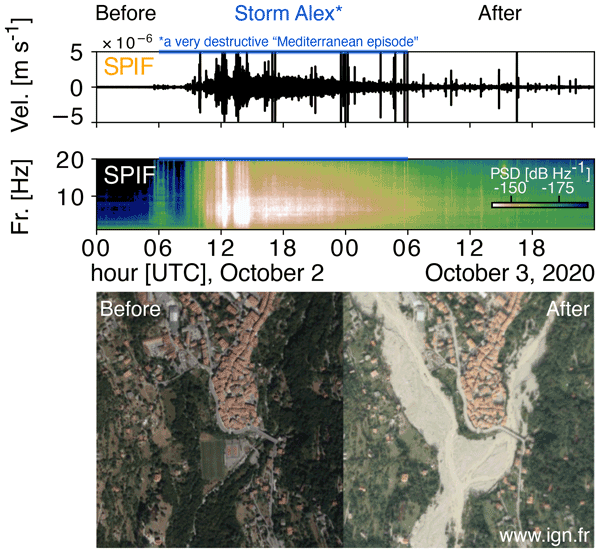
On 2 October 2020, the French Maritime Alps were struck by an extreme rainfall event caused by Storm Alex. Here, we show that seismic data provide the timing and velocity of the propagation of flash-flood waves along the Vésubie River. We also detect 114 small local earthquakes triggered by the rainwater weight and/or its infiltration into the ground. This study paves the way for future works that can reveal further details of the impact of Storm Alex on the Earth’s surface and subsurface.
Cited articles
Allam, A. A., Kroll, K. A., Milliner, C. W. D., and Richards-Dinger, K. B.: Effects of Fault Roughness on Coseismic Slip and Earthquake Locations, Journal of Geophysical Research: Solid Earth, 124, 11336–11349, https://doi.org/10.1029/2018JB016216, 2019.
Anderson, H. and Jackson, J.: Active tectonics of the Adriatic Region, Geophysical Journal of the Royal Astronomical Society, 91, 937–983, https://doi.org/10.1111/j.1365-246X.1987.tb01675.x, 1987.
Bagh, S., Chiaraluce, L., De Gori, P., Moretti, M., Govoni, A., Chiarabba, C., Di Bartolomeo, P., and Romanelli, M.: Background seismicity in the Central Apennines of Italy: The Abruzzo region case study, Tectonophysics, 444, 80–92, https://doi.org/10.1016/j.tecto.2007.08.009, 2007.
Barbot, S.: Slow-slip, slow earthquakes, period-two cycles, full and partial ruptures, and deterministic chaos in a single asperity fault, Tectonophysics, 768, 228171, https://doi.org/10.1016/j.tecto.2019.228171, 2019.
Bello, S., Lavecchia, G., Andrenacci, C., Ercoli, M., Cirillo, D., Carboni, F., Barchi, M. R., and Brozzetti, F.: Complex trans-ridge normal faults controlling large earthquakes, Sci. Rep., 12, 10676, https://doi.org/10.1038/s41598-022-14406-4, 2022.
Benedetti, L., Tapponnier, P., King, G. C. P., and Piccardi, L.: Surface Rupture of the 1857 Southern Italian Earthquake?, Terra Nova, 10, 206–210, https://doi.org/10.1046/j.1365-3121.1998.00189.x, 1998.
Benedetti, L., Manighetti, I., Gaudemer, Y., Finkel, R., Malavieille, J., Pou, K., Arnold, M., Aumaître, G., Bourlès, D., and Keddadouche, K.: Earthquake synchrony and clustering on Fucino faults (Central Italy) as revealed from in situ 36Cl exposure dating, Journal of Geophysical Research: Solid Earth, 118, 4948–4974, https://doi.org/10.1002/jgrb.50299, 2013.
Bernard, P. and Zollo, A.: The Irpinia (Italy) 1980 earthquake: Detailed analysis of a complex normal faulting, Journal of Geophysical Research: Solid Earth, 94, 1631–1647, https://doi.org/10.1029/JB094iB02p01631, 1989.
Boschi, E., Gasperini, P., and Mulargia, F.: Forecasting where larger crustal earthquakes are likely to occur in Italy in the near future, Bulletin of the Seismological Society of America, 85, 1475–1482, https://doi.org/10.1785/BSSA0850051475, 1995.
Bradley, A. M.: Software for Efficient Static Dislocation–Traction Calculations in Fault Simulators, Seismological Research Letters, 85, 1358–1365, https://doi.org/10.1785/0220140092, 2014.
Castelli, V., Galli, P., Camassi, R., and Caracciolo, C.: The 1561 earthquake (s) in Southern Italy: new insights into a complex seismic sequence, Journal of Earthquake Engineering, 12, 1054–1077, https://doi.org/10.1080/13632460801890356, 2008.
Cattania, C.: Complex Earthquake Sequences On Simple Faults, Geophysical Research Letters, 46, 10384–10393, https://doi.org/10.1029/2019GL083628, 2019.
Cattania, C. and Segall, P.: Crack Models of Repeating Earthquakes Predict Observed Moment-Recurrence Scaling, Journal of Geophysical Research: Solid Earth, 124, 476–503, https://doi.org/10.1029/2018JB016056, 2019.
Cavinato, G. P. and Celles, P. G. D.: Extensional basins in the tectonically bimodal central Apennines fold-thrust belt, Italy: Response to corner flow above a subducting slab in retrograde motion, Geology, 27, 955–958, https://doi.org/10.1130/0091-7613(1999)027<0955:EBITTB>2.3.CO;2, 1999.
Cello, G., Tondi, E., Micarelli, L., and Mattioni, L.: Active tectonics and earthquake sources in the epicentral area of the 1857 Basilicata earthquake (southern Italy), Journal of Geodynamics, 36, 37–50, https://doi.org/10.1016/S0264-3707(03)00037-1, 2003.
Chan, C.-H., Sørensen, M. B., Stromeyer, D., Grünthal, G., Heidbach, O., Hakimhashemi, A., and Catalli, F.: Forecasting Italian seismicity through a spatio-temporal physical model: importance of considering time-dependency and reliability of the forecast, Annals of Geophysics, 53, 129–140, https://doi.org/10.4401/ag-4761, 2010.
Chiarabba, C., Jovane, L., and DiStefano, R.: A new view of Italian seismicity using 20 years of instrumental recordings, Tectonophysics, 395, 251–268, https://doi.org/10.1016/j.tecto.2004.09.013, 2005.
Chiaraluce, L., Barchi, M., Collettini, C., Mirabella, F., and Pucci, S.: Connecting seismically active normal faults with Quaternary geological structures in a complex extensional environment: The Colfiorito 1997 case history (northern Apennines, Italy), Tectonics, 24, https://doi.org/10.1029/2004TC001627, 2005.
Chiaraluce, L., Michele, M., Waldhauser, F., Tan, Y. J., Herrmann, M., Spallarossa, D., Beroza, G. C., Cattaneo, M., Chiarabba, C., De Gori, P., Di Stefano, R., Ellsworth, W., Main, I., Mancini, S., Margheriti, L., Marzocchi, W., Meier, M.-A., Scafidi, D., Schaff, D., and Segou, M.: A comprehensive suite of earthquake catalogues for the 2016-2017 Central Italy seismic sequence, Sci. Data, 9, 710, https://doi.org/10.1038/s41597-022-01827-z, 2022.
Cinque, A., Ascione, A., and Caiazzo, C.: Distribuzione spazio-temporale e caratterizzazione della fagliazione quaternaria in Appennino meridionale, ITA, 2000.
Cowie, P. A., Roberts, G. P., Bull, J. M., and Visini, F.: Relationships between fault geometry, slip rate variability and earthquake recurrence in extensional settings, Geophysical Journal International, 189, 143–160, https://doi.org/10.1111/j.1365-246X.2012.05378.x, 2012.
Cowie, P. A., Phillips, R. J., Roberts, G. P., McCaffrey, K., Zijerveld, L. J. J., Gregory, L. C., Faure Walker, J., Wedmore, L. N. J., Dunai, T. J., Binnie, S. A., Freeman, S. P. H. T., Wilcken, K., Shanks, R. P., Huismans, R. S., Papanikolaou, I., Michetti, A. M., and Wilkinson, M.: Orogen-scale uplift in the central Italian Apennines drives episodic behaviour of earthquake faults, Sci. Rep., 7, 44858, https://doi.org/10.1038/srep44858, 2017.
D'Addezio, G., Pantosti, G., and Valensise, G.: Paleoearthquakes along the Irpinia fault at Pantano di San Gregorio Magno (southern Italy), Alpine and Mediterranean Quaternary, 4, 121–136, 1991.
Delogkos, E., Howell, A., Seebeck, H., Shaw, B. E., Nicol, A., Mika Liao, Y.-W., and Walsh, J. J.: Impact of Variable Fault Geometries and Slip Rates on Earthquake Catalogs From Physics-Based Simulations of a Normal Fault, Journal of Geophysical Research: Solid Earth, 128, e2023JB026746, https://doi.org/10.1029/2023JB026746, 2023.
Dieterich, J. H.: Modeling of rock friction 1. Experimental results and constitutive equations, Journal of Geophysical Research: Solid Earth, 84, 2161–2168, https://doi.org/10.1029/JB084iB05p02161, 1979.
Dieterich, J. H. and Richards-Dinger, K. B.: Earthquake Recurrence in Simulated Fault Systems, Pure Appl. Geophys., 167, 1087–1104, https://doi.org/10.1007/s00024-010-0094-0, 2010.
Dieterich, J. H. and Smith, D. E.: Nonplanar Faults: Mechanics of Slip and Off-fault Damage, in: Mechanics, Structure and Evolution of Fault Zones, edited by: Ben-Zion, Y. and Sammis, C., Birkhäuser, Basel, 1799–1815, https://doi.org/10.1007/978-3-0346-0138-2_12, 2010.
Doglioni, C.: Some remarks on the origin of foredeeps, Tectonophysics, 228, 1–20, https://doi.org/10.1016/0040-1951(93)90211-2, 1993.
Ellsworth, W. L., Matthews, M. V., Nadeau, R. M., Nishenko, S. P., Reasenberg, P. A., and Simpson, R. W.: A physically-based earthquake recurrence model for estimation of long-term earthquake probabilities, US Geological Survey, No. 99-522, 1999.
Erickson, B. A., Jiang, J., Barall, M., Lapusta, N., Dunham, E. M., Harris, R., Abrahams, L. S., Allison, K. L., Ampuero, J., Barbot, S., Cattania, C., Elbanna, A., Fialko, Y., Idini, B., Kozdon, J. E., Lambert, V., Liu, Y., Luo, Y., Ma, X., Best McKay, M., Segall, P., Shi, P., van den Ende, M., and Wei, M.: The Community Code Verification Exercise for Simulating Sequences of Earthquakes and Aseismic Slip (SEAS), Seismological Research Letters, 91, 874–890, https://doi.org/10.1785/0220190248, 2020.
Faure Walker, J. P.: Mechanics of continental extension from Quaternary strain fields in the Italian Apennines, Doctoral, UCL (University College London), 405 pp., 2010.
Faure Walker, J. P., Roberts, G. P., Cowie, P. A., Papanikolaou, I. D., Sammonds, P. R., Michetti, A. M., and Phillips, R. J.: Horizontal strain-rates and throw-rates across breached relay zones, central Italy: Implications for the preservation of throw deficits at points of normal fault linkage, Journal of Structural Geology, 31, 1145–1160, https://doi.org/10.1016/j.jsg.2009.06.011, 2009.
Faure Walker, J. P., Visini, F., Roberts, G., Galasso, C., McCaffrey, K., and Mildon, Z.: Variable Fault Geometry Suggests Detailed Fault-Slip-Rate Profiles and Geometries Are Needed for Fault-Based Probabilistic Seismic Hazard Assessment (PSHA), Bulletin of the Seismological Society of America, 109, 110–123, https://doi.org/10.1785/0120180137, 2019.
Faure Walker, J. P., Boncio, P., Pace, B., Roberts, G., Benedetti, L., Scotti, O., Visini, F., and Peruzza, L.: Fault2SHA Central Apennines database and structuring active fault data for seismic hazard assessment, Sci. Data, 8, 87, https://doi.org/10.1038/s41597-021-00868-0, 2021.
Freed, A. M.: Earthquake Triggering by Static, Dynamic, and Postseismic Stress Transfer, Annual Review of Earth and Planetary Sciences, 33, 335–367, https://doi.org/10.1146/annurev.earth.33.092203.122505, 2005.
Frepoli, A., Maggi, C., Cimini, G. B., Marchetti, A., and Chiappini, M.: Seismotectonic of Southern Apennines from recent passive seismic experiments, Journal of Geodynamics, 51, 110–124, https://doi.org/10.1016/j.jog.2010.02.007, 2011.
Galadini, F. and Galli, P.: Paleoseismology related to deformed archaeological remains in the Fucino Plain. Implications for subrecent seismicity in Central Italy, Annals of Geophysics, 39, https://doi.org/10.4401/ag-4025, 1996.
Galadini, F. and Galli, P.: The Holocene paleoearthquakes on the 1915 Avezzano earthquake faults (central Italy): implications for active tectonics in the central Apennines, Tectonophysics, 308, 143–170, https://doi.org/10.1016/S0040-1951(99)00091-8, 1999.
Galli, P.: Recurrence times of central-southern Apennine faults (Italy): Hints from palaeoseismology, Terra Nova, 32, 399–407, https://doi.org/10.1111/ter.12470, 2020.
Galli, P. and Peronace, E.: New paleoseismic data from the Irpinia Fault. A different seismogenic perspective for southern Apennines (Italy), Earth-Science Reviews, 136, 175–201, https://doi.org/10.1016/j.earscirev.2014.05.013, 2014.
Galli, P., Bosi, V., Piscitelli, S., Giocoli, A., and Scionti, V.: Late Holocene earthquakes in southern Apennine: paleoseismology of the Caggiano fault, Int. J. Earth Sci. (Geol. Rundsch.), 95, 855–870, https://doi.org/10.1007/s00531-005-0066-2, 2006.
Galli, P., Galadini, F., and Pantosti, D.: Twenty years of paleoseismology in Italy, Earth-Science Reviews, 88, 89–117, https://doi.org/10.1016/j.earscirev.2008.01.001, 2008.
Galli, P., Giaccio, B., Peronace, E., and Messina, P.: Holocene Paleoearthquakes and Early–Late Pleistocene Slip Rate on the Sulmona Fault (Central Apeninnes, Italy), Bulletin of the Seismological Society of America, 105, 1–13, https://doi.org/10.1785/0120140029, 2015.
Galli, P., Giaccio, B., Messina, P., and Peronace, E.: Three magnitude 7 earthquakes on a single fault in central Italy in 1400 years, evidenced by new palaeoseismic results, Terra Nova, 28, 146–154, https://doi.org/10.1111/ter.12202, 2016.
Galli, P. A. C., Peronace, E., Quadrio, B., and Esposito, G.: Earthquake fingerprints along fault scarps: A case study of the Irpinia 1980 earthquake fault (southern Apennines), Geomorphology, 206, 97–106, https://doi.org/10.1016/j.geomorph.2013.09.023, 2014.
Galvez, P., Somerville, P., Petukhin, A., Ampuero, J.-P., and Peter, D.: Earthquake Cycle Modelling of Multi-segmented Faults: Dynamic Rupture and Ground Motion Simulation of the 1992 Mw 7.3 Landers Earthquake, Pure Appl. Geophys., 177, 2163–2179, https://doi.org/10.1007/s00024-019-02228-x, 2020.
Gasperini, P. and Ferrari, G.: Deriving numerical estimates from descriptive information: the computation of earthquake parameters, Annals of Geophysics, 43, https://doi.org/10.4401/ag-3670, 2000.
Gerstenberger, M. C., Marzocchi, W., Allen, T., Pagani, M., Adams, J., Danciu, L., Field, E. H., Fujiwara, H., Luco, N., Ma, K. -F., Meletti, C., and Petersen, M. D.: Probabilistic Seismic Hazard Analysis at Regional and National Scales: State of the Art and Future Challenges, Rev. Geophys., 58, https://doi.org/10.1029/2019RG000653, 2020.
Giardini, D., Basili, A., and Boschi, E.: Applying the relative hypocentre location approach: where was the 1980 November 23 Irpinia earthquake?, Geophysical Journal International, 127, 605–615, https://doi.org/10.1111/j.1365-246X.1996.tb04041.x, 1996.
Gioia, D., Schiattarella, M., Mattei, M., and Nico, G.: Quantitative morphotectonics of the Pliocene to Quaternary Auletta basin, southern Italy, Geomorphology, 134, 326–343, https://doi.org/10.1016/j.geomorph.2011.07.009, 2011.
Guidoboni, E., Ferrari, G., Tarabusi, G., Sgattoni, G., Comastri, A., Mariotti, D., Ciuccarelli, C., Bianchi, M. G., and Valensise, G.: CFTI5Med, the new release of the catalogue of strong earthquakes in Italy and in the Mediterranean area, Sci. Data, 6, 80, https://doi.org/10.1038/s41597-019-0091-9, 2019.
Hanks, T. C. and Kanamori, H.: A moment magnitude scale, Journal of Geophysical Research, 84, 2348–2350, https://doi.org/10.1029/JB084iB05p02348, 1979.
Harris, R. A. and Simpson, R. W.: Suppression of large earthquakes by stress shadows: A comparison of Coulomb and rate-and-state failure, Journal of Geophysical Research: Solid Earth, 103, 24439–24451, https://doi.org/10.1029/98JB00793, 1998.
Heimisson, E. R.: Crack to pulse transition and magnitude statistics during earthquake cycles on a self-similar rough fault, Earth and Planetary Science Letters, 537, 116202, https://doi.org/10.1016/j.epsl.2020.116202, 2020.
Herrero-Barbero, P., Álvarez-Gómez, J. A., Williams, C., Villamor, P., Insua-Arévalo, J. M., Alonso-Henar, J., and Martínez-Díaz, J. J.: Physics-Based Earthquake Simulations in Slow-Moving Faults: A Case Study From the Eastern Betic Shear Zone (SE Iberian Peninsula), Journal of Geophysical Research: Solid Earth, 126, e2020JB021133, https://doi.org/10.1029/2020JB021133, 2021.
Hillers, G., Mai, P. M., Ben-Zion, Y., and Ampuero, J.-P.: Statistical properties of seismicity of fault zones at different evolutionary stages, Geophysical Journal International, 169, 515–533, https://doi.org/10.1111/j.1365-246X.2006.03275.x, 2007.
Iacoletti, S., Cremen, G., and Galasso, C.: Advancements in multi-rupture time-dependent seismic hazard modeling, including fault interaction, Earth-Science Reviews, 220, 103650, https://doi.org/10.1016/j.earscirev.2021.103650, 2021.
Jiang, J., Erickson, B. A., Lambert, V. R., Ampuero, J.-P., Ando, R., Barbot, S. D., Cattania, C., Zilio, L. D., Duan, B., Dunham, E. M., Gabriel, A.-A., Lapusta, N., Li, D., Li, M., Liu, D., Liu, Y., Ozawa, S., Pranger, C., and van Dinther, Y.: Community-Driven Code Comparisons for Three-Dimensional Dynamic Modeling of Sequences of Earthquakes and Aseismic Slip, Journal of Geophysical Research: Solid Earth, 127, e2021JB023519, https://doi.org/10.1029/2021JB023519, 2022.
Jolivet, L., Faccenna, C., Goffé, B., Mattei, M., Rossetti, F., Brunet, C., Storti, F., Funiciello, R., Cadet, J. P., d'Agostino, N., and Parra, T.: Midcrustal shear zones in postorogenic extension: Example from the northern Tyrrhenian Sea, Journal of Geophysical Research: Solid Earth, 103, 12123–12160, https://doi.org/10.1029/97JB03616, 1998.
King, G. C. P., Stein, R. S., and Lin, J.: Static stress changes and the triggering of earthquakes, B. Seismol. Soc. Am., 84, 935–953, https://doi.org/10.1785/BSSA0840030935, 1994.
Lapusta, N., Rice, J. R., Ben-Zion, Y., and Zheng, G.: Elastodynamic analysis for slow tectonic loading with spontaneous rupture episodes on faults with rate- and state-dependent friction, Journal of Geophysical Research: Solid Earth, 105, 23765–23789, https://doi.org/10.1029/2000JB900250, 2000.
Lombardi, A. M., Cinti, F. R., and Pantosti, D.: Paleoearthquakes modelling and effects of uncertainties on probability assessment of next fault ruptures: the case of Central Italy surface faulting earthquakes, Geophysical Journal International, 241, 1327–1347, https://doi.org/10.1093/gji/ggaf105, 2025.
Luo, Y. and Ampuero, J.-P.: Stability of faults with heterogeneous friction properties and effective normal stress, Tectonophysics, 733, 257–272, https://doi.org/10.1016/j.tecto.2017.11.006, 2018.
Luo, Y., Ampuero, J. P., Galvez, P., van den Ende, M., and Idini, B.: QDYN: a Quasi-DYNamic earthquake simulator (v1.1) (qdyn_1.1), Zenodo [software], https://doi.org/10.5281/zenodo.322459, 2017.
Marone, C.: Laboratory-Derived Friction Laws and Their Application to Seismic Faulting, Annual Review of Earth and Planetary Sciences, 26, 643–696, https://doi.org/10.1146/annurev.earth.26.1.643, 1998a.
Marone, C.: The effect of loading rate on static friction and the rate of fault healing during the earthquake cycle, Nature, 391, 69–72, https://doi.org/10.1038/34157, 1998b.
Marturano, A.: The January 15, 1466 and November 23, 1980 Irpinia (Italy) earthquakes, Bollettino di Geofisica Teorica ed Applicata, 48, 115–126, 2007.
Matthews, M. V., Ellsworth, W. L., and Reasenberg, P. A.: A Brownian Model for Recurrent Earthquakes, B. Seismol. Soc. Am., 92, 2233–2250, https://doi.org/10.1785/0120010267, 2002.
Michetti, A. M., Brunamonte, F., Serva, L., and Vittori, E.: Trench investigations of the 1915 Fucino earthquake fault scarps (Abruzzo, central Italy): Geological evidence of large historical events, Journal of Geophysical Research: Solid Earth, 101, 5921–5936, https://doi.org/10.1029/95JB02852, 1996.
Mignan, A., Danciu, L., and Giardini, D.: Considering large earthquake clustering in seismic risk analysis, Nat. Hazards, 91, 149–172, https://doi.org/10.1007/s11069-016-2549-9, 2018.
Mildon, Z. K.: The link between earthquakes and structural geology: The role of elapsed time, 3D geometry and stress transfer in the central Apennines, Italy, Doctoral thesis, University College London, UCL Discovery, https://discovery.ucl.ac.uk/id/eprint/10039494 (last access: 15 September 2025), 2017.
Mildon, Z. K., Roberts, G. P., Faure Walker, J. P., and Toda, S.: Coulomb pre-stress and fault bends are ignored yet vital factors for earthquake triggering, Nat. Commun., 1–9, https://doi.org/10.31223/osf.io/pt829, 2019.
Mildon, Z. K., Roberts, G. P., Faure Walker, J. P., Beck, J., Papanikolaou, I., Michetti, A. M., Toda, S., Iezzi, F., Campbell, L., McCaffrey, K. J. W., Shanks, R., Sgambato, C., Robertson, J., Meschis, M., and Vittori, E.: Surface faulting earthquake clustering controlled by fault and shear-zone interactions, Nat. Commun., 13, 7126, https://doi.org/10.1038/s41467-022-34821-5, 2022.
Milner, K. R., Shaw, B. E., Goulet, C. A., Richards-Dinger, K. B., Callaghan, S., Jordan, T. H., Dieterich, J. H., and Field, E. H.: Toward Physics-Based Nonergodic PSHA: A Prototype Fully Deterministic Seismic Hazard Model for Southern California, Bulletin of the Seismological Society of America, 111, 898–915, https://doi.org/10.1785/0120200216, 2021.
Morewood, N. C. and Roberts, G. P.: The geometry, kinematics and rates of deformation within an en échelon normal fault segment boundary, central Italy, Journal of Structural Geology, 22, 1027–1047, https://doi.org/10.1016/S0191-8141(00)00030-4, 2000.
Mouslopoulou, V., Nicol, A., Howell, A., and Griffin, J. D.: Comparison of Paleoearthquake Elapsed-Times and Mean Interevent-Times for a Global Data Set of Active Faults: Implications for Future Earthquakes and Seismic Hazard, Journal of Geophysical Research: Solid Earth, 130, e2024JB030036, https://doi.org/10.1029/2024JB030036, 2025.
Nicol, A., Watterson, J., Walsh, J. J., and Childs, C.: The shapes, major axis orientations and displacement patterns of fault surfaces, Journal of Structural Geology, 18, 235–248, https://doi.org/10.1016/S0191-8141(96)80047-2, 1996.
Nicol, A., Walsh, J., Berryman, K., and Nodder, S.: Growth of a normal fault by the accumulation of slip over millions of years, Journal of Structural Geology, 27, 327–342, https://doi.org/10.1016/j.jsg.2004.09.002, 2005.
Nicol, A., Robinson, R., Van Dissen, R., and Harvison, A.: Variability of recurrence interval and single-event slip for surface-rupturing earthquakes in New Zealand, New Zealand Journal of Geology and Geophysics, 59, 97–116, https://doi.org/10.1080/00288306.2015.1127822, 2016.
Nishenko, S. P. and Buland, R.: A generic recurrence interval distribution for earthquake forecasting, B. Seismol. Soc. Am., 77, 1382–1399, https://doi.org/10.1785/BSSA0770041382, 1987.
Okada, Y.: Internal deformation due to shear and tensile faults in a half-space, Bulletin of the Seismological Society of America, 82, 1018–1040, https://doi.org/10.1785/BSSA0820021018, 1992.
Pace, B., Visini, F., and Peruzza, L.: FiSH: MATLAB Tools to Turn Fault Data into Seismic-Hazard Models, Seismological Research Letters, 87, 374–386, https://doi.org/10.1785/0220150189, 2016.
Pace, B., Valentini, A., Ferranti, L., Vasta, M., Vassallo, M., Montagna, P., Colella, A., and Pons-Branchu, E.: A Large Paleoearthquake in the Central Apennines, Italy, Recorded by the Collapse of a Cave Speleothem, Tectonics, 39, e2020TC006289, https://doi.org/10.1029/2020TC006289, 2020.
Pantosti, D., Schwartz, D. P., and Valensise, G.: Paleoseismology along the 1980 surface rupture of the Irpinia Fault: Implications for earthquake recurrence in the southern Apennines, Italy, Journal of Geophysical Research: Solid Earth, 98, 6561–6577, https://doi.org/10.1029/92JB02277, 1993.
Papanikolaou, I. D. and Roberts, G. P.: Geometry, kinematics and deformation rates along the active normal fault system in the southern Apennines: Implications for fault growth, Journal of Structural Geology, 29, 166–188, https://doi.org/10.1016/j.jsg.2006.07.009, 2007.
Papanikolaou, I. D., Roberts, G. P., and Michetti, A. M.: Fault scarps and deformation rates in Lazio–Abruzzo, Central Italy: Comparison between geological fault slip-rate and GPS data, Tectonophysics, 408, 147–176, https://doi.org/10.1016/j.tecto.2005.05.043, 2005.
Pizzi, A., Falcucci, E., Gori, S., Galadini, F., Messina, P., Di Vincenzo, M., Giaccio, B., Pomposo, G., and Sposato, A.: Active faulting in the Maiella Massif (central Apennines, Italy), GeoActa Special Publication, 3, 57–73, Università degli Studi “G. d’Annunzio” Chieti–Pescara, 2010.
QGIS Development Team: QGIS Geographic Information System, Open Source Geospatial Foundation, 2009.
Rice, J. R.: Spatio-temporal complexity of slip on a fault, Journal of Geophysical Research: Solid Earth, 98, 9885–9907, https://doi.org/10.1029/93JB00191, 1993.
Rice, J. R. and Ben-Zion, Y.: Slip complexity in earthquake fault models, Proceedings of the National Academy of Sciences, 93, 3811–3818, https://doi.org/10.1073/pnas.93.9.3811, 1996.
Roberts, G. P.: Fault orientation variations along the strike of active normal fault systems in Italy and Greece: Implications for predicting the orientations of subseismic-resolution faults in hydrocarbon reservoirs, AAPG Bulletin, 91, 1–20, https://doi.org/10.1306/08300605146, 2007.
Roberts, G. P. and Michetti, A. M.: Spatial and temporal variations in growth rates along active normal fault systems: an example from The Lazio–Abruzzo Apennines, central Italy, Journal of Structural Geology, 26, 339–376, https://doi.org/10.1016/S0191-8141(03)00103-2, 2004.
Roberts, G. P., Sgambato, C., Mildon, Z. K., Iezzi, F., Beck, J., Robertson, J., Papanikolaou, I., Michetti, A. M., Faure Walker, J. P., Meschis, M., Shanks, R., Phillips, R., McCaffrey, K. J. W., Vittori, E., and Mitchell, S.: Spatial migration of temporal earthquake clusters driven by the transfer of differential stress between neighbouring fault/shear-zone structures, Journal of Structural Geology, 181, 105096, https://doi.org/10.1016/j.jsg.2024.105096, 2024.
Roberts, G. P., Iezzi, F., Sgambato, C., Robertson, J., Beck, J., Mildon, Z. K., Papanikoloau, I., Michetti, A. M., Faure Walker, J., Mitchell, S., Meschis, M., Shanks, R., Phillips, R., McCaffrey, K., Vittori, E., and Iqbal, M.: Characteristics and modelling of slip-rate variability and temporal earthquake clustering across a distributed network of active normal faults constrained by in situ 36Cl cosmogenic dating of fault scarp exhumation, central Italy, Journal of Structural Geology, 195, 105391, 2025.
Rodriguez Piceda, C., Mildon, Z., Andrews, B. J., Visini, F., Ampuero, J. P., and van den Ende, M.: Spatially heterogenous Holocene slip rates drive seismic sequence variability on normal faults, Seismica, 4, https://doi.org/10.26443/seismica.v4i2.1682, 2025a.
Rodriguez Piceda, C., Mildon, Z. K., van den Ende, M., Ampuero, J.-P., and Andrews, B. J.: Normal Fault Interactions in Seismic Cycles and the Impact of Fault Network Geometry, Journal of Geophysical Research: Solid Earth, 130, e2024JB030382, https://doi.org/10.1029/2024JB030382, 2025b.
Rodriguez Piceda, C., Mildon, Z., Yin, Y., and Galvez, P.: qdyn_hmat_lsoda: QDYN earthquake simulator with Hierarchical matrices and LSODA solver, Zenodo [software], https://doi.org/10.5281/zenodo.17178002, 2025c.
Rodriguez Piceda, C., Mildon, Z., Andrews, B., Yin, Y., Ampuero, J. P., van den Ende, M., Sgambato, C., and Galvez, P.: Supplementary information 3D seismic cycle models of the Italian Apennines (Version 2), Zenodo [data set], https://doi.org/10.5281/zenodo.18339858, 2026.
Romanet, P., Bhat, H. S., Jolivet, R., and Madariaga, R.: Fast and Slow Slip Events Emerge Due to Fault Geometrical Complexity, Geophysical Research Letters, 45, 4809–4819, https://doi.org/10.1029/2018GL077579, 2018.
Rovida, A., Locati, M., Camassi, R., Lolli, B., and Gasperini, P.: The Italian earthquake catalogue CPTI15, Bull. Earthquake Eng., 18, 2953–2984, https://doi.org/10.1007/s10518-020-00818-y, 2020.
Rubin, A. M. and Ampuero, J.-P.: Earthquake nucleation on (aging) rate and state faults, Journal of Geophysical Research: Solid Earth, 110, https://doi.org/10.1029/2005JB003686, 2005.
Ruina, A.: Slip instability and state variable friction laws, Journal of Geophysical Research, 88, 10359–10370, https://doi.org/10.1029/JB088iB12p10359, 1983.
Savage, J. C.: A dislocation model of strain accumulation and release at a subduction zone, Journal of Geophysical Research, 88, 4984–4996, https://doi.org/10.1029/JB088iB06p04984, 1983.
Sgambato, C.: Variations in fault parameters and seismic hazard in the Central and Southern Italian Apennines, Doctoral, UCL (University College London), 522 pp., 2022.
Sgambato, C., Faure Walker, J. P., Mildon, Z. K., and Roberts, G. P.: Stress loading history of earthquake faults influenced by fault/shear zone geometry and Coulomb pre-stress, Sci. Rep., 10, 12724, https://doi.org/10.1038/s41598-020-69681-w, 2020a.
Sgambato, C., Faure Walker, J. P., and Roberts, G. P.: Uncertainty in strain-rate from field measurements of the geometry, rates and kinematics of active normal faults: Implications for seismic hazard assessment, Journal of Structural Geology, 131, 103934, https://doi.org/10.1016/j.jsg.2019.103934, 2020b.
Sgambato, C., Faure Walker, J. P., Roberts, G. P., Mildon, Z. K., and Meschis, M.: Influence of Fault System Geometry and Slip Rates on the Relative Role of Coseismic and Interseismic Stresses on Earthquake Triggering and Recurrence Variability, Journal of Geophysical Research: Solid Earth, 128, e2023JB026496, https://doi.org/10.1029/2023JB026496, 2023.
Sgambato, C., Roberts, G. P., Iezzi, F., Faure Walker, J. P., Beck, J., Mildon, Z. K., Michetti, A. M., Vittori, E., Robertson, J., Gheorghiu, D. M., and Shanks, R. P.: Millennial Slip-Rates Variability of Along-Strike Active Faults in the Italian Southern Apennines Revealed by Cosmogenic 36Cl Dating of Fault Scarps, Tectonics, 44, e2024TC008529, https://doi.org/10.1029/2024TC008529, 2025.
Shaw, B. E., Milner, K. R., Field, E. H., Richards-Dinger, K., Gilchrist, J. J., Dieterich, J. H., and Jordan, T. H.: A physics-based earthquake simulator replicates seismic hazard statistics across California, Science Advances, 4, eaau0688, https://doi.org/10.1126/sciadv.aau0688, 2018.
Shaw, B. E., Fry, B., Nicol, A., Howell, A., and Gerstenberger, M.: An Earthquake Simulator for New Zealand, Bulletin of the Seismological Society of America, 112, 763–778, https://doi.org/10.1785/0120210087, 2022.
Shaw, B. E., Milner, K. R., and Goulet, C. A.: Deterministic Physics-Based Earthquake Sequence Simulators Match Empirical Ground-Motion Models and Enable Extrapolation to Data-Poor Regimes: Application to Multifault Multimechanism Ruptures, Seismological Research Letters, 96, 2431–2444, https://doi.org/10.1785/0220240141, 2025.
Soliva, R., Benedicto, A., Schultz, R. A., Maerten, L., and Micarelli, L.: Displacement and interaction of normal fault segments branched at depth: Implications for fault growth and potential earthquake rupture size, Journal of Structural Geology, 30, 1288–1299, https://doi.org/10.1016/j.jsg.2008.07.005, 2008.
Spagnuolo, E., Herrero, A., and Cultrera, G.: The effect of directivity in a PSHA framework, Geophysical Journal International, 191, 616–626, https://doi.org/10.1111/j.1365-246X.2012.05630.x, 2012.
Stein, R. S.: The role of stress transfer in earthquake occurrence, Nature, 402, 605–609, https://doi.org/10.1038/45144, 1999.
Stein, R. S., Barka, A. A., and Dieterich, J. H.: Progressive failure on the North Anatolian fault since 1939 by earthquake stress triggering, Geophysical Journal International, 128, 594–604, https://doi.org/10.1111/j.1365-246X.1997.tb05321.x, 1997.
Stirling, M. W., Wesnousky, S. G., and Shimazaki, K.: Fault trace complexity, cumulative slip, and the shape of the magnitude-frequency distribution for strike-slip faults: a global survey, Geophys. J. Int., 124, 833–868, https://doi.org/10.1111/j.1365-246X.1996.tb05641.x, 1996.
Thomas, M. Y., Lapusta, N., Noda, H., and Avouac, J.-P.: Quasi-dynamic versus fully dynamic simulations of earthquakes and aseismic slip with and without enhanced coseismic weakening, Journal of Geophysical Research: Solid Earth, 119, 1986–2004, https://doi.org/10.1002/2013JB010615, 2014.
Thompson, E. M. and Worden, C. B.: Estimating Rupture Distances without a Rupture, Bulletin of the Seismological Society of America, 108, 371–379, https://doi.org/10.1785/0120170174, 2017.
Toda, S., Stein, R. S., Reasenberg, P. A., Dieterich, J. H., and Yoshida, A.: Stress transferred by the 1995 Mw = 6.9 Kobe, Japan, shock: Effect on aftershocks and future earthquake probabilities, Journal of Geophysical Research: Solid Earth, 103, 24543–24565, https://doi.org/10.1029/98JB00765, 1998.
Valentini, A., Visini, F., and Pace, B.: Integrating faults and past earthquakes into a probabilistic seismic hazard model for peninsular Italy, Nat. Hazards Earth Syst. Sci., 17, 2017–2039, https://doi.org/10.5194/nhess-17-2017-2017, 2017.
Wells, D. L. and Coppersmith, K. J.: New empirical relationships among magnitude, rupture length, rupture width, rupture area, and surface displacement, Bulletin of the Seismological Society of America, 84, 974–1002, https://doi.org/10.1785/BSSA0840040974, 1994.
Westaway, R.: Quaternary uplift of southern Italy, J. Geophys. Res.-Sol. Ea., 98, 21741–21772, https://doi.org/10.1029/93JB01566, 1993.
Westaway, R. and Jackson, J.: The earthquake of 1980 November 23 in Campania—Basilicata (southern Italy), Geophysical Journal International, 90, 375–443, https://doi.org/10.1111/j.1365-246X.1987.tb00733.x, 1987.
Yin, Y.: Seismicity and fault interaction through observation and simulation, ETH Zurich, https://doi.org/10.3929/ETHZ-B-000578638, 2022.
Yin, Y., Galvez, P., Heimisson, E. R., and Wiemer, S.: The role of three-dimensional fault interactions in creating complex seismic sequences, Earth and Planetary Science Letters, 606, 118056, https://doi.org/10.1016/j.epsl.2023.118056, 2023.
Short summary
We investigate how the spatial arrangement of normal faults in the Italian Apennines affects earthquake timing and size. Computer-based models show that wide networks with faults offset across-strike produce more irregular and variable earthquakes, while narrow networks with fewer across-strike faults lead to more regular events. Faster-moving faults are more sensitive to nearby positive stress interactions, highlighting the need to consider fault geometry in seismic hazard assessments.
We investigate how the spatial arrangement of normal faults in the Italian Apennines affects...


