
Articles | Volume 17, issue 3
https://doi.org/10.5194/se-17-429-2026
© Author(s) 2026. This work is distributed under
the Creative Commons Attribution 4.0 License.
the Creative Commons Attribution 4.0 License.
https://doi.org/10.5194/se-17-429-2026
© Author(s) 2026. This work is distributed under
the Creative Commons Attribution 4.0 License.
the Creative Commons Attribution 4.0 License.
Research article
| Highlight paper
| 
05 Mar 2026
Research article | Highlight paper |
| 05 Mar 2026
| 05 Mar 2026
Where curling stones collide with rock mechanics: cyclical damage accumulation and fatigue in granitoids

School of GeoSciences, University of Edinburgh, Edinburgh, UK
Harquail School of Earth Sciences, Laurentian University, Sudbury, Canada
Department of Earth Sciences, University of Regina, Regina, Saskatchewan, Canada
Florian Fusseis
CORRESPONDING AUTHOR
School of GeoSciences, University of Edinburgh, Edinburgh, UK
Applied Structural Geology, Rheinisch-Westfälische Technische Hochschule RWTH, Aachen, Germany
Ian B. Butler
School of GeoSciences, University of Edinburgh, Edinburgh, UK
Related authors
Derek D. V. Leung and Paige E. dePolo
Geosci. Commun., 6, 125–129, https://doi.org/10.5194/gc-6-125-2023, https://doi.org/10.5194/gc-6-125-2023, 2023
Short summary
Short summary
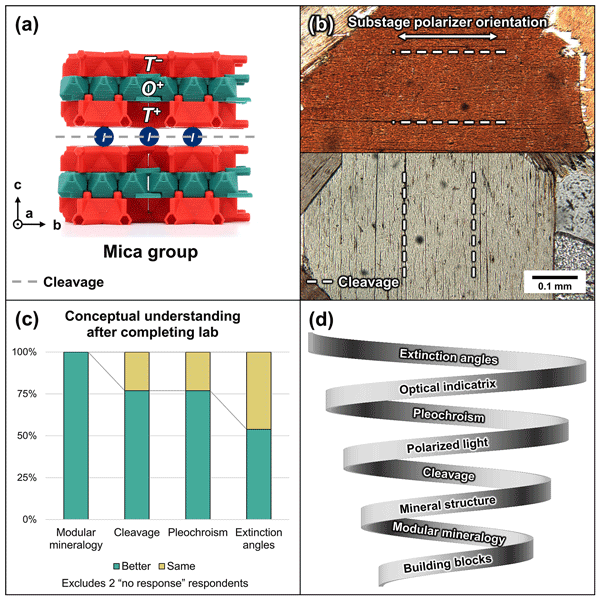
We used 3D-printed building blocks (TotBlocks) in an undergraduate optical mineralogy lab session to illustrate the links between crystal structures and the properties of minerals. Students built mica, pyroxene, and amphibole structures. We observed an improved understanding of cleavage (how minerals break) and pleochroism (how light interacts with minerals), but understanding did not improve with more abstract concepts. TotBlocks hold potential as a teaching tool in mineralogy classrooms.
Derek D. V. Leung and Paige E. dePolo
Eur. J. Mineral., 34, 523–538, https://doi.org/10.5194/ejm-34-523-2022, https://doi.org/10.5194/ejm-34-523-2022, 2022
Short summary
Short summary
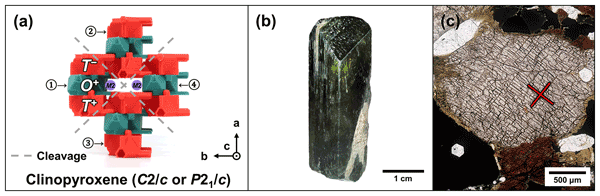
Minerals have complex crystal structures, but many common minerals are built from the same chemical building blocks. TotBlocks is a novel, open-source tool for investigating these structures. It consists of 3D-printed modules representing the silica tetrahedra and metal–oxygen octahedra that form the shared chemical building blocks of rock-forming minerals. TotBlocks is a low-cost visualization tool that relates mineral properties (habit, cleavage, and symmetry) to crystal structures.
Hannah Calleja, Eric C. P. Breard, Tom D. Pering, Linda A. Kirstein, Ian B. Butler, and J. Godfrey Fitton
Geosci. Instrum. Method. Data Syst., 15, 141–163, https://doi.org/10.5194/gi-15-141-2026, https://doi.org/10.5194/gi-15-141-2026, 2026
Short summary
Short summary
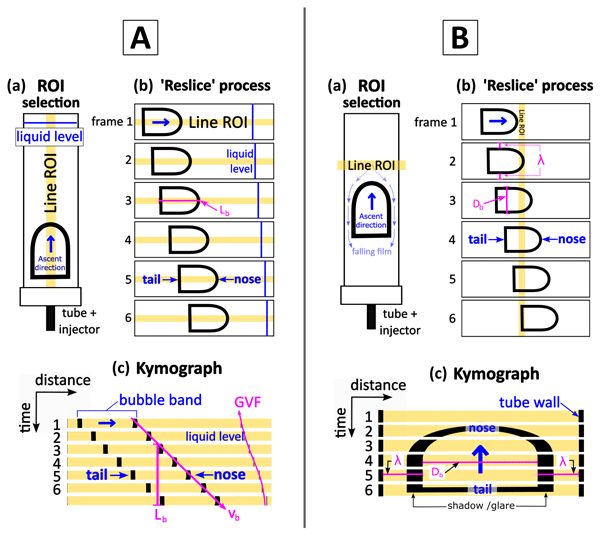
Some volcanic eruptions are driven by huge gas pockets called Taylor bubbles. Volcanologists use experiments that replicate flow inside volcanic conduits to study these eruptions. We show for the first time that kymography can be used to effectively quantify key Taylor bubble flow features such as: gas volume fraction, gas and liquid slug velocities, bubble length and diameter, falling film thickness, bubble and coalescence event counts, and to indicate steady-state ascent.
Roberto Emanuele Rizzo, Damien Freitas, James Gilgannon, Sohan Seth, Ian B. Butler, Gina Elizabeth McGill, and Florian Fusseis
Solid Earth, 15, 493–512, https://doi.org/10.5194/se-15-493-2024, https://doi.org/10.5194/se-15-493-2024, 2024
Short summary
Short summary
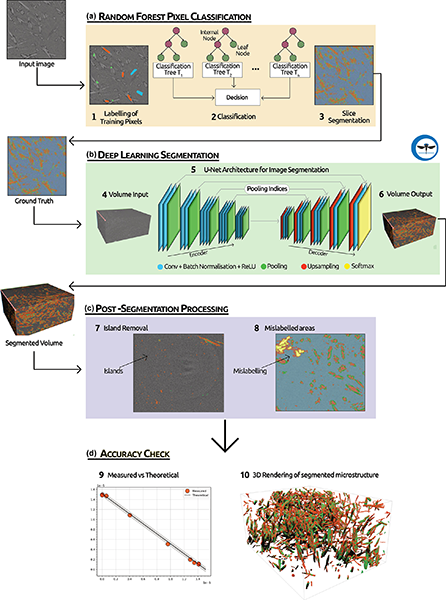
Here we introduce a new approach for analysing time-resolved 3D X-ray images tracking mineral changes in rocks. Using deep learning, we accurately identify and quantify the evolution of mineral components during reactions. The method demonstrates high precision in quantifying a metamorphic reaction, enabling accurate calculation of mineral growth rates and porosity changes. This showcases artificial intelligence's potential to enhance our understanding of Earth science processes.
Derek D. V. Leung and Paige E. dePolo
Geosci. Commun., 6, 125–129, https://doi.org/10.5194/gc-6-125-2023, https://doi.org/10.5194/gc-6-125-2023, 2023
Short summary
Short summary
We used 3D-printed building blocks (TotBlocks) in an undergraduate optical mineralogy lab session to illustrate the links between crystal structures and the properties of minerals. Students built mica, pyroxene, and amphibole structures. We observed an improved understanding of cleavage (how minerals break) and pleochroism (how light interacts with minerals), but understanding did not improve with more abstract concepts. TotBlocks hold potential as a teaching tool in mineralogy classrooms.
Derek D. V. Leung and Paige E. dePolo
Eur. J. Mineral., 34, 523–538, https://doi.org/10.5194/ejm-34-523-2022, https://doi.org/10.5194/ejm-34-523-2022, 2022
Short summary
Short summary
Minerals have complex crystal structures, but many common minerals are built from the same chemical building blocks. TotBlocks is a novel, open-source tool for investigating these structures. It consists of 3D-printed modules representing the silica tetrahedra and metal–oxygen octahedra that form the shared chemical building blocks of rock-forming minerals. TotBlocks is a low-cost visualization tool that relates mineral properties (habit, cleavage, and symmetry) to crystal structures.
Berit Schwichtenberg, Florian Fusseis, Ian B. Butler, and Edward Andò
Solid Earth, 13, 41–64, https://doi.org/10.5194/se-13-41-2022, https://doi.org/10.5194/se-13-41-2022, 2022
Short summary
Short summary
Hydraulic rock properties such as porosity and permeability are relevant factors that have an impact on groundwater resources, geological repositories and fossil fuel reservoirs. We investigate the influence of chemical compaction upon the porosity evolution in salt–biotite mixtures and related transport length scales by conducting laboratory experiments in combination with 4-D analysis. Our observations invite a renewed discussion of the effect of sheet silicates on chemical compaction.
Cited articles
Aben, F. M., Doan, M.-L., Mitchell, T. M., Toussaint, R., Reuschlé, T., Fondriest, M., Gratier, J.-P., and Renard, F.: Dynamic fracturing by successive coseismic loadings leads to pulverization in active fault zones, J. Geophys. Res.-Sol. Ea., 121, 2338–2360, https://doi.org/10.1002/2015JB012542, 2016. a, b, c, d
Aben, F. M., Doan, M.-L., Gratier, J.-P., and Renard, F.: Coseismic Damage Generation and Pulverization in Fault Zones, Chap. 4, American Geophysical Union (AGU), 47–80, https://doi.org/10.1002/9781119156895.ch4, 2017. a
Ahrens, T. J. and Rubin, A. M.: Impact-induced tensional failure in rock, J. Geophys. Res.-Planets, 98, 1185–1203, https://doi.org/10.1029/92JE02679, 1993. a
Akesson, U., Hansson, J., and Stigh, J.: Characterisation of microcracks in the Bohus granite, western Sweden, caused by uniaxial cyclic loading, Eng. Geol., 72, 131–142, https://doi.org/10.1016/j.enggeo.2003.07.001, 2004. a
AliceVision: Meshroom: A 3D reconstruction software, https://github.com/alicevision/meshroom (last access: 21 November 2020), 2018. a
Arganda-Carreras, I., Kaynig, V., Rueden, C., Eliceiri, K. W., Schindelin, J., Cardona, A., and Sebastian Seung, H.: Trainable Weka Segmentation: a machine learning tool for microscopy pixel classification, Bioinformatics, 33, 2424–2426, https://doi.org/10.1093/bioinformatics/btx180, 2017. a
Bahat, D., Rabinovitch, A., and Frid, V.: Tensile fracturing in rocks, Springer, https://doi.org/10.1007/b137741, 2005. a
Baratoux, D. and Reimold, W. U.: The current state of knowledge about shatter cones: Introduction to the special issue, Meteoritics & Planetary Science, 51, 1389–1434, https://doi.org/10.1111/maps.12678, 2016. a
Bestmann, M., Rice, A., Langenhorst, F., Grasemann, B., and Heidelbach, F.: Subglacial bedrock welding associated with glacial earthquakes, J. Geol. Soc. London, 163, 417–420, https://doi.org/10.1144/0016-764920-164, 2006. a
Blenkinsop, T. G.: Deformation Microstructures and Mechanisms in Minerals and Rocks, Springer Netherlands, Dordrecht, https://doi.org/10.1007/0-306-47543-X, 2000. a, b
Braunagel, M. J. and Griffith, W. A.: The Effect of Dynamic Stress Cycling on the Compressive Strength of Rocks, Geophys. Res. Lett., 46, 6479–6486, https://doi.org/10.1029/2019GL082723, 2019. a, b, c, d
Cartwright-Taylor, A., Main, I. G., Butler, I. B., Fusseis, F., Flynn, M., and King, A.: Catastrophic Failure: How and When? Insights From 4-D In Situ X-ray Microtomography, J. Geophys. Res.-Sol. Ea., 125, e2020JB019642, https://doi.org/10.1029/2020JB019642, 2020. a
Cerfontaine, B. and Collin, F.: Cyclic and Fatigue Behaviour of Rock Materials: Review, Interpretation and Research Perspectives, Rock Mechanics and Rock Engineering, https://doi.org/10.1007/S00603-017-1337-5, 2018. a
Chen, Y., Watanabe, K., Kusuda, H., Kusaka, E., and Mabuchi, M.: Crack growth in Westerly granite during a cyclic loading test, Eng. Geol., 117, 189–197, https://doi.org/10.1016/j.enggeo.2010.10.017, 2011. a
DeCarli, P.: Shock metamorphism, in: Encyclopedia of Geology, edited by: Selley, R. C., Cocks, L. R. M., and Plimer, I. R., Elsevier, Oxford, 179–184, https://doi.org/10.1016/B0-12-369396-9/00323-3, 2005. a
Fossen, H.: Structural Geology, Cambridge University Press, https://doi.org/10.1017/CBO9780511777806, 2010. a
Frank, F. C. and Lawn, B. R.: On the theory of Hertzian fracture, Proceedings of the Royal Society of London. Series A. Mathematical and Physical Sciences, 299, 291–306, https://doi.org/10.1098/rspa.1967.0137, 1967. a
Gilbert, G. K.: Crescentic gouges on glaciated surfaces, GSA Bulletin, 17, 303–316, https://doi.org/10.1130/GSAB-17-303, 1906. a, b
Green, S. and Perkins, R.: Uniaxial Compression Tests At Varying Strain Rates On Three Geologic Materials, 10th U.S. Symposium on Rock Mechanics (USRMS) of U.S. Rock Mechanics/Geomechanics Symposium, Austin, Texas, 20–22 May 1968, ARMA-68-0035, 1968. a
Harris, S. E.: Friction Cracks and the Direction of Glacial Movement, J. Geol., 51, 244–258, https://doi.org/10.1086/625148, 1943. a
Hokka, M., Black, J., Tkalich, D., Fourmeau, M., Kane, A., Hoang, N.-H., Li, C., Chen, W., and Kuokkala, V.-T.: Effects of strain rate and confining pressure on the compressive behavior of Kuru granite, Int. J. Impact Eng., 91, 183–193, https://doi.org/10.1016/j.ijimpeng.2016.01.010, 2016. a
Kaiser, P., Yazici, S., and Maloney, S.: Mining-induced stress change and consequences of stress path on excavation stability – a case study, Int. J. Rock Mech. Min., 38, 167–180, https://doi.org/10.1016/S1365-1609(00)00038-1, 2001. a
Kieffer, S. W., Phakey, P. P., and Christie, J. M.: Shock processes in porous quartzite: Transmission electron microscope observations and theory, Contributions to Mineralogy and Petrology, 59, 41–93, https://doi.org/10.1007/BF00375110, 1976. a
Kocer, C. and Collins, R. E.: Angle of Hertzian Cone Cracks, Journal of the American Ceramic Society, 81, 1736–1742, https://doi.org/10.1111/j.1151-2916.1998.tb02542.x, 1998. a
Lawn, B. R.: Indentation of Ceramics with Spheres: A Century after Hertz, Journal of the American Ceramic Society, 81, 1977–1994, https://doi.org/10.1111/j.1151-2916.1998.tb02580.x, 1998. a, b
Leung, D. D. V.: Taking rocks for granite: An integrated mineralogical, textural, and petrographic baseline of curling stones used in international-level competition, B.Sc. thesis, Laurentian University, Canada, 2019. a
Leung, D. D. V.: Author Comment 1, Reply to RC1, https://doi.org/10.5194/egusphere-2025-3499-AC1, 2025. a, b, c
Leung, D. D. V. and McDonald, A. M.: Taking Rocks for Granite: An Integrated Geological, Mineralogical, and Textural Study of Curling Stones Used in International Competition, Can. Mineral., 60, 171–199, https://doi.org/10.3749/canmin.2100052, 2022. a, b, c, d
Li, H., Zhao, J., and Li, T.: Micromechanical modelling of the mechanical properties of a granite under dynamic uniaxial compressive loads, Int. J. Rock Mech. Min., 37, 923–935, https://doi.org/10.1016/S1365-1609(00)00025-3, 2000. a
Master, S.: Hertzian fractures in the sub-Dwyka Nooitgedacht Striated pavement, and implications for the former thickness of Karoo strata near Kimberley, South Africa, South African Journal of Geology, 115, 561–576, https://doi.org/10.2113/gssajg.115.4.561, 2012. a, b
Moore, D. E. and Lockner, D.: The role of microcracking in shear-fracture propagation in granite, J. Struct. Geol., 17, 95–114, 1995. a
Moore, D. E., Morrow, C. A., and Byerlee, J. D.: Fluid-rock interaction and fracture development in “crystalline” rock types, Tech. rep., U. S. Geological Survey, https://doi.org/10.3133/ofr87279, 1987. a
Mougin, J.-P., Perrotin, P., Mommessin, M., Tonnelo, J., and Agbossou, A.: Rock fall impact on reinforced concrete slab: An experimental approach, Int. J. Impact Eng., 31, 169–183, https://doi.org/10.1016/j.ijimpeng.2003.11.005, 2005. a, b
Nemat-Nasser, S., Isaacs, J. B., and Starrett, J. E.: Hopkinson techniques for dynamic recovery experiments, Proceedings of the Royal Society of London. Series A: Mathematical and Physical Sciences, 435, 371–391, https://doi.org/10.1098/rspa.1991.0150, 1991. a
Nichol, D.: Ornamental granite from Ailsa Craig, Scotland, The Journal of Gemmology, 27, 286–290, 2001. a
Nikitin, V.: TomocuPy – efficient GPU-based tomographic reconstruction with asynchronous data processing, Journal of Synchrotron Radiation, 30, 179–191, https://doi.org/10.1107/S1600577522010311, 2023. a
Nyberg, H., Alfredson, S., Hogmark, S., and Jacobson, S.: The asymmetrical friction mechanism that puts the curl in the curling stone, Wear, 301, 583–589, 2013. a
Ostermeijer, G. A., Aben, F. M., Mitchell, T. M., Rockwell, T. K., Rempe, M., and Farrington, K.: Evolution of co-seismic off-fault damage towards pulverisation, Earth Planet. Sc. Lett., 579, 117353, https://doi.org/10.1016/j.epsl.2021.117353, 2022. a
Pfiffner, O. A. and Ramsay, J. G.: Constraints on geological strain rates: Arguments from finite strain states of naturally deformed rocks, J. Geophys. Res.-Sol. Ea., 87, 311–321, https://doi.org/10.1029/JB087iB01p00311, 1982. a
Reimold, W. and Minnitt, R.: Impact-induced shatter cones or percussion marks on quartzites of the Witwatersrand and Transvaal Supergroups?, South African Journal of Geology, 99, 299–308, 1996. a
Rockwell, T., Sisk, M., Girty, G., Dor, O., Wechsler, N., and Ben-Zion, Y.: Chemical and Physical Characteristics of Pulverized Tejon Lookout Granite Adjacent to the San Andreas and Garlock Faults: Implications for Earthquake Physics, Pure Appl. Geophys., 166, 1725–1746, https://doi.org/10.1007/s00024-009-0514-1, 2009. a
Schindelin, J., Arganda-Carreras, I., Frise, E., Kaynig, V., Longair, M., Pietzsch, T., Preibisch, S., Rueden, C., Saalfeld, S., Schmid, B., Tinevez, J.-Y., White, D. J., Hartenstein, V., Eliceiri, K., Tomancak, P., and Cardona, A.: Fiji: an open-source platform for biological-image analysis, Nature Methods, 9, 676–682, 2012. a, b, c, d, e, f, g
Schrank, C. E., Fusseis, F., Karrech, A., and Regenauer-Lieb, K.: Thermal-elastic stresses and the criticality of the continental crust, Geochem. Geophy. Geosy., 13, https://doi.org/10.1029/2012GC004085, 2012. a
Sondergeld, C. H. and Estey, L. H.: Acoustic emission study of microfracturing during the cyclic loading of westerly granite, J. Geophys. Res.-Sol. Ea., 86, 2915–2924, https://doi.org/10.1029/JB086iB04p02915, 1981. a
Stöffler, D. and Langenhorst, F.: Shock metamorphism of quartz in nature and experiment: I. Basic observation and theory, Meteoritics, 29, 155–181, https://doi.org/10.1111/j.1945-5100.1994.tb00670.x, 1994. a
Voorn, M., Exner, U., and Rath, A.: Multiscale Hessian fracture filtering for the enhancement and segmentation of narrow fractures in 3D image data, Comput. Geosci., 57, 44–53, https://doi.org/10.1016/j.cageo.2013.03.006, 2013. a, b
Wang, X., Yang, J., Liu, Q.-f., Zhang, Y.-M., and Zhao, C.: A comparative study of numerical modelling techniques for the fracture of brittle materials with specific reference to glass, Engineering Structures, 152, 493–505, https://doi.org/10.1016/j.engstruct.2017.08.050, 2017. a, b, c
Wilson, B., Dewers, T., Reches, Z., and Brune, J.: Particle size and energetics of gouge from earthquake rupture zones, Nature, 434, 749–752, https://doi.org/10.1038/nature03433, 2005. a
World Curling Federation: The rules of curling and rules of competition, October, 2018. a
Xu, H., Rong, C., Wang, B., Zhang, Q., Shen, Z., and Jin, Y.: Dynamic mechanical behavior and energy dissipation characteristics of low-temperature saturated granite under cyclic impact loading, Scientific Reports, 14, 26840, https://doi.org/10.1038/s41598-024-74059-3, 2024. a
Zhang, Q. and Zhao, J.: A Review of Dynamic Experimental Techniques and Mechanical Behaviour of Rock Materials, Rock Mechanics and Rock Engineering, 47, https://doi.org/10.1007/s00603-013-0463-y, 2014. a, b
Zhou, T., Dong, S. L., Zhao, G. F., Zhang, R., Wu, S. Y., and Zhu, J. B.: An Experimental Study of Fatigue Behavior of Granite Under Low-Cycle Repetitive Compressive Impacts, Rock Mechanics and Rock Engineering, 51, 3157–3166, https://doi.org/10.1007/s00603-018-1515-0, 2018. a
Editorial statement
In curling – one of the 2026 Winter Olympic sports - stones are slid on ice and made to collide along a circumferential striking band. Each stone experiences thousands of impacts per season, over a lifespan of 10–15 years before refurbishment. This provides a unique opportunity to investigate fatigue and damage accumulation under cyclic loading, which is exactly what this unconventional study of rock physics and curling does.
In curling – one of the 2026 Winter Olympic sports - stones are slid on ice and made to...
Short summary
Curling stones often collide with each other during a game. Over time, these collisions cause damage in the striking bands on the sides of the stones. We determined experimentally how hard these stones collide into one another. We then looked at old curling stones to understand how damage builds up in these rocks. We found that early, fast impacts produce fractures until the striking band is saturated in fractures. Repeated impacts after this stage make fractures grow.
Curling stones often collide with each other during a game. Over time, these collisions cause...


