
Articles | Volume 17, issue 8
https://doi.org/10.5194/se-17-979-2026
© Author(s) 2026. This work is distributed under
the Creative Commons Attribution 4.0 License.
the Creative Commons Attribution 4.0 License.
https://doi.org/10.5194/se-17-979-2026
© Author(s) 2026. This work is distributed under
the Creative Commons Attribution 4.0 License.
the Creative Commons Attribution 4.0 License.
Research article
| 
19 Aug 2026
Research article |
| 19 Aug 2026
| 19 Aug 2026
Public response to two rare earthquakes: crowdsourcing constraints on crustal structure in south Bohemian Massif

Institute of Geophysics, Czech Academy of Sciences, Prague, 141 00, Czechia
Matěj Machek
Institute of Geophysics, Czech Academy of Sciences, Prague, 141 00, Czechia
Jiří Vackář
Institute of Structure and Rock Mechanics, Czech Academy of Sciences, Prague, 182 09, Czechia
Anna Pohořalá
Institute of Geophysics, Czech Academy of Sciences, Prague, 141 00, Czechia
Hana Kampfová Exnerová
Institute of Geophysics, Czech Academy of Sciences, Prague, 141 00, Czechia
Petr Špaček
Institute of Physics of the Earth, Masaryk University, Brno, 602 00, Czechia
Jan Zedník
Institute of Geophysics, Czech Academy of Sciences, Prague, 141 00, Czechia
Related authors

Tomáš Fischer, Pavla Hrubcová, Torsten Dahm, Heiko Woith, Tomáš Vylita, Matthias Ohrnberger, Josef Vlček, Josef Horálek, Petr Dědeček, Martin Zimmer, Martin P. Lipus, Simona Pierdominici, Jens Kallmeyer, Frank Krüger, Katrin Hannemann, Michael Korn, Horst Kämpf, Thomas Reinsch, Jakub Klicpera, Daniel Vollmer, and Kyriaki Daskalopoulou
Sci. Dril., 31, 31–49, https://doi.org/10.5194/sd-31-31-2022, https://doi.org/10.5194/sd-31-31-2022, 2022
Short summary
Short summary
The newly established geodynamic laboratory aims to develop modern, comprehensive, multiparameter observations at depth for studying earthquake swarms, crustal fluid flow, mantle-derived fluid degassing and processes of the deep biosphere. It is located in the West Bohemia–Vogtland (western Eger Rift) geodynamic region and comprises a set of five shallow boreholes with high-frequency 3-D seismic arrays as well as continuous real-time fluid monitoring at depth and the study of the deep biosphere.
Filip Havlíček, David Uličný, Ondřej Krýza, Matěj Machek, Michael Warsitzka, and Prokop Závada
EGUsphere, https://doi.org/10.5194/egusphere-2026-4246, https://doi.org/10.5194/egusphere-2026-4246, 2026
Short summary
Short summary
We performed 3 sets of analogue models of continental rifting which incorporated multiple types of predisposed mechanical weaknesses. The specific geometry of the model scenarios was inspired by the basement structure beneath the Cenozoic Eger Graben, Central Europe. When compared with the regional tectonic framework of the Eger Graben, our results suggest a major role of inherited structures in the development of the Eger Graben and partly challenge an existing two-phase extensional model.
Jaroslav Chum, Zbyšek Mošna, Jiří Baše, Jan Zedník, Carsten Schmidt, Patrick Hannawald, Jan Rusz, Jaroslav Urbář, and Šimon Mackovjak
Atmos. Chem. Phys., 26, 9559–9569, https://doi.org/10.5194/acp-26-9559-2026, https://doi.org/10.5194/acp-26-9559-2026, 2026
Short summary
Short summary
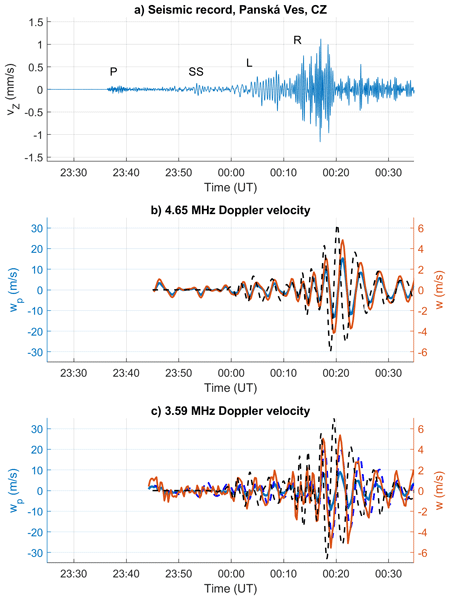
An analysis of unique observations of long period infrasound waves (~200 s) recorded in the ionosphere over Central Europe at record heights by continuous Doppler sounding is presented. The infrasound was generated by the Long-period surface seismic waves induced by the M8.8 Kamchatka earthquake on July 29, 2025. The time delay of the infrasound detection in the ionosphere relative to the vertical motion of the ground surface is consistent with the numerical simulation of infrasound propagation.
Tomáš Fischer, Pavla Hrubcová, Torsten Dahm, Heiko Woith, Tomáš Vylita, Matthias Ohrnberger, Josef Vlček, Josef Horálek, Petr Dědeček, Martin Zimmer, Martin P. Lipus, Simona Pierdominici, Jens Kallmeyer, Frank Krüger, Katrin Hannemann, Michael Korn, Horst Kämpf, Thomas Reinsch, Jakub Klicpera, Daniel Vollmer, and Kyriaki Daskalopoulou
Sci. Dril., 31, 31–49, https://doi.org/10.5194/sd-31-31-2022, https://doi.org/10.5194/sd-31-31-2022, 2022
Short summary
Short summary
The newly established geodynamic laboratory aims to develop modern, comprehensive, multiparameter observations at depth for studying earthquake swarms, crustal fluid flow, mantle-derived fluid degassing and processes of the deep biosphere. It is located in the West Bohemia–Vogtland (western Eger Rift) geodynamic region and comprises a set of five shallow boreholes with high-frequency 3-D seismic arrays as well as continuous real-time fluid monitoring at depth and the study of the deep biosphere.
Cited articles
Babuška, V. and Plomerová, J.: Saxothuringian–Moldanubian suture and predisposition of seismicity in the western Bohemian Massif, Stud. Geophys. Geod., 44, 292–306, 2000.
Beránek, B. and Zátopek, A.: Earth's crust structure in Czechoslovakia and central Europe by methods of explosion seismology, in: Geophysical Synthesis in Czechoslovakia, edited by: Zátopek, A., Veda, Bratislava, Slovakia, 253– 264, 1981.
Bucha, V. and Blížkovský, M.: Crustal Structure of the Bohemian Massif and the West Carpathians, Academia Praha, Prague, ISBN-13: 978-3642789977, 1994.
Čermák, V.: Geothermal Models of the Bohemian Massif (Variscan) and the Western Carpathians (Alpine) and their Mutual Relation, Tectonophysics, 41, 127–137, 1977.
Cifelli, F., Donati, S., Funiciello, F., and Tertulliani, A.: High-Density Macroseismic Survey in Urban Areas, Part 2: Results for the City of Rome, Italy, B. Seismol. Soc. Am., 90, 298–311, 2000.
CZEQ catalogue: Catalogue of Earthquakes in the Czech Republic since 2000, https://doi.org/10.48790/86v9-3g98, 2024.
CZ: Institute of Geophysics, Academy of Sciences of the Czech Republic, Charles University in Prague, Institute of Geonics, Institute of Physics of the Earth Masaryk University, & Institute of Rock Structure and Mechanics, Czech Regional Seismic Network, International Federation of Digital Seismograph Networks [data set], https://doi.org/10.7914/SN/CZ, 1973.
D1: Institute of Physics of the Earth Masaryk University (Czech), IPE_EDU, International Federation of Digital Seismograph Networks [data set], https://doi.org/10.7914/SN/D1, 2014.
Deiller, P., Štípská, P., Ulrich, M., Schulmann, K., Collett, S., Peřestý, V., Hacker, B., Kylander-Clark, A., Whitechurch, H., Lexa, O., Pelt, E., and Míková, J.: Eclogite subduction wedge intruded by arc-type magma: The earliest record of Variscan arc in the Bohemian Massif, Gondwana Res., 99, 220–246, https://doi.org/10.1016/j.gr.2021.07.005, 2021.
Edel, J. B., Schulmann, K., Lexa, O., and Lardeaux, J. M.: Late Palaeozoic palaeomagnetic and tectonic constraints for amalgamation of Pangea supercontinent in the European Variscan belt, Earth-Sci. Rev., 177, 589–612, https://doi.org/10.1016/j.earscirev.2017.12.007, 2018.
Firbas, P. and Werl, M.: HYPO3D, rev. 9.00. Lokalizace ve 3D blokovém prostředí. Etapová zpráva, Geofyzika n.p., Brno, https://github.com/firbas/hypo3d (last access: October 2025), 1988.
Fischer, T., Horálek, J., Hrubcová, P., Vavryčuk, V., Bräuer, K., and Kämpf, H.: Intra-continental earthquake swarms in West-Bohemia and Vogtland, A review, Tectonophysics, 611, 1–27, https://doi.org/10.1016/j.tecto.2013.11.001, 2014.
GR: Federal Institute for Geosciences and Natural Resources, German Regional Seismic Network (GRSN), Bundesanstalt für Geowissenschaften und Rohstoffe, https://doi.org/10.25928/mbx6-hr74, 1976.
Grünthal, G.: European Macroseismic Scale 1998 (EMS-98), Cahiers du Centre Européen de Géodynamique et de Séismologie 15, Helfent-Betrange (Luxembourg), ISBN 2-87977-008-4, 1998.
Guan, X. and Chen, C.: Using social media data to understand and assess disasters, Nat. Hazards, 74, 837–850, https://doi.org/10.1007/s11069-014-1217-1, 2014.
H1: Brož, M., Štrunc, J. (in Czech): Methodology and results of long-term seismological monitoring at underground gas storage Háje – Innogy.cz, Exploration Geophysics, Remote Sensing and Environment, XXIV, https://doi.org/10.26345/EGRSE-001-17-101, 2017.
Hajná, J., Žák, J., and Dörr, W.: Time scales and mechanisms of growth of active margins of Gondwana: A model based on detrital zircon ages from the Neoproterozoic to Cambrian Blovice accretionary complex, Bohemian Massif, Gondwana Res., 42, 63–83, https://doi.org/10.1016/j.gr.2016.10.004, 2017.
Hanžl, P., Janoušek, V., Soejono, I., Buriánek, D., Svojtka, M., Hrdličková, K., Erban, V., and Pin, C.: The rise of the Brunovistulicum: age, geology, petrology and geochemical character of the Neoproterozoic magmatic rocks of the Central Basic Belt of the Brno Massif, Int. J. Earth Sci., 108, 1165–1199, https://doi.org/10.1007/s00531-019-01700-2, 2019.
Hao, H. and Wang, Y.: Leveraging multimodal social media data for rapid disaster damage assessment, Int. J. Disast. Risk Re., 51, 101760, https://doi.org/10.1016/j.ijdrr.2020.101760, 2020.
Heidbach, O., Rajabi, M., Reiter, K., Ziegler, M., and WSM Team: World Stress Map Database Release 2016, V.1.1., GFZ Data Services, https://doi.org/10.5880/WSM.2016.001, 2016.
Hrubcová, P., Środa, P., Špičák, A., Guterch, A., Grad, M., Keller, G. R., Brückl, E., and Thybo, H.: Crustal and uppermost mantle structure of the Bohemian Massif based on CELEBRATION 2000 data, J. Geophys. Res., 110, B11305, https://doi.org/10.1029/2004JB003080, 2005.
Hrubcová, P., Środa, P., Grad, M., Geissler, W. H., Guterch, A., Vozár, J., Hegedűs, E., and Sudetes 2003 Working Group: From the Variscan to the Alpine Orogeny: Crustal structure of the Bohemian Massif and Western Carpathians in the light of the SUDETES 2003 seismic data, Geophys. J. Int., 183, 611–633, https://doi.org/10.1111/j.1365-246X.2010.04766.x, 2010.
Hrubcová, P., Geissler, W. H., Bräuer, K., Vavryčuk, V., Tomek, Č., and Kämpf, H.: Active magmatic underplating in western Eger Rift, Central Europe, Tectonics, 36, 2846–2862, https://doi.org/10.1002/2017TC004710, 2017.
Kankanamge, N., Yigitcanlara, T., Goonetilleke, A., and Kamruzzaman, M.: Can volunteer crowdsourcing reduce disaster risk? A systematic review of the literature, Int. J. Disast. Risk Re., 35, 101097, https://doi.org/10.1016/j.ijdrr.2019.101097, 2019.
Kolínský, P., Meier, T., Agius, M. R., Bijedić, A., Bokelmann, G.; Borleanu, F., Brnović, D., Cambaz, M. D., Cammarano, F., Čarman, M., Cauzzi, C., Chernih, D., Csicsay, K., Cvijić Amulić, S., Czuba, W., Diaz, J., Dimitrova, L., Dushi, E., Evangelidis, C. P., Faccenna, C., Farfuliak, L., Friederich, W., Georgieva, G., Horn, N., Ivančić, I., Jia, Y., Kaviris, G., Kovács, I. J., Lebedev, S., Le Breton, E., Lukešová, R., Mazur, S., van der Meijde, M., Molinari, I., Mustafa, S., Nagel, T., Nielsen, S. B., Obermann, A., Papazachos, C., Parolai, S., Paul, A., Piromallo, C., Plicka, V., Rietbrock, A., Rondenay, S., Rossi, G., Rümpker, G., Schiffer, C., Schlömer, A., Sigloch, K., Silvennoinen, H., Sokos, E., Špaček, P., Stipčević, J., Tallarico, A., Tiira, T., Tilmann, F., Valčić, D., Wassermann, J., Wesztergom, V., Xhahysa, A., Živčić, M., and the AdriaArray Seismology Group: AdriaArray – a Passive Seismic Experiment to Study Structure, Geodynamics and Geohazards of the Adriatic Plate, Ann. Geophys., 68, DM555, https://doi.org/10.4401/ag-9284, 2025.
Kryvasheyeu, Y., Chen, H., Obradovich, N., Moro, E., Van Hentenryck, P., Fowler, J., and Cebrian, M.: Rapid assessment of disaster damage using social media activity, Science Advances, 2, e1500779, https://doi.org/10.1126/sciadv.1500779, 2016.
M1: Institute of Physics of the Earth Masaryk University Brno (IPE), MOravia NETwork (MONET), GFZ Data Services [data set], https://doi.org/10.14470/Z6115722, 2017.
Machek, M., Soejono, I., Sláma, J., and Žáčková, E.: Timing and kinematics of the Variscan orogenic cycle at the Moldanubian periphery of the central Bohemian Massif, J. Geol. Soc. London, 179, jgs2021-096, https://doi.org/10.1144/jgs2021-096, 2022.
Málek, J., Prachař, I., Vackář, J., and Mazanec, M.: Probabilistic assessment of seismic hazard at sites selected for the construction of a deep geological repository, Technical report, TZ 232/2018, MS SÚRAO (in Czech, with English abstract), 2018.
Meissner, R. and Wever, T.: Nature and development of the crust according to deep reflection data from the German Variscides, in: Reflection Seismology: A Global Perspective, edited by; Barazangi, M. and Brown, L., Geodyn. Ser., 13, AGU, Washington, D.C., 31–42, ISBN 978-1-118-67030-9, 1986.
Müller, B., Zoback, M. L., Fuchs, K., Mastin, L., Gregersen, S., Pavoni, N., Stephansson, O., and Ljunggren, C.: Regional patterns of tectonic stress in Europe, J. Geophys. Res., 97, 91JB01096, 11783–11803, 1992.
Prachař, I.: Rodl-Blanice Fault System, in: Faults of the Bohemian Massif – Source of Analytical Data on Main Faults and Faulted Areas with Seismogenic Potential, edited by: Špaček, P., Štěpančíková, P., and Prachař, I., IPE, Masaryk University, https://doi.org/10.48790/MWF4-SH44, 2022.
Růžek, B., Vavryčuk, V., Hrubcová, P., Zedník, J., and CELEBRATION Working Group: Crustal anisotropy in the Bohemian Massif, Czech Republic: Observations based on Central European Lithospheric Experiment Based on Refraction (CELEBRATION) 2000, J. Geophys. Res., 108, 2392, https://doi.org/10.1029/2002JB002242, 2003.
Růžek, B., Hrubcová, P., Novotný, M., Špičák, A., and Karousová, O.: Inversion of travel times obtained during active seismic refraction experiments CELEBRATION 2000, ALP 2002 and SUDETES 2003, Stud. Geophys. Geod., 51, 141–166, 2007.
Schlömer, A., Wassermann, J., Plomerová, J., Vecsey, L., Süle, B., Wéber, Z., Xhahysa, A., Rama, B., Tomanovic, M., Dedic, J., Mustafa, S., Fojtikova, L., Csicsay, K., Müller, J., van Laaten, M., Wegler, U., Meier, T., Mazur, S., Soni, T., and Schiffer, C.: AdriaArray Temporary Network: Albania, Austria, Czech Rep., Germany, Hungary, Kosovo, Montenegro, Slovakia, Poland, International Federation of Digital Seismograph Networks [data set], https://doi.org/10.7914/2cat-tq59, 2022.
Schulmann, K., Lexa, O., Janoušek, V., Lardeaux, J. M., and Edel, J. B.: Anatomy of a diffuse cryptic suture zone: an example from the Bohemian Massif, European Variscides, Geology, 42, 275–278, https://doi.org/10.1130/G35290.1, 2014.
Soejono, I., Machek, M., Sláma, J., Janoušek, V., and Kohút, M.: Cambro–Ordovician anatexis and magmatic recycling at the thinned Gondwana margin: new constraints from the Kouřim Unit, Bohemian Massif, J. Geol. Soc. London, 177, 325–341, https://doi.org/10.1144/jgs2019-037, 2020.
Švancara, J., Meurers, B., Bielik, M., and Špaček, P.: Gravity maps of the contact region of the Bohemian Massif, Eastern Alps, Vienna Basin and Western Carpathians, https://doi.org/10.48790/6RHA-GW96, 2021.
SX: University of Leipzig, Saxon Seismic Network (SXNET), International Federation of Digital Seismograph Networks [data set], https://doi.org/10.7914/SN/SX, 2001.
T1: Institute of Physics of the Earth Masaryk University (Czech), IPE_ETE, International Federation of Digital Seismograph Networks [data set], https://doi.org/10.7914/SN/T1, 1991.
Tomek, Č., Dvořáková, V., and Vrána, S.: Geological interpretation of the 9HR and 503 M seismic profiles in western Bohemia, J. Geol. Sci., Prague, 47, 43–51, 1997.
Tomek, F., Žák, J., and Chadima, M.: Granitic magma emplacement and deformation during early-orogenic syn-convergent transtension: The Staré Sedlo complex, Bohemian Massif, J. Geodyn., 87, 50–66, https://doi.org/10.1016/j.jog.2015.02.007, 2015.
Toshinawa, T., Taber, J. J., and Berrill, J. J.: Distribution of Ground Motion Intensity Inferred from Questionnaire Survey Recordings, and Microtremor Measurements – A Case Study in Christchurch, New Zealand, during the 1994 Arthurs Pass Earthquake, B. Seismol. Soc. Am., 87, 356–369, 1997.
Tosi, P., Sbarra, P., and De Rubeis, V.: Earthquake sound perception, Geophys. Res. Lett., 39, L24301, https://doi.org/10.1029/2012GL054382, 2012.
Tosi, P., Sbarra, P., De Rubeis, V., and Ferrari, C.: Macroseismic intensity assessment method for web questionnaires, Seismol. Res. Lett., 86, 985–990, https://doi.org/10.1785/0220140229, 2015.
Tosi, P., De Rubeis, V., and Sbarra, P.: HSIT system: Citizen Participation in Seismology for Data Collection and Enhanced Understanding of Earthquake Effects, J. Geoethics and Social Geosci., 2, https://doi.org/10.13127/jgsg-51, 2024.
Vackář, J., Gallovič, F., Burjánek, J., Zahradník, J., and Clinton, J.: Bayesian ISOLA: New tool for automated centroid moment tensor inversion, Geophys J. Int., 210, 693–705, https://doi.org/10.1093/gji/ggx158, 2017.
Vavryčuk, V., Hrubcová, P., Brož, M., Málek, J., and ALP 2002 Working Group: Azimuthal variation of Pg velocity in the Moldanubian, Czech Republic: observations based on a multi-azimuthal common-shot experiment, Tectonophysics, 387, 189–203, https://doi.org/10.1016/j.tecto.2004.06.015, 2004.
Vecsey, L., Środa, P., Plomerová, J., Bokelmann, G., Bociarska, M., Csicsay, K., Czuba, W., Fojtíková, L., Jedlička, P., Kampfová Exnerová, H., Kolínský, P., Kotek, J., Malinowski, S., Mendecki, M., Rewers, J., and Schützenhofer, D.: Northern Promontory of AdriaArray: Network Design and Realization, Ann. Geophys., 68, DM557, https://doi.org/10.4401/ag-9327, 2025.
WB: Institute of Geophysics, Academy of Sciences of the Czech Republic. West Bohemia Local Seismic Network (WEBNET), International Federation of Digital Seismograph Networks [data set], https://doi.org/10.7914/SN/WB, 1991.
Z6: Antje Schlömer, Joachim Wassermann, Jaroslava Plomerová, Luděk Vecsey, Bálint Süle, Zoltán Wéber, Anila Xhahysa, Besian Rama, Milena Tomanovic, Jovan Dedic, Shemsi Mustafa, Lucia Fojtikova, Kristian Csicsay, Jozef Müller, Marcel van Laaten, Ulrich Wegler, Thomas Meier, Stanislaw Mazur, Tanishka Soni, and Christian Schiffer, AdriaArray Temporary Network: Albania, Austria, Czech Rep., Germany, Hungary, Kosovo, Montenegro, Slovakia, Poland, International Federation of Digital Seismograph Networks [data set], https://doi.org/10.7914/2cat-tq59, 2022.
Žák, J., Verner, K., Janoušek, V., Holub, F. V., Kachlík, V., Finger, F., Hajná, J., Tomek, F., Vondrovic, L., and Trubač, J.: A plate-kinematic model for the assembly of the Bohemian Massif constrained by structural relationships around granitoid plutons, in: The Variscan Orogeny: Extent, Timescale and the Formation of the European Crust, edited by: Schulmann, K., Martínez Catalán, J. R., Lardeaux, J. M., Janoušek, V., and Oggiano, G., Geol. Soc. London Special Publications, 405, 169–196, https://doi.org/10.1144/SP405.9, 2014.
Short summary
Two rare earthquakes in the Bohemian Massif in 2024 and 2025 were analysed from crowdsourced macroseismic and seismological data. Both events occurred at large depths (~ 24 km) and were widely felt. Non-even distribution of observations reflects contrasting attenuation and control on geology in the Bohemian Massif. Results show that crowdsourced data can effectively constrain deep geological structures and complement instrumental observations in regions with sparse seismicity.
Two rare earthquakes in the Bohemian Massif in 2024 and 2025 were analysed from crowdsourced...


