
Articles | Volume 17, issue 11
https://doi.org/10.5194/se-17-1271-2026
© Author(s) 2026. This work is distributed under
the Creative Commons Attribution 4.0 License.
the Creative Commons Attribution 4.0 License.
https://doi.org/10.5194/se-17-1271-2026
© Author(s) 2026. This work is distributed under
the Creative Commons Attribution 4.0 License.
the Creative Commons Attribution 4.0 License.
Review article
| Highlight paper
| 
13 Nov 2026
Review article | Highlight paper |
| 13 Nov 2026
| 13 Nov 2026
Solid-Earth geophysics and geodesy in Antarctica: achievements, current capabilities, and future directions
Mirko Scheinert
CORRESPONDING AUTHOR

TUD Dresden University of Technology, Department of Geosciences, Chair of Geodetic Earth System Research, 01062 Dresden, Germany
Weisen Shen
CORRESPONDING AUTHOR
Department of Geosciences, Stony Brook University, 255 Earth and Space Science Building, Stony Brook, NY, 11794-2100, USA
Richard C. Aster
Department of Geosciences and Warner College of Natural Resources, Colorado State University, 801 S. Howes Street, Fort Collins, CO, 80523-1482, USA
Lambert Caron
Jet Propulsion Laboratory, California Institute of Technology, 4800 Oak Grove Dr., Pasadena, CA, 91109, USA
Michael D. Hartinger
Space Science Institute, 4765 Walnut St. Suite B, Boulder, CO, 80301, USA
Matt A. King
School of Geography, Planning, and Spatial Sciences and Institute for Marine and Antarctic Studies, University of Tasmania, Hobart 7001, Tasmania, Australia
Australian Centre for Excellence in Antarctic Science, University of Tasmania, Hobart 7001, Tasmania, Australia
Andrew Lloyd
Lamont-Doherty Earth Observatory, Columbia University, 226 Seismology, New York, NY, USA
Anya M. Reading
School of Natural Sciences, University of Tasmania, Hobart 7001, Tasmania, Australia
Australian Centre for Excellence in Antarctic Science, University of Tasmania, Hobart 7001, Tasmania, Australia
J. Paul Winberry
Department of Geological Sciences, Central Washington University, Ellensburg, WA, 98926, USA
Terry Wilson
Byrd Polar and Climate Research Center, Ohio State University, 108 Scott Hall, 1090 Carmack Rd, Columbus, OH, 43210, USA
Lucilla Alfonsi
Istituto Nazionale di Geofisica e Vulcanologia, Via di Vigna Murata 605, 00143 Rome, Italy
Michael J. Bentley
Department of Geography, Durham University, Stockton Road, Durham DH1 3LE, United Kingdom
Eric Buchta
TUD Dresden University of Technology, Department of Geosciences, Chair of Geodetic Earth System Research, 01062 Dresden, Germany
now at: Federal Agency for Cartography and Geodesy, Karl-Rothe-Straße 10–14, 04105 Leipzig, Germany
Thomas Y. Chen
Fu Foundation School of Engineering and Applied Science, Columbia University, New York, NY, 10027, USA
Peter J. Clarke
School of Engineering, Newcastle University, Newcastle upon Tyne NE1 7RU, United Kingdom
Jörg Ebbing
Department of Geosciences, Kiel University, Otto-Hahn-Platz 1, 24118 Kiel, Germany
Olaf Eisen
Glaciology Section, Alfred Wegener Institute Helmholtz Centre of Polar and Marine Research, Am Alten Hafen 26, 27568 Bremerhaven, Germany
Faculty of Geosciences, University of Bremen, Klagenfurter Straße 2–4, 28359 Bremen, Germany
Natalya Gomez
Department of Earth & Planetary Sciences, McGill University, 3450 University St., Montreal, Quebec, H3A 0E8, Canada
Esra Günaydın
Department of Geomatics Engineering, Istanbul Technical University, 34469 Istanbul, Türkiye
Polar Research Center, Istanbul Technical University, 34469 Istanbul, Türkiye
Samantha Hansen
Department of Geological Sciences, The University of Alabama, 201 7th Ave., Tuscaloosa, AL, 35487, USA
Erik R. Ivins
Jet Propulsion Laboratory, California Institute of Technology, 4800 Oak Grove Dr., Pasadena, CA, 91109, USA
Achraf Koulali
School of Engineering, Newcastle University, Newcastle upon Tyne NE1 7RU, United Kingdom
Grace A. Nield
Department of Geography, Durham University, Stockton Road, Durham DH1 3LE, United Kingdom
Frederick Richards
Department of Earth Science & Engineering, Imperial College London, Royal School of Mines, Prince Consort Road, London SW7 2BP, United Kingdom
M. Oğuz Selbesoğlu
Department of Geomatics Engineering, Istanbul Technical University, 34469 Istanbul, Türkiye
Polar Research Center, Istanbul Technical University, 34469 Istanbul, Türkiye
Stephanie Sherman
Byrd Polar and Climate Research Center, Ohio State University, 108 Scott Hall, 1090 Carmack Rd, Columbus, OH, 43210, USA
Pippa L. Whitehouse
Department of Geography, Durham University, Stockton Road, Durham DH1 3LE, United Kingdom
Matthias Willen
TUD Dresden University of Technology, Department of Geosciences, Chair of Geodetic Earth System Research, 01062 Dresden, Germany
Related authors
Torsten Kanzow, Angelika Humbert, Thomas Mölg, Mirko Scheinert, Matthias Braun, Hans Burchard, Francesca Doglioni, Philipp Hochreuther, Martin Horwath, Oliver Huhn, Maria Kappelsberger, Jürgen Kusche, Erik Loebel, Katrina Lutz, Ben Marzeion, Rebecca McPherson, Mahdi Mohammadi-Aragh, Marco Möller, Carolyne Pickler, Markus Reinert, Monika Rhein, Martin Rückamp, Janin Schaffer, Muhammad Shafeeque, Sophie Stolzenberger, Ralph Timmermann, Jenny Turton, Claudia Wekerle, and Ole Zeising
The Cryosphere, 19, 1789–1824, https://doi.org/10.5194/tc-19-1789-2025, https://doi.org/10.5194/tc-19-1789-2025, 2025
Short summary
Short summary
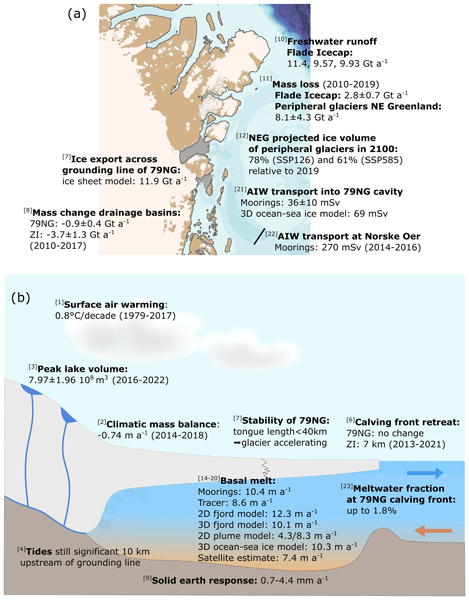
The Greenland Ice Sheet represents the second-largest contributor to global sea-level rise. We quantify atmosphere, ice and ocean processes related to the mass balance of glaciers in northeast Greenland, focusing on Greenland’s largest floating ice tongue, the 79° N Glacier. We find that together, the different in situ and remote sensing observations and model simulations reveal a consistent picture of a coupled atmosphere–ice sheet–ocean system that has entered a phase of major change.
Eric Buchta, Mirko Scheinert, Matt A. King, Terry Wilson, Achraf Koulali, Peter J. Clarke, Demián Gómez, Eric Kendrick, Christoph Knöfel, and Peter Busch
Earth Syst. Sci. Data, 17, 1761–1780, https://doi.org/10.5194/essd-17-1761-2025, https://doi.org/10.5194/essd-17-1761-2025, 2025
Short summary
Short summary
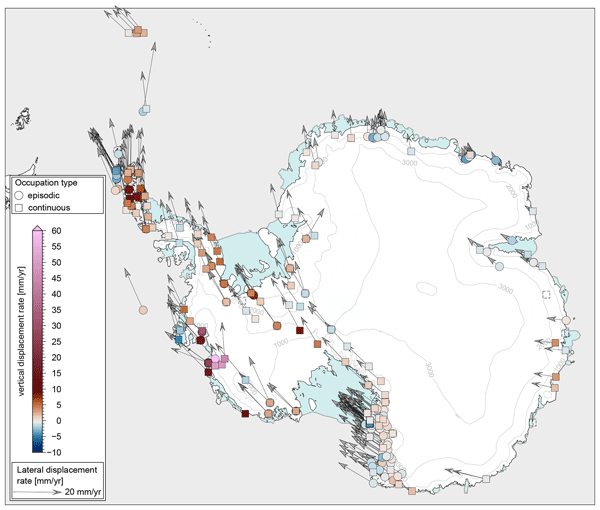
Geodetic GPS measurements in Antarctica have been used to track bedrock displacement, which is vital for understanding geodynamic processes such as plate motion and glacial isostatic adjustment. However, the potential of GPS data has been limited by its partially fragmented availability and unreliable metadata. A new dataset, which spans the period from 1995 to 2021, offers consistently processed coordinate time series for 286 GPS sites and promises to enhance future geodynamic research.
Erik Loebel, Celia A. Baumhoer, Andreas Dietz, Mirko Scheinert, and Martin Horwath
Earth Syst. Sci. Data, 17, 65–78, https://doi.org/10.5194/essd-17-65-2025, https://doi.org/10.5194/essd-17-65-2025, 2025
Short summary
Short summary
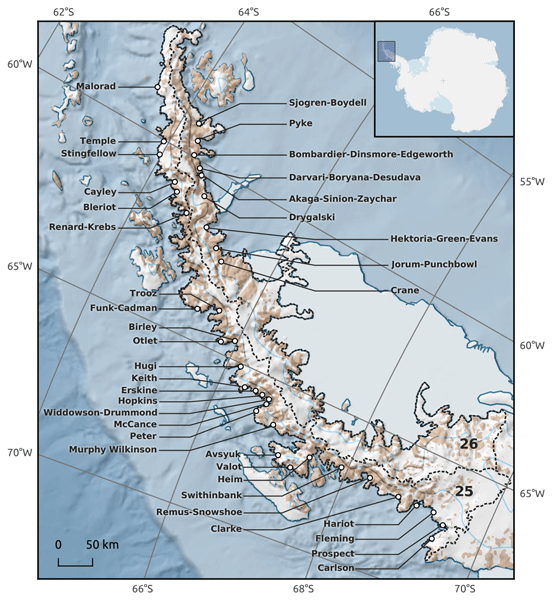
Glacier calving front positions are important for understanding glacier dynamics and constraining ice modelling. We apply a deep-learning framework to multi-spectral Landsat imagery to create a calving front record for 42 key outlet glaciers of the Antarctic Peninsula Ice Sheet. The resulting data product includes 4817 calving front locations from 2013 to 2023 and achieves sub-seasonal temporal resolution.
Katrina Lutz, Lily Bever, Christian Sommer, Thorsten Seehaus, Angelika Humbert, Mirko Scheinert, and Matthias Braun
The Cryosphere, 18, 5431–5449, https://doi.org/10.5194/tc-18-5431-2024, https://doi.org/10.5194/tc-18-5431-2024, 2024
Short summary
Short summary
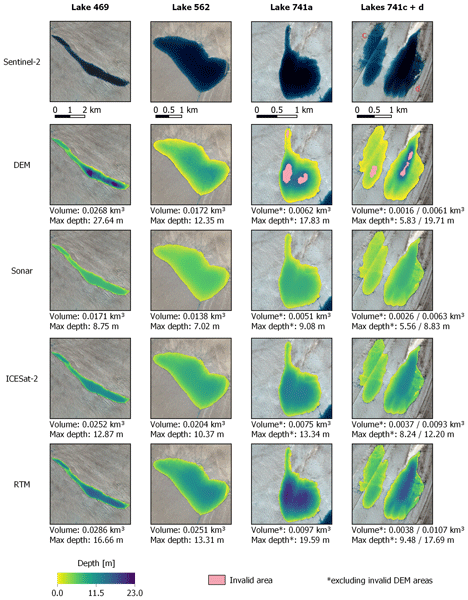
The estimation of the amount of water found within supraglacial lakes is important for understanding how much water is lost from glaciers each year. Here, we develop two new methods for estimating supraglacial lake volume that can be easily applied on a large scale. Furthermore, we compare these methods to two previously developed methods in order to determine when it is best to use each method. Finally, three of these methods are applied to peak melt dates over an area in Northeast Greenland.
Erik Loebel, Mirko Scheinert, Martin Horwath, Angelika Humbert, Julia Sohn, Konrad Heidler, Charlotte Liebezeit, and Xiao Xiang Zhu
The Cryosphere, 18, 3315–3332, https://doi.org/10.5194/tc-18-3315-2024, https://doi.org/10.5194/tc-18-3315-2024, 2024
Short summary
Short summary
Comprehensive datasets of calving-front changes are essential for studying and modeling outlet glaciers. Current records are limited in temporal resolution due to manual delineation. We use deep learning to automatically delineate calving fronts for 23 glaciers in Greenland. Resulting time series resolve long-term, seasonal, and subseasonal patterns. We discuss the implications of our results and provide the cryosphere community with a data product and an implementation of our processing system.
Matthias O. Willen, Martin Horwath, Eric Buchta, Mirko Scheinert, Veit Helm, Bernd Uebbing, and Jürgen Kusche
The Cryosphere, 18, 775–790, https://doi.org/10.5194/tc-18-775-2024, https://doi.org/10.5194/tc-18-775-2024, 2024
Short summary
Short summary
Shrinkage of the Antarctic ice sheet (AIS) leads to sea level rise. Satellite gravimetry measures AIS mass changes. We apply a new method that overcomes two limitations: low spatial resolution and large uncertainties due to the Earth's interior mass changes. To do so, we additionally include data from satellite altimetry and climate and firn modelling, which are evaluated in a globally consistent way with thoroughly characterized errors. The results are in better agreement with independent data.
Reinhard Dietrich, Christoph Knöfel, Mirko Scheinert, and Ralf Rosenau
Polarforschung, 92, 1–13, https://doi.org/10.5194/polf-92-1-2024, https://doi.org/10.5194/polf-92-1-2024, 2024
Short summary
Short summary
Drygalski führte in den Jahren 1891 und 1892/93 Forschungsarbeiten in Westgrönland durch, wobei zur Überwinterung eine Forschungsstation am Großen Karajak-Gletscher errichtetet wurde. An gleicher Stelle erfolgten durch die TU Dresden 2007 und 2019 geodätische Feldarbeiten. Im Beitrag werden das Areal der damaligen Station sowie die Forschungsarbeiten Drygalskis vorgestellt. Ein Vergleich mit heutigen Messungen zeigt, dass sich der Große Karajak-Gletscher in 120 Jahren kaum verändert hat.
Alexandra M. Zuhr, Erik Loebel, Marek Muchow, Donovan Dennis, Luisa von Albedyll, Frigga Kruse, Heidemarie Kassens, Johanna Grabow, Dieter Piepenburg, Sören Brandt, Rainer Lehmann, Marlene Jessen, Friederike Krüger, Monika Kallfelz, Andreas Preußer, Matthias Braun, Thorsten Seehaus, Frank Lisker, Daniela Röhnert, and Mirko Scheinert
Polarforschung, 91, 73–80, https://doi.org/10.5194/polf-91-73-2023, https://doi.org/10.5194/polf-91-73-2023, 2023
Short summary
Short summary
Polar research is an interdisciplinary and multi-faceted field of research. Its diversity ranges from history to geology and geophysics to social sciences and education. This article provides insights into the different areas of German polar research. This was made possible by a seminar series, POLARSTUNDE, established in the summer of 2020 and organized by the German Society of Polar Research and the German National Committee of the Association of Polar Early Career Scientists (APECS Germany).
Angelika Graiff, Matthias Braun, Amelie Driemel, Jörg Ebbing, Hans-Peter Grossart, Tilmann Harder, Joseph I. Hoffman, Boris Koch, Florian Leese, Judith Piontek, Mirko Scheinert, Petra Quillfeldt, Jonas Zimmermann, and Ulf Karsten
Polarforschung, 91, 45–57, https://doi.org/10.5194/polf-91-45-2023, https://doi.org/10.5194/polf-91-45-2023, 2023
Short summary
Short summary
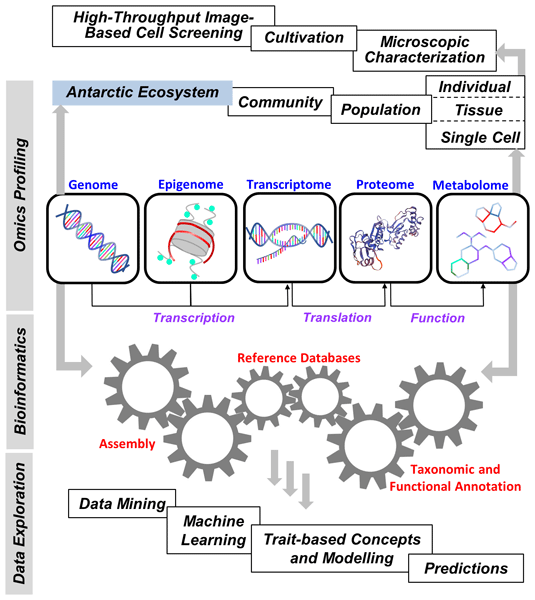
There are many approaches to better understanding Antarctic processes that generate very large data sets (
Antarctic big data). For these large data sets there is a pressing need for improved data acquisition, curation, integration, service, and application to support fundamental scientific research, and this article describes and evaluates the current status of big data in various Antarctic scientific disciplines, identifies current gaps, and provides solutions to fill these gaps.
Gerrit Lohmann, Almut Brunner, Gesine Mollenhauer, Christian Haas, Thomas Laepple, Torsten Kanzow, Ilka Weikusat, Monica Ionita, Olaf Eisen, Florian Adolphi, Vera S. N. Schlindwein, Angelika Humbert, Karsten Gohl, Juliane Müller, Klaus Grosfeld, Johann P. Klages, Frank Lamy, Lu Niu, Gregor Knorr, Walter Geibert, Maria Hoerhold, Ingo Sasgen, Daniela Jansen, Rebecca McPherson, Junjie Wu, Xinyue Li, Thomas Krumpen, Hanna Knahl, Helge Goessling, Renate Treffeisen, Peter Köhler, and Thomas Jung
Polarforschung, 94, 69–95, https://doi.org/10.5194/polf-94-69-2026, https://doi.org/10.5194/polf-94-69-2026, 2026
Short summary
Short summary
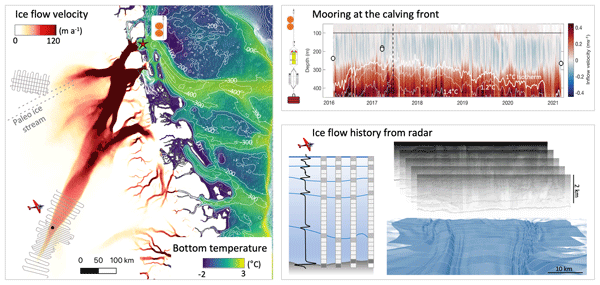
This paper reviews how the Alfred Wegener Institute studies changes in the ocean and the polar ice regions under climate warming. We bring together results from field observations, laboratory work, and computer models to show how melting ice and changing seas affect global climate and sea level. By combining many approaches, we identify key advances, remaining gaps, and future priorities. Integrating these methods improves our ability to project future climate change and guide decision-making.
Emma J. MacKie, Lu Li, Anna Ruth W. Halberstadt, Stewart S. R. Jamieson, Robert Law, Maximilian Lowe, Felicity S. McCormack, Guy J. G. Paxman, Alan R. A. Aitken, Eliza Dawson, Jeremy Ely, Michael Field, Jacqueline A. Halpin, Dougal Hansen, Yasmina M. Martos, Sophie Nowicki, Anya Reading, Niya Shao, Tobias Stål, Kirsty J. Tinto, and Ryan Venturelli
EGUsphere, https://doi.org/10.5194/egusphere-2026-5815, https://doi.org/10.5194/egusphere-2026-5815, 2026
This preprint is open for discussion and under review for The Cryosphere (TC).
Short summary
Short summary
Antarctica’s geology controls how its ice sheet moves and responds to climate change. The landscape, rocks, sediments, water, and heat beneath the ice all influence ice flow, yet these conditions remain poorly understood and are often oversimplified in ice-sheet models. Here, we examine how geology influences ice-sheet behavior, identify gaps between geological observations and models, and explore ways to improve collaboration between geologists and ice-sheet modelers.
Huw Joseph Horgan, Andrew Robert Gorman, J. Paul Winberry, Sridhar Anandakrishnan, Howard Conway, Gavin B. Dunbar, Tina van de Flierdt, Denise K. Kulhanek, Richard H. Levy, Molly O. Patterson, and Ilaria Santin
Earth Syst. Sci. Data Discuss., https://doi.org/10.5194/essd-2026-723, https://doi.org/10.5194/essd-2026-723, 2026
Preprint under review for ESSD
Short summary
Short summary
Knowledge of the past and future of Earth's ice sheets requires us to image beneath the ice surface and into the ice, water, sediment, and rock that lies beneath. An effective way of doing this uses active source seismology. Here we present active source seismic data imaging a diverse range of subglacial environments including subglacial lakes, sub-ice ocean cavities, and geological archives preserving the history of the ice sheets.
Esra Günaydın, Muhammed Oğuzhan Mete, Furkan Ali Küçük, Ayça Hafızoğlu, and Mahmut Oğuz Selbesoğlu
Int. Arch. Photogramm. Remote Sens. Spatial Inf. Sci., XLVIII-M-13-2026, 17–23, https://doi.org/10.5194/isprs-archives-XLVIII-M-13-2026-17-2026, https://doi.org/10.5194/isprs-archives-XLVIII-M-13-2026-17-2026, 2026
Ailsa Chung, Yéva Jeaumot, Frédéric Parrenin, Daniel Steinhage, and Olaf Eisen
EGUsphere, https://doi.org/10.5194/egusphere-2026-4351, https://doi.org/10.5194/egusphere-2026-4351, 2026
This preprint is open for discussion and under review for The Cryosphere (TC).
Short summary
Short summary
We use a 2.5D ice flow model constrained by radar data to estimate the age of ice, basal conditions and particle paths along a flow line from Dome Fuji (DF) to the EPICA Dronning Maud Land ice core site (EDML), Antarctica. Modelled basal melt rates are highest in bedrock dips and stagnant ice occurs on or slightly downstream of bedrock highs. At EDML, particle paths show that the deepest ice may originate 130 km upstream. We also identify a potential old-ice area (>1 Ma), ~200 km from DF.
Yéva Jeaumot, Frédéric Parrenin, Ailsa Chung, Olaf Eisen, Daniel Steinhage, Robert Mulvaney, Marie G. P. Cavitte, David A. Lilien, and Emilie Capron
EGUsphere, https://doi.org/10.5194/egusphere-2026-4174, https://doi.org/10.5194/egusphere-2026-4174, 2026
This preprint is open for discussion and under review for The Cryosphere (TC).
Short summary
Short summary
To choose good drilling sites and interpret ice cores correctly, scientists need reliable estimates of ice age at each depth. We developed a new way to model how ice behaves at the base of ice sheets, where it can melt or stop moving entirely, using radar data from Antarctica. Our estimates matched real measurements at a well-studied site, revealed a layer of stagnant ice at another, and predicted that a newly proposed drilling site could yield ice over two million years old.
Jenan Rajavarathan, Matt King, Christopher Watson, and Nicolaj Hansen
The Cryosphere, 20, 5099–5113, https://doi.org/10.5194/tc-20-5099-2026, https://doi.org/10.5194/tc-20-5099-2026, 2026
Short summary
Short summary
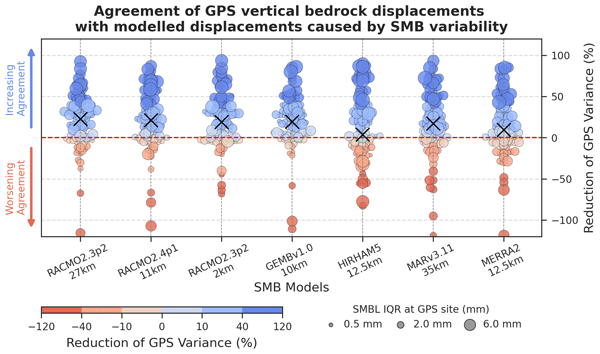
Antarctic surface mass balance (SMB) is a source of major uncertainty in ice-sheet mass balance estimates, but its evaluation remains limited. We introduce a novel method using continuous, bedrock-fixed GPS vertical displacements as a spatially integrated constraint on low-frequency SMB variability over hundreds of kilometres. Applied across Antarctica, it reveals systematic, region-dependent differences with modelled SMB-driven displacements, guiding SMB model refinement.
Surendra Adhikari, Lambert Caron, Erik R. Ivins, Holly K. Han, Luc Houriez, and Eric Larour
The Cryosphere, 20, 5041–5060, https://doi.org/10.5194/tc-20-5041-2026, https://doi.org/10.5194/tc-20-5041-2026, 2026
Short summary
Short summary
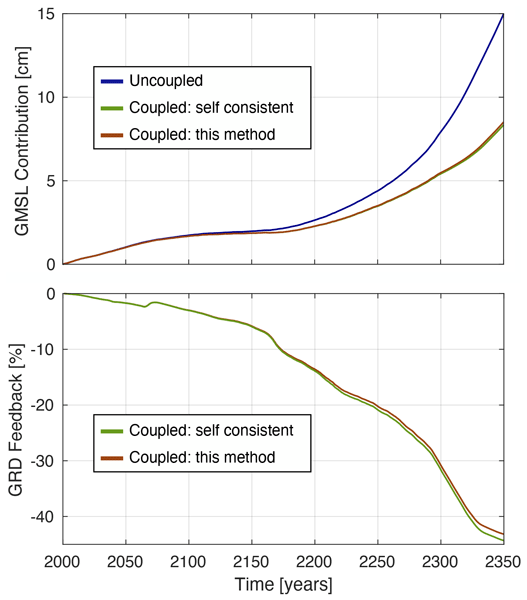
We present an efficient approach for coupling ice sheet and solid Earth models, bringing realistic gravitational and deformational processes into mainstream ice sheet modeling. Earth responses are encoded in precomputed Green’s functions and applied to modeled ice mass change through matrix multiplication. By removing a major computational and technical barrier, the approach could accelerate adoption within the Ice Sheet Model Intercomparison Project (ISMIP) to improve sea level projections.
Judith Freienstein, Charlotte Carter, Georg-Maximilian Hüttner, Olaf Eisen, Wolfgang Szwillus, and Jörg Ebbing
EGUsphere, https://doi.org/10.5194/egusphere-2026-4746, https://doi.org/10.5194/egusphere-2026-4746, 2026
Short summary
Short summary
The North East Greenland Ice Stream is a fast flowing ice stream with its formation so far inland remaining unclear. We used high-resolution bed topography data in 3D modeling to investigate its effects on geothermal heat flow (GHF). Results show local deviations of up to 20 % compared to 1D solutions. Our study highlights the importance of small-scale models to reduce uncertainty in GHF estimates to improve the understanding of ice stream dynamics.
Rebecca Schlegel, Johannes Noll, Leah Sopie Muhle, Christian T. Wild, Falk M. Oraschewski, Olaf Eisen, and Reinhard Drews
EGUsphere, https://doi.org/10.5194/egusphere-2026-3900, https://doi.org/10.5194/egusphere-2026-3900, 2026
This preprint is open for discussion and under review for The Cryosphere (TC).
Short summary
Short summary
Step-like terraces at the base of Antarctic ice shelves are known from warm-water settings, but we show for the first time that they also occur at the base of a cold-water ice shelf. Repeat radar observations reveal that the terraces melt slowly and remain almost unchanged over one year. Our results suggest they form near the grounding line and are then transported with the flowing ice while melting only slowly.
Xiaojun Ma, Matt King, Jonathan Bamber, Bin Liu, Wenke Sun, and Qiuyu Wang
EGUsphere, https://doi.org/10.5194/egusphere-2026-3461, https://doi.org/10.5194/egusphere-2026-3461, 2026
Short summary
Short summary
Satellite records of glacier change are only about two decades long, so short-term climate swings can strongly affect estimated trends. Using satellite gravity data, we show that the largest year-to-year changes in global glacier mass come from the Arctic and are linked to the North Atlantic Oscillation and Pacific Decadal Oscillation. Accounting for these effects makes Alaska’s estimated ice loss about one-third larger, improving interpretation of glacier change and future sea-level rise.
Emma Pearce, Dimitri Zigone, Coen Hofstede, Andreas Fichtner, and Olaf Eisen
EGUsphere, https://doi.org/10.5194/egusphere-2026-3762, https://doi.org/10.5194/egusphere-2026-3762, 2026
Short summary
Short summary
When ice cores are drilled, they are broken before being brought back to the surface, generating small seismic signals. We tested whether these signals could be used to study the inside of the North East Greenland Ice Stream. Most possible signals were too weak or noisy, but a few clear examples produced realistic estimates of ice speed. The results show that this method is promising, but future experiments need better timing, quieter conditions, and sensors placed specifically for this purpose.
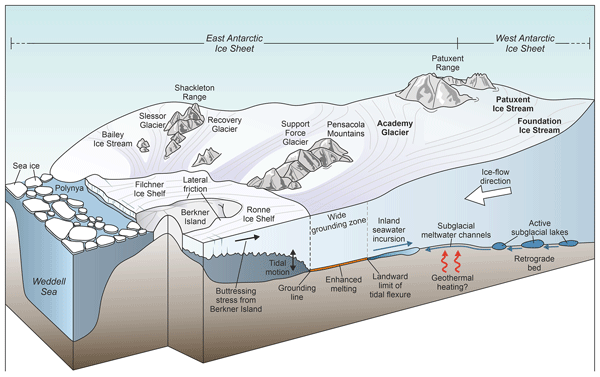
Neil Ross, Rebecca J. Sanderson, Bernd Kulessa, Martin Siegert, Guy J. G. Paxman, Keir A. Nichols, Matthew R. Siegfried, Stewart S. R. Jamieson, Michael J. Bentley, Tom A. Jordan, Christine L. Batchelor, David Small, Olaf Eisen, Kate Winter, Robert G. Bingham, S. Louise Callard, Rachel Carr, Christine F. Dow, Helen A. Fricker, Emily Hill, Benjamin H. Hills, Coen Hofstede, Hafeez Jeofry, Felipe Napoleoni, and Wilson Sauthoff
The Cryosphere, 20, 3705–3737, https://doi.org/10.5194/tc-20-3705-2026, https://doi.org/10.5194/tc-20-3705-2026, 2026
Short summary
Short summary
We review research about a group of fast-flowing Antarctic ice streams, the Foundation-Patuxent-Academy System. Previously, we knew little about how these ice streams flow, how they interact with each other and the ocean, what their geological history was, and how they might evolve in a warming world. By reviewing existing research, we have identified the future research needed to determine how these ice streams function, and how they might contribute to future global sea level rise.
Jan Swierczek-Jereczek, Erica M. Lucas, Natalya Gomez, Andrew J. Lloyd, Konstantin Latychev, and Jerry X. Mitrovica
EGUsphere, https://doi.org/10.5194/egusphere-2026-2640, https://doi.org/10.5194/egusphere-2026-2640, 2026
Short summary
Short summary
Projections of Antarctic ice loss and associated sea level contributions over the coming centuries are linked to glacial isostatic adjustment, a process by which changing ice sheets deform the solid Earth and sea surface. We show that FastIsostasy, a computationally efficient glacial isostatic adjustment model, offers a viable approach for ice sheet modellers to accurately capture solid Earth – ice sheet feedbacks at multi-century timescales.
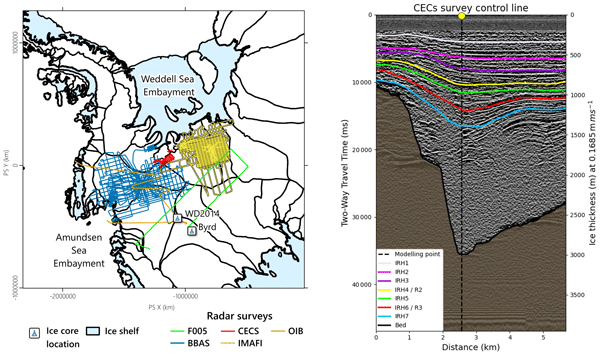
Felipe Napoleoni, Michael J. Bentley, Neil Ross, Stewart S. R. Jamieson, José A. Uribe, Jonathan Oberreuter, Rodrigo Zamora, Andrés Rivera, Andrew M. Smith, Robert G. Bingham, and Kenichi Matsuoka
The Cryosphere, 20, 2793–2824, https://doi.org/10.5194/tc-20-2793-2026, https://doi.org/10.5194/tc-20-2793-2026, 2026
Short summary
Short summary
We mapped buried layers inside West Antarctic ice across 13,000 km² near the Amundsen–Weddell divide using radar. Some layers may be up to 17 kyr old. The layers remain well preserved in slow-moving ice but become distorted where ice flows faster. Snowfall has long been greater on one side of the divide, suggesting the ice divide has remained stable for thousands of years. Our study helps connect climate records across West Antarctica and improve models used to predict future ice-sheet change.
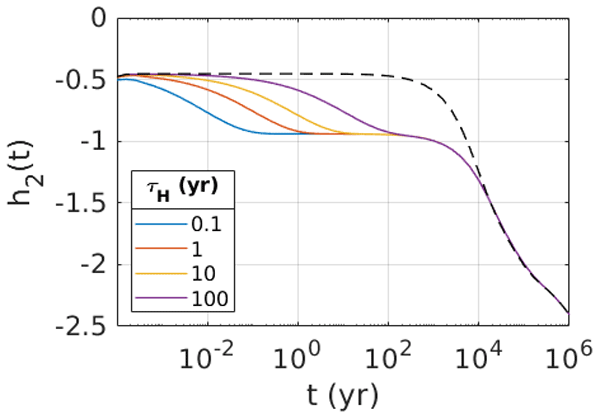
Lambert Caron, Erik Ivins, Eric Larour, Surendra Adhikari, and Laurent Métivier
Geosci. Model Dev., 19, 4031–4054, https://doi.org/10.5194/gmd-19-4031-2026, https://doi.org/10.5194/gmd-19-4031-2026, 2026
Short summary
Short summary
Presented here is a new model of the solid-Earth response to tides and mass changes in ice sheets, oceans, and groundwater, in of terms of gravity change and bedrock motion. The model is capable simulating mantle deformation including elasticity, transient and steady-state viscous flow. We detail our approach to numerical optimization, and report the accuracy of results with respect to community benchmarks. The resulting coupled system features kilometer-scale resolution and fast computation.
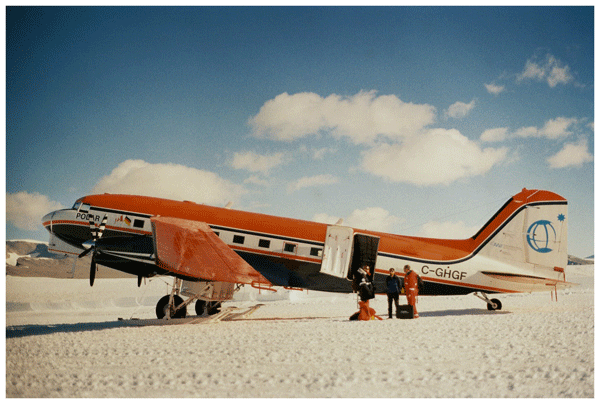
Steven Franke, Daniel Steinhage, Veit Helm, Tobias Binder, Uwe Nixdorf, Heinrich Miller, Angelika Humbert, Daniela Jansen, Graeme Eagles, Hannes Eisermann, Wilfried Jokat, Antonia Ruppel, Reinhard Drews, Alexandra Zuhr, Amelie Driemel, Andreas Walter, Peter Konopatzky, Robin Heß, Antonie Haas, Roland Koppe, Pascal H. Andreas, and Olaf Eisen
The Cryosphere, 20, 2485–2530, https://doi.org/10.5194/tc-20-2485-2026, https://doi.org/10.5194/tc-20-2485-2026, 2026
Short summary
Short summary
This review synthesizes 30 years of Alfred Wegener Institute’s (AWI) airborne radar research in Antarctica and Greenland, detailing six radar systems and their applications in studying ice dynamics, basal properties, and subglacial landscapes. Moreover, it introduces the public release of AWI's airborne radar datasets via the Radar Data over Polar Ice Sheets Viewer and PANGAEA, ensuring findable, accessible, interoperable, and reusable access for future polar research.
Allie N. Coonin, B. Parazin, Harriet C. P. Lau, and Natalya Gomez
EGUsphere, https://doi.org/10.5194/egusphere-2026-2172, https://doi.org/10.5194/egusphere-2026-2172, 2026
Short summary
Short summary
Sea level change and ice sheet stability depend on how Earth’s bedrock warps as ice melts. Rock experiments show that traditional models for bedrock deformation leave out important processes relevant for modern ice loss. We simulate the coevolution of the Antarctic ice sheet and global sea level under various climate change scenarios. When more realistic bedrock behavior is considered, Antarctic ice retreat is delayed. Ultimately, this has implications for the rate of global temperature rise.
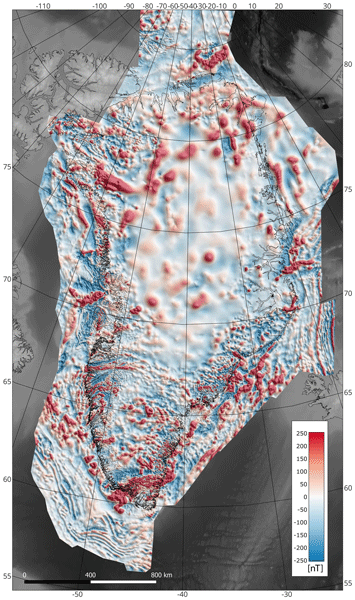
Björn H. Heincke, Wolfgang Szwillus, Judith Freienstein, Jörg Ebbing, Carmen Gaina, Antonia Ruppel, Yixiati Dilixiati, and Agnes Wansing
Earth Syst. Sci. Data, 18, 1943–1967, https://doi.org/10.5194/essd-18-1943-2026, https://doi.org/10.5194/essd-18-1943-2026, 2026
Short summary
Short summary
With over three-quarters of Greenland hidden beneath ice, direct geological observation is nearly impossible. Magnetic mapping provides now a passive and efficient geophysical method to image hidden subsurface features, offering a powerful tool for tectonic analysis and geological modeling in otherwise inaccessible regions. We have now developed a new magnetic anomaly map of Greenland using state-of-the-art technology providing new insight into Greenland's buried geology.
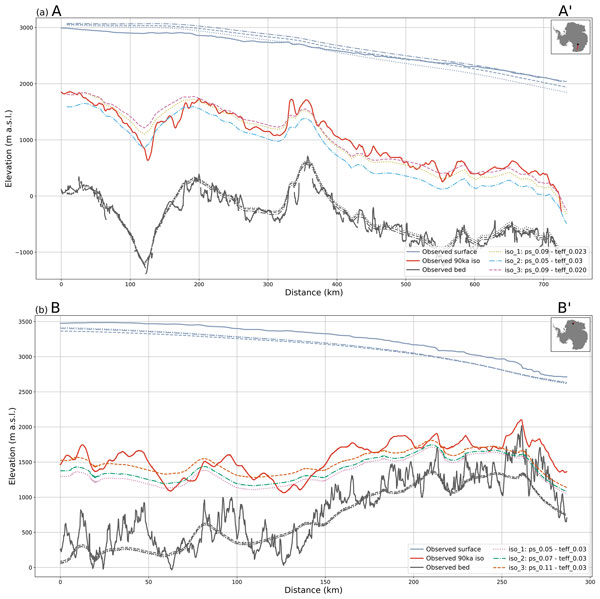
Julien A. Bodart, Vjeran Višnjević, Steven Franke, Veit Helm, Olaf Eisen, Antoine Hermant, Alexandra M. Zuhr, Daniel Steinhage, and Johannes C. R. Sutter
The Cryosphere, 20, 1379–1404, https://doi.org/10.5194/tc-20-1379-2026, https://doi.org/10.5194/tc-20-1379-2026, 2026
Short summary
Short summary
We used radar data and computer models to study layers within Antarctic ice that record past snowfall and ice-sheet changes. These layers, called isochrones, are seldomly used to model Antarctica’s past. By comparing radar observations with simulations, we show how they can greatly improve model accuracy and provide two new datasets to help refine future reconstructions of Antarctic ice evolution.
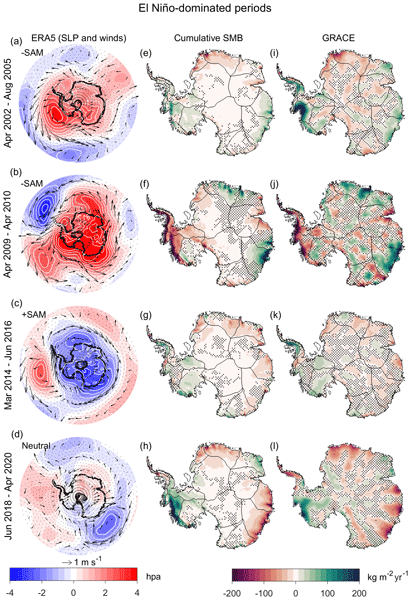
John Bright Ayabilah, Matt King, Danielle Udy, and Tessa Vance
The Cryosphere, 20, 1237–1255, https://doi.org/10.5194/tc-20-1237-2026, https://doi.org/10.5194/tc-20-1237-2026, 2026
Short summary
Short summary
Large-scale climate modes significantly influence Antarctic Ice Sheet (AIS) mass variability. This study investigates AIS variability during different El Niño-Southern Oscillation (ENSO) periods using GRACE data (2002–2022). Results show strong spatial variability driven by changes in the Amundsen Sea Low (ASL) and Southern Annular Mode (SAM). This highlights the importance of understanding these patterns for future ice mass estimates and sea level rise predictions.
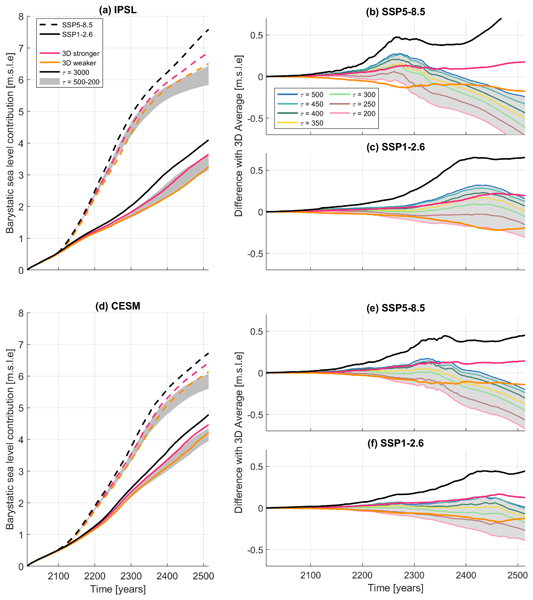
Caroline J. van Calcar, Pippa L. Whitehouse, Roderik S. W. van de Wal, and Wouter van der Wal
The Cryosphere, 20, 757–775, https://doi.org/10.5194/tc-20-757-2026, https://doi.org/10.5194/tc-20-757-2026, 2026
Short summary
Short summary
The bedrock deformation in response to a melting ice sheet provides significant negative feedback on Antarctic ice mass loss in the next 500 years. Current ice sheet models often use computationally fast but simplified Earth models. Our results show that projections of the Antarctic Ice Sheet contribution to sea-level rise using an ice sheet - 3D GIA (glacial isostatic adjustment) model can be approximated using a laterally varying ELRA (elastic lithosphere, relaxed asthenosphere) model or a 1D GIA model when the recommended parameters are used.
Mahmut Oğuz Selbesoğlu, Mustafa Fahri Karabulut, Bilal Mutlu, Mehmet İşiler, Esra Günaydın Dağ, Mehmet Arkalı, Burak Akpınar, Tolga Bakırman, Çetin Biçer, Serdar Erol, and Reha Metin Alkan
Int. Arch. Photogramm. Remote Sens. Spatial Inf. Sci., XLVIII-4-W17-2025, 301–307, https://doi.org/10.5194/isprs-archives-XLVIII-4-W17-2025-301-2026, https://doi.org/10.5194/isprs-archives-XLVIII-4-W17-2025-301-2026, 2026
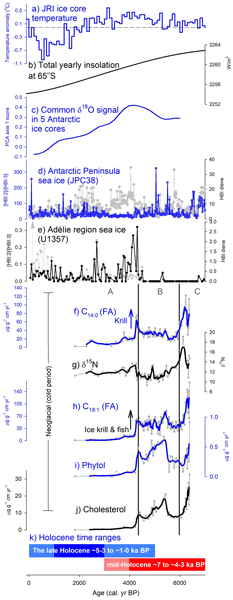
Mark A. Stevenson, Dominic A. Hodgson, Michael J. Bentley, Darren R. Gröcke, Neil Tunstall, Chris Longley, Alice Graham, and Erin L. McClymont
Clim. Past, 21, 2465–2483, https://doi.org/10.5194/cp-21-2465-2025, https://doi.org/10.5194/cp-21-2465-2025, 2025
Short summary
Short summary
We present a record of sea ice and climate inferred from novel snow petrel stomach oil deposits from East Antarctica. Snow petrels feed in the sea ice on a mixture of marine organisms and regurgitate these oils close to their nesting sites in nunatak mountains. We use makers of past diet and productivity from within a deposit to show how sea ice and climate has varied over part of the Holocene. Three periods are identified ranging from low to intermediate and increased sea ice cover.
Valerie Reppert, Olaf Eisen, Holger Schmithüsen, Stefanie Arndt, Guido Ascenso, Linda Ort, and Zsófia Jurányi
EGUsphere, https://doi.org/10.5194/egusphere-2025-5199, https://doi.org/10.5194/egusphere-2025-5199, 2025
Short summary
Short summary
We analyzed 33 years of snow accumulation measurements at Neumayer Station, Antarctica, to understand changes in the amount of snow building up on the surface over time. The long-term, high-resolution data show mostly stable accumulation, but rare positive extremes appeared in 2021 and 2023. Seasonal and multi-year patterns were identified, providing valuable data to improve climate models and satellite observations.
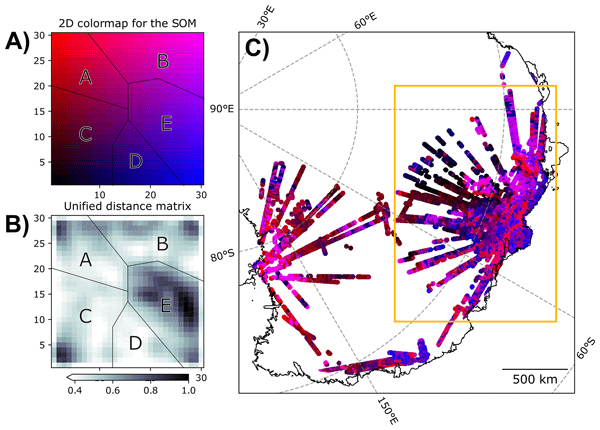
Jonas Liebsch, Jörg Ebbing, and Kenichi Matsuoka
Solid Earth, 16, 1401–1420, https://doi.org/10.5194/se-16-1401-2025, https://doi.org/10.5194/se-16-1401-2025, 2025
Short summary
Short summary
The evolution of the Antarctic ice sheets depends, in addition to factors representing the warming climate, on the earth structure beneath the ice. What’s beneath the ice is largely inaccessible for direct sampling, but can be interpreted with the use of airborne measurements. We apply an unsupervised machine learning method to such data in East Antarctica to test whether this can ease interpretation and hence our understanding of what rocks types are beneath the ice.
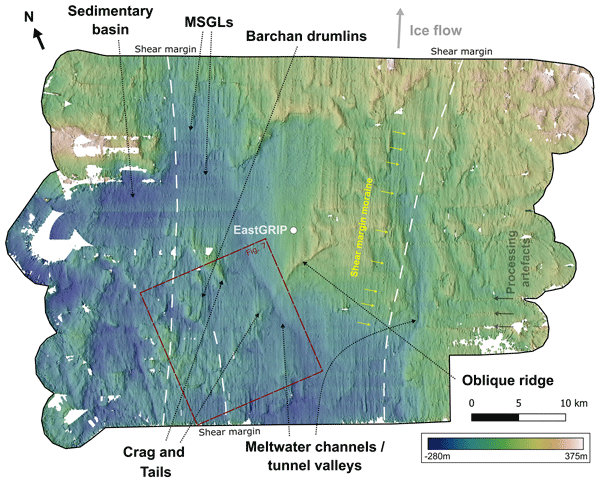
Charlotte M. Carter, Steven Franke, Daniela Jansen, Chris R. Stokes, Veit Helm, John Paden, and Olaf Eisen
The Cryosphere, 19, 5299–5315, https://doi.org/10.5194/tc-19-5299-2025, https://doi.org/10.5194/tc-19-5299-2025, 2025
Short summary
Short summary
The subglacial landforms beneath actively fast-flowing ice in Greenland have not been explored in detail, as digital elevation models have not had a high enough resolution to see these features. We use swath radar imaging to visualise landforms at the onset of an ice stream, revealing mega-scale glacial lineations, that would usually be assumed to be indicative of faster ice flow than the current velocities. Interpretation of the landscape also gives an indication of the properties of the bed.
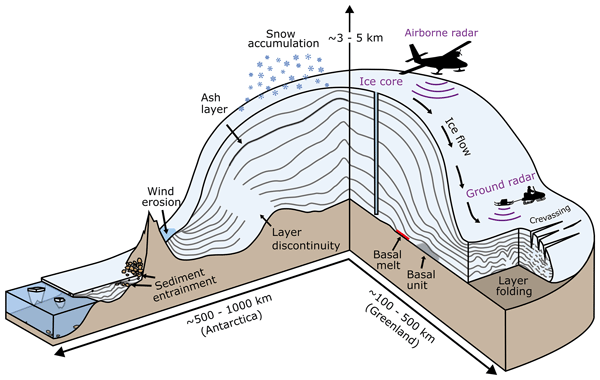
Robert G. Bingham, Julien A. Bodart, Marie G. P. Cavitte, Ailsa Chung, Rebecca J. Sanderson, Johannes C. R. Sutter, Olaf Eisen, Nanna B. Karlsson, Joseph A. MacGregor, Neil Ross, Duncan A. Young, David W. Ashmore, Andreas Born, Winnie Chu, Xiangbin Cui, Reinhard Drews, Steven Franke, Vikram Goel, John W. Goodge, A. Clara J. Henry, Antoine Hermant, Benjamin H. Hills, Nicholas Holschuh, Michelle R. Koutnik, Gwendolyn J.-M. C. Leysinger Vieli, Emma J. MacKie, Elisa Mantelli, Carlos Martín, Felix S. L. Ng, Falk M. Oraschewski, Felipe Napoleoni, Frédéric Parrenin, Sergey V. Popov, Therese Rieckh, Rebecca Schlegel, Dustin M. Schroeder, Martin J. Siegert, Xueyuan Tang, Thomas O. Teisberg, Kate Winter, Shuai Yan, Harry Davis, Christine F. Dow, Tyler J. Fudge, Tom A. Jordan, Bernd Kulessa, Kenichi Matsuoka, Clara J. Nyqvist, Maryam Rahnemoonfar, Matthew R. Siegfried, Shivangini Singh, Vjeran Višnjević, Rodrigo Zamora, and Alexandra Zuhr
The Cryosphere, 19, 4611–4655, https://doi.org/10.5194/tc-19-4611-2025, https://doi.org/10.5194/tc-19-4611-2025, 2025
Short summary
Short summary
The ice sheets covering Antarctica have built up over millenia through successive snowfall events which become buried and preserved as internal surfaces of equal age detectable with ice-penetrating radar. This paper describes an international initiative working together on these archival data to build a comprehensive 3-D picture of how old the ice is everywhere across Antarctica and how this is being used to reconstruct past and to predict future ice and climate behaviour.
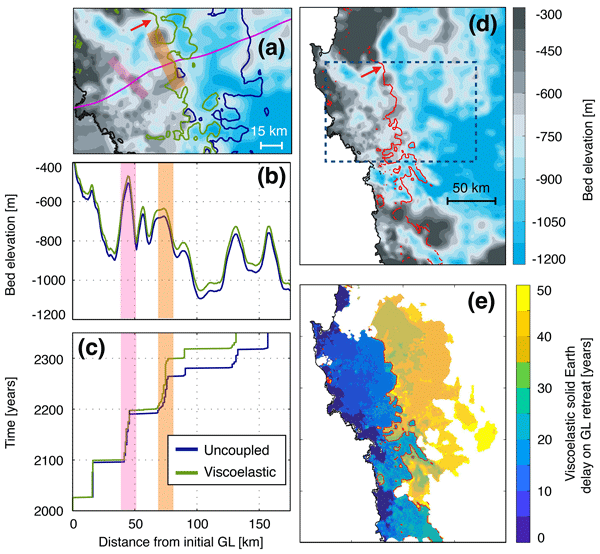
Luc Houriez, Eric Larour, Lambert Caron, Nicole-Jeanne Schlegel, Surendra Adhikari, Erik Ivins, Tyler Pelle, Hélène Seroussi, Eric Darve, and Martin Fischer
The Cryosphere, 19, 4355–4372, https://doi.org/10.5194/tc-19-4355-2025, https://doi.org/10.5194/tc-19-4355-2025, 2025
Short summary
Short summary
This work examines how interactions between the ice sheet and the Earth’s evolving surface affect the future of Thwaites Glacier in Antarctica. We find that small features in the bedrock play a major role in these interactions which can delay the glacier’s retreat by decades or even centuries. This can significantly reduce sea-level rise projections. Our study highlights resolution requirements for similar ice–earth models and the importance of bedrock mapping efforts in Antarctica.
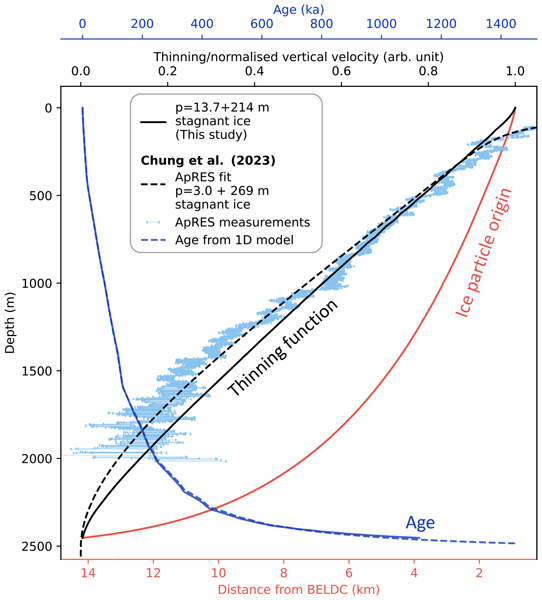
Ailsa Chung, Frédéric Parrenin, Robert Mulvaney, Luca Vittuari, Massimo Frezzotti, Antonio Zanutta, David A. Lilien, Marie G. P. Cavitte, and Olaf Eisen
The Cryosphere, 19, 4125–4140, https://doi.org/10.5194/tc-19-4125-2025, https://doi.org/10.5194/tc-19-4125-2025, 2025
Short summary
Short summary
We applied an ice flow model to a flow line from the summit of Dome C to the Beyond EPICA ice core drill site on Little Dome C in Antarctica. Results show that the oldest ice at the drill site may be 1.12 Ma (at an age density of 20 kyr m-1) and originate from around 15 km upstream. We also discuss the nature of the 200–250 m thick basal layer which could be composed of stagnant ice, disturbed ice or even accreted ice (possibly containing debris).

Samuel T. Kodama, Tamara Pico, Alexander A. Robel, John Erich Christian, Natalya Gomez, Casey Vigilia, Evelyn Powell, Jessica Gagliardi, Slawek Tulaczyk, and Terrence Blackburn
The Cryosphere, 19, 2935–2948, https://doi.org/10.5194/tc-19-2935-2025, https://doi.org/10.5194/tc-19-2935-2025, 2025
Short summary
Short summary
We predicted how sea level changed in the Ross Sea (Antarctica) due to glacial isostatic adjustment, or solid Earth ice sheet interactions, over the last deglaciation (20 000 years ago to present) and calculated how these changes in bathymetry impacted ice stream stability. Glacial isostatic adjustment shifts stability from where ice reached its maximum 20 000 years ago, at the continental shelf edge, to the modern grounding line today, reinforcing ice-age climate endmembers.
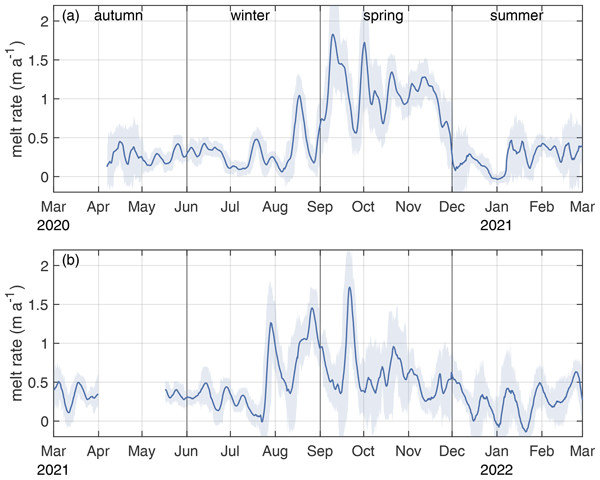
Ole Zeising, Tore Hattermann, Lars Kaleschke, Sophie Berger, Olaf Boebel, Reinhard Drews, M. Reza Ershadi, Tanja Fromm, Frank Pattyn, Daniel Steinhage, and Olaf Eisen
The Cryosphere, 19, 2837–2854, https://doi.org/10.5194/tc-19-2837-2025, https://doi.org/10.5194/tc-19-2837-2025, 2025
Short summary
Short summary
Basal melting of ice shelves impacts the mass loss of the Antarctic Ice Sheet. This study focuses on the Ekström Ice Shelf in East Antarctica, using multiyear data from an autonomous radar system. Results show a surprising seasonal pattern of high melt rates in winter and spring. The seasonalities of sea-ice growth and ocean density indicate that, in winter, dense water enhances plume activity and melt rates. Understanding these dynamics is crucial for improving future mass balance projections.
Esra Günaydın, İrem Yakar, Tolga Bakırman, and Mahmut Oğuz Selbesoğlu
Int. Arch. Photogramm. Remote Sens. Spatial Inf. Sci., XLVIII-2-W10-2025, 101–106, https://doi.org/10.5194/isprs-archives-XLVIII-2-W10-2025-101-2025, https://doi.org/10.5194/isprs-archives-XLVIII-2-W10-2025-101-2025, 2025

Erica M. Lucas, Natalya Gomez, and Terry Wilson
The Cryosphere, 19, 2387–2405, https://doi.org/10.5194/tc-19-2387-2025, https://doi.org/10.5194/tc-19-2387-2025, 2025
Short summary
Short summary
We investigate the effects of incorporating regional-scale lateral variability (ca. 50–100 km) in upper-mantle structure into models of Earth deformation and sea level change associated with ice mass changes in West Antarctica. Regional-scale variability in upper-mantle structure is found to impact relative sea level and crustal rate predictions for modern (last ca. 25–125 years) and projected (next ca. 300 years) ice mass changes, especially in coastal regions that undergo rapid ice mass loss.
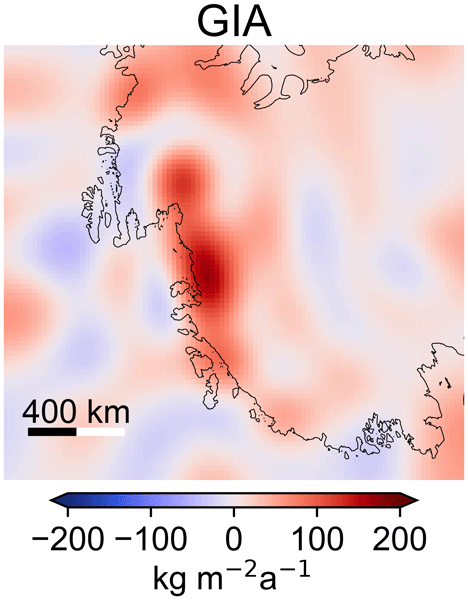
Matthias O. Willen, Bert Wouters, Taco Broerse, Eric Buchta, and Veit Helm
The Cryosphere, 19, 2213–2227, https://doi.org/10.5194/tc-19-2213-2025, https://doi.org/10.5194/tc-19-2213-2025, 2025
Short summary
Short summary
Collapse of the West Antarctic Ice Sheet in the Amundsen Sea Embayment is likely in the near future. Vertical uplift of bedrock due to glacial isostatic adjustment stabilizes the ice sheet and may delay its collapse. So far, only spatially and temporally sparse GPS measurements have been able to observe this bedrock motion. We have combined satellite data and quantified a region-wide bedrock motion that independently matches GPS measurements. This can improve ice sheet predictions.
Hameed Moqadam and Olaf Eisen
The Cryosphere, 19, 2159–2196, https://doi.org/10.5194/tc-19-2159-2025, https://doi.org/10.5194/tc-19-2159-2025, 2025
Short summary
Short summary
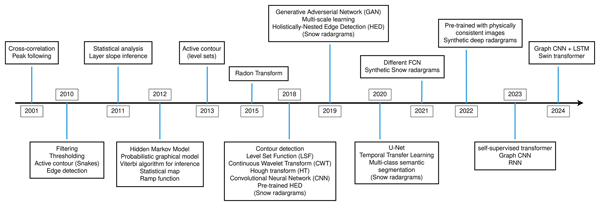
This is an overview of methodologies that have been applied to map the internal reflection horizons, or ice-layer boundaries, of ice sheets on Earth and other planets. We briefly explain radar applications in glaciology and the methods which have been used and published. There are summaries of the published work of the last 2 decades. Finally, we conclude by introducing the gaps and opportunities for further advancement in this field, and we present possible future directions.
Tamara Annina Gerber, David A. Lilien, Niels F. Nymand, Daniel Steinhage, Olaf Eisen, and Dorthe Dahl-Jensen
The Cryosphere, 19, 1955–1971, https://doi.org/10.5194/tc-19-1955-2025, https://doi.org/10.5194/tc-19-1955-2025, 2025
Short summary
Short summary
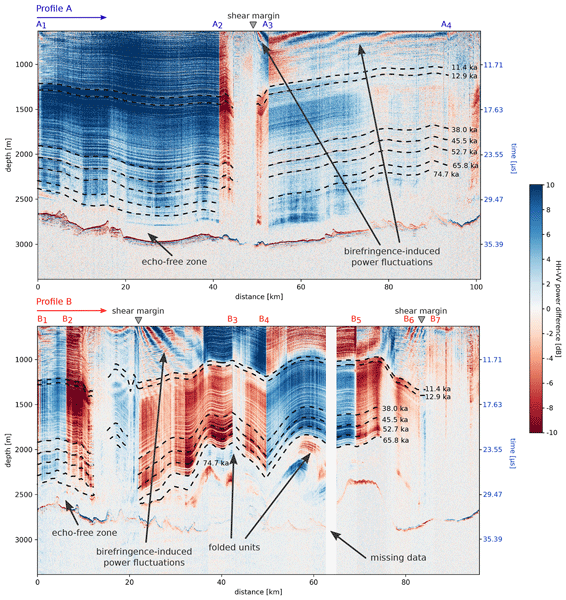
This study examines how anisotropic scattering and birefringence affect radar signals in ice sheets. Using data from northeast Greenland, we show that anisotropic scattering – driven by subtle ice crystal orientation changes – dominates the azimuthal power response. We find a strong link between scattering strength, orientation, and stratigraphy. This suggests anisotropic scattering can reveal crystal fabric orientation and differentiate ice units from distinct climatic periods.
Torsten Kanzow, Angelika Humbert, Thomas Mölg, Mirko Scheinert, Matthias Braun, Hans Burchard, Francesca Doglioni, Philipp Hochreuther, Martin Horwath, Oliver Huhn, Maria Kappelsberger, Jürgen Kusche, Erik Loebel, Katrina Lutz, Ben Marzeion, Rebecca McPherson, Mahdi Mohammadi-Aragh, Marco Möller, Carolyne Pickler, Markus Reinert, Monika Rhein, Martin Rückamp, Janin Schaffer, Muhammad Shafeeque, Sophie Stolzenberger, Ralph Timmermann, Jenny Turton, Claudia Wekerle, and Ole Zeising
The Cryosphere, 19, 1789–1824, https://doi.org/10.5194/tc-19-1789-2025, https://doi.org/10.5194/tc-19-1789-2025, 2025
Short summary
Short summary
The Greenland Ice Sheet represents the second-largest contributor to global sea-level rise. We quantify atmosphere, ice and ocean processes related to the mass balance of glaciers in northeast Greenland, focusing on Greenland’s largest floating ice tongue, the 79° N Glacier. We find that together, the different in situ and remote sensing observations and model simulations reveal a consistent picture of a coupled atmosphere–ice sheet–ocean system that has entered a phase of major change.
Eric Buchta, Mirko Scheinert, Matt A. King, Terry Wilson, Achraf Koulali, Peter J. Clarke, Demián Gómez, Eric Kendrick, Christoph Knöfel, and Peter Busch
Earth Syst. Sci. Data, 17, 1761–1780, https://doi.org/10.5194/essd-17-1761-2025, https://doi.org/10.5194/essd-17-1761-2025, 2025
Short summary
Short summary
Geodetic GPS measurements in Antarctica have been used to track bedrock displacement, which is vital for understanding geodynamic processes such as plate motion and glacial isostatic adjustment. However, the potential of GPS data has been limited by its partially fragmented availability and unreliable metadata. A new dataset, which spans the period from 1995 to 2021, offers consistently processed coordinate time series for 286 GPS sites and promises to enhance future geodynamic research.
Steven Franke, Daniel Steinhage, Veit Helm, Alexandra M. Zuhr, Julien A. Bodart, Olaf Eisen, and Paul Bons
The Cryosphere, 19, 1153–1180, https://doi.org/10.5194/tc-19-1153-2025, https://doi.org/10.5194/tc-19-1153-2025, 2025
Short summary
Short summary
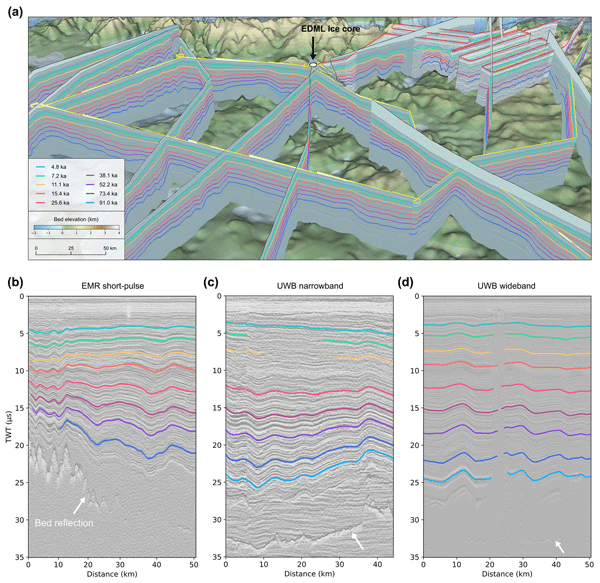
The study presents internal reflection horizons (IRHs) over an area of 450 000 km² from western Dronning Maud Land, Antarctica, spanning 4.8–91 ka. Using radar and ice core data, nine IRHs were dated and correlated with volcanic events. The data enhance our understanding of the ice sheet's age–depth architecture, accumulation, and dynamics. The findings inform ice flow models and contribute to Antarctic-wide comparisons of IRHs, supporting efforts toward a 3D age–depth ice sheet model.
Erik Loebel, Celia A. Baumhoer, Andreas Dietz, Mirko Scheinert, and Martin Horwath
Earth Syst. Sci. Data, 17, 65–78, https://doi.org/10.5194/essd-17-65-2025, https://doi.org/10.5194/essd-17-65-2025, 2025
Short summary
Short summary
Glacier calving front positions are important for understanding glacier dynamics and constraining ice modelling. We apply a deep-learning framework to multi-spectral Landsat imagery to create a calving front record for 42 key outlet glaciers of the Antarctic Peninsula Ice Sheet. The resulting data product includes 4817 calving front locations from 2013 to 2023 and achieves sub-seasonal temporal resolution.
Conor P. B. O'Malley, Gareth G. Roberts, James Panton, Fred D. Richards, J. Huw Davies, Victoria M. Fernandes, and Sia Ghelichkhan
Geosci. Model Dev., 17, 9023–9049, https://doi.org/10.5194/gmd-17-9023-2024, https://doi.org/10.5194/gmd-17-9023-2024, 2024
Short summary
Short summary
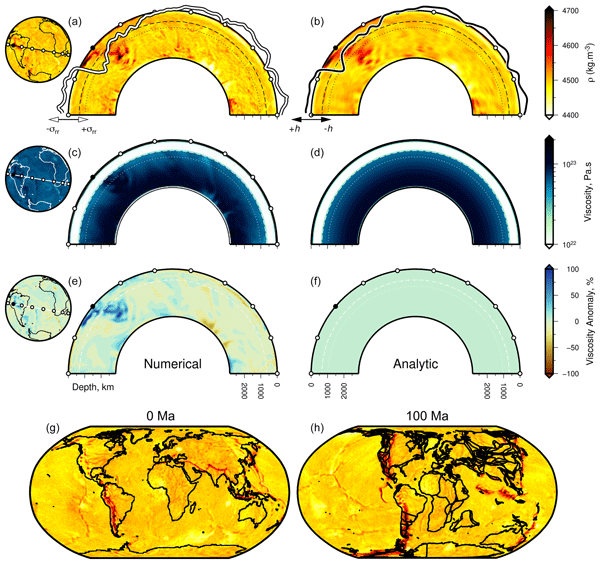
We wish to understand how the history of flowing rock within Earth's interior impacts deflection of its surface. Observations exist to address this problem, and mathematics and different computing tools can be used to predict histories of flow. We explore how modeling choices impact calculated vertical deflections. The sensitivity of vertical motions at Earth's surface to deep flow is assessed, demonstrating how surface observations can enlighten flow histories.
İrem Yakar, Esra Gunaydın, Ramazan Alper Kucak, Serdar Bilgi, and Mahmut Oguz Selbesoglu
Int. Arch. Photogramm. Remote Sens. Spatial Inf. Sci., XLVIII-2-W7-2024, 183–188, https://doi.org/10.5194/isprs-archives-XLVIII-2-W7-2024-183-2024, https://doi.org/10.5194/isprs-archives-XLVIII-2-W7-2024-183-2024, 2024
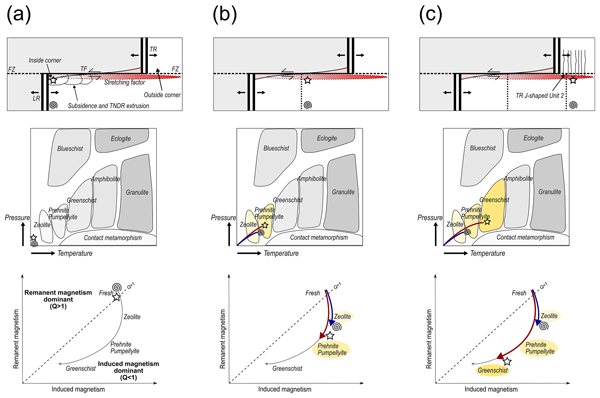
Peter Haas, Myron F. H. Thomas, Christian Heine, Jörg Ebbing, Andrey Seregin, and Jimmy van Itterbeeck
Solid Earth, 15, 1419–1443, https://doi.org/10.5194/se-15-1419-2024, https://doi.org/10.5194/se-15-1419-2024, 2024
Short summary
Short summary
Transform faults are conservative plate boundaries where no material is added or destroyed. Oceanic fracture zones are their inactive remnants and record tectonic processes that formed oceanic crust. In this study, we combine high-resolution data sets along fracture zones in the Gulf of Guinea to demonstrate that their formation is characterized by increased metamorphic conditions. This is in line with previous studies that describe the non-conservative character of transform faults.
Katrina Lutz, Lily Bever, Christian Sommer, Thorsten Seehaus, Angelika Humbert, Mirko Scheinert, and Matthias Braun
The Cryosphere, 18, 5431–5449, https://doi.org/10.5194/tc-18-5431-2024, https://doi.org/10.5194/tc-18-5431-2024, 2024
Short summary
Short summary
The estimation of the amount of water found within supraglacial lakes is important for understanding how much water is lost from glaciers each year. Here, we develop two new methods for estimating supraglacial lake volume that can be easily applied on a large scale. Furthermore, we compare these methods to two previously developed methods in order to determine when it is best to use each method. Finally, three of these methods are applied to peak melt dates over an area in Northeast Greenland.
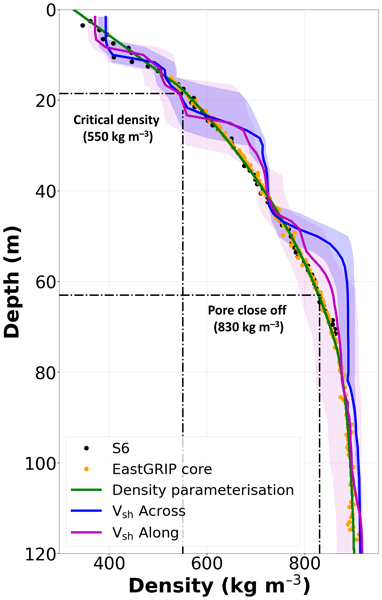
Emma Pearce, Dimitri Zigone, Coen Hofstede, Andreas Fichtner, Joachim Rimpot, Sune Olander Rasmussen, Johannes Freitag, and Olaf Eisen
The Cryosphere, 18, 4917–4932, https://doi.org/10.5194/tc-18-4917-2024, https://doi.org/10.5194/tc-18-4917-2024, 2024
Short summary
Short summary
Our study near EastGRIP camp in Greenland shows varying firn properties by direction (crucial for studying ice stream stability, structure, surface mass balance, and past climate conditions). We used dispersion curve analysis of Love and Rayleigh waves to show firn is nonuniform along and across the flow of an ice stream due to wind patterns, seasonal variability, and the proximity to the edge of the ice stream. This method better informs firn structure, advancing ice stream understanding.
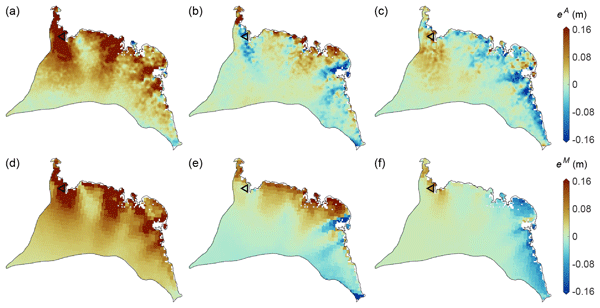
Maria T. Kappelsberger, Martin Horwath, Eric Buchta, Matthias O. Willen, Ludwig Schröder, Sanne B. M. Veldhuijsen, Peter Kuipers Munneke, and Michiel R. van den Broeke
The Cryosphere, 18, 4355–4378, https://doi.org/10.5194/tc-18-4355-2024, https://doi.org/10.5194/tc-18-4355-2024, 2024
Short summary
Short summary
The interannual variations in the height of the Antarctic Ice Sheet (AIS) are mainly due to natural variations in snowfall. Precise knowledge of these variations is important for the detection of any long-term climatic trends in AIS surface elevation. We present a new product that spatially resolves these height variations over the period 1992–2017. The product combines the strengths of atmospheric modeling results and satellite altimetry measurements.
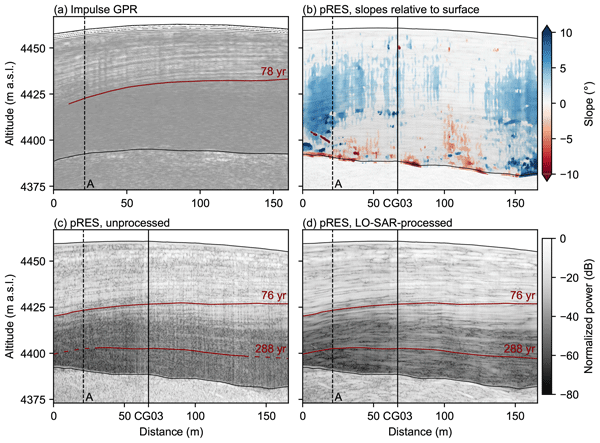
Falk M. Oraschewski, Inka Koch, M. Reza Ershadi, Jonathan D. Hawkins, Olaf Eisen, and Reinhard Drews
The Cryosphere, 18, 3875–3889, https://doi.org/10.5194/tc-18-3875-2024, https://doi.org/10.5194/tc-18-3875-2024, 2024
Short summary
Short summary
Mountain glaciers have a layered structure which contains information about past snow accumulation and ice flow. Using ground-penetrating radar instruments, the internal structure can be observed. The detection of layers in the deeper parts of a glacier is often difficult. Here, we present a new approach for imaging the englacial structure of an Alpine glacier (Colle Gnifetti, Switzerland and Italy) using a phase-sensitive radar that can detect reflection depth changes at sub-wavelength scales.
Erik Loebel, Mirko Scheinert, Martin Horwath, Angelika Humbert, Julia Sohn, Konrad Heidler, Charlotte Liebezeit, and Xiao Xiang Zhu
The Cryosphere, 18, 3315–3332, https://doi.org/10.5194/tc-18-3315-2024, https://doi.org/10.5194/tc-18-3315-2024, 2024
Short summary
Short summary
Comprehensive datasets of calving-front changes are essential for studying and modeling outlet glaciers. Current records are limited in temporal resolution due to manual delineation. We use deep learning to automatically delineate calving fronts for 23 glaciers in Greenland. Resulting time series resolve long-term, seasonal, and subseasonal patterns. We discuss the implications of our results and provide the cryosphere community with a data product and an implementation of our processing system.
Andrew Hollyday, Maureen E. Raymo, Jacqueline Austermann, Fred Richards, Mark Hoggard, and Alessio Rovere
Earth Surf. Dynam., 12, 883–905, https://doi.org/10.5194/esurf-12-883-2024, https://doi.org/10.5194/esurf-12-883-2024, 2024
Short summary
Short summary
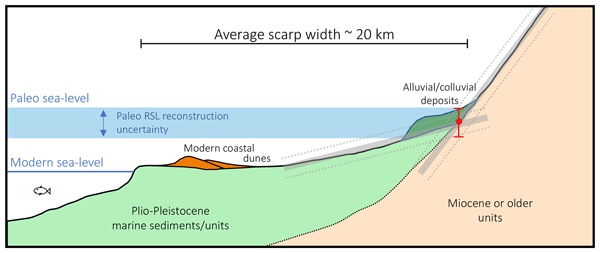
Sea level was significantly higher during the Pliocene epoch, around 3 million years ago. The present-day elevations of shorelines that formed in the past provide a data constraint on the extent of ice sheet melt and the global sea level response under warm Pliocene conditions. In this study, we identify 10 escarpments that formed from wave-cut erosion during Pliocene times and compare their elevations with model predictions of solid Earth deformation processes to estimate past sea level.
Ran Issachar, Peter Haas, Nico Augustin, and Jörg Ebbing
Solid Earth, 15, 807–826, https://doi.org/10.5194/se-15-807-2024, https://doi.org/10.5194/se-15-807-2024, 2024
Short summary
Short summary
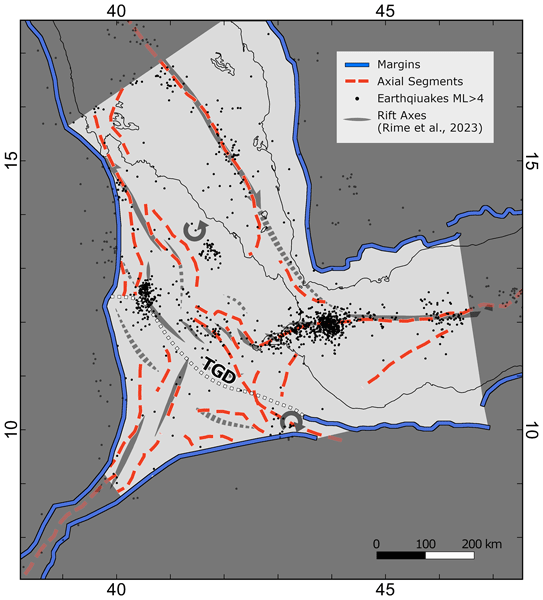
In this contribution, we explore the causal relationship between the arrival of the Afar plume and the initiation of the Afro-Arabian rift. We mapped the rift architecture in the triple-junction region using geophysical data and reviewed the available geological data. We interpret a progressive development of the plume–rift system and suggest an interaction between active and passive mechanisms in which the plume provided a push force that changed the kinematics of the associated plates.

Natasha Valencic, Linda Pan, Konstantin Latychev, Natalya Gomez, Evelyn Powell, and Jerry X. Mitrovica
The Cryosphere, 18, 2969–2978, https://doi.org/10.5194/tc-18-2969-2024, https://doi.org/10.5194/tc-18-2969-2024, 2024
Short summary
Short summary
We quantify the effect of ongoing Antarctic bedrock uplift due to Ice Age or modern ice mass changes on estimates of ice thickness changes obtained from satellite-based ice height measurements. We find that variations in the Ice Age signal introduce an uncertainty in estimates of total Antarctic ice change of up to ~10%. Moreover, the usual assumption that the mapping between modern ice height and thickness changes is uniform systematically underestimates net Antarctic ice volume changes.
Charlotte M. Carter, Michael J. Bentley, Stewart S. R. Jamieson, Guy J. G. Paxman, Tom A. Jordan, Julien A. Bodart, Neil Ross, and Felipe Napoleoni
The Cryosphere, 18, 2277–2296, https://doi.org/10.5194/tc-18-2277-2024, https://doi.org/10.5194/tc-18-2277-2024, 2024
Short summary
Short summary
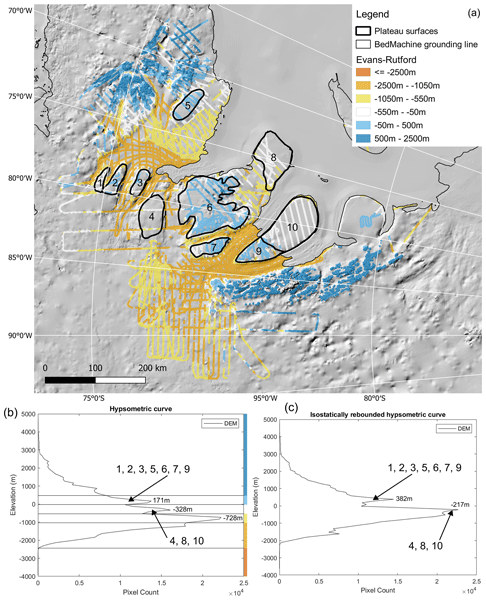
We use radio-echo sounding data to investigate the presence of flat surfaces beneath the Evans–Rutford region in West Antarctica. These surfaces may be what remains of laterally continuous surfaces, formed before the inception of the West Antarctic Ice Sheet, and we assess two hypotheses for their formation. Tectonic structures in the region may have also had a control on the growth of the ice sheet by focusing ice flow into troughs adjoining these surfaces.

Rebecca B. Latto, Ross J. Turner, Anya M. Reading, and J. Paul Winberry
The Cryosphere, 18, 2061–2079, https://doi.org/10.5194/tc-18-2061-2024, https://doi.org/10.5194/tc-18-2061-2024, 2024
Short summary
Short summary
The study of icequakes allows for investigation of many glacier processes that are unseen by typical reconnaissance methods. However, detection of such seismic signals is challenging due to low signal-to-noise levels and diverse source mechanisms. Here we present a novel algorithm that is optimized to detect signals from a glacier environment. We apply the algorithm to seismic data recorded in the 2010–2011 austral summer from the Whillans Ice Stream and evaluate the resulting event catalogue.
Rebecca B. Latto, Ross J. Turner, Anya M. Reading, Sue Cook, Bernd Kulessa, and J. Paul Winberry
The Cryosphere, 18, 2081–2101, https://doi.org/10.5194/tc-18-2081-2024, https://doi.org/10.5194/tc-18-2081-2024, 2024
Short summary
Short summary
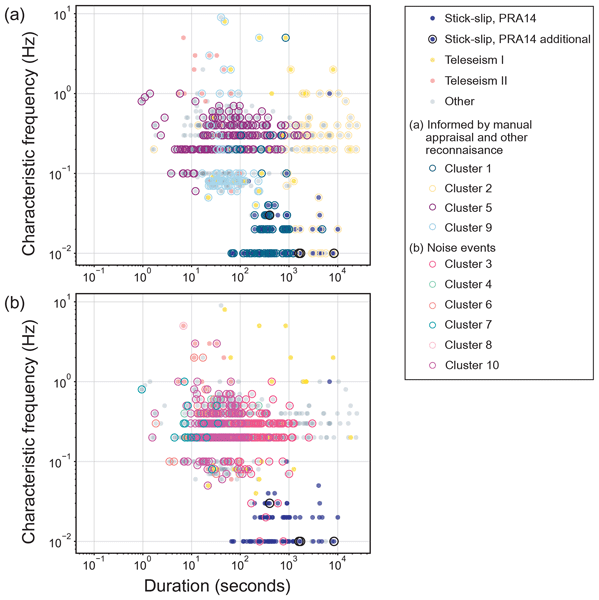
Seismic catalogues are potentially rich sources of information on glacier processes. In a companion study, we constructed an event catalogue for seismic data from the Whillans Ice Stream. Here, we provide a semi-automated workflow for consistent catalogue analysis using an unsupervised cluster analysis. We discuss the defining characteristics of identified signal types found in this catalogue and possible mechanisms for the underlying glacier processes and noise sources.
Edmund J. Lea, Stewart S. R. Jamieson, and Michael J. Bentley
The Cryosphere, 18, 1733–1751, https://doi.org/10.5194/tc-18-1733-2024, https://doi.org/10.5194/tc-18-1733-2024, 2024
Short summary
Short summary
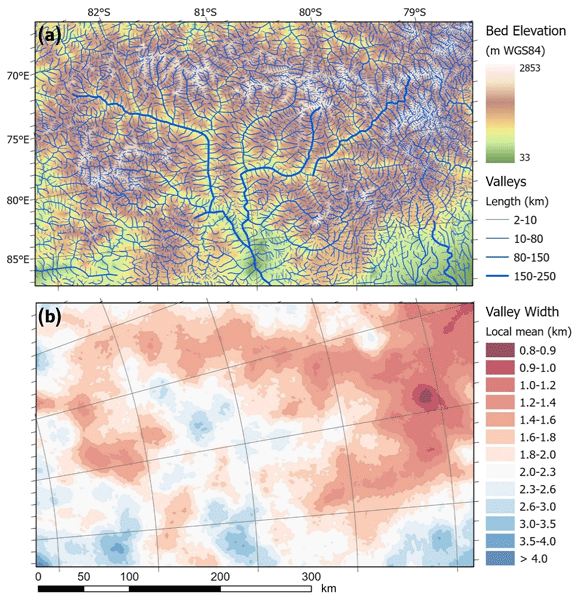
We use the ice surface expression of the Gamburtsev Subglacial Mountains in East Antarctica to map the horizontal pattern of valleys and ridges in finer detail than possible from previous methods. In upland areas, valleys are spaced much less than 5 km apart, with consequences for the distribution of melting at the bed and hence the likelihood of ancient ice being preserved. Automated mapping techniques were tested alongside manual approaches, with a hybrid approach recommended for future work.
Judith Freienstein, Wolfgang Szwillus, Agnes Wansing, and Jörg Ebbing
Solid Earth, 15, 513–533, https://doi.org/10.5194/se-15-513-2024, https://doi.org/10.5194/se-15-513-2024, 2024
Short summary
Short summary
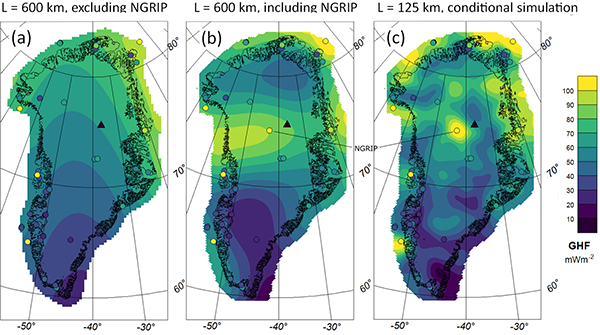
Geothermal heat flow influences ice sheet dynamics, making its investigation important for ice-covered regions. Here we evaluate the sparse measurements for their agreement with regional solid Earth models, as well as with a statistical approach. This shows that some points should be excluded from regional studies. In particular, the NGRIP point, which strongly influences heat flow maps and the distribution of high basal melts, should be statistically considered an outlier.
Guy J. G. Paxman, Stewart S. R. Jamieson, Aisling M. Dolan, and Michael J. Bentley
The Cryosphere, 18, 1467–1493, https://doi.org/10.5194/tc-18-1467-2024, https://doi.org/10.5194/tc-18-1467-2024, 2024
Short summary
Short summary
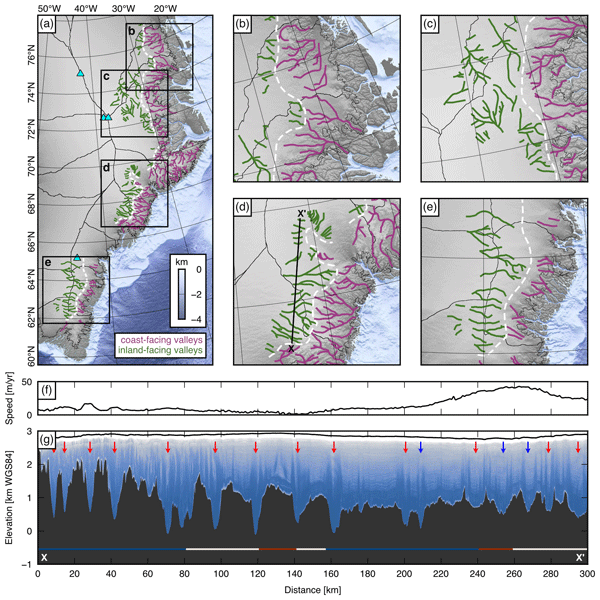
This study uses airborne radar data and satellite imagery to map mountainous topography hidden beneath the Greenland Ice Sheet. We find that the landscape records the former extent and configuration of ice masses that were restricted to areas of high topography. Computer models of ice flow indicate that valley glaciers eroded this landscape millions of years ago when local air temperatures were at least 4 °C higher than today and Greenland’s ice volume was < 10 % of that of the modern ice sheet.
M. O. Selbesoğlu, T. Bakırman, M. F. Karabulut, E. Günaydın, O. Vassilev, O. Oktar, and B. Özsoy
Int. Arch. Photogramm. Remote Sens. Spatial Inf. Sci., XLVIII-4-W9-2024, 321–327, https://doi.org/10.5194/isprs-archives-XLVIII-4-W9-2024-321-2024, https://doi.org/10.5194/isprs-archives-XLVIII-4-W9-2024-321-2024, 2024
Matthias O. Willen, Martin Horwath, Eric Buchta, Mirko Scheinert, Veit Helm, Bernd Uebbing, and Jürgen Kusche
The Cryosphere, 18, 775–790, https://doi.org/10.5194/tc-18-775-2024, https://doi.org/10.5194/tc-18-775-2024, 2024
Short summary
Short summary
Shrinkage of the Antarctic ice sheet (AIS) leads to sea level rise. Satellite gravimetry measures AIS mass changes. We apply a new method that overcomes two limitations: low spatial resolution and large uncertainties due to the Earth's interior mass changes. To do so, we additionally include data from satellite altimetry and climate and firn modelling, which are evaluated in a globally consistent way with thoroughly characterized errors. The results are in better agreement with independent data.
Reinhard Dietrich, Christoph Knöfel, Mirko Scheinert, and Ralf Rosenau
Polarforschung, 92, 1–13, https://doi.org/10.5194/polf-92-1-2024, https://doi.org/10.5194/polf-92-1-2024, 2024
Short summary
Short summary
Drygalski führte in den Jahren 1891 und 1892/93 Forschungsarbeiten in Westgrönland durch, wobei zur Überwinterung eine Forschungsstation am Großen Karajak-Gletscher errichtetet wurde. An gleicher Stelle erfolgten durch die TU Dresden 2007 und 2019 geodätische Feldarbeiten. Im Beitrag werden das Areal der damaligen Station sowie die Forschungsarbeiten Drygalskis vorgestellt. Ein Vergleich mit heutigen Messungen zeigt, dass sich der Große Karajak-Gletscher in 120 Jahren kaum verändert hat.
Ladina Steiner, Holger Schmithüsen, Jens Wickert, and Olaf Eisen
The Cryosphere, 17, 4903–4916, https://doi.org/10.5194/tc-17-4903-2023, https://doi.org/10.5194/tc-17-4903-2023, 2023
Short summary
Short summary
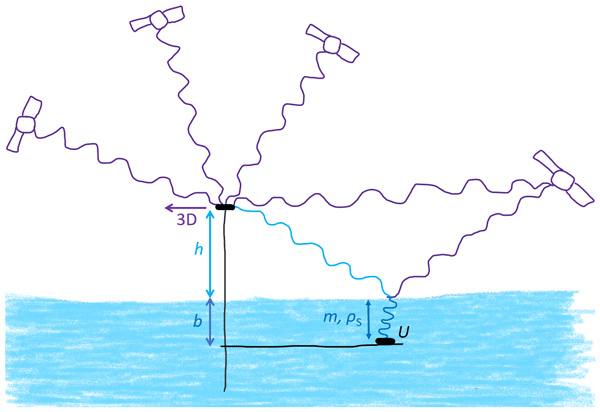
The present study illustrates the potential of a combined Global Navigation Satellite System reflectometry and refractometry (GNSS-RR) method for accurate, simultaneous, and continuous estimation of in situ snow accumulation, snow water equivalent, and snow density time series. The combined GNSS-RR method was successfully applied on a fast-moving, polar ice shelf. The combined GNSS-RR approach could be highly advantageous for a continuous quantification of ice sheet surface mass balances.
Oliver G. Pollard, Natasha L. M. Barlow, Lauren J. Gregoire, Natalya Gomez, Víctor Cartelle, Jeremy C. Ely, and Lachlan C. Astfalck
The Cryosphere, 17, 4751–4777, https://doi.org/10.5194/tc-17-4751-2023, https://doi.org/10.5194/tc-17-4751-2023, 2023
Short summary
Short summary
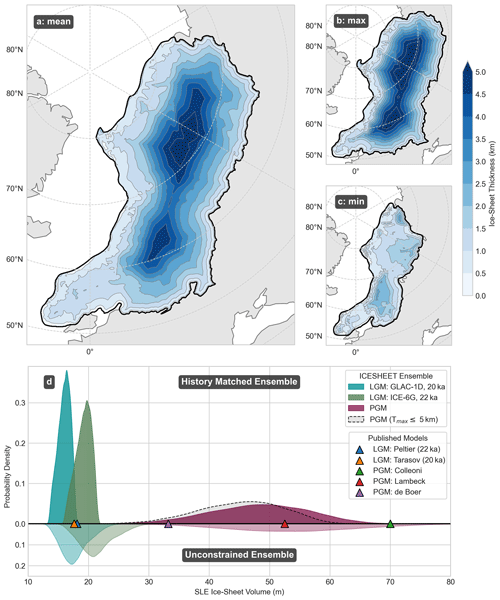
We use advanced statistical techniques and a simple ice-sheet model to produce an ensemble of plausible 3D shapes of the ice sheet that once stretched across northern Europe during the previous glacial maximum (140,000 years ago). This new reconstruction, equivalent in volume to 48 ± 8 m of global mean sea-level rise, will improve the interpretation of high sea levels recorded from the Last Interglacial period (120 000 years ago) that provide a useful perspective on the future.
Alexandra M. Zuhr, Erik Loebel, Marek Muchow, Donovan Dennis, Luisa von Albedyll, Frigga Kruse, Heidemarie Kassens, Johanna Grabow, Dieter Piepenburg, Sören Brandt, Rainer Lehmann, Marlene Jessen, Friederike Krüger, Monika Kallfelz, Andreas Preußer, Matthias Braun, Thorsten Seehaus, Frank Lisker, Daniela Röhnert, and Mirko Scheinert
Polarforschung, 91, 73–80, https://doi.org/10.5194/polf-91-73-2023, https://doi.org/10.5194/polf-91-73-2023, 2023
Short summary
Short summary
Polar research is an interdisciplinary and multi-faceted field of research. Its diversity ranges from history to geology and geophysics to social sciences and education. This article provides insights into the different areas of German polar research. This was made possible by a seminar series, POLARSTUNDE, established in the summer of 2020 and organized by the German Society of Polar Research and the German National Committee of the Association of Polar Early Career Scientists (APECS Germany).
Zhuo Wang, Ailsa Chung, Daniel Steinhage, Frédéric Parrenin, Johannes Freitag, and Olaf Eisen
The Cryosphere, 17, 4297–4314, https://doi.org/10.5194/tc-17-4297-2023, https://doi.org/10.5194/tc-17-4297-2023, 2023
Short summary
Short summary
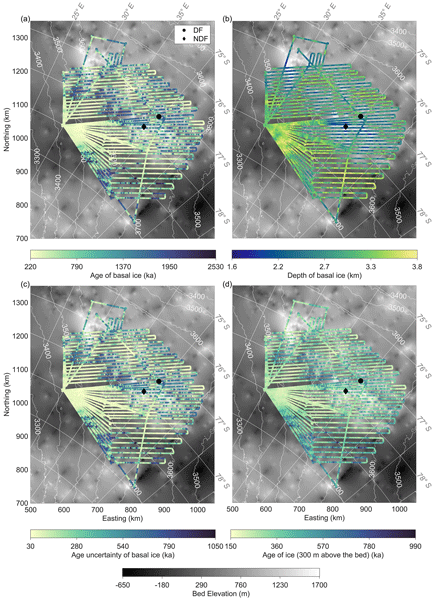
We combine radar-based observed internal layer stratigraphy of the ice sheet with a 1-D ice flow model in the Dome Fuji region. This results in maps of age and age density of the basal ice, the basal thermal conditions, and reconstructed accumulation rates. Based on modeled age we then identify four potential candidates for ice which is potentially 1.5 Myr old. Our map of basal thermal conditions indicates that melting prevails over the presence of stagnant ice in the study area.
Angelika Graiff, Matthias Braun, Amelie Driemel, Jörg Ebbing, Hans-Peter Grossart, Tilmann Harder, Joseph I. Hoffman, Boris Koch, Florian Leese, Judith Piontek, Mirko Scheinert, Petra Quillfeldt, Jonas Zimmermann, and Ulf Karsten
Polarforschung, 91, 45–57, https://doi.org/10.5194/polf-91-45-2023, https://doi.org/10.5194/polf-91-45-2023, 2023
Short summary
Short summary
There are many approaches to better understanding Antarctic processes that generate very large data sets (
Antarctic big data). For these large data sets there is a pressing need for improved data acquisition, curation, integration, service, and application to support fundamental scientific research, and this article describes and evaluates the current status of big data in various Antarctic scientific disciplines, identifies current gaps, and provides solutions to fill these gaps.
Ailsa Chung, Frédéric Parrenin, Daniel Steinhage, Robert Mulvaney, Carlos Martín, Marie G. P. Cavitte, David A. Lilien, Veit Helm, Drew Taylor, Prasad Gogineni, Catherine Ritz, Massimo Frezzotti, Charles O'Neill, Heinrich Miller, Dorthe Dahl-Jensen, and Olaf Eisen
The Cryosphere, 17, 3461–3483, https://doi.org/10.5194/tc-17-3461-2023, https://doi.org/10.5194/tc-17-3461-2023, 2023
Short summary
Short summary
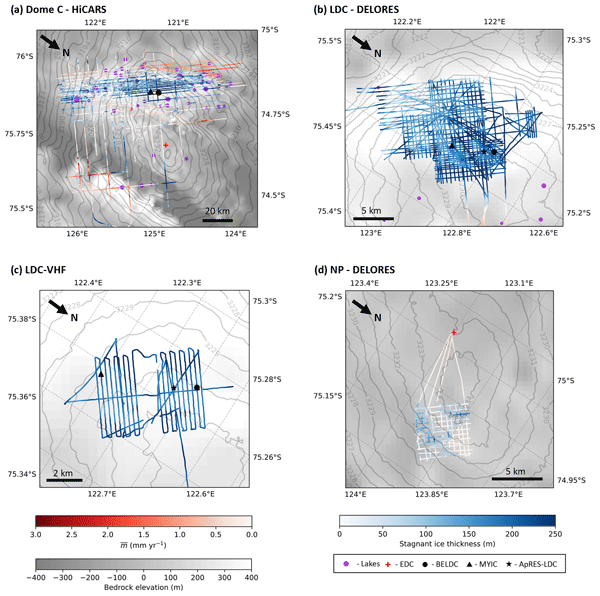
We combined a numerical model with radar measurements in order to determine the age of ice in the Dome C region of Antarctica. Our results show that at the current ice core drilling sites on Little Dome C, the maximum age of the ice is almost 1.5 Ma. We also highlight a new potential drill site called North Patch with ice up to 2 Ma. Finally, we explore the nature of a stagnant ice layer at the base of the ice sheet which has been independently observed and modelled but is not well understood.
Benoit S. Lecavalier, Lev Tarasov, Greg Balco, Perry Spector, Claus-Dieter Hillenbrand, Christo Buizert, Catherine Ritz, Marion Leduc-Leballeur, Robert Mulvaney, Pippa L. Whitehouse, Michael J. Bentley, and Jonathan Bamber
Earth Syst. Sci. Data, 15, 3573–3596, https://doi.org/10.5194/essd-15-3573-2023, https://doi.org/10.5194/essd-15-3573-2023, 2023
Short summary
Short summary
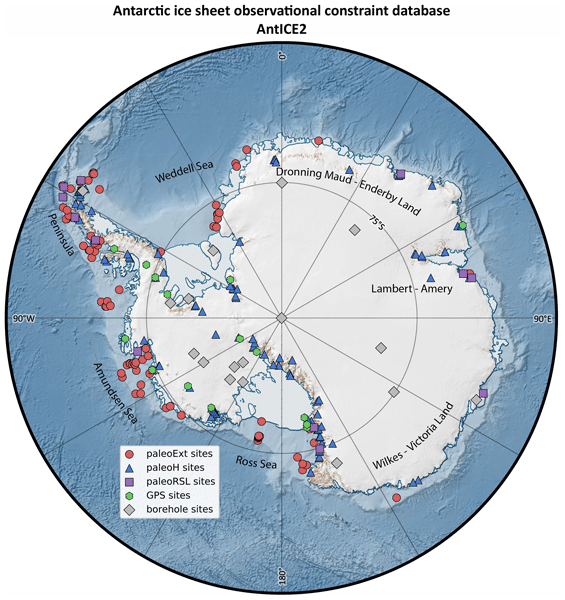
The Antarctic Ice Sheet Evolution constraint database version 2 (AntICE2) consists of a large variety of observations that constrain the evolution of the Antarctic Ice Sheet over the last glacial cycle. This includes observations of past ice sheet extent, past ice thickness, past relative sea level, borehole temperature profiles, and present-day bedrock displacement rates. The database is intended to improve our understanding of past Antarctic changes and for ice sheet model calibrations.
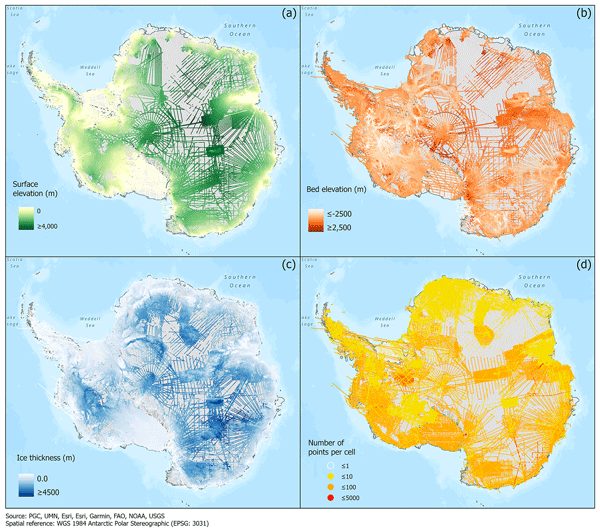
Alice C. Frémand, Peter Fretwell, Julien A. Bodart, Hamish D. Pritchard, Alan Aitken, Jonathan L. Bamber, Robin Bell, Cesidio Bianchi, Robert G. Bingham, Donald D. Blankenship, Gino Casassa, Ginny Catania, Knut Christianson, Howard Conway, Hugh F. J. Corr, Xiangbin Cui, Detlef Damaske, Volkmar Damm, Reinhard Drews, Graeme Eagles, Olaf Eisen, Hannes Eisermann, Fausto Ferraccioli, Elena Field, René Forsberg, Steven Franke, Shuji Fujita, Yonggyu Gim, Vikram Goel, Siva Prasad Gogineni, Jamin Greenbaum, Benjamin Hills, Richard C. A. Hindmarsh, Andrew O. Hoffman, Per Holmlund, Nicholas Holschuh, John W. Holt, Annika N. Horlings, Angelika Humbert, Robert W. Jacobel, Daniela Jansen, Adrian Jenkins, Wilfried Jokat, Tom Jordan, Edward King, Jack Kohler, William Krabill, Mette Kusk Gillespie, Kirsty Langley, Joohan Lee, German Leitchenkov, Carlton Leuschen, Bruce Luyendyk, Joseph MacGregor, Emma MacKie, Kenichi Matsuoka, Mathieu Morlighem, Jérémie Mouginot, Frank O. Nitsche, Yoshifumi Nogi, Ole A. Nost, John Paden, Frank Pattyn, Sergey V. Popov, Eric Rignot, David M. Rippin, Andrés Rivera, Jason Roberts, Neil Ross, Anotonia Ruppel, Dustin M. Schroeder, Martin J. Siegert, Andrew M. Smith, Daniel Steinhage, Michael Studinger, Bo Sun, Ignazio Tabacco, Kirsty Tinto, Stefano Urbini, David Vaughan, Brian C. Welch, Douglas S. Wilson, Duncan A. Young, and Achille Zirizzotti
Earth Syst. Sci. Data, 15, 2695–2710, https://doi.org/10.5194/essd-15-2695-2023, https://doi.org/10.5194/essd-15-2695-2023, 2023
Short summary
Short summary
This paper presents the release of over 60 years of ice thickness, bed elevation, and surface elevation data acquired over Antarctica by the international community. These data are a crucial component of the Antarctic Bedmap initiative which aims to produce a new map and datasets of Antarctic ice thickness and bed topography for the international glaciology and geophysical community.
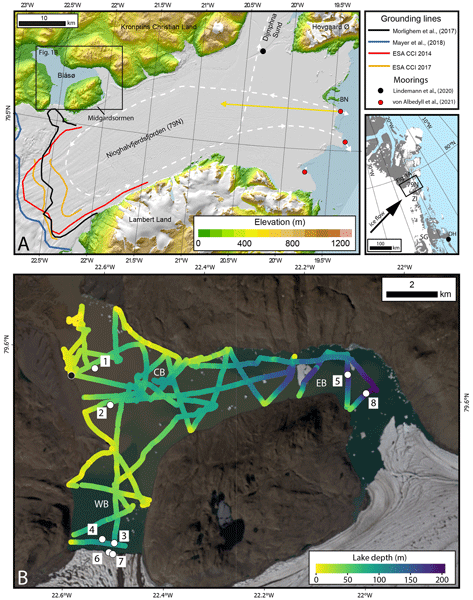
Michael J. Bentley, James A. Smith, Stewart S. R. Jamieson, Margaret R. Lindeman, Brice R. Rea, Angelika Humbert, Timothy P. Lane, Christopher M. Darvill, Jeremy M. Lloyd, Fiamma Straneo, Veit Helm, and David H. Roberts
The Cryosphere, 17, 1821–1837, https://doi.org/10.5194/tc-17-1821-2023, https://doi.org/10.5194/tc-17-1821-2023, 2023
Short summary
Short summary
The Northeast Greenland Ice Stream is a major outlet of the Greenland Ice Sheet. Some of its outlet glaciers and ice shelves have been breaking up and retreating, with inflows of warm ocean water identified as the likely reason. Here we report direct measurements of warm ocean water in an unusual lake that is connected to the ocean beneath the ice shelf in front of the 79° N Glacier. This glacier has not yet shown much retreat, but the presence of warm water makes future retreat more likely.
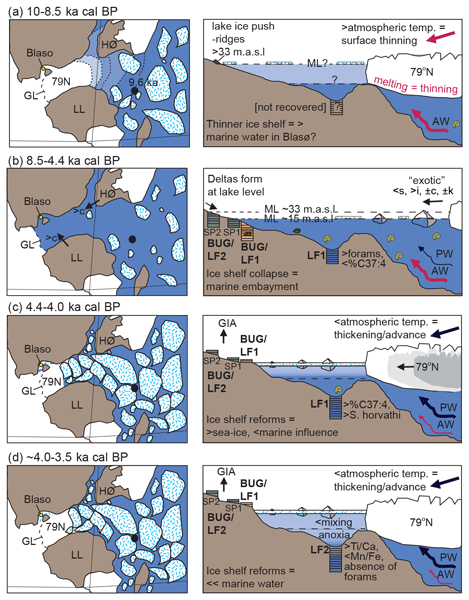
James A. Smith, Louise Callard, Michael J. Bentley, Stewart S. R. Jamieson, Maria Luisa Sánchez-Montes, Timothy P. Lane, Jeremy M. Lloyd, Erin L. McClymont, Christopher M. Darvill, Brice R. Rea, Colm O'Cofaigh, Pauline Gulliver, Werner Ehrmann, Richard S. Jones, and David H. Roberts
The Cryosphere, 17, 1247–1270, https://doi.org/10.5194/tc-17-1247-2023, https://doi.org/10.5194/tc-17-1247-2023, 2023
Short summary
Short summary
The Greenland Ice Sheet is melting at an accelerating rate. To understand the significance of these changes we reconstruct the history of one of its fringing ice shelves, known as 79° N ice shelf. We show that the ice shelf disappeared 8500 years ago, following a period of enhanced warming. An important implication of our study is that 79° N ice shelf is susceptible to collapse when atmospheric and ocean temperatures are ~2°C warmer than present, which could occur by the middle of this century.
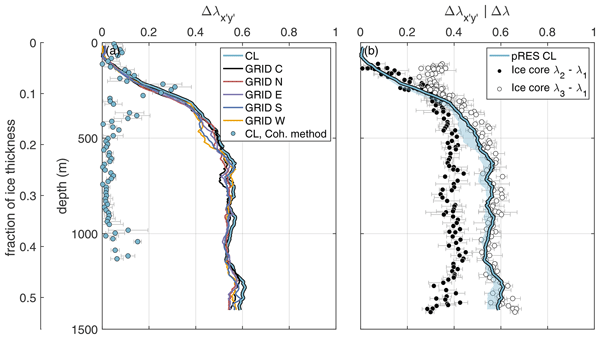
Ole Zeising, Tamara Annina Gerber, Olaf Eisen, M. Reza Ershadi, Nicolas Stoll, Ilka Weikusat, and Angelika Humbert
The Cryosphere, 17, 1097–1105, https://doi.org/10.5194/tc-17-1097-2023, https://doi.org/10.5194/tc-17-1097-2023, 2023
Short summary
Short summary
The flow of glaciers and ice streams is influenced by crystal fabric orientation. Besides sparse ice cores, these can be investigated by radar measurements. Here, we present an improved method which allows us to infer the horizontal fabric asymmetry using polarimetric phase-sensitive radar data. A validation of the method on a deep ice core from the Greenland Ice Sheet shows an excellent agreement, which is a large improvement over previously used methods.
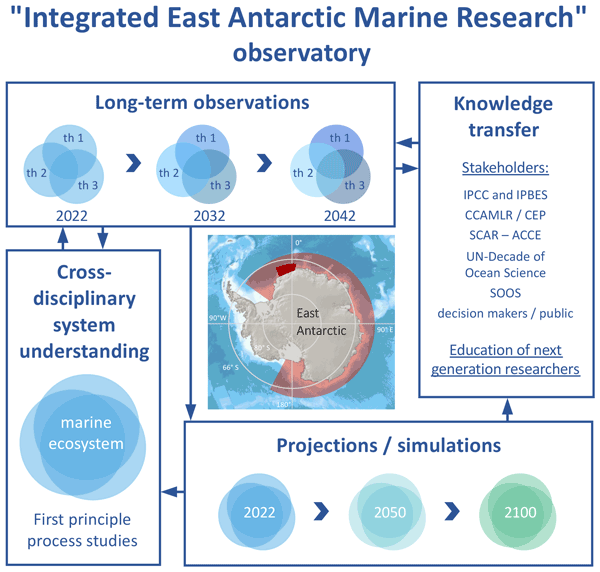
Julian Gutt, Stefanie Arndt, David Keith Alan Barnes, Horst Bornemann, Thomas Brey, Olaf Eisen, Hauke Flores, Huw Griffiths, Christian Haas, Stefan Hain, Tore Hattermann, Christoph Held, Mario Hoppema, Enrique Isla, Markus Janout, Céline Le Bohec, Heike Link, Felix Christopher Mark, Sebastien Moreau, Scarlett Trimborn, Ilse van Opzeeland, Hans-Otto Pörtner, Fokje Schaafsma, Katharina Teschke, Sandra Tippenhauer, Anton Van de Putte, Mia Wege, Daniel Zitterbart, and Dieter Piepenburg
Biogeosciences, 19, 5313–5342, https://doi.org/10.5194/bg-19-5313-2022, https://doi.org/10.5194/bg-19-5313-2022, 2022
Short summary
Short summary
Long-term ecological observations are key to assess, understand and predict impacts of environmental change on biotas. We present a multidisciplinary framework for such largely lacking investigations in the East Antarctic Southern Ocean, combined with case studies, experimental and modelling work. As climate change is still minor here but is projected to start soon, the timely implementation of this framework provides the unique opportunity to document its ecological impacts from the very onset.
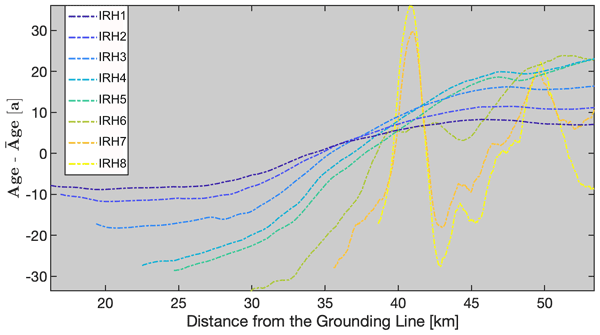
Vjeran Višnjević, Reinhard Drews, Clemens Schannwell, Inka Koch, Steven Franke, Daniela Jansen, and Olaf Eisen
The Cryosphere, 16, 4763–4777, https://doi.org/10.5194/tc-16-4763-2022, https://doi.org/10.5194/tc-16-4763-2022, 2022
Short summary
Short summary
We present a simple way to model the internal layers of an ice shelf and apply the method to the Roi Baudouin Ice Shelf in East Antarctica. Modeled results are compared to measurements obtained by radar. We distinguish between ice directly formed on the shelf and ice transported from the ice sheet, and we map the spatial changes in the volume of the locally accumulated ice. In this context, we discuss the sensitivity of the ice shelf to future changes in surface accumulation and basal melt.

Jeannette Xiu Wen Wan, Natalya Gomez, Konstantin Latychev, and Holly Kyeore Han
The Cryosphere, 16, 2203–2223, https://doi.org/10.5194/tc-16-2203-2022, https://doi.org/10.5194/tc-16-2203-2022, 2022
Short summary
Short summary
This paper assesses the grid resolution necessary to accurately model the Earth deformation and sea-level change associated with West Antarctic ice mass changes. We find that results converge at higher resolutions, and errors of less than 5 % can be achieved with a 7.5 km grid. Our results also indicate that error due to grid resolution is negligible compared to the effect of neglecting viscous deformation in low-viscosity regions.

Astrid Oetting, Emma C. Smith, Jan Erik Arndt, Boris Dorschel, Reinhard Drews, Todd A. Ehlers, Christoph Gaedicke, Coen Hofstede, Johann P. Klages, Gerhard Kuhn, Astrid Lambrecht, Andreas Läufer, Christoph Mayer, Ralf Tiedemann, Frank Wilhelms, and Olaf Eisen
The Cryosphere, 16, 2051–2066, https://doi.org/10.5194/tc-16-2051-2022, https://doi.org/10.5194/tc-16-2051-2022, 2022
Short summary
Short summary
This study combines a variety of geophysical measurements in front of and beneath the Ekström Ice Shelf in order to identify and interpret geomorphological evidences of past ice sheet flow, extent and retreat.
The maximal extent of grounded ice in this region was 11 km away from the continental shelf break.
The thickness of palaeo-ice on the calving front around the LGM was estimated to be at least 305 to 320 m.
We provide essential boundary conditions for palaeo-ice-sheet models.
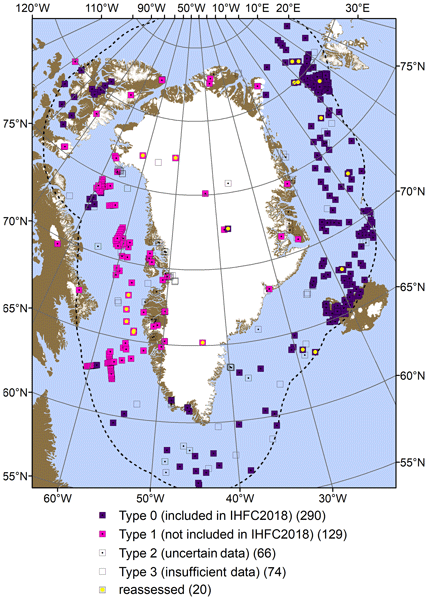
William Colgan, Agnes Wansing, Kenneth Mankoff, Mareen Lösing, John Hopper, Keith Louden, Jörg Ebbing, Flemming G. Christiansen, Thomas Ingeman-Nielsen, Lillemor Claesson Liljedahl, Joseph A. MacGregor, Árni Hjartarson, Stefan Bernstein, Nanna B. Karlsson, Sven Fuchs, Juha Hartikainen, Johan Liakka, Robert S. Fausto, Dorthe Dahl-Jensen, Anders Bjørk, Jens-Ove Naslund, Finn Mørk, Yasmina Martos, Niels Balling, Thomas Funck, Kristian K. Kjeldsen, Dorthe Petersen, Ulrik Gregersen, Gregers Dam, Tove Nielsen, Shfaqat A. Khan, and Anja Løkkegaard
Earth Syst. Sci. Data, 14, 2209–2238, https://doi.org/10.5194/essd-14-2209-2022, https://doi.org/10.5194/essd-14-2209-2022, 2022
Short summary
Short summary
We assemble all available geothermal heat flow measurements collected in and around Greenland into a new database. We use this database of point measurements, in combination with other geophysical datasets, to model geothermal heat flow in and around Greenland. Our geothermal heat flow model is generally cooler than previous models of Greenland, especially in southern Greenland. It does not suggest any high geothermal heat flows resulting from Icelandic plume activity over 50 million years ago.
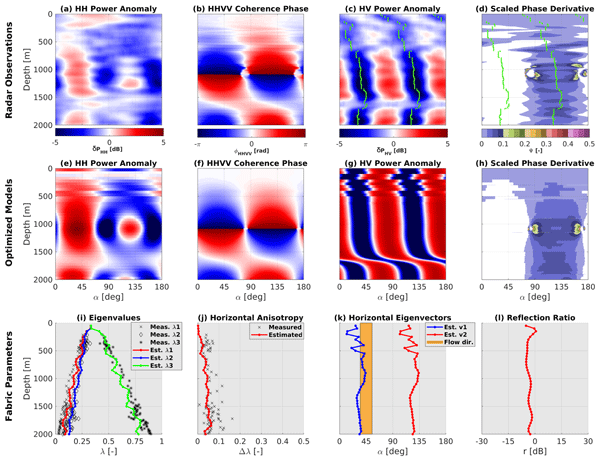
M. Reza Ershadi, Reinhard Drews, Carlos Martín, Olaf Eisen, Catherine Ritz, Hugh Corr, Julia Christmann, Ole Zeising, Angelika Humbert, and Robert Mulvaney
The Cryosphere, 16, 1719–1739, https://doi.org/10.5194/tc-16-1719-2022, https://doi.org/10.5194/tc-16-1719-2022, 2022
Short summary
Short summary
Radio waves transmitted through ice split up and inform us about the ice sheet interior and orientation of single ice crystals. This can be used to infer how ice flows and improve projections on how it will evolve in the future. Here we used an inverse approach and developed a new algorithm to infer ice properties from observed radar data. We applied this technique to the radar data obtained at two EPICA drilling sites, where ice cores were used to validate our results.
Ole Richter, David E. Gwyther, Matt A. King, and Benjamin K. Galton-Fenzi
The Cryosphere, 16, 1409–1429, https://doi.org/10.5194/tc-16-1409-2022, https://doi.org/10.5194/tc-16-1409-2022, 2022
Short summary
Short summary
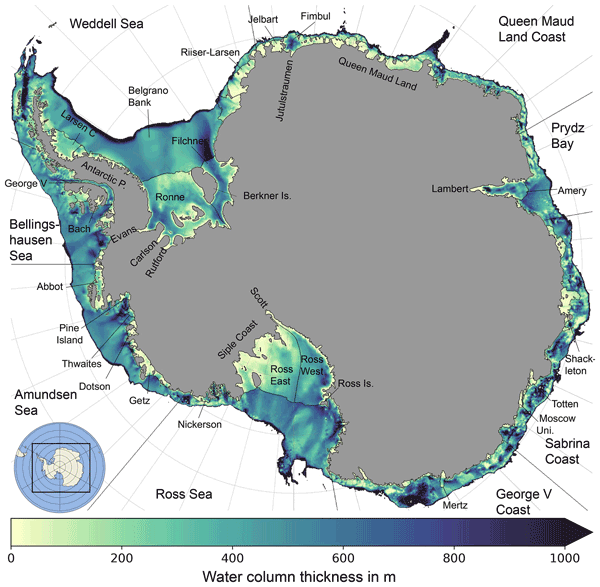
Tidal currents may play an important role in Antarctic ice sheet retreat by changing the rate at which the ocean melts glaciers. Here, using a computational ocean model, we derive the first estimate of present-day tidal melting that covers all of Antarctica. Our results suggest that large-scale ocean models aiming to accurately predict ice melt rates will need to account for the effects of tides. The inclusion of tide-induced friction at the ice–ocean interface should be prioritized.
Grace A. Nield, Matt A. King, Rebekka Steffen, and Bas Blank
Geosci. Model Dev., 15, 2489–2503, https://doi.org/10.5194/gmd-15-2489-2022, https://doi.org/10.5194/gmd-15-2489-2022, 2022
Short summary
Short summary
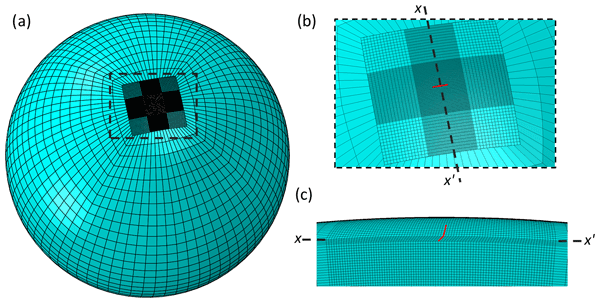
We present a finite-element model of post-seismic solid Earth deformation built in the software package Abaqus for the purpose of calculating post-seismic deformation in the far field of major earthquakes. The model is benchmarked against an existing open-source post-seismic model demonstrating good agreement. The advantage over existing models is the potential for simple modification to include 3-D Earth structure, non-linear rheologies and alternative or multiple sources of stress change.
Blake A. Castleman, Nicole-Jeanne Schlegel, Lambert Caron, Eric Larour, and Ala Khazendar
The Cryosphere, 16, 761–778, https://doi.org/10.5194/tc-16-761-2022, https://doi.org/10.5194/tc-16-761-2022, 2022
Short summary
Short summary
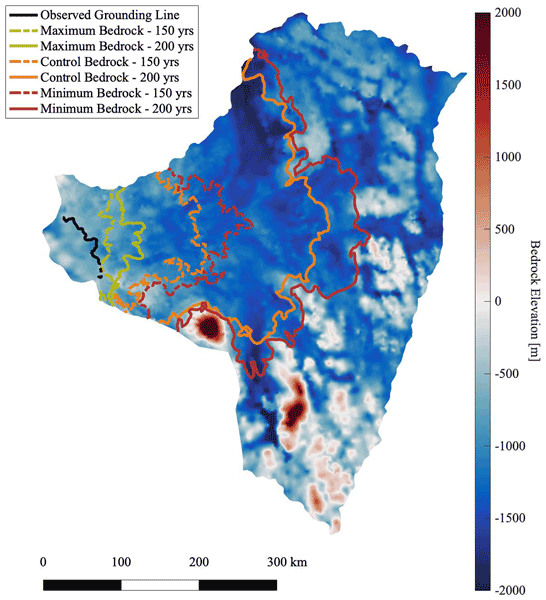
In the described study, we derive an uncertainty range for global mean sea level rise (SLR) contribution from Thwaites Glacier in a 200-year period under an extreme ocean warming scenario. We derive the spatial and vertical resolutions needed for bedrock data acquisition missions in order to limit global mean SLR contribution from Thwaites Glacier to ±2 cm in a 200-year period. We conduct sensitivity experiments in order to present the locations of critical regions in need of accurate mapping.
Igor Ognev, Jörg Ebbing, and Peter Haas
Solid Earth, 13, 431–448, https://doi.org/10.5194/se-13-431-2022, https://doi.org/10.5194/se-13-431-2022, 2022
Short summary
Short summary
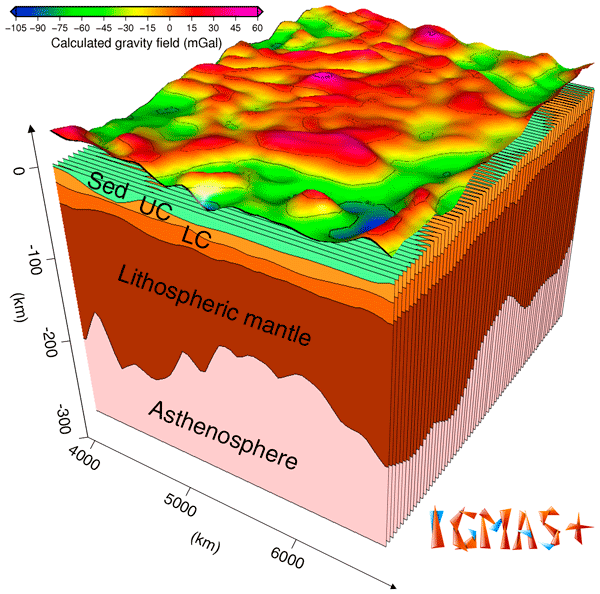
We present a new 3D crustal model of Volgo–Uralia, an eastern segment of the East European craton. We built this model by processing the satellite gravity data and using prior crustal thickness estimation from regional seismic studies to constrain the results. The modelling revealed a high-density body on the top of the mantle and otherwise reflected the main known features of the Volgo–Uralian crustal architecture. We plan to use the obtained model for further geothermal analysis of the region.

Erin L. McClymont, Michael J. Bentley, Dominic A. Hodgson, Charlotte L. Spencer-Jones, Thomas Wardley, Martin D. West, Ian W. Croudace, Sonja Berg, Darren R. Gröcke, Gerhard Kuhn, Stewart S. R. Jamieson, Louise Sime, and Richard A. Phillips
Clim. Past, 18, 381–403, https://doi.org/10.5194/cp-18-381-2022, https://doi.org/10.5194/cp-18-381-2022, 2022
Short summary
Short summary
Sea ice is important for our climate system and for the unique ecosystems it supports. We present a novel way to understand past Antarctic sea-ice ecosystems: using the regurgitated stomach contents of snow petrels, which nest above the ice sheet but feed in the sea ice. During a time when sea ice was more extensive than today (24 000–30 000 years ago), we show that snow petrel diet had varying contributions of fish and krill, which we interpret to show changing sea-ice distribution.
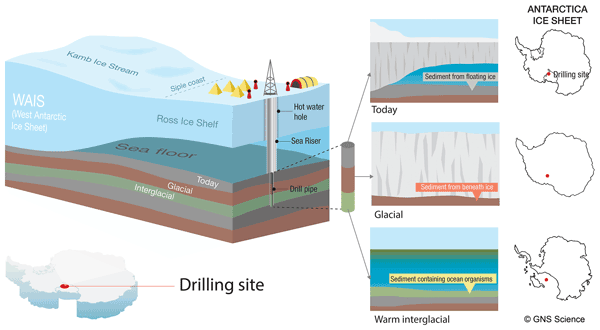
Molly O. Patterson, Richard H. Levy, Denise K. Kulhanek, Tina van de Flierdt, Huw Horgan, Gavin B. Dunbar, Timothy R. Naish, Jeanine Ash, Alex Pyne, Darcy Mandeno, Paul Winberry, David M. Harwood, Fabio Florindo, Francisco J. Jimenez-Espejo, Andreas Läufer, Kyu-Cheul Yoo, Osamu Seki, Paolo Stocchi, Johann P. Klages, Jae Il Lee, Florence Colleoni, Yusuke Suganuma, Edward Gasson, Christian Ohneiser, José-Abel Flores, David Try, Rachel Kirkman, Daleen Koch, and the SWAIS 2C Science Team
Sci. Dril., 30, 101–112, https://doi.org/10.5194/sd-30-101-2022, https://doi.org/10.5194/sd-30-101-2022, 2022
Short summary
Short summary
How much of the West Antarctic Ice Sheet will melt and how quickly it will happen when average global temperatures exceed 2 °C is currently unknown. Given the far-reaching and international consequences of Antarctica’s future contribution to global sea level rise, the SWAIS 2C Project was developed in order to better forecast the size and timing of future changes.
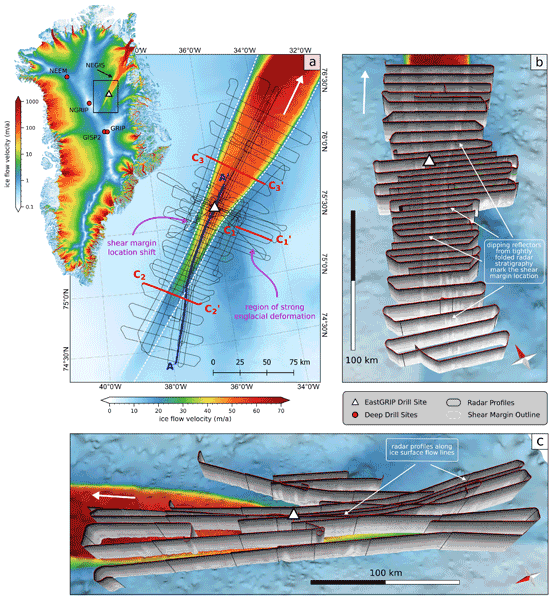
Steven Franke, Daniela Jansen, Tobias Binder, John D. Paden, Nils Dörr, Tamara A. Gerber, Heinrich Miller, Dorthe Dahl-Jensen, Veit Helm, Daniel Steinhage, Ilka Weikusat, Frank Wilhelms, and Olaf Eisen
Earth Syst. Sci. Data, 14, 763–779, https://doi.org/10.5194/essd-14-763-2022, https://doi.org/10.5194/essd-14-763-2022, 2022
Short summary
Short summary
The Northeast Greenland Ice Stream (NEGIS) is the largest ice stream in Greenland. In order to better understand the past and future dynamics of the NEGIS, we present a high-resolution airborne radar data set (EGRIP-NOR-2018) for the onset region of the NEGIS. The survey area is centered at the location of the drill site of the East Greenland Ice-Core Project (EastGRIP), and radar profiles cover both shear margins and are aligned parallel to several flow lines.

Holly Kyeore Han, Natalya Gomez, and Jeannette Xiu Wen Wan
Geosci. Model Dev., 15, 1355–1373, https://doi.org/10.5194/gmd-15-1355-2022, https://doi.org/10.5194/gmd-15-1355-2022, 2022
Short summary
Short summary
Interactions between ice sheets, sea level and the solid Earth occur over a range of timescales from years to tens of thousands of years. This requires coupled ice-sheet–sea-level models to exchange information frequently, leading to a quadratic increase in computation time with the number of model timesteps. We present a new sea-level model algorithm that allows coupled models to improve the computational feasibility and precisely capture short-term interactions within longer simulations.
Cited articles
Adhikari, S., Ivins, E. R., Larour, E., Seroussi, H., Morlighem, M., and Nowicki, S.: Future Antarctic bed topography and its implications for ice sheet dynamics, Solid Earth, 5, 569–584, https://doi.org/10.5194/se-5-569-2014, 2014. a
Adhikari, S., Caron, L., Ivins, E. R., Han, H. K., Houriez, L., and Larour, E.: Enabling ice sheet models to capture centennial-scale solid Earth feedback with relative ease and sufficient accuracy, The Cryosphere, 20, 5041–5060, https://doi.org/10.5194/tc-20-5041-2026, 2026. a
Agboola, K. J., Hansen, S. E., Garnero, E. J., Rost, S., Li, M., and Shim, S.: Ultra‐Low Velocity Zones Beneath the Southern Hemisphere Imaged With Double‐Array Stacking of PcP Waveforms, J. Geophys. Res.-Sol. Ea., 129, https://doi.org/10.1029/2023jb028170, 2024. a, b
Agnew, R. S., Pearce, E., Karplus, M., Ranganathan, M., Hoffman, A. O., Hunt, M., Pretorius, A., Shanly, S. E., Beres, M., Pradhan, K. K., Seldon, Y., Booth, A. D., Clark, R. A., and Jan Young, T.: Active and Passive Seismic Surveys over the Grounding Zone of Eastwind Glacier, Antarctica, Seismol. Res. Lett., 97, 591–605, https://doi.org/10.1785/0220250024, 2025. a
Aitken, A. R. A., Young, D., Ferraccioli, F., Betts, P. G., Greenbaum, J. S., Richter, T. G., Roberts, J. L., Blankenship, D. D., and Siegert, M. J.: The subglacial geology of Wilkes Land, East Antarctica, Geophys. Res. Lett., 41, 2390–2400, 2014. a
Aitken, A. R. A., Li, L., Kulessa, B., Schroeder, D., Jordan, T. A., Whittaker, J. M., Anandakrishnan, S., Dawson, E. J., Wiens, D. A., Eisen, O., and Siegert, M. J.: Antarctic Sedimentary Basins and Their Influence on Ice‐Sheet Dynamics, Rev. Geophys., 61, https://doi.org/10.1029/2021rg000767, 2023. a, b
Alfonsi, L., Bergeot, N., Cilliers, P. J., De Franceschi, G., Baddeley, L., Correia, E., Di Mauro, D., Enell, C.-F., Engebretson, M., Ghoddousi-Fard, R., Häggström, I., Ham, Y.-B., Heygster, G., Jee, G., Kero, A., Kosch, M., Kwon, H.-J., Lee, C., Lotz, S., Macotela, L., Marcucci, M. F., Miloch, W. J., Morton, Y. J., Naoi, T., Negusini, M., Partamies, N., Petkov, B. H., Pottiaux, E., Prikryl, P., Shreedevi, P. R., Slapak, R., Spogli, L., Stephenson, J., Triana-Gómez, A. M., Troshichev, O. A., Van Malderen, R., Weygand, J. M., and Zou, S.: Review of Environmental Monitoring by Means of Radio Waves in the Polar Regions: From Atmosphere to Geospace, Surv. Geophys., 43, 1609–1698, https://doi.org/10.1007/s10712-022-09734-z, 2022. a, b, c
Altamimi, Z., Rebischung, P., Collilieux, X., Métivier, L., and Chanard, K.: ITRF2020: an augmented reference frame refining the modeling of nonlinear station motions, J. Geodesy, 97, https://doi.org/10.1007/s00190-023-01738-w, 2023. a, b
Amalvict, M., Willis, P., Wöppelmann, G., Ivins, E. R., Bouin, M.-N., Testut, L., and Hinderer, J.: Isostatic stability of the East Antarctic station Dumont d’Urville from long-term geodetic observations and geophysical models, Polar Res., 28, 193–202, https://doi.org/10.1111/j.1751-8369.2008.00091.x, 2009. a
An, M., Wiens, D. A., Zhao, Y., Feng, M., Nyblade, A. A., Kanao, M., Li, Y., Maggi, A., and Lévêque, J.: S‐velocity model and inferred Moho topography beneath the Antarctic Plate from Rayleigh waves, J. Geophys. Res.-Sol. Ea., 120, 359–383, https://doi.org/10.1002/2014jb011332, 2015. a, b
Anandakrishnan, S., Voigt, D. E., Burkett, P. G., Long, B., and Henry, R.: Deployment of a broadband seismic network in West Antarctica, Geophys. Res. Lett., 27, 2053–2056, https://doi.org/10.1029/1999gl011189, 2000. a
Andrews, J. and Deuss, A.: Detailed nature of the 660 km region of the mantle from global receiver function data, J. Geophys. Res.-Sol. Ea., 113, https://doi.org/10.1029/2007jb005111, 2008. a
Anthony, R. E., Aster, R. C., and McGrath, D.: Links between atmosphere, ocean, and cryosphere from two decades of microseism observations on the Antarctic Peninsula, J. Geophys. Res.-Earth Surf., 122, 153–166, https://doi.org/10.1002/2016jf004098, 2017. a, b, c
Anthony, R. E., Ringler, A. T., DuVernois, M., Anderson, K. R., and Wilson, D. C.: Six Decades of Seismology at South Pole, Antarctica: Current Limitations and Future Opportunities to Facilitate New Geophysical Observations, Seismol. Res. Lett., 92, 2718–2735, https://doi.org/10.1785/0220200448, 2021. a, b
Ardhuin, F., Gualtieri, L., and Stutzmann, E.: How ocean waves rock the Earth: Two mechanisms explain microseisms with periods 3 to 300 s, Geophys. Res. Lett., 42, 765–772, https://doi.org/10.1002/2014GL062782, 2015. a
Argus, D. F., Blewitt, G., Peltier, W. R., and Kreemer, C.: Rise of the Ellsworth mountains and parts of the East Antarctic coast observed with GPS, Geophys. Res. Lett., 38, https://doi.org/10.1029/2011gl048025, 2011. a
Argus, D. F., Peltier, W. R., Drummond, R., and Moore, A. W.: The Antarctica component of postglacial rebound model ICE-6G_C (VM5a) based on GPS positioning, exposure age dating of ice thicknesses, and relative sea level histories, Geophys. J. Int., 198, 537–563, https://doi.org/10.1093/gji/ggu140, 2014. a
Arora, D., Pant, N. C., Stål, T., Naik, A., Pandey, M., and Gupta, R.: Geothermal heat flow in the Princess Elizabeth Land sector, East Antarctica, Earth Sci. Rev., 277, https://doi.org/10.1016/j.earscirev.2026.105475, 2026. a
Aschwanden, A., Bueler, E., Khroulev, C., and Blatter, H.: An enthalpy formulation for glaciers and ice sheets, J. Glaciol., 58, 441–457, https://doi.org/10.3189/2012jog11j088, 2012. a
Aster, R. and Simons, M.: Future Geophysical Facilities Required to Address Grand Challenges in the Earth Sciences, Community Report to the National Science Foundation, Incorporated Research Institutions for Seismology, Workshop, Leesburg (VA), 4–6 May 2015, https://web-archive-2022.iris.edu/hq/files/publications/other_workshops/docs/futures_report.pdf (last access: 8 November 2026), 2015. a
Aster, R., Zandomeneghi, D., Mah, S., McNamara, S., Henderson, D. B., Knox, H., and Jones, K.: Moment tensor inversion of very long period seismic signals from Strombolian eruptions of Erebus Volcano, J. Volcanol. Geoth. Res., 177, 635–647, https://doi.org/10.1016/j.jvolgeores.2008.08.013, 2008. a
Aster, R. C. and Winberry, J. P.: Glacial seismology, Rep. Prog. Phys., 80, 126801, https://doi.org/10.1088/1361-6633/aa8473, 2017. a, b, c
Aster, R. C., McNamara, D. E., and Bromirski, P. D.: Global trends in extremal microseism intensity, Geophys. Res. Lett., 37, L14303, https://doi.org/10.1029/2010gl043472, 2010. a
Aster, R. C., Lipovsky, B. P., Cole, H. M., Bromirski, P. D., Gerstoft, P., Nyblade, A., Wiens, D. A., and Stephen, R.: Swell-Triggered Seismicity at the Near-Front Damage Zone of the Ross Ice Shelf, Seismol. Res. Lett., 92, 2768–2792, https://doi.org/10.1785/0220200478, 2021. a, b
Aster, R. C., Ringler, A. T., Anthony, R. E., and Lee, T. A.: Increasing ocean wave energy observed in Earth’s seismic wavefield since the late 20th century, Nat. Commun., 14, https://doi.org/10.1038/s41467-023-42673-w, 2023. a, b
Austermann, J., Pollard, D., Mitrovica, J. X., Moucha, R., Forte, A. M., DeConto, R. M., Rowley, D. B., and Raymo, M. E.: The impact of dynamic topography change on Antarctic ice sheet stability during the mid-Pliocene warm period, Geology, 43, 927–930, https://doi.org/10.1130/g36988.1, 2015. a
Bagge, M., Klemann, V., Steinberger, B., Latinović, M., and Thomas, M.: Glacial‐Isostatic Adjustment Models Using Geodynamically Constrained 3D Earth Structures, Geochem. Geophys. Geosyst., 22, https://doi.org/10.1029/2021gc009853, 2021. a
Bamber, J. L., Riva, R. E. M., Vermeersen, B. L. A., and LeBrocq, A. M.: Reassessment of the Potential Sea-Level Rise from a Collapse of the West Antarctic Ice Sheet, Science, 324, 901–903, https://doi.org/10.1126/science.1169335, 2009. a
Baranov, A. and Morelli, A.: The Moho depth map of the Antarctica region, Tectonophysics, 609, 299–313, https://doi.org/10.1016/j.tecto.2012.12.023, 2013. a
Baranov, A., Tenzer, R., and Morelli, A.: Updated Antarctic crustal model, Gondwana Res., 89, 1–18, https://doi.org/10.1016/j.gr.2020.08.010, 2021. a
Barcheck, G., Brodsky, E. E., Fulton, P. M., King, M. A., Siegfried, M. R., and Tulaczyk, S.: Migratory earthquake precursors are dominant on an ice stream fault, Sci. Adv., 7, eabd0105, https://doi.org/10.1126/sciadv.abd0105, 2021. a, b
Barletta, V. R., Bevis, M., Smith, B. E., Wilson, T., Brown, A., Bordoni, A., Willis, M., Khan, S. A., Rovira-Navarro, M., Dalziel, I., Smalley, R., Kendrick, E., Konfal, S., Caccamise, D. J., Aster, R. C., Nyblade, A., and Wiens, D. A.: Observed rapid bedrock uplift in Amundsen Sea Embayment promotes ice-sheet stability, Science, 360, 1335–1339, https://doi.org/10.1126/science.aao1447, 2018. a, b, c, d, e, f
Bayer, B., Geissler, W. H., Eckstaller, A., and Jokat, W.: Seismic imaging of the crust beneath Dronning Maud Land, East Antarctica, Geophys. J. Int., 178, 860–876, https://doi.org/10.1111/j.1365-246x.2009.04196.x, 2009. a, b
Becker, J. N., Aster, R. C., Rapoport, Y., Lee, T. A., Simons, F. J., Ringler, A. T., and Anthony, R. E.: Global Seasonal Microseism Intensity and Hemispheric Asymmetry, Seismol. Res. Lett., 97, 3414–3437, https://doi.org/10.1785/0220260057, 2026. a
Begeman, C. B., Tulaczyk, S. M., and Fisher, A. T.: Spatially variable geothermal heat flux in West Antarctica: Evidence and implications, Geophys. Res. Lett., 44, 9823–9832, https://doi.org/10.1002/2017gl075579, 2017. a
Bellas-Manley, A., Kang, K., Becker, T. W., and Nerem, R. S.: 3D Variations in Viscosity Reconcile the Strength of the Lower Mantle Inferred from Glacial Isostatic Adjustment and Mantle Convection, Geophys. Res. Lett., 53, https://doi.org/10.1029/2025GL120160, 2026. a
Berdahl, M., Leguy, G., Lipscomb, W. H., Urban, N. M., and Hoffman, M. J.: Exploring ice sheet model sensitivity to ocean thermal forcing and basal sliding using the Community Ice Sheet Model (CISM), The Cryosphere, 17, 1513–1543, https://doi.org/10.5194/tc-17-1513-2023, 2023. a
Berg, S., Wagner, B., White, D. A., and Melles, M.: No significant ice-sheet expansion beyond present ice margins during the past 4500 yr at Rauer Group, East Antarctica, Quaternary Res., 74, 23–25, https://doi.org/10.1016/j.yqres.2010.04.004, 2010. a
Berg, S., Melles, M., Gore, D. B., Verkulich, S., and Pushina, Z. V.: Postglacial evolution of marine and lacustrine water bodies in Bunger Hills, Antarct. Sci., 32, 107–129, https://doi.org/10.1017/s0954102019000476, 2020. a
Berrocoso, M., Prates, G., Fernández-Ros, A., and García, A.: Normal vector analysis from GNSS–GPS data applied to Deception volcano surface deformation, Geophys. J. Int., 190, 1562–1570, https://doi.org/10.1111/j.1365-246x.2012.05584.x, 2012. a
Bevis, M., Kendrick, E., Smalley, R., Dalziel, I., Caccamise, D., Sasgen, I., Helsen, M., Taylor, F. W., Zhou, H., Brown, A., Raleigh, D., Willis, M., Wilson, T., and Konfal, S.: Geodetic measurements of vertical crustal velocity in West Antarctica and the implications for ice mass balance, Geochem. Geophys. Geosyst., 10, https://doi.org/10.1029/2009gc002642, 2009. a
Bina, C. R. and Helffrich, G.: Phase transition Clapeyron slopes and transition zone seismic discontinuity topography, J. Geophys. Res.-Sol. Ea., 99, 15853–15860, https://doi.org/10.1029/94jb00462, 1994. a
Bingham, R. G., Bodart, J. A., Cavitte, M. G. P., Chung, A., Sanderson, R. J., Sutter, J. C. R., Eisen, O., Karlsson, N. B., MacGregor, J. A., Ross, N., Young, D. A., Ashmore, D. W., Born, A., Chu, W., Cui, X., Drews, R., Franke, S., Goel, V., Goodge, J. W., Henry, A. C. J., Hermant, A., Hills, B. H., Holschuh, N., Koutnik, M. R., Leysinger Vieli, G. J.-M. C., MacKie, E. J., Mantelli, E., Martín, C., Ng, F. S. L., Oraschewski, F. M., Napoleoni, F., Parrenin, F., Popov, S. V., Rieckh, T., Schlegel, R., Schroeder, D. M., Siegert, M. J., Tang, X., Teisberg, T. O., Winter, K., Yan, S., Davis, H., Dow, C. F., Fudge, T. J., Jordan, T. A., Kulessa, B., Matsuoka, K., Nyqvist, C. J., Rahnemoonfar, M., Siegfried, M. R., Singh, S., Višnjević, V., Zamora, R., and Zuhr, A.: Review article: AntArchitecture – building an age–depth model from Antarctica's radiostratigraphy to explore ice-sheet evolution, The Cryosphere, 19, 4611–4655, https://doi.org/10.5194/tc-19-4611-2025, 2025. a, b
Blackburn, T., Edwards, G. H., Tulaczyk, S., Scudder, M., Piccione, G., Hallet, B., McLean, N., Zachos, J. C., Cheney, B., and Babbe, J. T.: Ice retreat in Wilkes Basin of East Antarctica during a warm interglacial, Nature, 583, 554–559, https://doi.org/10.1038/s41586-020-2484-5, 2020. a
Blank, B., Barletta, V., Hu, H., Pappa, F., and van der Wal, W.: Effect of Lateral and Stress‐Dependent Viscosity Variations on GIA Induced Uplift Rates in the Amundsen Sea Embayment, Geochem. Geophys. Geosyst., 22, https://doi.org/10.1029/2021gc009807, 2021. a, b
Book, C., Hoffman, M. J., Kachuck, S. B., Hillebrand, T. R., Price, S. F., Perego, M., and Bassis, J. N.: Stabilizing effect of bedrock uplift on retreat of Thwaites Glacier, Antarctica, at centennial timescales, Earth Planet. Sc. Lett., 597, 117798, https://doi.org/10.1016/j.epsl.2022.117798, 2022. a, b, c
Booth, A. D., Christoffersen, P., Schoonman, C., Clarke, A., Hubbard, B., Law, R., Doyle, S. H., Chudley, T. R., and Chalari, A.: Distributed Acoustic Sensing of Seismic Properties in a Borehole Drilled on a Fast‐Flowing Greenlandic Outlet Glacier, Geophys. Res. Lett., 47, https://doi.org/10.1029/2020gl088148, 2020. a
Bradley, S. L., Hindmarsh, R. C., Whitehouse, P. L., Bentley, M. J., and King, M. A.: Low post-glacial rebound rates in the Weddell Sea due to Late Holocene ice-sheet readvance, Earth Planet. Sc. Lett., 413, 79–89, https://doi.org/10.1016/j.epsl.2014.12.039, 2015. a, b, c, d
Brenn, G. R., Hansen, S. E., and Park, Y.: Variable thermal loading and flexural uplift along the Transantarctic Mountains, Antarctica, Geology, 45, 463–466, https://doi.org/10.1130/g38784.1, 2017. a
Brisbourne, A. M., Kendall, M., Kufner, S.-K., Hudson, T. S., and Smith, A. M.: Downhole distributed acoustic seismic profiling at Skytrain Ice Rise, West Antarctica, The Cryosphere, 15, 3443–3458, https://doi.org/10.5194/tc-15-3443-2021, 2021. a
Brisbourne, A. M., Hudson, T. S., and Kendall, J. M.: Borehole and Surface Applications of Distributed Acoustic Sensing for Characterization of the Cryosphere and Glacial Environments, Chap. 11, 225–237, American Geophysical Union (AGU), ISBN 9781394179275, https://doi.org/10.1002/9781394179275.ch11, 2024. a
Broerse, T., Riva, R., and Vermeersen, B.: Ocean contribution to seismic gravity changes: the sea level equation for seismic perturbations revisited, Geophys. J. Int., 199, 1094–1109, https://doi.org/10.1093/gji/ggu315, 2014. a
Bromirski, P. D., Diez, A., Gerstoft, P., Stephen, R. A., Bolmer, T., Wiens, D., Aster, R., and Nyblade, A.: Ross ice shelf vibrations, Geophys. Res. Lett., 42, 7589–7597, https://doi.org/10.1002/2015GL065284, 2015. a, b
Bromirski, P. D., Chen, Z., Stephen, R. A., Gerstoft, P., Arcas, D., Diez, A., Aster, R. C., Wiens, D. A., and Nyblade, A.: Tsunami and infragravity waves impacting Antarctic ice shelves, J. Geophys. Res.-Oceans, 122, 5786–5801, https://doi.org/10.1002/2017JC012913, 2017. a
Buchta, E., Scheinert, M., King, M. A., Wilson, T., Koulali, A., Clarke, P. J., Gómez, D., Kendrick, E., Knöfel, C., and Busch, P.: Advancing geodynamic research in Antarctica: reprocessing GNSS data to infer consistent coordinate time series (GIANT-REGAIN), Earth Syst. Sci. Data, 17, 1761–1780, https://doi.org/10.5194/essd-17-1761-2025, 2025. a, b, c, d, e
Burton-Johnson, A., Dziadek, R., and Martin, C.: Review article: Geothermal heat flow in Antarctica: current and future directions, The Cryosphere, 14, 3843–3873, https://doi.org/10.5194/tc-14-3843-2020, 2020. a, b
Busch, P., Scheinert, M., Knöfel, C., Eberlein, L., Johnson, J., Horwath, M., Schröder, L., and Groh, A.: GNSS measurements in West Antarctica to reconcile glacial-isostatic adjustment, presented at the IAG/SCAR-SERCE Workshop on Glacial Isostatic Adjustment and Elastic Deformation, 5–7 September 2017, Reykjavik, Iceland, Zenodo [presentation], https://doi.org/10.5281/zenodo.24082117, 2017. a
Cande, S. C., Stock, J. M., Müller, R. D., and Ishihara, T.: Cenozoic motion between East and West Antarctica, Nature, 404, 145–150, https://doi.org/10.1038/35004501, 2000. a, b
Caron, L., Ivins, E. R., Larour, E., Adhikari, S., Nilsson, J., and Blewitt, G.: GIA Model Statistics for GRACE Hydrology, Cryosphere, and Ocean Science, Geophys. Res. Lett., 45, 2203–2212, https://doi.org/10.1002/2017gl076644, 2018. a
Cartwright, J., Banks, C. J., and Srokosz, M.: Sea Ice Detection Using GNSS‐R Data From TechDemoSat‐1, J. Geophys. Res.-Oceans, 124, 5801–5810, https://doi.org/10.1029/2019jc015327, 2019. a
Castleman, B. A., Schlegel, N.-J., Caron, L., Larour, E., and Khazendar, A.: Derivation of bedrock topography measurement requirements for the reduction of uncertainty in ice-sheet model projections of Thwaites Glacier, The Cryosphere, 16, 761–778, https://doi.org/10.5194/tc-16-761-2022, 2022. a
Catania, G. A., Stearns, L. A., Moon, T. A., Enderlin, E. M., and Jackson, R. H.: Future Evolution of Greenland’s Marine‐Terminating Outlet Glaciers, J. Geophys. Res.-Earth Surf., 125, https://doi.org/10.1029/2018jf004873, 2020. a
Cathles, L. M., Okal, E. A., and MacAyeal, D. R.: Seismic observations of sea swell on the floating Ross Ice Shelf, Antarctica, J. Geophys. Res.-Earth Surf., 114, https://doi.org/10.1029/2007jf000934, 2009. a
Cesca, S., Sugan, M., Rudzinski, Ł., Vajedian, S., Niemz, P., Plank, S., Petersen, G., Deng, Z., Rivalta, E., Vuan, A., Plasencia Linares, M. P., Heimann, S., and Dahm, T.: Massive earthquake swarm driven by magmatic intrusion at the Bransfield Strait, Antarctica, Commun. Earth Environ., 3, https://doi.org/10.1038/s43247-022-00418-5, 2022. a
Chaput, J., Aster, R., Huerta, A. D., Sun, X., Lloyd, A., Wiens, D., Nyblade, A., Anandakrishan, S., Winberry, J. P., and Wilson, T.: The Crustal Thickness of West Antarctica, J. Geophys. Res., 119, 1–18, https://doi.org/10.1002/2013JB010642, 2014. a, b
Chaput, J., Aster, R. C., McGrath, D., Baker, M., Anthony, R. E., Gerstoft, P., Bromirski, P., Nyblade, A., Stephen, R. A., Wiens, D. A., Das, S. B., and Stevens, L. A.: Near-Surface Environmentally Forced Changes in the Ross Ice Shelf Observed With Ambient Seismic Noise, Geophys. Res. Lett., 45, 11187–11196, https://doi.org/10.1029/2018GL079665, 2018. a, b, c
Chaput, J., Aster, R. C., and Karplus, M.: The singing firn, Ann. Glaciol., 63, 137–142, https://doi.org/10.1017/aog.2023.34, 2022. a, b
Chaput, J., Aster, R., Karplus, M., Nakata, N., Gerstoft, P., Bromirski, P. D., Nyblade, A., Stephen, R. A., and Wiens, D. A.: Near-surface seismic anisotropy in Antarctic glacial snow and ice revealed by high-frequency ambient noise, J. Glaciol., 69, 773–789, https://doi.org/10.1017/jog.2022.98, 2023. a
Charrassin, R., Millan, R., Rignot, E., and Scheinert, M.: Bathymetry of the Antarctic continental shelf and ice shelf cavities from circumpolar gravity anomalies and other data, Sci. Rep., 15, https://doi.org/10.1038/s41598-024-81599-1, 2025. a, b, c
Chave, A. D. and Jones, A. G. (Eds.): The magnetotelluric method: Theory and practice, Cambridge University Press, 1st edn., ISBN 052181927X, 2012. a
Chua, E. L. and Lebedev, S.: Waveform tomography of the Antarctic Plate, Geophys. J. Int., 241, 219–240, https://doi.org/10.1093/gji/ggaf041, 2025. a
Cook, A. J. and Vaughan, D. G.: Overview of areal changes of the ice shelves on the Antarctic Peninsula over the past 50 years, The Cryosphere, 4, 77–98, https://doi.org/10.5194/tc-4-77-2010, 2010. a
Cook, M. J., Fredrickson, E. K., Roland, E. C., Sasagawa, G. S., Schmidt, D. A., Wilcock, W. S. D., and Zumberge, M. A.: Calibrated Absolute Seafloor Pressure Measurements for Geodesy in Cascadia, J. Geophys. Res.-Sol. Ea., 128, https://doi.org/10.1029/2023jb026413, 2023. a
Coulon, V., Bulthuis, K., Whitehouse, P. L., Sun, S., Haubner, K., Zipf, L., and Pattyn, F.: Contrasting Response of West and East Antarctic Ice Sheets to Glacial Isostatic Adjustment, J. Geophys. Res.-Earth Surf., 126, https://doi.org/10.1029/2020jf006003, 2021. a
Danesi, S. and Morelli, A.: Structure of the upper mantle under the Antarctic Plate from surface wave tomography, Geophys. Res. Lett., 28, 4395–4398, https://doi.org/10.1029/2001gl013431, 2001. a
Danesi, S., Bannister, S., and Morelli, A.: Repeating earthquakes from rupture of an asperity under an Antarctic outlet glacier, Earth Planet. Sc. Lett., 253, 151–158, https://doi.org/10.1016/j.epsl.2006.10.023, 2007. a
DeConto, R. M. and Pollard, D.: Contribution of Antarctica to past and future sea-level rise, Nature, 531, 591–597, https://doi.org/10.1038/nature17145, 2016. a
DeConto, R. M., Pollard, D., Alley, R. B., Velicogna, I., Gasson, E., Gomez, N., Sadai, S., Condron, A., Gilford, D. M., Ashe, E. L., Kopp, R. E., Li, D., and Dutton, A.: The Paris Climate Agreement and future sea-level rise from Antarctica, Nature, 593, 83–89, https://doi.org/10.1038/s41586-021-03427-0, 2021. a
Dietrich, R. (Ed.): The Geodetic Antarctic Project GAP95. German Contributions to the SCAR 95 Epoch Campaign, no. 304 in Reihe B, Deutsche Geodätische Kommission, Bayerischen Akademie derWissenschaften, München, ISBN 3 7696 8586 6, 1996. a
Dietrich, R. and Rülke, A.: A Precise Reference Frame for Antarctica from SCAR GPS Campaign Data and Some Geophysical Implications, 1–10, Springer Berlin Heidelberg, ISBN 9783540748823, https://doi.org/10.1007/978-3-540-74882-3_1, 2008. a, b
Dietrich, R., Dach, R., Engelhardt, G., Ihde, J., Korth, W., Kutterer, H.-J., Lindner, K., Mayer, M., Menge, F., Miller, H., Müller, C., Niemeier, W., Perlt, J., Pohl, M., Salbach, H., Schenke, H.-W., Schöne, T., Seeber, G., Veit, A., and Völksen, C.: ITRF coordinates and plate velocities from repeated GPS campaigns in Antarctica – an analysis based on different individual solutions, J. Geodesy, 74, 756–766, https://doi.org/10.1007/s001900000147, 2001. a
Diez, A., Bromirski, P. D., Gerstoft, P., Stephen, R. A., Anthony, R., Aster, R., Cai, C., Nyblade, A., and Wiens, D.: Ice shelf structure derived from dispersion curve analysis of ambient seismic noise, Ross Ice Shelf, Antarctica, Geophys. J. Int., 205, https://doi.org/10.1093/gji/ggw036, 2016. a
Donnellan, A. and Luyendyk, B. P.: GPS evidence for a coherent Antarctic plate and for postglacial rebound in Marie Byrd Land, Global Planet. Change, 42, 305–311, https://doi.org/10.1016/j.gloplacha.2004.02.006, 2004. a
Dow, C., McCormack, F., Young, D., Greenbaum, J., Roberts, J., and Blankenship, D.: Totten Glacier subglacial hydrology determined from geophysics and modeling, Earth Planet. Sc. Lett., 531, 115961, https://doi.org/10.1016/j.epsl.2019.115961, 2020. a
Ebbing, J., Haas, P., Ferraccioli, F., Pappa, F., Szwillus, W., and Bouman, J.: Earth tectonics as seen by GOCE – Enhanced satellite gravity gradient imaging, Sci. Rep., 8, https://doi.org/10.1038/s41598-018-34733-9, 2018. a
Ebbing, J., Dilixiati, Y., Haas, P., Ferraccioli, F., and Scheiber-Enslin, S.: East Antarctica magnetically linked to its ancient neighbours in Gondwana, Sci. Rep., 11, https://doi.org/10.1038/s41598-021-84834-1, 2021. a, b, c
Emry, E. L., Nyblade, A. A., Julià, J., Anandakrishnan, S., Aster, R. C., Wiens, D. A., Huerta, A. D., and Wilson, T. J.: The mantle transition zone beneath West Antarctica: Seismic evidence for hydration and thermal upwellings, Geochem. Geophys. Geosyst., 16, 40–58, https://doi.org/10.1002/2014gc005588, 2015. a
Emry, E. L., Nyblade, A. A., Horton, A., Hansen, S. E., Julià, J., Aster, R. C., Huerta, A. D., Winberry, J. P., Wiens, D. A., and Wilson, T. J.: Prominent thermal anomalies in the mantle transition zone beneath the Transantarctic Mountains, Geology, 48, 748–752, https://doi.org/10.1130/g47346.1, 2020. a
Engels, O., Gunter, B., Riva, R., and Klees, R.: Separating Geophysical Signals Using GRACE and High‐Resolution Data: A Case Study in Antarctica, Geophys. Res. Lett., 45, https://doi.org/10.1029/2018GL079670, 2018. a
Faul, U. H. and Jackson, I.: The seismological signature of temperature and grain size variations in the upper mantle, Earth Planet. Sc. Lett., 234, 119–134, https://doi.org/10.1016/j.epsl.2005.02.008, 2005. a
Fichtner, A., Hofstede, C., Kennett, B. L. N., Svensson, A., Westhoff, J., Walter, F., Ampuero, J.-P., Cook, E., Zigone, D., Jansen, D., and Eisen, O.: Hidden cascades of seismic ice stream deformation, Science, 387, 858–864, https://doi.org/10.1126/science.adp8094, 2025. a, b
Fichtner, A., Walter, F., Brisbourne, A., Booth, A. D., Kendall, J. M., Hudson, T., Paitz, P., and Lipovsky, B. P.: Fibre-optic exploration of the cryosphere, Geophys. J. Int., 244, https://doi.org/10.1093/gji/ggaf489, 2026. a
Finn, C., Anandakrishnan, S., Goodge, J., Panter, K., Siddoway, C., and Wilson, T.: REVEAL: REmote Views and Exploration of Antarctic Lithosphere Workshop: The future of Antarctic airborne geophysical capabilities – Workshop Report, Open-File Report 03-065, U.S. Geological Survey, https://pubs.usgs.gov/of/2003/ofr-03-065/OFR-03-065-508.pdf (last access: 8 November 2026), 2003. a, b
Frankinet, B., Lecocq, T., and Camelbeeck, T.: Wind-induced seismic noise at the Princess Elisabeth Antarctica Station, The Cryosphere, 15, 5007–5016, https://doi.org/10.5194/tc-15-5007-2021, 2021. a
Fretwell, P., Pritchard, H. D., Vaughan, D. G., Bamber, J. L., Barrand, N. E., Bell, R., Bianchi, C., Bingham, R. G., Blankenship, D. D., Casassa, G., Catania, G., Callens, D., Conway, H., Cook, A. J., Corr, H. F. J., Damaske, D., Damm, V., Ferraccioli, F., Forsberg, R., Fujita, S., Gim, Y., Gogineni, P., Griggs, J. A., Hindmarsh, R. C. A., Holmlund, P., Holt, J. W., Jacobel, R. W., Jenkins, A., Jokat, W., Jordan, T., King, E. C., Kohler, J., Krabill, W., Riger-Kusk, M., Langley, K. A., Leitchenkov, G., Leuschen, C., Luyendyk, B. P., Matsuoka, K., Mouginot, J., Nitsche, F. O., Nogi, Y., Nost, O. A., Popov, S. V., Rignot, E., Rippin, D. M., Rivera, A., Roberts, J., Ross, N., Siegert, M. J., Smith, A. M., Steinhage, D., Studinger, M., Sun, B., Tinto, B. K., Welch, B. C., Wilson, D., Young, D. A., Xiangbin, C., and Zirizzotti, A.: Bedmap2: improved ice bed, surface and thickness datasets for Antarctica, The Cryosphere, 7, 375–393, https://doi.org/10.5194/tc-7-375-2013, 2013. a
Frémand, A. C., Bodart, J. A., Jordan, T. A., Ferraccioli, F., Robinson, C., Corr, H. F. J., Peat, H. J., Bingham, R. G., and Vaughan, D. G.: British Antarctic Survey's aerogeophysical data: releasing 25 years of airborne gravity, magnetic, and radar datasets over Antarctica, Earth Syst. Sci. Data, 14, 3379–3410, https://doi.org/10.5194/essd-14-3379-2022, 2022. a
Frémand, A. C., Fretwell, P., Bodart, J. A., Pritchard, H. D., Aitken, A., Bamber, J. L., Bell, R., Bianchi, C., Bingham, R. G., Blankenship, D. D., Casassa, G., Catania, G., Christianson, K., Conway, H., Corr, H. F. J., Cui, X., Damaske, D., Damm, V., Drews, R., Eagles, G., Eisen, O., Eisermann, H., Ferraccioli, F., Field, E., Forsberg, R., Franke, S., Fujita, S., Gim, Y., Goel, V., Gogineni, S. P., Greenbaum, J., Hills, B., Hindmarsh, R. C. A., Hoffman, A. O., Holmlund, P., Holschuh, N., Holt, J. W., Horlings, A. N., Humbert, A., Jacobel, R. W., Jansen, D., Jenkins, A., Jokat, W., Jordan, T., King, E., Kohler, J., Krabill, W., Kusk Gillespie, M., Langley, K., Lee, J., Leitchenkov, G., Leuschen, C., Luyendyk, B., MacGregor, J., MacKie, E., Matsuoka, K., Morlighem, M., Mouginot, J., Nitsche, F. O., Nogi, Y., Nost, O. A., Paden, J., Pattyn, F., Popov, S. V., Rignot, E., Rippin, D. M., Rivera, A., Roberts, J., Ross, N., Ruppel, A., Schroeder, D. M., Siegert, M. J., Smith, A. M., Steinhage, D., Studinger, M., Sun, B., Tabacco, I., Tinto, K., Urbini, S., Vaughan, D., Welch, B. C., Wilson, D. S., Young, D. A., and Zirizzotti, A.: Antarctic Bedmap data: Findable, Accessible, Interoperable, and Reusable (FAIR) sharing of 60 years of ice bed, surface, and thickness data, Earth Syst. Sci. Data, 15, 2695–2710, https://doi.org/10.5194/essd-15-2695-2023, 2023. a
Fullea, J., Afonso, J. C., Connolly, J. A. D., Fernàndez, M., García-Castellanos, D., and Zeyen, H.: LitMod3D: An interactive 3-D software to model the thermal, compositional, density, seismological, and rheological structure of the lithosphere and sublithospheric upper mantle, Geochem. Geophys. Geosyst., 10, https://doi.org/10.1029/2009gc002391, 2009. a
Fullea, J., Lebedev, S., Martinec, Z., and Celli, N. L.: WINTERC-G: mapping the upper mantle thermochemical heterogeneity from coupled geophysical–petrological inversion of seismic waveforms, heat flow, surface elevation and gravity satellite data, Geophys. J. Int., 226, 146–191, https://doi.org/10.1093/gji/ggab094, 2021. a
Gajek, W., Trojanowski, J., and Malinowski, M.: Automating long-term glacier dynamics monitoring using single-station seismological observations and fuzzy logic classification: a case study from Spitsbergen, J. Glaciol., 63, 581–592, https://doi.org/10.1017/jog.2017.25, 2017. a
Galassi, G. and Spada, G.: Tide gauge observations in Antarctica (1958–2014) and recent ice loss, Antarct. Sci., 29, 369–381, https://doi.org/10.1017/s0954102016000729, 2017. a, b
Geremia-Nievinski, F., Hobiger, T., Haas, R., Liu, W., Strandberg, J., Tabibi, S., Vey, S., Wickert, J., and Williams, S.: SNR-based GNSS reflectometry for coastal sea-level altimetry: results from the first IAG inter-comparison campaign, J. Geodesy, 94, https://doi.org/10.1007/s00190-020-01387-3, 2020. a
Gilbert, A., Gimbert, F., Gagliardini, O., and Vincent, C.: Inferring the Basal Friction Law From Long Term Changes of Glacier Length, Thickness and Velocity on an Alpine Glacier, Geophys. Res. Lett., 50, https://doi.org/10.1029/2023gl104503, 2023. a
Golynsky, A., Chiappini, M., Damaske, D., Ferraccioli, F., Finn, C. A., Ishihara, T., Kim, H. R., Kovacs, L., Masolov, V. N., Morris, P., and von Frese, R.: ADMAP – A Digital Magnetic Anomaly Map of the Antarctic, 109–116, Springer Berlin Heidelberg, ISBN 9783540329343, https://doi.org/10.1007/3-540-32934-x_12, 2006. a
Golynsky, A. V., Ferraccioli, F., Hong, J. K., Golynsky, D. A., von Frese, R. R. B., Young, D. A., Blankenship, D. D., Holt, J. W., Ivanov, S. V., Kiselev, A. V., Masolov, V. N., Eagles, G., Gohl, K., Jokat, W., Damaske, D., Finn, C., Aitken, A., Bell, R. E., Armadillo, E., Jordan, T. A., Greenbaum, J. S., Bozzo, E., Caneva, G., Forsberg, R., Ghidella, M., Galindo‐Zaldivar, J., Bohoyo, F., Martos, Y. M., Nogi, Y., Quartini, E., Kim, H. R., and Roberts, J. L.: New Magnetic Anomaly Map of the Antarctic, Geophys. Res. Lett., 45, 6437–6449, https://doi.org/10.1029/2018gl078153, 2018. a, b
Gomez, N., Mitrovica, J. X., Tamisiea, M. E., and Clark, P. U.: A new projection of sea level change in response to collapse of marine sectors of the Antarctic Ice Sheet, Geophys. J. Int., 180, 623–634, https://doi.org/10.1111/j.1365-246x.2009.04419.x, 2010. a
Gomez, N., Latychev, K., and Pollard, D.: A Coupled Ice Sheet–Sea Level Model Incorporating 3D Earth Structure: Variations in Antarctica during the Last Deglacial Retreat, J. Climate, 31, 4041–4054, https://doi.org/10.1175/jcli-d-17-0352.1, 2018. a, b
Gomez, N., Yousefi, M., Pollard, D., DeConto, R. M., Sadai, S., Lloyd, A., Nyblade, A., Wiens, D. A., Aster, R. C., and Wilson, T.: The influence of realistic 3D mantle viscosity on Antarctica’s contribution to future global sea levels, Sci. Adv., 10, https://doi.org/10.1126/sciadv.adn1470, 2024. a, b, c, d, e, f, g, h, i, j, k, l, m, n
Graham, F. S., Roberts, J. L., Galton-Fenzi, B. K., Young, D., Blankenship, D., and Siegert, M. J.: A high-resolution synthetic bed elevation grid of the Antarctic continent, Earth Syst. Sci. Data, 9, 267–279, https://doi.org/10.5194/essd-9-267-2017, 2017. a
Grapenthin, R., Kyle, P., Aster, R. C., Angarita, M., Wilson, T., and Chaput, J.: Deformation at the open-vent Erebus volcano, Antarctica, from more than 20 years of GNSS observations, J. Volcanol. Geoth. Res., 432, 107703, https://doi.org/10.1016/j.jvolgeores.2022.107703, 2022. a, b
Greenbaum, J. S., Blankenship, D. D., Young, D. A., Richter, T. G., Roberts, J. L., Aitken, A. R. A., Legresy, B., Schroeder, D. M., Warner, R. C., van Ommen, T. D., and Siegert, M. J.: Ocean access to a cavity beneath Totten Glacier in East Antarctica, Nat. Geosci., 8, 294–298, https://doi.org/10.1038/ngeo2388, 2015. a
Grob, M., Maggi, A., and Stutzmann, E.: Observations of the seasonality of the Antarctic microseismic signal, and its association to sea ice variability, Geophys. Res. Lett., 38, https://doi.org/10.1029/2011gl047525, 2011. a, b
Groh, A. and Horwath, M.: Antarctic Ice Mass Change Products from GRACE/GRACE-FO Using Tailored Sensitivity Kernels, Remote Sens., 13, 1736, https://doi.org/10.3390/rs13091736, 2021. a, b, c, d
Groh, A., Ewert, H., Scheinert, M., Fritsche, M., Rülke, A., Richter, A., Rosenau, R., and Dietrich, R.: An investigation of Glacial Isostatic Adjustment over the Amundsen Sea sector, West Antarctica, Global Planet. Change, 98–99, 45–53, https://doi.org/10.1016/j.gloplacha.2012.08.001, 2012. a
Guerin, G., Mordret, A., Rivet, D., Lipovsky, B. P., and Minchew, B. M.: Frictional Origin of Slip Events of the Whillans Ice Stream, Antarctica, Geophys. Res. Lett., 48, https://doi.org/10.1029/2021gl092950, 2021. a, b
Gunter, B. C., Didova, O., Riva, R. E. M., Ligtenberg, S. R. M., Lenaerts, J. T. M., King, M. A., van den Broeke, M. R., and Urban, T.: Empirical estimation of present-day Antarctic glacial isostatic adjustment and ice mass change, The Cryosphere, 8, 743–760, https://doi.org/10.5194/tc-8-743-2014, 2014. a
Gustafson, C. D., Key, K., Siegfried, M. R., Winberry, J. P., Fricker, H. A., Venturelli, R. A., and Michaud, A. B.: A dynamic saline groundwater system mapped beneath an Antarctic ice stream, Science, 376, 640–644, https://doi.org/10.1126/science.abm3301, 2022. a
Haeger, C., Kaban, M. K., Tesauro, M., Petrunin, A. G., and Mooney, W. D.: 3‐D Density, Thermal, and Compositional Model of the Antarctic Lithosphere and Implications for Its Evolution, Geochem. Geophys. Geosyst., 20, 688–707, https://doi.org/10.1029/2018gc008033, 2019. a
Hall, C. and Cordey, R.: Multistatic Scatterometry, in: International Geoscience and Remote Sensing Symposium, “Remote Sensing: Moving Toward the 21st Century”, IEEE, https://doi.org/10.1109/igarss.1988.570200, 1988. a
Han, H. K., Hoffman, M., Asay‐Davis, X., Hillebrand, T. R., and Perego, M.: Improving Projections of Antarctic Ice Sheet Contribution to Sea‐Level Change Through 2300 by Capturing Gravitational, Rotational, and Deformational Effects, J. Geophys. Res.-Earth Surf., 130, https://doi.org/10.1029/2025jf008388, 2025. a, b
Hansen, S. E. and Emry, E. L.: East Antarctic tectonic basin structure and its implications for ice-sheet modeling and sea-level projections, Commun. Earth Environ., 6, https://doi.org/10.1038/s43247-025-02140-4, 2025. a, b, c
Hansen, S. E., Julià, J., Nyblade, A. A., Pyle, M. L., Wiens, D. A., and Anandakrishnan, S.: Using S wave receiver functions to estimate crustal structure beneath ice sheets: An application to the Transantarctic Mountains and East Antarctic craton, Geochem. Geophys. Geosyst., 10, https://doi.org/10.1029/2009gc002576, 2009. a
Hansen, S. E., Nyblade, A. A., Heeszel, D. S., Wiens, D. A., Shore, P., and Kanao, M.: Crustal structure of the Gamburtsev Mountains, East Antarctica, from S-wave receiver functions and Rayleigh wave phase velocities, Earth Planet. Sc. Lett., 300, 395–401, https://doi.org/10.1016/j.epsl.2010.10.022, 2010. a
Hansen, S. E., Kenyon, L. M., Graw, J. H., Park, Y., and Nyblade, A. A.: Crustal structure beneath the Northern Transantarctic Mountains and Wilkes Subglacial Basin: Implications for tectonic origins, J. Geophys. Res.-Sol. Ea., 121, 812–825, https://doi.org/10.1002/2015jb012325, 2016. a, b
Hansen, S. E., Carson, S. E., Garnero, E. J., Rost, S., and Yu, S.: Investigating ultra-low velocity zones in the southern hemisphere using an Antarctic dataset, Earth Planet. Sc. Lett., 536, 116142, https://doi.org/10.1016/j.epsl.2020.116142, 2020. a, b, c
Hansen, S. E., Garnero, E. J., Li, M., Shim, S.-H., and Rost, S.: Globally distributed subducted materials along the Earth’s core-mantle boundary: Implications for ultralow velocity zones, Sci. Adv., 9, https://doi.org/10.1126/sciadv.add4838, 2023. a, b
Hazeleger, W., Aerts, J. P. M., Bauer, P., Bierkens, M. F. P., Camps-Valls, G., Dekker, M. M., Doblas-Reyes, F. J., Eyring, V., Finkenauer, C., Grundner, A., Hachinger, S., Hall, D. M., Hartmann, T., Iglesias-Suarez, F., Janssens, M., Jones, E. R., Kölling, T., Lees, M., Lhermitte, S., van Nieuwpoort, R. V., Pahker, A.-K., Pellicer-Valero, O. J., Pijpers, F. P., Siibak, A., Spitzer, J., Stevens, B., Vasconcelos, V. V., and Vossepoel, F. C.: Digital twins of the Earth with and for humans, Commun. Earth Environ., 5, 463, https://doi.org/10.1038/s43247-024-01626-x, 2024. a
Hazzard, J. A. N. and Richards, F. D.: Antarctic geothermal heat flow, crustal conductivity and heat production inferred from seismological data, Geophys. Res. Lett., 51, https://doi.org/10.1029/2023gl106274, 2024. a
Heeszel, D. S., Wiens, D. A., Nyblade, A. A., Hansen, S. E., Kanao, M., An, M., and Zhao, Y.: Rayleigh wave constraints on the structure and tectonic history of the Gamburtsev Subglacial Mountains, East Antarctica, J. Geophys. Res.-Sol. Ea., 118, 2138–2153, https://doi.org/10.1002/jgrb.50171, 2013. a, b, c
Hightower, E., Caron, L., Landerer, F., Watkins, M., Ivins, E., and Larour, E.: Impact of Heterogeneous Mantle Viscosity on the Glacial Isostatic Adjustment Correction for GRACE(-FO): Implications for Surface Mass Trends, J. Geophys. Res.-Sol. Ea., 131, https://doi.org/10.1029/2026jb033791, 2026. a
Hill, G. J.: On the Use of Electromagnetics for Earth Imaging of the Polar Regions, Surv. Geophys., 41, 5–45, https://doi.org/10.1007/s10712-019-09570-8, 2020. a
Hills, B. H., Christianson, K., Hoffman, A. O., Fudge, T. J., Holschuh, N., Kahle, E. C., Conway, H., Christian, J. E., Horlings, A. N., O’Connor, G. K., and Steig, E. J.: Geophysics and Thermodynamics at South Pole Lake Indicate Stability and a Regionally Thawed Bed, Geophys. Res. Lett., 49, https://doi.org/10.1029/2021gl096218, 2022. a
Himeno, T., Kanao, M., and Ogata, Y.: Statistical analysis of seismicity in a wide region around the 1998 Mw 8.1 Balleny Islands earthquake in the Antarctic Plate, Polar Sci., 5, 421–431, https://doi.org/10.1016/j.polar.2011.08.002, 2011. a, b
Hirth, G. and Kohlstedt, D.: Rheology of the upper mantle and the mantle wedge: A view from the experimentalists, 83–105, American Geophysical Union, https://doi.org/10.1029/138gm06, 2003. a
Ho, L. M., Walter, J. I., Hansen, S. E., Sánchez‐Roldán, J. L., and Peng, Z.: Evaluating Automated Seismic Event Detection Approaches: An application to Victoria Land, East Antarctica, J. Geophys. Res.-Mach. Learn. Comput., 1, https://doi.org/10.1029/2024jh000185, 2024. a
Horwath, M., Gutknecht, B. D., Cazenave, A., Palanisamy, H. K., Marti, F., Marzeion, B., Paul, F., Le Bris, R., Hogg, A. E., Otosaka, I., Shepherd, A., Döll, P., Cáceres, D., Müller Schmied, H., Johannessen, J. A., Nilsen, J. E. Ø., Raj, R. P., Forsberg, R., Sandberg Sørensen, L., Barletta, V. R., Simonsen, S. B., Knudsen, P., Andersen, O. B., Ranndal, H., Rose, S. K., Merchant, C. J., Macintosh, C. R., von Schuckmann, K., Novotny, K., Groh, A., Restano, M., and Benveniste, J.: Global sea-level budget and ocean-mass budget, with a focus on advanced data products and uncertainty characterisation, Earth Syst. Sci. Data, 14, 411–447, https://doi.org/10.5194/essd-14-411-2022, 2022. a, b
Houriez, L., Larour, E., Caron, L., Schlegel, N.-J., Adhikari, S., Ivins, E., Pelle, T., Seroussi, H., Darve, E., and Fischer, M.: Reinforced ridges in Thwaites Glacier yield insights into resolution requirements for coupled ice sheet and solid Earth models, The Cryosphere, 19, 4355–4372, https://doi.org/10.5194/tc-19-4355-2025, 2025. a, b, c, d
Hudson, T., Stork, A., Muir, J., and Fichtner, A.: Unlocking DAS amplitude information through coherency coupling quantification, Seismica, 4, https://doi.org/10.26443/seismica.v4i1.1488, 2025. a
Hudson, T. S., Baird, A. F., Kendall, J. M., Kufner, S. K., Brisbourne, A. M., Smith, A. M., Butcher, A., Chalari, A., and Clarke, A.: Distributed Acoustic Sensing (DAS) for Natural Microseismicity Studies: A Case Study From Antarctica, J. Geophys. Res.-Sol. Ea., 126, https://doi.org/10.1029/2020jb021493, 2021. a
Hudson, T. S., Kufner, S. K., Brisbourne, A. M., Kendall, J. M., Smith, A. M., Alley, R. B., Arthern, R. J., and Murray, T.: Highly variable friction and slip observed at Antarctic ice stream bed, Nat. Geosci., 16, 612–618, https://doi.org/10.1038/s41561-023-01204-4, 2023. a
IPCC: Climate Change 2021 – The Physical Science Basis: Working Group I Contribution to the Sixth Assessment Report of the Intergovernmental Panel on Climate Change, Cambridge University Press, Cambridge, United Kingdom and New York, NY, USA, ISBN 9781009157896, https://doi.org/10.1017/9781009157896, 2023. a, b, c, d
Ivins, E. R., James, T. S., and Klemann, V.: Glacial isostatic stress shadowing by the Antarctic ice sheet, J. Geophys. Res.-Sol. Ea., 108, https://doi.org/10.1029/2002jb002182, 2003. a
Ivins, E. R., Watkins, M. M., Yuan, D.-N., Dietrich, R., Casassa, G., and Rülke, A.: On-land ice loss and glacial isostatic adjustment at the Drake Passage: 2003–2009, J. Geophys. Res., 116, https://doi.org/10.1029/2010jb007607, 2011. a
Ivins, E. R., James, T. S., Wahr, J., O. Schrama, E. J., Landerer, F. W., and Simon, K. M.: Antarctic contribution to sea level rise observed by GRACE with improved GIA correction, J. Geophys. Res.-Sol. Ea., 118, 3126–3141, https://doi.org/10.1002/jgrb.50208, 2013. a
Ivins, E. R., Caron, L., Adhikari, S., Larour, E., and Scheinert, M.: A linear viscoelasticity for decadal to centennial time scale mantle deformation, Rep. Prog. Phys., 83, https://doi.org/10.1088/1361-6633/aba346, 2020. a
Ivins, E. R., Caron, L., Adhikari, S., and Larour, E.: Notes on a compressible extended Burgers model of rheology, Geophys. J. Int., 228, 1975–1991, https://doi.org/10.1093/gji/ggab452, 2022. a
Ivins, E. R., Caron, L., and Adhikari, S.: Anthropocene isostatic adjustment on an anelastic mantle, J. Geodesy, 97, https://doi.org/10.1007/s00190-023-01781-7, 2023a. a, b
James, S. R., Knox, H. A., Abbott, R. E., Panning, M. P., and Screaton, E. J.: Insights Into Permafrost and Seasonal Active‐Layer Dynamics From Ambient Seismic Noise Monitoring, J. Geophys. Res.-Earth Surf., 124, 1798–1816, https://doi.org/10.1029/2019jf005051, 2019. a
Jaupart, C. and Mareschal, J.-C.: Heat Flow and thermal structure of the lithosphere, in: Treatise on Geophysics, 2nd edn., vol. 6, edited by: Schubert, G., 217–253, Elsevier, ISBN 978-0-444-53803-1, https://doi.org/10.1016/B978-0-444-53802-4.00114-7, 2015. a
Ji, X., Xiao, M., Martin, E. R., and Zhu, T.: Statistical Evaluation of Seismic Velocity Models of Permafrost, J. Cold Reg. Eng., 38, https://doi.org/10.1061/jcrgei.creng-760, 2024. a
Johnson, J. S., Venturelli, R. A., Balco, G., Allen, C. S., Braddock, S., Campbell, S., Goehring, B. M., Hall, B. L., Neff, P. D., Nichols, K. A., Rood, D. H., Thomas, E. R., and Woodward, J.: Review article: Existing and potential evidence for Holocene grounding line retreat and readvance in Antarctica, The Cryosphere, 16, 1543–1562, https://doi.org/10.5194/tc-16-1543-2022, 2022. a
Jones, R. S., Johnson, J. S., Lin, Y., Mackintosh, A. N., Sefton, J. P., Smith, J. A., Thomas, E. R., and Whitehouse, P. L.: Stability of the Antarctic Ice Sheet during the pre-industrial Holocene, Nat. Rev. Earth Environ., 3, 500–515, https://doi.org/10.1038/s43017-022-00309-5, 2022. a
Jordan, T. A., Riley, T. R., and Siddoway, C. S.: The geological history and evolution of West Antarctica, Nat. Rev. Earth Environ., 1, 117–133, https://doi.org/10.1038/s43017-019-0013-6, 2020. a
Joughin, I., Smith, B. E., and Medley, B.: Marine Ice Sheet Collapse Potentially Under Way for the Thwaites Glacier Basin, West Antarctica, Science, 344, 735–738, https://doi.org/10.1126/science.1249055, 2014. a
Kachuck, S. B., Martin, D. F., Bassis, J. N., and Price, S. F.: Rapid Viscoelastic Deformation Slows Marine Ice Sheet Instability at Pine Island Glacier, Geophys. Res. Lett., 47, https://doi.org/10.1029/2019gl086446, 2020. a
Kelly, I. D., Reading, A. M., Stål, T., Kulessa, B., García-Jerez, A., Piña-Flores, J., Paolucci, E., Tanzini, A., Turner, R. J., Magyar, J. C., and Bassom, A. P.: Determining the character of subglacial sediments in the ice‐bedrock interface zone of Antarctica using horizontal‐to‐vertical spectral ratios (HVSRs) of seismic ambient noise, J. Geophys. Res.-Sol. Ea., 131, e2025JB033029, https://doi.org/10.1029/2025jb033029, 2026. a
Kennicutt, M. C., Chown, S. L., Cassano, J. J., Liggett, D., Massom, R., Peck, L. S., Rintoul, S. R., Storey, J. W. V., Vaughan, D. G., Wilson, T. J., and Sutherland, W. J.: Polar research: Six priorities for Antarctic science, Nature, 512, 23–25, https://doi.org/10.1038/512023a, 2014. a
Kerr, M., Young, D. A., Yan, S., and Pierce, C.: Radar specularity content indicates a strong geothermal heat flow gradient in Antarctica's South Pole Basin, Geophys. Res. Lett., 53, https://doi.org/10.1029/2025gl120928, 2026. a
Kharita, A., Denolle, M. A., and West, M. E.: Discrimination between icequakes and earthquakes in southern Alaska: an exploration of waveform features using Random Forest algorithm, Geophys. J. Int., 237, 1189–1207, https://doi.org/10.1093/gji/ggae106, 2024. a
King, M. A. and Santamaría‐Gómez, A.: Ongoing deformation of Antarctica following recent Great Earthquakes, Geophys. Res. Lett., 43, 1918–1927, https://doi.org/10.1002/2016gl067773, 2016. a, b, c
King, M. A. and Watson, C. S.: Antarctic Surface Mass Balance: Natural Variability, Noise, and Detecting New Trends, Geophys. Res. Lett., 47, https://doi.org/10.1029/2020gl087493, 2020. a
King, M. A., Penna, N. T., Clarke, P. J., and King, E. C.: Validation of ocean tide models around Antarctica using onshore GPS and gravity data, J. Geophys. Res.-Sol. Ea., 110, https://doi.org/10.1029/2004jb003390, 2005. a
King, M. A., Padman, L., Nicholls, K., Clarke, P. J., Gudmundsson, G. H., Kulessa, B., and Shepherd, A.: Ocean tides in the Weddell Sea: New observations on the Filchner-Ronne and Larsen C ice shelves and model validation, J. Geophys. Res., 116, https://doi.org/10.1029/2011jc006949, 2011. a
King, M. A., Whitehouse, P. L., and van der Wal, W.: Incomplete separability of Antarctic plate rotation from glacial isostatic adjustment deformation within geodetic observations, Geophys. J. Int., 204, 324–330, https://doi.org/10.1093/gji/ggv461, 2016. a, b
King, M. A., Watson, C. S., and White, D.: GPS Rates of Vertical Bedrock Motion Suggest Late Holocene Ice‐Sheet Readvance in a Critical Sector of East Antarctica, Geophys. Res. Lett., 49, https://doi.org/10.1029/2021gl097232, 2022. a, b, c, d
Kingslake, J., Scherer, R. P., Albrecht, T., Coenen, J., Powell, R. D., Reese, R., Stansell, N. D., Tulaczyk, S., Wearing, M. G., and Whitehouse, P. L.: Extensive retreat and re-advance of the West Antarctic Ice Sheet during the Holocene, Nature, 558, 430–434, https://doi.org/10.1038/s41586-018-0208-x, 2018. a, b
Klein, E., Fleitout, L., Vigny, C., and Garaud, J.: Afterslip and viscoelastic relaxation model inferred from the large-scale post-seismic deformation following the 2010Mw8.8 Maule earthquake (Chile), Geophys. J. Int., 205, 1455–1472, https://doi.org/10.1093/gji/ggw086, 2016. a
Klemann, V., Martinec, Z., and Ivins, E. R.: Glacial isostasy and plate motion, J. Geodyn., 46, 95–103, https://doi.org/10.1016/j.jog.2008.04.005, 2008. a
Knopoff, L. and Vane, G.: Age of East Antarctica from surface wave dispersion, Pure Appl. Geophys., 117, 806–815, https://doi.org/10.1007/BF00879981, 1978. a
Knox, H. A., Chaput, J. A., Aster, R. C., and Kyle, P. R.: Multi-year shallow conduit changes observed with lava lake eruption seismograms at Erebus volcano, Antarctica, J. Geophys. Res.-Sol. Ea., 123, 3178–3196, https://doi.org/10.1002/2017JB015045, 2018. a
Konfal, S., Kendrick, E., Saddler, D., Wilson, T., and Bevis, M.: Crustal velocity solutions in polar environments: GPS position errors caused by ice in antennas, in: Antarctica in the Global Earth System: From the Poles to the Tropics, SCAR Biennial Meetings & Open Science Conference, Kuala Lumpur, 20–30 August 2016, 671, ISBN 978-0-948277-32-0, 2016. a
Konrad, H., Sasgen, I., Pollard, D., and Klemann, V.: Potential of the solid-Earth response for limiting long-term West Antarctic Ice Sheet retreat in a warming climate, Earth Planet. Sci. Lett., 432, 254–264, https://doi.org/10.1016/j.epsl.2015.10.008, 2015. a, b
Kopp, R. E., Hay, C. C., Little, C. M., and Mitrovica, J. X.: Geographic Variability of Sea-Level Change, Current Climate Change Reports, 1, 192–204, https://doi.org/10.1007/s40641-015-0015-5, 2015. a
Koulali, A. and Clarke, P. J.: Effect of antenna snow intrusion on vertical GPS position time series in Antarctica, J. Geodesy, 94, https://doi.org/10.1007/s00190-020-01403-6, 2020. a
Koulali, A., Whitehouse, P. L., Clarke, P. J., van den Broeke, M. R., Nield, G. A., King, M. A., Bentley, M. J., Wouters, B., and Wilson, T.: GPS‐Observed Elastic Deformation Due to Surface Mass Balance Variability in the Southern Antarctic Peninsula, Geophys. Res. Lett., 49, https://doi.org/10.1029/2021gl097109, 2022. a
Koulali, A., King, M. A., Clarke, P. J., Nield, G. A., and Bentley, M. J.: Geodetic Observations Reveal Near‐Zero Uplift Rates in the Transantarctic Mountains: Implications of Surface Mass Loading Deformation, Geophys. Res. Lett., 52, https://doi.org/10.1029/2025gl119082, 2025. a, b
Kreuzer, M., Albrecht, T., Nicola, L., Reese, R., and Winkelmann, R.: Bathymetry-constrained impact of relative sea-level change on basal melting in Antarctica, The Cryosphere, 19, 1181–1203, https://doi.org/10.5194/tc-19-1181-2025, 2025. a
Langston, C. A.: Structure under Mount Rainier, Washington, inferred from teleseismic body waves, J. Geophys. Res.-Sol. Ea., 84, 4749–4762, https://doi.org/10.1029/jb084ib09p04749, 1979. a
Larour, E., Seroussi, H., Adhikari, S., Ivins, E., Caron, L., Morlighem, M., and Schlegel, N.: Slowdown in Antarctic mass loss from solid Earth and sea-level feedbacks, Science, 364, https://doi.org/10.1126/science.aav7908, 2019. a, b
Larour, E., Caron, L., Morlighem, M., Adhikari, S., Frederikse, T., Schlegel, N.-J., Ivins, E., Hamlington, B., Kopp, R., and Nowicki, S.: ISSM-SLPS: geodetically compliant Sea-Level Projection System for the Ice-sheet and Sea-level System Model v4.17, Geosci. Model Dev., 13, 4925–4941, https://doi.org/10.5194/gmd-13-4925-2020, 2020. a
Larson, K. M. and Williams, S. D. P.: Water level measurements using reflected GNSS signals, Int. Hydrogr. Rev., 29, 66–76, https://doi.org/10.58440/ihr-29-2-a30, 2023. a
Larson, K. M., Freymueller, J. T., and Philipsen, S.: Global plate velocities from the Global Positioning System, J. Geophys. Res.-Sol. Ea., 102, 9961–9981, https://doi.org/10.1029/97jb00514, 1997. a
Latto, R. B., Turner, R. J., Reading, A. M., Cook, S., Kulessa, B., and Winberry, J. P.: Towards the systematic reconnaissance of seismic signals from glaciers and ice sheets – Part 2: Unsupervised learning for source process characterization, The Cryosphere, 18, 2081–2101, https://doi.org/10.5194/tc-18-2081-2024, 2024. a
Lau, H. C. P. and Holtzman, B. K.: “Measures of Dissipation in Viscoelastic Media” Extended: Toward Continuous Characterization Across Very Broad Geophysical Time Scales, Geophys. Res. Lett., 46, 9544–9553, https://doi.org/10.1029/2019gl083529, 2019. a
Lau, H. C. P., Austermann, J., Holtzman, B. K., Havlin, C., Lloyd, A. J., Book, C., and Hopper, E.: Frequency Dependent Mantle Viscoelasticity via the Complex Viscosity: Cases From Antarctica, J. Geophys. Res.-Sol. Ea., 126, e2021JB022622, https://doi.org/10.1029/2021JB022622, 2021. a, b
Lawrence, J. F., Wiens, D. A., Nyblade, A. A., Anandakrishnan, S., Shore, P. J., and Voigt, D.: Rayleigh wave phase velocity analysis of the Ross Sea, Transantarctic Mountains, and East Antarctica from a temporary seismograph array, J. Geophys. Res.-Sol. Ea., 111, B06302, https://doi.org/10.1029/2005JB003812, 2006. a
Li, J., Li, W., Shum, C. K., Li, F., Zhang, S., and Lei, J.: Unraveling the contributions of atmospheric rivers on Antarctica crustal deformation and its spatiotemporal distribution during the past decade, Geophys. J. Int., 235, 1325–1338, https://doi.org/10.1093/gji/ggad306, 2023. a
Li, L. and Aitken, A. R. A.: Crustal heterogeneity of Antarctica signals spatially variable radiogenic heat production, Geophys. Res. Lett., 51, https://doi.org/10.1029/2023gl106201, 2024. a, b
Li, L., Aitken, A. R. A., Lindsay, M. D., and Kulessa, B.: Sedimentary basins reduce stability of Antarctic ice streams through groundwater feedbacks, Nat. Geosci., 15, 645–650, https://doi.org/10.1038/s41561-022-00992-5, 2022. a
Li, L., Aitken, A. R. A., Gross, L., and Codd, A.: Resolving mantle composition suggests a warmer east Antarctic mantle, J. Geophys. Res.-Sol. Ea., 130, e2024JB029677, https://doi.org/10.1029/2024jb029677, 2025. a
Li, M. and Zhong, S.: The source location of mantle plumes from 3D spherical models of mantle convection, Earth Planet. Sc. Lett., 478, 47–57, https://doi.org/10.1016/j.epsl.2017.08.033, 2017. a
Li, W., Li, F., Zhang, S., Lei, J., Zhang, Q., and Yuan, L.: Spatiotemporal Filtering and Noise Analysis for Regional GNSS Network in Antarctica Using Independent Component Analysis, Remote Sens., 11, 386, https://doi.org/10.3390/rs11040386, 2019. a
Lijun, L. and Hasterok, D.: High-resolution lithosphere viscosity and dynamics revealed by magnetotelluric imaging, Science, 353, 1515–1519, https://doi.org/10.1126/science.aaf6542, 2016. a, b
Lin, Y., Whitehouse, P. L., Valentine, A. P., and Woodroffe, S. A.: GEORGIA: A Graph Neural Network Based EmulatOR for Glacial Isostatic Adjustment, Geophys. Res. Lett., 50, https://doi.org/10.1029/2023gl103672, 2023. a
Lipovsky, B. P. and Dunham, E. M.: Slow-slip events on the Whillans Ice Plain, Antarctica, described using rate-and-state friction as an ice stream sliding law, J. Geophys. Res.-Earth Surf., 122, 973–1003, https://doi.org/10.1002/2016jf004183, 2017. a
Liu, B., King, M., and Dai, W.: Common mode error in Antarctic GPS coordinate time-series on its effect on bedrock-uplift estimates, Geophys. J. Int., 214, 1652–1664, https://doi.org/10.1093/gji/ggy217, 2018. a
Lloyd, A. J., Wiens, D. A., Nyblade, A. A., Anandakrishnan, S., Aster, R. C., Huerta, A. D., Wilson, T. J., Dalziel, I. W. D., Shore, P. J., and Zhao, D.: A seismic transect across West Antarctica: Evidence for mantle thermal anomalies beneath the Bentley Subglacial Trench and the Marie Byrd Land Dome, J. Geophys. Res.-Sol. Ea., 120, 8439–8460, https://doi.org/10.1002/2015jb012455, 2015. a
Lloyd, A. J., Wiens, D. A., Zhu, H., Tromp, J., Nyblade, A. A., Aster, R. C., Hansen, S. E., Dalziel, I. W. D., Wilson, T., Ivins, E. R., and O’Donnell, J. P.: Seismic Structure of the Antarctic Upper Mantle Imaged with Adjoint Tomography, J. Geophys. Res.-Sol. Ea., 125, https://doi.org/10.1029/2019jb017823, 2020. a, b, c, d
Lösing, M. and Ebbing, J.: Predicting Geothermal Heat Flow in Antarctica With a Machine Learning Approach, J. Geophys. Res.-Sol. Ea., 126, https://doi.org/10.1029/2020jb021499, 2021. a
Lösing, M., Moorkamp, M., and Ebbing, J.: Joint inversion based on variation of information – a crustal model of Wilkes Land, East Antarctica, Geophys. J. Int., 232, 162–175, https://doi.org/10.1093/gji/ggac334, 2022. a
Lösing, M., Aitken, A., Ebbing, J., Halpin, J. A., Li, L., Moorkamp, M., Reading, A., and Stål, T.: Linking tectonics and crustal thermal properties in southwestern Australia and East Antarctica through coupled gravity and magnetic analysis, J. Geophys. Res.-Sol. Ea., 130, https://doi.org/10.1029/2024jb030770, 2025. a
Lösing, M., Aitken, A., Field, M., MacKie, E., and Li, L.: Gravity topography modeling of the Denman Glacier region using a geostatistical approach, The Cryosphere, 20, 5629–5652, https://doi.org/10.5194/tc-20-5629-2026, 2026. a
Lough, A. C., Wiens, D. A., Grace Barcheck, C., Anandakrishnan, S., Aster, R. C., Blankenship, D. D., Huerta, A. D., Nyblade, A., Young, D. A., and Wilson, T. J.: Seismic detection of an active subglacial magmatic complex in Marie Byrd Land, Antarctica, Nat. Geosci., 6, 1031–1035, https://doi.org/10.1038/ngeo1992, 2013. a
Lough, A. C., Wiens, D. A., and Nyblade, A.: Reactivation of ancient Antarctic rift zones by intraplate seismicity, Nat. Geosci., 11, 515–519, https://doi.org/10.1038/s41561-018-0140-6, 2018. a
Love, R., Milne, G. A., Ajourlou, P., Parang, S., Tarasov, L., and Latychev, K.: A fast surrogate model for 3D Earth glacial isostatic adjustment using Tensorflow (v2.8.0) artificial neural networks, Geosci. Model Dev., 17, 8535–8551, https://doi.org/10.5194/gmd-17-8535-2024, 2024. a
Lowe, M., Mather, B., Green, C., Jordan, T. A., Ebbing, J., and Larter, R.: Anomalously high heat flow regions beneath the transantarctic mountains and Wilkes subglacial basin in east Antarctica inferred from curie depth, J. Geophys. Res.-Sol. Ea., 128, https://doi.org/10.1029/2022jb025423, 2023. a
Lowe, M., Jordan, T., Moorkamp, M., Ebbing, J., Green, C., Lösing, M., Riley, T., and Larter, R.: The 3D crustal structure of the Wilkes Subglacial Basin, east Antarctica, using variation of information joint inversion of gravity and magnetic data, J. Geophys. Res.-Sol. Ea., 129, https://doi.org/10.1029/2023jb027794, 2024. a
Lowry, D. P., Han, H. K., Golledge, N. R., Gomez, N., Johnson, K. M., and McKay, R. M.: Ocean cavity regime shift reversed West Antarctic grounding line retreat in the late Holocene, Nat. Commun., 15, https://doi.org/10.1038/s41467-024-47369-3, 2024. a
Lu, B., Förste, C., Barthelmes, F., Petrovic, S., Flechtner, F., Luo, Z., Zhong, B., Zhou, H., Wang, X., and Wu, T.: Using real polar ground gravimetry data to solve the GOCE polar gap problem in satellite-only gravity field recovery, J. Geodesy, 94, https://doi.org/10.1007/s00190-020-01361-z, 2020. a
Lucas, E. M., Soto, D., Nyblade, A. A., Lloyd, A. J., Aster, R. C., Wiens, D. A., O’Donnell, J. P., Stuart, G. W., Wilson, T. J., Dalziel, I. W., Winberry, J. P., and Huerta, A. D.: P- and S-wave velocity structure of central West Antarctica: Implications for the tectonic evolution of the West Antarctic Rift System, Earth Planet. Sc. Lett., 546, 116437, https://doi.org/10.1016/j.epsl.2020.116437, 2020. a, b
Lucazeau, F.: Analysis and mapping of an updated terrestrial heat flow data set, Geochem. Geophys. Geosyst., 20, 4001–4024, https://doi.org/10.1029/2019gc008389, 2019. a
Ludwigsen, C. B., Andersen, O. B., Marzeion, B., Malles, J.-H., Müller Schmied, H., Döll, P., Watson, C., and King, M. A.: Global and regional ocean mass budget closure since 2003, Nat. Commun., 15, https://doi.org/10.1038/s41467-024-45726-w, 2024. a, b
Ma, X., Sun, X., Wiens, D. A., Wen, L., Nyblade, A., Anandakrishnan, S., Aster, R., Huerta, A., and Wilson, T.: Strong seismic scatterers near the core–mantle boundary north of the Pacific Anomaly, Phys. Earth Planet. In., 253, 21–30, https://doi.org/10.1016/j.pepi.2016.01.007, 2016. a
MacAyeal, D., Banwell, A., Okal, E., Lin, J., Willis, I., Boodsell, B., and Macdonald, G.: Diurnal seismicity cycle linked to subsurface melting on an ice shelf, Ann. Glaciol., 60, 137–157, https://doi.org/10.1017/aog.2018.29, 2018. a
MacAyeal, D. R., Okal, E. A., Aster, R. C., Bassis, J. N., Brunt, K. M., Cathles, L. M., Drucker, R., Fricker, H. A., Kim, Y., Martin, S., Okal, M. H., Sergienko, O. V., Sponsler, M. P., and Thom, J. E.: Transoceanic wave propagation links iceberg calving margins of Antarctica with storms in tropics and Northern Hemisphere, Geophys. Res. Lett., 33, https://doi.org/10.1029/2006gl027235, 2006. a
MacAyeal, D. R., Okal, E. A., Aster, R. C., and Bassis, J. N.: Seismic and hydroacoustic tremor generated by colliding icebergs, J. Geophys. Res., 113, https://doi.org/10.1029/2008jf001005, 2008. a
MacKie, E. J., Schroeder, D. M., Caers, J., Siegfried, M. R., and Scheidt, C.: Antarctic Topographic Realizations and Geostatistical Modeling Used to Map Subglacial Lakes, J. Geophys. Res.-Earth Surf., 125, https://doi.org/10.1029/2019jf005420, 2020. a
Mäkinen, J., Amalvict, M., Shibuya, K., and Fukuda, Y.: Absolute gravimetry in Antarctica: Status and prospects, J. Geodyn., 43, 339–357, https://doi.org/10.1016/j.jog.2006.08.002, 2007. a
Manassero, M. C., Selway, K., Stål, T., Scheiter, M., Loesing, M., McCormack, F., Halpin, J. A., Kulessa, B., and Reading, A. M.: Bed Topography and Subglacial Conditions of Denman Glacier, East Antarctica: Insights From Magnetotelluric Data and Interdisciplinary Studies, J. Geophys. Res.-Earth Surf., 131, https://doi.org/10.1029/2026jf009277, 2026. a, b, c
Martin, A. P., van der Wal, W., and de Boer, B.: An introduction to the geochemistry and geophysics of the Antarctic mantle, Geol. Soc. Lond. Mem., 56, 1–16, https://doi.org/10.1144/m56-2022-21, 2023. a
Martin, S., Drucker, R., Aster, R., Davey, F., Okal, E., Scambos, T., and MacAyeal, D.: Kinematic and seismic analysis of giant tabular iceberg breakup at Cape Adare, Antarctica, J. Geophys. Res.-Sol. Ea., 115, https://doi.org/10.1029/2009JB006700, 2010. a, b
Martín‐Español, A., King, M. A., Zammit‐Mangion, A., Andrews, S. B., Moore, P., and Bamber, J. L.: An assessment of forward and inverse GIA solutions for Antarctica, J. Geophys. Res.-Sol. Ea., 121, 6947–6965, https://doi.org/10.1002/2016jb013154, 2016. a, b, c
Martín-Neira, M.: A passive reflectometry and interferometry system (PARIS) application to ocean altimetry, ESA Journal, 17, 331–355, 1993. a
Matsuoka, K., Moholdt, G., Arthur, J. F., Bodart, J. A., Cui, X., Ferraccioli, F., Forsberg, R., Goel, V., Jordan, T. A., McCormack, F. S., Mottram, R., Pritchard, H. D., Shackleton, C., Tinto, K. J., Boberg, F., Cavitte, M. G. P., Drews, R., Dutrieux, P., Ebbing, J., Eisen, O., Eisermann, H., Gardner, A. S., Greene, C. A., Holschuh, N., Jamieson, S. S. R., Kim, B., Krauzig, N., Kulessa, B., Leuschen, C., Li, J., Li, L., Liebsch, J., MacGregor, J. A., MacKie, E., Mahagaonkar, A., Maton, J., Morlighem, M., Navarro, F., Neff, P. D., Otosaka, I. N., Pattyn, F., Ruppel, A., Sanderson, R. J., Seroussi, H., Shepherd, A., Siegfried, M. R., Slater, T., Stroeven, A. P., Studinger, M., Teisberg, T., Venturelli, R. A., Winberry, J. P., Zhao, C., An, L., Bamber, J. L., Bell, R. E., Bingham, R. G., Brehmer‐Moltmann, J., Eagles, G., Greenbaum, J., Gronset, J., Lee, W. S., Le Meur, E., Jong, L. M., Lindbäck, K., Lidström, S., Lösing, M., Minowa, M., Pandey, M., Ray, Y., Scheinert, M., Schroeder, D. M., Seehaus, T., Shahateet, K., Steinhage, D., Tang, X., Taylor, D., Verboncoeur, H., Yang, J., and Young, D. A.: Toward an Improved Understanding of the Antarctic Coastal Zone and Its Contribution to Future Global Sea Level, Rev. Geophys., 64, https://doi.org/10.1029/2022rg000803, 2026. a, b, c, d
McArthur, K., McCormack, F. S., and Dow, C. F.: Basal conditions of Denman Glacier from glacier hydrology and ice dynamics modeling, The Cryosphere, 17, 4705–4727, https://doi.org/10.5194/tc-17-4705-2023, 2023. a
McCarthy, C., Savage, H., and Nettles, M.: Temperature dependence of ice-on-rock friction at realistic glacier conditions, Philos. T. R. Soc. A, 375, 20150348, https://doi.org/10.1098/rsta.2015.0348, 2017. a
McCormack, F. S., Roberts, J. L., Dow, C. F., Stål, T., Halpin, J. A., Reading, A. M., and Siegert, M. J.: Fine‐Scale Geothermal Heat Flow in Antarctica Can Increase Simulated Subglacial Melt Estimates, Geophys. Res. Lett., 49, https://doi.org/10.1029/2022gl098539, 2022. a
McCormack, F. S., Stål, T., Shao, N., MacKie, E., Fabela Hinojosa, A., Lösing, M., Roberts, J., Ehrenfeucht, S., and Dow, C.: Synthetic bed topographies for Antarctica and their utility in ice sheet modelling, Philos. T. R. Soc. A, 384, https://doi.org/10.1098/rsta.2024.0537, 2026. a
Meng, X., Hartinger, M. D., Verkhoglyadova, O., Ozturk, D. S., Shi, X., Bentley, M. J., Clarke, P. J., and Di Matteo, S.: Total Electron Content Disturbances Driven by Solar Wind Ultra Low Frequency Oscillations on 3 December 2021, J. Geophys. Res.-Space Phys., 130, https://doi.org/10.1029/2025ja034215, 2025. a
Mengel, M. and Levermann, A.: Ice plug prevents irreversible discharge from East Antarctica, Nat. Clim. Change, 4, 451–455, https://doi.org/10.1038/nclimate2226, 2014. a
Milne, J.: Preliminary Notes on Observations Made with a Horizontal Pendulum in the Antarctic Regions, P. Roy. Soc. Lond. A, 76, 284–295, https://doi.org/10.1098/rspa.1905.0028, 1905. a
Mony, L., Roberts, J. L., and Halpin, J. A.: Inferring geothermal heat flux from an ice-borehole temperature profile at Law Dome, East Antarctica, J. Glaciol., 66, 509–519, https://doi.org/10.1017/jog.2020.27, 2020. a
Mordret, A.: Uncovering the Iceland Hot Spot Track Beneath Greenland, J. Geophys. Res.-Sol. Ea., 123, 4922–4941, https://doi.org/10.1029/2017jb015104, 2018. a
Morlighem, M.: MEaSUREs BedMachine Antarctica, Version 4, Boulder, Colorado USA, NASA National Snow and Ice Data Center Distributed Active Archive Center [data set], https://doi.org/10.5067/POJQI54A45HX, 2025. a
Morlighem, M., Rignot, E., Binder, T., Blankenship, D., Drews, R., Eagles, G., Eisen, O., Ferraccioli, F., Forsberg, R., Fretwell, P., Goel, V., Greenbaum, J. S., Gudmundsson, H., Guo, J., Helm, V., Hofstede, C., Howat, I., Humbert, A., Jokat, W., Karlsson, N. B., Lee, W. S., Matsuoka, K., Millan, R., Mouginot, J., Paden, J., Pattyn, F., Roberts, J., Rosier, S., Ruppel, A., Seroussi, H., Smith, E. C., Steinhage, D., Sun, B., Broeke, M. R. v. d., Ommen, T. D. v., Wessem, M. v., and Young, D. A.: Deep glacial troughs and stabilizing ridges unveiled beneath the margins of the Antarctic ice sheet, Nat. Geosci., 13, 132–137, https://doi.org/10.1038/s41561-019-0510-8, 2020. a
Morlighem, M., Goldberg, D., Barnes, J. M., Bassis, J. N., Benn, D. I., Crawford, A. J., Gudmundsson, G. H., and Seroussi, H.: The West Antarctic Ice Sheet may not be vulnerable to marine ice cliff instability during the 21st century, Sci. Adv., 10, eado7794, https://doi.org/10.1126/sciadv.ado7794, 2024. a
Morlighem, M., Charrassin, R., Maffezzoli, N., Millan, R., Ockenden, H., Schlegel, N.-J., Seroussi, H., and Wood, M.: New high-resolution subglacial bed topography and coastal bathymetry of the Antarctic and Greenland Ice Sheets, Philos. T. R. Soc. A, 384, https://doi.org/10.1098/rsta.2024.0538, 2026. a
Mottram, R., Hansen, N., Kittel, C., van Wessem, J. M., Agosta, C., Amory, C., Boberg, F., van de Berg, W. J., Fettweis, X., Gossart, A., van Lipzig, N. P. M., van Meijgaard, E., Orr, A., Phillips, T., Webster, S., Simonsen, S. B., and Souverijns, N.: What is the surface mass balance of Antarctica? An intercomparison of regional climate model estimates, The Cryosphere, 15, 3751–3784, https://doi.org/10.5194/tc-15-3751-2021, 2021. a
Mound, J., Davies, C., Rost, S., and Aurnou, J.: Regional stratification at the top of Earth’s core due to core–mantle boundary heat flux variations, Nat. Geosci., 12, 575–580, https://doi.org/10.1038/s41561-019-0381-z, 2019. a
Mousavi, S. M., Ellsworth, W. L., Zhu, W., Chuang, L. Y., and Beroza, G. C.: Earthquake transformer – an attentive deep-learning model for simultaneous earthquake detection and phase picking, Nat. Commun., 11, https://doi.org/10.1038/s41467-020-17591-w, 2020. a
Nakagawa, T. and Tackley, P. J.: Influence of initial CMB temperature and other parameters on the thermal evolution of Earth’s core resulting from thermochemical spherical mantle convection, Geochem. Geophys. Geosyst., 11, https://doi.org/10.1029/2010gc003031, 2010. a
Näränen, J., Mäkinen, J., Nordman, M., and Raja-Halli, A.: Three Decades of Repeated Absolute Gravity Measurements at the Finnish Antarctic Research Station Aboa, Pure Appl. Geophys., 183, 137–157, https://doi.org/10.1007/s00024-025-03868-y, 2025. a
National Academies Press: Lessons and Legacies of International Polar Year 2007-2008, vol. 13321, The National Academies Press, Washington, D.C., ISBN 978-0-309-25203-4, https://doi.org/10.17226/13321, 2012. a
National Academies Press: A Strategic Vision for NSF Investments in Antarctic and Southern Ocean Research, vol. 21741, The National Academies Press, Washington, D.C., ISBN 978-0-309-37367-8, https://doi.org/10.17226/21741, 2015. a
National Academies Press: Pathways to Discovery in Astronomy and Astrophysics for the 2020s, vol. 26141, The National Academies Press, Washington, D.C., ISBN 978-0-309-46734-6, https://doi.org/10.17226/26141, 2023. a
National Academies Press: Future Directions for Southern Ocean and Antarctic Nearshore and Coastal Research, vol. 27160, The National Academies Press, Washington, D.C., ISBN 978-0-309-70682-7, https://doi.org/10.17226/27160, 2024. a
National Science Foundation: NSF Ice Drilling Program Long Range Science Plan 2026–2036, https://icedrill.org/library/long-range-science-plan, last access: 8 November 2026, 2026a. a
National Science Foundation: NSF Ice Drilling Program Long Range Drilling Technology Plan, https://icedrill.org/library/long-range-drilling-technology-plan, last access: 8 November 2026, 2026b. a
Negusini, M., Petkov, B. H., Sarti, P., and Tomasi, C.: Ground-Based Water Vapor Retrieval in Antarctica: An Assessment, IEEE T. Geosci. Remote, 54, 2935–2948, https://doi.org/10.1109/tgrs.2015.2509059, 2016. a
Negusini, M., Petkov, B. H., Tornatore, V., Barindelli, S., Martelli, L., Sarti, P., and Tomasi, C.: Water Vapour Assessment Using GNSS and Radiosondes over Polar Regions and Estimation of Climatological Trends from Long-Term Time Series Analysis, Remote Sens., 13, 4871, https://doi.org/10.3390/rs13234871, 2021. a
Nield, G. A., Whitehouse, P. L., King, M. A., Clarke, P. J., and Bentley, M. J.: Increased ice loading in the Antarctic Peninsula since the 1850s and its effect on glacial isostatic adjustment, Geophys. Res. Lett., 39, https://doi.org/10.1029/2012gl052559, 2012. a, b
Nield, G. A., Barletta, V. R., Bordoni, A., King, M. A., Whitehouse, P. L., Clarke, P. J., Domack, E., Scambos, T. A., and Berthier, E.: Rapid bedrock uplift in the Antarctic Peninsula explained by viscoelastic response to recent ice unloading, Earth Planet. Sc. Lett., 397, 32–41, https://doi.org/10.1016/j.epsl.2014.04.019, 2014. a, b, c, d
Nield, G. A., King, M. A., Koulali, A., and Samrat, N.: Postseismic deformation in the northern Antarctic Peninsula following the 2003 and 2013 Scotia Sea Earthquakes, J. Geophys. Res.-Sol. Ea., 128, https://doi.org/10.1029/2023jb026685, 2023. a, b, c
Nield, G. A., Bentley, M. J., Koulali, A., Clarke, P. J., King, M. A., Wilson, T., and Whitehouse, P. L.: Surface Mass Balance Variability Causes Viscoelastic Solid Earth Deformation in the Antarctic Peninsula, Geophys. Res. Lett., 52, https://doi.org/10.1029/2025gl114595, 2025. a, b
Nievinski, F. G. and Larson, K. M.: Inverse Modeling of GPS Multipath for Snow Depth Estimation – Part I: Formulation and Simulations, IEEE T. Geosci. Remote, 52, 6555–6563, https://doi.org/10.1109/tgrs.2013.2297681, 2014a. a, b
Nievinski, F. G. and Larson, K. M.: Inverse Modeling of GPS Multipath for Snow Depth Estimation – Part II: Application and Validation, IEEE T. Geosci. Remote, 52, 6564–6573, https://doi.org/10.1109/tgrs.2013.2297688, 2014b. a, b
Ockenden, H., Bingham, R., Curtis, A., and Goldberg, D.: Ice-flow perturbation analysis: a method to estimate ice-sheet bed topography and conditions from surface datasets, J. Glaciol., 69, 1677–1686, https://doi.org/10.1017/jog.2023.50, 2023. a
Ockenden, H., Bingham, R. G., Goldberg, D., Curtis, A., and Morlighem, M.: Complex mesoscale landscapes beneath Antarctica mapped from space, Science, 391, 314–319, https://doi.org/10.1126/science.ady2532, 2026. a
Olsen, N., Ravat, D., Finlay, C. C., and Kother, L. K.: LCS-1: a high-resolution global model of the lithospheric magnetic field derived from CHAMP and Swarm satellite observations, Geophys. J. Int., 211, 1461–1477, https://doi.org/10.1093/gji/ggx381, 2017. a
Otosaka, I. N., Shepherd, A., Ivins, E. R., Schlegel, N.-J., Amory, C., van den Broeke, M. R., Horwath, M., Joughin, I., King, M. D., Krinner, G., Nowicki, S., Payne, A. J., Rignot, E., Scambos, T., Simon, K. M., Smith, B. E., Sørensen, L. S., Velicogna, I., Whitehouse, P. L., A, G., Agosta, C., Ahlstrøm, A. P., Blazquez, A., Colgan, W., Engdahl, M. E., Fettweis, X., Forsberg, R., Gallée, H., Gardner, A., Gilbert, L., Gourmelen, N., Groh, A., Gunter, B. C., Harig, C., Helm, V., Khan, S. A., Kittel, C., Konrad, H., Langen, P. L., Lecavalier, B. S., Liang, C.-C., Loomis, B. D., McMillan, M., Melini, D., Mernild, S. H., Mottram, R., Mouginot, J., Nilsson, J., Noël, B., Pattle, M. E., Peltier, W. R., Pie, N., Roca, M., Sasgen, I., Save, H. V., Seo, K.-W., Scheuchl, B., Schrama, E. J. O., Schröder, L., Simonsen, S. B., Slater, T., Spada, G., Sutterley, T. C., Vishwakarma, B. D., van Wessem, J. M., Wiese, D., van der Wal, W., and Wouters, B.: Mass balance of the Greenland and Antarctic ice sheets from 1992 to 2020, Earth Syst. Sci. Data, 15, 1597–1616, https://doi.org/10.5194/essd-15-1597-2023, 2023. a
Padman, L., Siegfried, M. R., and Fricker, H. A.: Ocean Tide Influences on the Antarctic and Greenland Ice Sheets, Rev. Geophys., 56, 142–184, https://doi.org/10.1002/2016rg000546, 2018. a
Pan, L., Powell, E. M., Latychev, K., Mitrovica, J. X., Creveling, J. R., Gomez, N., Hoggard, M. J., and Clark, P. U.: Rapid postglacial rebound amplifies global sea level rise following West Antarctic Ice Sheet collapse, Sci. Adv., 7, https://doi.org/10.1126/sciadv.abf7787, 2021. a
Pappa, F. and Ebbing, J.: Gravity, magnetics and geothermal heat flow of the Antarctic lithospheric crust and mantle, in: The Geochemistry and Geophysics of the Antarctic Mantle, edited by: Martin, A. P. and van der Wal, W., no. 56 in Geological Society Memoir, Geological Society of London, ISBN 9781786204677, https://doi.org/10.1144/M56-2020-5, 2023. a, b
Pappa, F., Ebbing, J., Ferraccioli, F., and van der Wal, W.: Modeling Satellite Gravity Gradient Data to Derive Density, Temperature, and Viscosity Structure of the Antarctic Lithosphere, J. Geophys. Res.-Sol. Ea., 124, 12053–12076, https://doi.org/10.1029/2019jb017997, 2019. a, b
Peacock, J. R. and Selway, K.: Magnetotelluric investigation of the Vestfold Hills and Rauer Group, East Antarctica, J. Geophys. Res.-Sol. Ea., 121, 2258–2273, https://doi.org/10.1002/2015jb012677, 2016. a
Peters, L. E., Anandakrishnan, S., Holland, C. W., Horgan, H. J., Blankenship, D. D., and Voigt, D. E.: Seismic detection of a subglacial lake near the South Pole, Antarctica, Geophys. Res. Lett., 35, https://doi.org/10.1029/2008gl035704, 2008. a
Peña Castro, A. F., Schmandt, B., Nakai, J., Aster, R. C., and Chaput, J.: (Re)Discovering the Seismicity of Antarctica: A New Seismic Catalog for the Southernmost Continent, Seismol. Res. Lett., 96, 576–594, https://doi.org/10.1785/0220240076, 2024. a, b, c
Pirli, M., Matsuoka, K., Schweitzer, J., and Moholdt, G.: Seismic signals from large, tabular icebergs drifting along the Dronning Maud Land coast, Antarctica, and their significance for iceberg monitoring, J. Glaciol., 61, 481–492, https://doi.org/10.3189/2015jog14j210, 2015. a
Podolskiy, E. A. and Walter, F.: Cryoseismology, Rev. Geophys., 54, 708–758, https://doi.org/10.1002/2016rg000526, 2016. a
Podolskiy, E. A., Murai, Y., Kanna, N., and Sugiyama, S.: Ocean-bottom and surface seismometers reveal continuous glacial tremor and slip, Nat. Commun., 12, 3929, https://doi.org/10.1038/s41467-021-24142-4, 2021. a
Poinelli, M., Siegelman, L., and Nakayama, Y.: Ocean submesoscales as drivers of submarine melting within Antarctic ice cavities, Nat. Geosci., 18, 1209–1215, https://doi.org/10.1038/s41561-025-01831-z, 2025. a
Poli, P., Cabrera, L., Flores, M. C., Báez, J. C., Ammirati, J. B., Vásquez, J., and Ruiz, S.: Volcanic Origin of a Long‐Lived Swarm in the Central Bransfield Basin, Antarctica, Geophys. Res. Lett., 49, https://doi.org/10.1029/2021gl095447, 2021. a
Pollard, D., DeConto, R. M., and Alley, R. B.: Potential Antarctic Ice Sheet retreat driven by hydrofracturing and ice cliff failure, Earth Planet. Sc. Lett., 412, 112–121, https://doi.org/10.1016/j.epsl.2014.12.035, 2015. a
Pritchard, H. D., Fretwell, P. T., Fremand, A. C., Bodart, J. A., Kirkham, J. D., Aitken, A., Bamber, J., Bell, R., Bianchi, C., Bingham, R. G., Blankenship, D. D., Casassa, G., Christianson, K., Conway, H., Corr, H. F. J., Cui, X., Damaske, D., Damm, V., Dorschel, B., Drews, R., Eagles, G., Eisen, O., Eisermann, H., Ferraccioli, F., Field, E., Forsberg, R., Franke, S., Goel, V., Gogineni, S. P., Greenbaum, J., Hills, B., Hindmarsh, R. C. A., Hoffman, A. O., Holschuh, N., Holt, J. W., Humbert, A., Jacobel, R. W., Jansen, D., Jenkins, A., Jokat, W., Jong, L., Jordan, T. A., King, E. C., Kohler, J., Krabill, W., Maton, J., Gillespie, M. K., Langley, K., Lee, J., Leitchenkov, G., Leuschen, C., Luyendyk, B., MacGregor, J. A., MacKie, E., Moholdt, G., Matsuoka, K., Morlighem, M., Mouginot, J., Nitsche, F. O., Nost, O. A., Paden, J., Pattyn, F., Popov, S., Rignot, E., Rippin, D. M., Rivera, A., Roberts, J. L., Ross, N., Ruppel, A., Schroeder, D. M., Siegert, M. J., Smith, A. M., Steinhage, D., Studinger, M., Sun, B., Tabacco, I., Tinto, K. J., Urbini, S., Vaughan, D. G., Wilson, D. S., Young, D. A., and Zirizzotti, A.: Bedmap3 updated ice bed, surface and thickness gridded datasets for Antarctica, Sci. Data, 12, https://doi.org/10.1038/s41597-025-04672-y, 2025. a, b, c, d
Ramirez, C., Nyblade, A., Hansen, S., Wiens, D., Anandakrishnan, S., Aster, R., Huerta, A., Shore, P., and Wilson, T.: Crustal and upper-mantle structure beneath ice-covered regions in Antarctica from S-wave receiver functions and implications for heat flow, Geophys. J. Int., 204, 1636–1648, https://doi.org/10.1093/gji/ggv542, 2016. a
Ramirez, F. D. C., Selway, K., Conrad, C. P., and Lithgow‐Bertelloni, C.: Constraining Upper Mantle Viscosity Using Temperature and Water Content Inferred From Seismic and Magnetotelluric Data, J. Geophys. Res.-Sol. Ea., 127, https://doi.org/10.1029/2021jb023824, 2022. a, b, c
Raymo, M. and Mitrovica, J.: Collapse of polar ice sheets during the stage 11 interglacial, Nature, 483, 453–456, https://doi.org/10.1038/nature10891, 2012. a
Raymond, C. A., Ivins, E. R., Heflin, M. B., and James, T. S.: Quasi-continuous global positioning system measurements of glacial isostatic deformation in the Northern Transantarctic Mountains, Global Planet. Change, 42, 295–303, https://doi.org/10.1016/j.gloplacha.2003.11.013, 2004. a
Reading, A.: The seismic structure of Precambrian and early Palaeozoic terranes in the Lambert Glacier region, East Antarctica, Earth Planet. Sc. Lett., 244, 44–57, https://doi.org/10.1016/j.epsl.2006.01.031, 2006. a
Reading, A. M.: The seismicity of the Antarctic plate, in: Continental Intraplate Earthquakes: Science, Hazard, and Policy Issues, Geological Society of America, ISBN 9780813724256, https://doi.org/10.1130/2007.2425(18), 2007. a
Reading, A. M., Stål, T., Halpin, J. A., Lösing, M., Ebbing, J., Shen, W., McCormack, F. S., Siddoway, C. S., and Hasterok, D.: Antarctic geothermal heat flow and its implications for tectonics and ice sheets, Nat. Rev. Earth Environ., 3, 814–831, https://doi.org/10.1038/s43017-022-00348-y, 2022. a, b, c, d, e
Reusch, A. M., Nyblade, A. A., Benoit, M. H., Wiens, D. A., Anandakrishnan, S., Voigt, D., and Shore, P. J.: Mantle transition zone thickness beneath Ross Island, the Transantarctic Mountains, and East Antarctica, Geophys. Res. Lett., 35, https://doi.org/10.1029/2008gl033873, 2008. a
Rezvani, M., Watson, C. S., and King, M. A.: Non‐Linear Vertical Land Motion of Coastal Chile and the Antarctic Peninsula Inferred From Combining Satellite Altimetry, Tide Gauge and GPS Data, J. Geophys. Res.-Sol. Ea., 129, https://doi.org/10.1029/2023jb028103, 2024. a, b
Rideout, W. and Coster, A.: Automated GPS processing for global total electron content data, GPS Solutions, 10, 219–228, https://doi.org/10.1007/s10291-006-0029-5, 2006. a
Riel, B., Minchew, B., and Bischoff, T.: Data‐driven inference of the mechanics of slip along glacier beds using physics‐informed neural networks: Case study on rutford ice stream, Antarctica, J. Adv. Model. Earth Syst., 13, https://doi.org/10.1029/2021ms002621, 2021. a
Rignot, E., Mouginot, J., Morlighem, M., Seroussi, H., and Scheuchl, B.: Widespread, rapid grounding line retreat of Pine Island, Thwaites, Smith, and Kohler glaciers, West Antarctica, from 1992 to 2011, Geophys. Res. Lett., 41, 3502–3509, https://doi.org/10.1002/2014gl060140, 2014. a
Rignot, E., Mouginot, J., Scheuchl, B., van den Broeke, M., van Wessem, M. J., and Morlighem, M.: Four decades of Antarctic Ice Sheet mass balance from 1979–2017, P. Natl. Acad. Sci. USA, 116, 1095–1103, https://doi.org/10.1073/pnas.1812883116, 2019. a
Ringler, A. T., Anthony, R. E., Aster, R. C., Ammon, C. J., Arrowsmith, S., Benz, H., Ebeling, C., Frassetto, A., Kim, W.-Y., Koelemeijer, P., Lau, H. C. P., Lekić, V., Montagner, J. P., Richards, P. G., Schaff, D. P., Vallée, M., and Yeck, W.: Achievements and Prospects of Global Broadband Seismographic Networks after 30 Years of Continuous Geophysical Observations, Rev. Geophys., 60, e2021RG000749, https://doi.org/10.1029/2021rg000749, 2022. a, b
Ritzwoller, M. H., Shapiro, N. M., Levshin, A. L., and Leahy, G. M.: Crustal and upper mantle structure beneath Antarctica and surrounding oceans, J. Geophys. Res.-Sol. Ea., 106, 30645–30670, https://doi.org/10.1029/2001jb000179, 2001. a
Ritzwoller, M., Anandakrishnan, S., Aster, R., Blankenship, D., Dalziel, I., Finn, C., Johns, B., Kennett, B., Lerner-Lam, A., Morelli, A., Nyblade, A., and Reading, A.: Antarctic Array: A vision for seismology on an ice-bound continent, AGU Fall Meeting Abstracts, https://www.researchgate.net/publication/253139208_Antarctic_Array_A_vision_for_seismology_on_an_ice-bound_continent (last access: 12 November 2026), 2003. a
Rius, A., Cardellach, E., Fabra, F., Li, W., Ribó, S., and Hernández-Pajares, M.: Feasibility of GNSS-R Ice Sheet Altimetry in Greenland Using TDS-1, Remote Sens., 9, 742, https://doi.org/10.3390/rs9070742, 2017. a
Riva, R., Gunter, B., Urban, T., Vermeersen, B., Lindenbergh, R., Helsen, M., Bamber, J., van de Wal, R., van den Broeke, M., and Schutz, B.: Glacial Isostatic Adjustment over Antarctica from combined ICESat and GRACE satellite data, Earth Planet. Sc. Lett., 288, https://doi.org/10.1016/j.epsl.2009.10.013, 2009. a
Roffman, J., Gomez, N., Yousefi, M., Han, H. K., and Nowicki, S.: Spatial and temporal variability of 21st century sea level changes, Geophys. J. Int., 235, 342–352, https://doi.org/10.1093/gji/ggad170, 2023. a
Ross, Z. E., Meier, M., and Hauksson, E.: P Wave Arrival Picking and First‐Motion Polarity Determination With Deep Learning, J. Geophys. Res.-Sol. Ea., 123, 5120–5129, https://doi.org/10.1029/2017jb015251, 2018. a
Rowe, C., Aster, R., Kyle, P., Dibble, R., and Schlue, J.: Seismic and acoustic observations at Mount Erebus Volcano, Ross Island, Antarctica, 1994–1998, J. Volcanol. Geoth. Res., 101, 105–128, https://doi.org/10.1016/s0377-0273(00)00170-0, 2000. a
Rowe, C. A., Aster, R. C., Kyle, P. R., Schlue, J. W., and Dibble, R. R.: Broadband recording of Strombolian explosions and associated very‐long‐period seismic signals on Mount Erebus Volcano, Ross Island, Antarctica, Geophys. Res. Lett., 25, 2297–2300, https://doi.org/10.1029/98gl01622, 1998. a
Ruppel, A., Jacobs, J., Eagles, G., Läufer, A., and Jokat, W.: New geophysical data from a key region in East Antarctica: Estimates for the spatial extent of the Tonian Oceanic Arc Super Terrane (TOAST), Gondwana Res., 59, 97–107, https://doi.org/10.1016/j.gr.2018.02.019, 2018. a
Saltiel, S., Groebner, N., Sawi, T., and McCarthy, C.: Characterization of seismicity from different glacial bed types: machine learning classification of laboratory stick-slip acoustic emissions, Ann. Glaciol., 65, https://doi.org/10.1017/aog.2024.11, 2024. a
Samrat, N. H., King, M. A., Watson, C., Hooper, A., Chen, X., Barletta, V. R., and Bordoni, A.: Reduced ice mass loss and three-dimensional viscoelastic deformation in northern Antarctic Peninsula inferred from GPS, Geophys. J. Int., 222, 1013–1022, https://doi.org/10.1093/gji/ggaa229, 2020. a, b
Samrat, N. H., King, M. A., Watson, C., Hay, A., Barletta, V. R., and Bordoni, A.: Upper Mantle Viscosity Underneath Northern Marguerite Bay, Antarctic Peninsula Constrained by Bedrock Uplift and Ice Mass Variability, Geophys. Res. Lett., 48, https://doi.org/10.1029/2021gl097065, 2021. a, b, c
Santamaría-Gómez, A., Gravelle, M., Collilieux, X., Guichard, M., Míguez, B. M., Tiphaneau, P., and Wöppelmann, G.: Mitigating the effects of vertical land motion in tide gauge records using a state-of-the-art GPS velocity field, Global Planet. Change, 98–99, 6–17, https://doi.org/10.1016/j.gloplacha.2012.07.007, 2012. a
Sasgen, I., Martín-Español, A., Horvath, A., Klemann, V., Petrie, E. J., Wouters, B., Horwath, M., Pail, R., Bamber, J. L., Clarke, P. J., Konrad, H., and Drinkwater, M. R.: Joint inversion estimate of regional glacial isostatic adjustment in Antarctica considering a lateral varying Earth structure (ESA STSE Project REGINA), Geophys. J. Int., 211, 1534–1553, https://doi.org/10.1093/gji/ggx368, 2017. a, b
SCAR: The Scientific Committee On Antarctic Research Strategic Plan 2023–2028: Urgent Messages from the South: Antarctic and Southern Ocean Science and Policy, Zenodo, https://doi.org/10.5281/zenodo.7825190, 2023. a
Scheinert, M., Ferraccioli, F., Schwabe, J., Bell, R., Studinger, M., Damaske, D., Jokat, W., Aleshkova, N., Jordan, T., Leitchenkov, G., Blankenship, D. D., Damiani, T. M., Young, D., Cochran, J. R., and Richter, T. D.: New Antarctic gravity anomaly grid for enhanced geodetic and geophysical studies in Antarctica, Geophys. Res. Lett., 43, 600–610, https://doi.org/10.1002/2015GL067439, 2016. a
Scheinert, M., Engels, O., Schrama, E. J. O., van der Wal, W., and Horwath, M.: Geodetic observations for constraining mantle processes in Antarctica, in: The Geochemistry and Geophysics of the Antarctic Mantle, edited by: Martin, A. P. and van der Wal, W., vol. 56 of Geological Societey Memoir, pp. 295–313, Geological Society of London, https://doi.org/10.1144/m56-2021-22, 2023. a
Scheinert, M., Zingerle, P., Schaller, T., and Pail, R.: Antarctic gravity anomaly and height anomaly grids (AntGG2021), PANGAEA [data set], https://doi.org/10.1594/PANGAEA.971238, 2024. a
Schoof, C.: Marine ice sheet stability, J. Fluid Mech., 698, 62–72, https://doi.org/10.1017/jfm.2012.43, 2012. a, b, c
Schroeder, D., Falconer, J., and Siegfried, M.: Enabling Subglacial Geodesy Through High-Precision Radar Sounding and GNSS Time Series Observations, EGU General Assembly 2024, Vienna, Austria, 14–19 April 2024, EGU24-25, https://doi.org/10.5194/egusphere-egu24-25, 2024. a
Schroeder, D. M., Bingham, R. G., Blankenship, D. D., Christianson, K., Eisen, O., Flowers, G. E., Karlsson, N. B., Koutnik, M. R., Paden, J. D., and Siegert, M. J.: Five decades of radioglaciology, Ann. Glaciol., 61, 1–13, 2020. a
Selbesoğlu, M. O.: Multi-GNSS reflectometry performance evaluation for coastal sea level monitoring: A case study in Antarctic Peninsula, Adv. Space Res., 71, 2990–2995, https://doi.org/10.1016/j.asr.2022.11.057, 2023. a, b
Seroussi, H., Ivins, E. R., Wiens, D. A., and Bondzio, J.: Influence of a West Antarctic mantle plume on ice sheet basal conditions, J. Geophys. Res.-Sol. Ea., 122, 7127–7155, https://doi.org/10.1002/2017jb014423, 2017. a, b
Seroussi, H., Nowicki, S., Payne, A. J., Goelzer, H., Lipscomb, W. H., Abe-Ouchi, A., Agosta, C., Albrecht, T., Asay-Davis, X., Barthel, A., Calov, R., Cullather, R., Dumas, C., Galton-Fenzi, B. K., Gladstone, R., Golledge, N. R., Gregory, J. M., Greve, R., Hattermann, T., Hoffman, M. J., Humbert, A., Huybrechts, P., Jourdain, N. C., Kleiner, T., Larour, E., Leguy, G. R., Lowry, D. P., Little, C. M., Morlighem, M., Pattyn, F., Pelle, T., Price, S. F., Quiquet, A., Reese, R., Schlegel, N.-J., Shepherd, A., Simon, E., Smith, R. S., Straneo, F., Sun, S., Trusel, L. D., Van Breedam, J., van de Wal, R. S. W., Winkelmann, R., Zhao, C., Zhang, T., and Zwinger, T.: ISMIP6 Antarctica: a multi-model ensemble of the Antarctic ice sheet evolution over the 21st century, The Cryosphere, 14, 3033–3070, https://doi.org/10.5194/tc-14-3033-2020, 2020. a
Seroussi, H., Pelle, T., Lipscomb, W. H., Abe-Ouchi, A., Albrecht, T., Alvarez-Solas, J., Asay-Davis, X., Barre, J., Berends, C. J., Bernales, J., Blasco, J., Caillet, J., Chandler, D. M., Coulon, V., Cullather, R., Dumas, C., Galton-Fenzi, B. K., Garbe, J., Gillet-Chaulet, F., Gladstone, R., Goelzer, H., Golledge, N., Greve, R., Gudmundsson, G. H., Han, H. K., Hillebrand, T. R., Hoffman, M. J., Huybrechts, P., Jourdain, N. C., Klose, A. K., Langebroek, P. M., Leguy, G. R., Lowry, D. P., Mathiot, P., Montoya, M., Morlighem, M., Nowicki, S., Pattyn, F., Payne, A. J., Quiquet, A., Reese, R., Robinson, A., Saraste, L., Simon, E. G., Sun, S., Twarog, J. P., Trusel, L. D., Urruty, B., Van Breedam, J., van de Wal, R. S. W., Wang, Y., Zhao, C., and Zwinger, T.: Evolution of the Antarctic Ice Sheet Over the Next Three Centuries From an ISMIP6 Model Ensemble, Earth's Future, 12, https://doi.org/10.1029/2024ef004561, 2024. a
Shearer, P. M.: Constraints on upper mantle discontinuities from observations of long‐period reflected and converted phases, J. Geophys. Res.-Sol. Ea., 96, 18147–18182, https://doi.org/10.1029/91jb01592, 1991. a
Shen, W., Wiens, D. A., Stern, T., Anandakrishnan, S., Aster, R. C., Dalziel, I., Hansen, S., Heeszel, D. S., Huerta, A., Nyblade, A., Wilson, T. J., and Winberry, J. P.: Seismic evidence for lithospheric foundering beneath the southern Transantarctic Mountains, Antarctica, Geology, 46, 71–74, https://doi.org/10.1130/g39555.1, 2017. a
Shen, W., Wiens, D. A., Anandakrishnan, S., Aster, R. C., Gerstoft, P., Bromirski, P. D., Hansen, S. E., Dalziel, I. W. D., Heeszel, D. S., Huerta, A. D., Nyblade, A. A., Stephen, R., Wilson, T. J., and Winberry, J. P.: The Crust and Upper Mantle Structure of Central and West Antarctica From Bayesian Inversion of Rayleigh Wave and Receiver Functions, J. Geophys. Res.-Sol. Ea., 123, 7824–7849, https://doi.org/10.1029/2017jb015346, 2018. a, b, c, d, e
Shen, W., Wiens, D. A., Lloyd, A. J., and Nyblade, A. A.: A Geothermal Heat Flux Map of Antarctica Empirically Constrained by Seismic Structure, Geophys. Res. Lett., 47, https://doi.org/10.1029/2020gl086955, 2020. a, b
Shepherd, A., Gilbert, L., Muir, A. S., Konrad, H., McMillan, M., Slater, T., Briggs, K. H., Sundal, A. V., Hogg, A. E., and Engdahl, M. E.: Trends in Antarctic Ice Sheet Elevation and Mass, Geophys. Res. Lett., 46, 8174–8183, https://doi.org/10.1029/2019gl082182, 2019. a, b
Sherman, S., Wilson, T., Steffen, R., Steffen, H., and Lloyd, A.: Getting Schooled in Complex Earth System Modeling, Eos, 106, https://doi.org/10.1029/2025eo250271, 2025. a
Siegert, M., Alley, R., and Dow, C.: Preface to `Next generation ice-sheet bed measurements', Philos. T. R. Soc. A, 384, https://doi.org/10.1098/rsta.2024.0553, 2026. a
Siegert, M. J., Kulessa, B., Bougamont, M., Christoffersen, P., Key, K., Andersen, K. R., Booth, A. D., and Smith, A. M.: Antarctic subglacial groundwater: a concept paper on its measurement and potential influence on ice flow, in: Exploration of Subsurface Antarctica: Uncovering Past Changes and Modern Processes, Geological Society of London, ISBN 9781786203229, https://doi.org/10.1144/SP461.8, 2018. a, b
Sieminski, A., Debayle, E., and Lévêque, J.-J.: Seismic evidence for deep low-velocity anomalies in the transition zone beneath West Antarctica, Earth Planet. Sc. Lett., 216, 645–661, https://doi.org/10.1016/s0012-821x(03)00518-1, 2003. a
Sillard, P., Altamimi, Z., and Boucher, C.: The ITRF96 realization and its associated velocity field, Geophys. Res. Lett., 25, 3223–3226, https://doi.org/10.1029/98gl52489, 1998. a
Simeonov, T., Ramatschi, M., Vey, S., and Wickert, J.: Snow depth monitoring with GNSS reflectometry: Results from Antarctica and selected geodetic ground stations, EMS Annual Meeting 2021, online, 6–10 Sep 2021, EMS2021-187, https://doi.org/10.5194/ems2021-187, 2021. a
Song, X. and Li, A.: Support for differential inner core superrotation from earthquakes in Alaska recorded at South Pole station, J. Geophys. Res.-Sol. Ea., 105, 623–630, https://doi.org/10.1029/1999jb900341, 2000. a
Spiegel, C., Lindow, J., Kamp, P. J., Meisel, O., Mukasa, S., Lisker, F., Kuhn, G., and Gohl, K.: Tectonomorphic evolution of Marie Byrd Land – Implications for Cenozoic rifting activity and onset of West Antarctic glaciation, Global Planet. Change, 145, 98–115, https://doi.org/10.1016/j.gloplacha.2016.08.013, 2016. a
Stål, T. and Reading, A. M.: A Grid for Multidimensional and Multivariate Spatial Representation and Data Processing, J. Open Res. Softw., 8, 2, https://doi.org/10.5334/jors.287, 2020. a
Stål, T., Reading, A. M., Halpin, J. A., and Whittaker, J. M.: A Multivariate Approach for Mapping Lithospheric Domain Boundaries in East Antarctica, Geophys. Res. Lett., 46, 10404–10416, https://doi.org/10.1029/2019gl083453, 2019. a
Stål, T., Reading, A. M., Halpin, J. A., Phipps, S. J., and Whittaker, J. M.: The Antarctic crust and upper mantle: A flexible 3D model and software framework for interdisciplinary research, Front. Earth Sci., 8, https://doi.org/10.3389/feart.2020.577502, 2020. a
Stål, T., Reading, A. M., Halpin, J. A., and Whittaker, J. M.: Antarctic Geothermal Heat Flow Model: Aq1, Geochem. Geophys. Geosyst., 22, https://doi.org/10.1029/2020gc009428, 2021. a, b, c, d
Stål, T., Halpin, J. A., Goodge, J. W., and Reading, A. M.: Geology Matters for Antarctic Geothermal Heat, Geophys. Res. Lett., 51, https://doi.org/10.1029/2024gl110098, 2024. a, b
Stokes, C. R., Abram, N. J., Bentley, M. J., Edwards, T. L., England, M. H., Foppert, A., Jamieson, S. S. R., Jones, R. S., King, M. A., Lenaerts, J. T. M., Medley, B., Miles, B. W. J., Paxman, G. J. G., Ritz, C., van de Flierdt, T., and Whitehouse, P. L.: Response of the East Antarctic Ice Sheet to past and future climate change, Nature, 608, 275–286, https://doi.org/10.1038/s41586-022-04946-0, 2022. a, b
Sun, S. and Gudmundsson, G. H.: The potential of marine ice cliff instability for Amundsen Sea glaciers revisited, Ann. Glaciol., 67, e15, https://doi.org/10.1017/aog.2026.10046, 2026. a
Sun, W., Zhou, X., Zhou, D., and Sun, Y.: Advances and Accuracy Assessment of Ocean Tide Models in the Antarctic Ocean, Front. Earth Sci., 10, https://doi.org/10.3389/feart.2022.757821, 2022. a
Swierczek-Jereczek, J., Montoya, M., Latychev, K., Robinson, A., Alvarez-Solas, J., and Mitrovica, J.: FastIsostasy v1.0 – a regional, accelerated 2D glacial isostatic adjustment (GIA) model accounting for the lateral variability of the solid Earth, Geosci. Model Dev., 17, 5263–5290, https://doi.org/10.5194/gmd-17-5263-2024, 2024. a
Tabibi, S., Geremia-Nievinski, F., Francis, O., and van Dam, T.: Tidal analysis of GNSS reflectometry applied for coastal sea level sensing in Antarctica and Greenland, Remote Sens. Environ., 248, 111959, https://doi.org/10.1016/j.rse.2020.111959, 2020. a
Talalay, P., Li, Y., Augustin, L., Clow, G. D., Hong, J., Lefebvre, E., Markov, A., Motoyama, H., and Ritz, C.: Geothermal heat flux from measured temperature profiles in deep ice boreholes in Antarctica, The Cryosphere, 14, 4021–4037, https://doi.org/10.5194/tc-14-4021-2020, 2020. a
Talalay, P. G., Gong, D., Fan, X., Li, Y., Leitchenkov, G., Li, B., Zhang, N., Wang, R., Yang, Y., and Hong, J.: Geothermal heat flow from borehole measurements at the margin of Princess Elizabeth Land (East Antarctic Ice Sheet), J. Glaciol., 69, 1524–1528, https://doi.org/10.1017/jog.2023.43, 2023. a
Talalay, P. G., Zhang, N., Fan, X., Li, Y., Gong, D., and Li, B.: Borehole geophysical studies in glaciers. Part I: Borehole logging, Earth Sci. Rev., 273, 105357, https://doi.org/10.1016/j.earscirev.2025.105357, 2026. a
Taylor, F. W., Bevis, M. G., Dalziel, I. W. D., Smalley, R., Frohlich, C., Kendrick, E., Foster, J., Phillips, D., and Gudipati, K.: Kinematics and segmentation of the South Shetland Islands‐Bransfield basin system, northern Antarctic Peninsula, Geochem. Geophys. Geosyst., 9, https://doi.org/10.1029/2007gc001873, 2008. a
Telford, W. M., Geldart, L. P., and Sheriff, R. E.: Applied Geophysics, Cambridge University Press, 2nd edn., 792 pp., ISBN 9780521339384, 1991. a
Thomas, I. D., King, M. A., Bentley, M. J., Whitehouse, P. L., Penna, N. T., Williams, S. D. P., Riva, R. E. M., Lavallee, D. A., Clarke, P. J., King, E. C., Hindmarsh, R. C. A., and Koivula, H.: Widespread low rates of Antarctic glacial isostatic adjustment revealed by GPS observations, Geophys. Res. Lett., 38, https://doi.org/10.1029/2011gl049277, 2011a. a, b, c
Thomas, I. D., King, M. A., Clarke, P. J., and Penna, N. T.: Precipitable water vapor estimates from homogeneously reprocessed GPS data: An intertechnique comparison in Antarctica, J. Geophys. Res., 116, https://doi.org/10.1029/2010jd013889, 2011b. a
Tkalčić, H., Young, M., Bodin, T., Ngo, S., and Sambridge, M.: The shuffling rotation of the Earth’s inner core revealed by earthquake doublets, Nat. Geosci., 6, 497–502, https://doi.org/10.1038/ngeo1813, 2013. a
Tregoning, P., Twilley, B., Hendy, M., and Zwartz, D.: Monitoring Isostatic Rebound in Antarctica with the Use of Continuous Remote GPS Observations, GPS Solut., 2, 70–75, https://doi.org/10.1007/pl00012759, 1999. a
Tregoning, P., Welsh, A., McQueen, H., and Lambeck, K.: The search for postglacial rebound near the Lambert Glacier, Antarctica, Earth Planets Space, 52, 1037–1041, https://doi.org/10.1186/bf03352327, 2000. a
Tregoning, P., Ramillien, G., McQueen, H., and Zwartz, D.: Glacial isostatic adjustment and nonstationary signals observed by GRACE, J. Geophys. Res.-Sol. Ea., 114, https://doi.org/10.1029/2008jb006161, 2009. a
Tromp, J.: Inner-Core Anisotropy and Rotation, Annu. Rev. Earth Planet. Sci., 29, 47–69, https://doi.org/10.1146/annurev.earth.29.1.47, 2001. a
Tsai, V. C., Stewart, A. L., and Thompson, A. F.: Marine ice-sheet profiles and stability under Coulomb basal conditions, J. Glaciol., 61, 205–215, https://doi.org/10.3189/2015JoG14J221, 2017. a
Turner, R. J., Reading, A. M., and King, M. A.: Separation of tectonic and local components of horizontal GPS station velocities: a case study for glacial isostatic adjustment in East Antarctica, Geophys. J. Int., 222, 1555–1569, https://doi.org/10.1093/gji/ggaa265, 2020. a, b
van Calcar, C. J., van de Wal, R. S. W., Blank, B., de Boer, B., and van der Wal, W.: Simulation of a fully coupled 3D glacial isostatic adjustment – ice sheet model for the Antarctic ice sheet over a glacial cycle, Geosci. Model Dev., 16, 5473–5492, https://doi.org/10.5194/gmd-16-5473-2023, 2023. a
van Calcar, C. J., Whitehouse, P. L., van de Wal, R. S. W., and van der Wal, W.: Approximating 3D bedrock deformation in an Antarctic ice-sheet model for projections, The Cryosphere, 20, 757–775, https://doi.org/10.5194/tc-20-757-2026, 2026. a
van der Wal, W., Whitehouse, P. L., and Schrama, E. J.: Effect of GIA models with 3D composite mantle viscosity on GRACE mass balance estimates for Antarctica, Earth Planet. Sc. Lett., 414, 134–143, https://doi.org/10.1016/j.epsl.2015.01.001, 2015. a
van der Wal, W., Barletta, V., Nield, G., and van Calcar, C.: Glacial isostatic adjustment and post-seismic deformation in Antarctica, Geol. Soc. Lond. Mem., 56, 315–341, https://doi.org/10.1144/M56-2022-13, 2023. a, b, c
Vardić, K., Clarke, P. J., and Whitehouse, P. L.: A GNSS velocity field for crustal deformation studies: The influence of glacial isostatic adjustment on plate motion models, Geophys. J. Int., 231, 426–458, https://doi.org/10.1093/gji/ggac047, 2022. a, b
Vidale, J. E., Wang, W., Wang, R., Pang, G., and Koper, K.: Annual-scale variability in both the rotation rate and near surface of Earth’s inner core, Nat. Geosci., 18, 267–272, https://doi.org/10.1038/s41561-025-01642-2, 2025. a
Vinnik, L. and Farra, V.: Low S velocity atop the 410-km discontinuity and mantle plumes, Earth Planet. Sc. Lett., 262, 398–412, https://doi.org/10.1016/j.epsl.2007.07.051, 2007. a
Wan, J. X. W., Gomez, N., Latychev, K., and Han, H. K.: Resolving glacial isostatic adjustment (GIA) in response to modern and future ice loss at marine grounding lines in West Antarctica, The Cryosphere, 16, 2203–2223, https://doi.org/10.5194/tc-16-2203-2022, 2022. a
Wang, W., Vidale, J. E., Pang, G., Koper, K. D., and Wang, R.: Inner core backtracking by seismic waveform change reversals, Nature, 631, 340–343, https://doi.org/10.1038/s41586-024-07536-4, 2024. a
Wannamaker, P. E., Stodt, J. A., Hill, G. J., Maris, V., and Kordy, M. A.: Thermal regime and state of hydration of the Antarctic upper mantle from regional-scale electrical properties, Geol. Soc. Lond. Mem., 56, 181–194, https://doi.org/10.1144/m56-2020-4, 2023. a
Weertman, J.: Stability of the junction of an ice sheet and an ice shelf, J. Glaciol., 13, 3–11, https://doi.org/10.3189/s0022143000023327, 1974. a
Whitehouse, P. L., Bentley, M. J., Milne, G. A., King, M. A., and Thomas, I. D.: A new glacial isostatic adjustment model for Antarctica: calibrated and tested using observations of relative sea-level change and present-day uplift rates, Geophys. J. Int., 190, 1464–1482, https://doi.org/10.1111/j.1365-246X.2012.05557.x, 2012. a
Wiens, D., Wilson, T. J., and Dietrich, R.: POLENET: Polar Earth Observing Network for the International Polar Year, in: AGU Fall Meeting Abstracts, vol. 2007, U24D–03, https://ui.adsabs.harvard.edu/abs/2007AGUFM.U24D..03W (last access: 8 November 2026), 2007. a
Wiens, D. A., Anandakrishnan, S., Winberry, J. P., and King, M. A.: Simultaneous teleseismic and geodetic observations of the stick-slip motion of an Antarctic ice stream, Nature, 453, 770–773, https://doi.org/10.1038/nature06990, 2008. a
Wiens, D. A., Shen, W., and Lloyd, A. J.: The seismic structure of the Antarctic upper mantle, Geol. Soc. Lond. Mem., 56, 195–212, https://doi.org/10.1144/m56-2020-18, 2023. a
Wiens, D. A., Aster, R. C., Nyblade, A. A., Bromirski, P. D., Gerstoft, P., and Stephen, R. A.: Ross Ice Shelf Displacement and Elastic Plate Waves Induced by Whillans Ice Stream Slip Events, Geophys. Res. Lett., 51, https://doi.org/10.1029/2023gl108040, 2024. a, b
Wilkinson, M. D., Dumontier, M., Aalbersberg, I. J., Appleton, G., Axton, M., Baak, A., Blomberg, N., Boiten, J.-W., da Silva Santos, L. B., Bourne, P. E., Bouwman, J., Brookes, A. J., Clark, T., Crosas, M., Dillo, I., Dumon, O., Edmunds, S., Evelo, C. T., Finkers, R., Gonzalez-Beltran, A., Gray, A. J., Groth, P., Goble, C., Grethe, J. S., Heringa, J., ’t Hoen, P. A., Hooft, R., Kuhn, T., Kok, R., Kok, J., Lusher, S. J., Martone, M. E., Mons, A., Packer, A. L., Persson, B., Rocca-Serra, P., Roos, M., van Schaik, R., Sansone, S.-A., Schultes, E., Sengstag, T., Slater, T., Strawn, G., Swertz, M. A., Thompson, M., van der Lei, J., van Mulligen, E., Velterop, J., Waagmeester, A., Wittenburg, P., Wolstencroft, K., Zhao, J., and Mons, B.: The FAIR Guiding Principles for scientific data management and stewardship, Sci. Data, 3, https://doi.org/10.1038/sdata.2016.18, 2016. a
Willen, M. O., Horwath, M., Buchta, E., Scheinert, M., Helm, V., Uebbing, B., and Kusche, J.: Globally consistent estimates of high-resolution Antarctic ice mass balance and spatially resolved glacial isostatic adjustment, The Cryosphere, 18, 775–790, https://doi.org/10.5194/tc-18-775-2024, 2024. a
Willen, M. O., Wouters, B., Broerse, T., Buchta, E., and Helm, V.: Satellite data reveal details of glacial isostatic adjustment in the Amundsen Sea Embayment, West Antarctica, The Cryosphere, 19, 2213–2227, https://doi.org/10.5194/tc-19-2213-2025, 2025. a, b
Wilson, T. J., Gohl, K., and López-Martínez, J.: Chapter 2.8: Earth Structure and Geodynamics at the Poles, in: Understanding Earth's Polar Challenges: International Polar Year 2007–2008 – Summary by the IPY Joint Committee, edited by: Krupnik, I., Allison, I., Bell, R., Cutler, P., Hik, D., Lopez-Martinez, J., Rachold, V., Sarukhanian, E., and Summerhayes, C., University of the Arctic and ICSU/WMO Joint Committee for International Polar Year 2007–2008, ISBN 978-1-896445-55-7, https://hdl.handle.net/102.100.100/538238 (last access: 8 November 2026), 2011. a
Winberry, J. P. and Anandakrishnan, S.: Seismicity and neotectonics of West Antarctica, Geophys. Res. Lett., 30, https://doi.org/10.1029/2003gl018001, 2003. a
Winberry, J. P., Anandakrishnan, S., Wiens, D. A., and Alley, R. B.: Nucleation and seismic tremor associated with the glacial earth-quakes of Whillans Ice Stream, Antarctica, Geophys. Res. Lett., 40, 312–315, https://doi.org/10.1002/grl.50130, 2013. a
Wolstencroft, M., King, M. A., Whitehouse, P. L., Bentley, M. J., Nield, G. A., King, E. C., McMillan, M., Shepherd, A., Barletta, V., Bordoni, A., Riva, R. E., Didova, O., and Gunter, B. C.: Uplift rates from a new high-density GPS network in Palmer Land indicate significant late Holocene ice loss in the southwestern Weddell Sea, Geophys. J. Int., 203, 737–754, https://doi.org/10.1093/gji/ggv327, 2015. a, b, c, d, e
Woollam, J., Rietbrock, A., Bueno, A., and De Angelis, S.: Convolutional Neural Network for Seismic Phase Classification, Performance Demonstration over a Local Seismic Network, Seismol. Res. Lett., 90, 491–502, https://doi.org/10.1785/0220180312, 2019. a
Wu, P., Wang, H., and Steffen, H.: The role of thermal effect on mantle seismic anomalies under Laurentia and Fennoscandia from observations of Glacial Isostatic Adjustment, Geophys. J. Int., 192, 7–17, https://doi.org/10.1093/gji/ggs009, 2012. a
Yamauchi, H. and Takei, Y.: Polycrystal anelasticity at near‐solidus temperatures, J. Geophys. Res.-Sol. Ea., 121, 7790–7820, https://doi.org/10.1002/2016jb013316, 2016. a
Yang, Y., Zhan, Z., Karrenbach, M., Reid‐McLaughlin, A., Biondi, E., Wiens, D. A., and Aster, R. C.: Characterizing South Pole Firn Structure With Fiber Optic Sensing, Geophys. Res. Lett., 51, https://doi.org/10.1029/2024gl109183, 2024. a, b, c
Ye, L., Lay, T., Koper, K. D., Smalley, R., Rivera, L., Bevis, M. G., Zakrajsek, A. F., and Teferle, F. N.: Complementary slip distributions of the August 4a, 2003 Mw 7.6 and November 17a, 2013 Mw 7.8 South Scotia Ridge earthquakes, Earth Planet. Sc. Lett., 401, 215–226, https://doi.org/10.1016/j.epsl.2014.06.007, 2014. a
Yoo, M., Gopalan, G., Hoffman, M., Coulson, S., Han, H. K., Wikle, C. K., and Hillebrand, T.: Emulation With Uncertainty Quantification of Regional Sea‐Level Change Caused by the Antarctic Ice Sheet, J. Geophys. Res.-Mach. Learn. Comput., 2, https://doi.org/10.1029/2024jh000349, 2025. a
Yousefi, M., Wan, J., Pan, L., Gomez, N., Latychev, K., Mitrovica, J. X., Pollard, D., and DeConto, R. M.: The Influence of the Solid Earth on the Contribution of Marine Sections of the Antarctic Ice Sheet to Future Sea‐Level Change, Geophys. Res. Lett., 49, https://doi.org/10.1029/2021gl097525, 2022. a, b
Yue, X., Wan, W., Liu, L., Liu, J., Zhang, S., Schreiner, W. S., Zhao, B., and Hu, L.: Mapping the conjugate and corotating storm‐enhanced density during 17 March 2013 storm through data assimilation, J. Geophys. Res.-Space Phys., 121, https://doi.org/10.1002/2016ja023038, 2016. a
Zandomeneghi, D., Aster, R., Kyle, P., Barclay, A. H., Chaput, J., and Knox, H.: Internal structure of Erebus volcano, Antarctica imaged by high-resolution active-source seismic tomography and coda interferometry, J. Geophys. Res., 118, 1067–1078, https://doi.org/10.1002/jgrb.50073, 2013. a
Zanutta, A., Negusini, M., Vittuari, L., Cianfarra, P., Salvini, F., Mancini, F., Sterzai, P., Dubbini, M., Galeandro, A., and Capra, A.: Monitoring geodynamic activity in the Victoria Land, East Antarctica: Evidence from GNSS measurements, J. Geodyn., 110, 31–42, https://doi.org/10.1016/j.jog.2017.07.008, 2017. a
Zanutta, A., Negusini, M., Vittuari, L., Martelli, L., Cianfarra, P., Salvini, F., Mancini, F., Sterzai, P., Dubbini, M., and Capra, A.: New Geodetic and Gravimetric Maps to Infer Geodynamics of Antarctica with Insights on Victoria Land, Remote Sens., 10, 1608, https://doi.org/10.3390/rs10101608, 2018. a
Zanutta, A., Negusini, M., Vittuari, L., Martelli, L., Cianfarra, P., Salvini, F., Mancini, F., Sterzai, P., Creati, N., Dubbini, M., and Capra, A.: Victoria Land, Antarctica: An Improved Geodynamic Interpretation Based on the Strain Rate Field of the Current Crustal Motion and Moho Depth Model, Remote Sens., 13, 87, https://doi.org/10.3390/rs13010087, 2020. a
Zhan, Z., Tsai, V. C., Jackson, J. M., and Helmberger, D.: Ambient noise correlation on the Amery Ice Shelf, East Antarctica, Geophys. J. Int., 196, 1796–1802, https://doi.org/10.1093/gji/ggt488, 2013. a
Zhang, Z., Nakata, N., Karplus, M., Kaip, G., Qin, L., Li, Z., Shi, C., and Chen, X.: Seismic full-wavefield imaging of the West Antarctic Ice Sheet interior near the ice flow divide, Earth Planet. Sc. Lett., 636, https://doi.org/10.1016/j.epsl.2024.118701, 2024. a
Zhao, C., King, M. A., Watson, C. S., Barletta, V. R., Bordoni, A., Dell, M., and Whitehouse, P. L.: Rapid ice unloading in the Fleming Glacier region, southern Antarctic Peninsula, and its effect on bedrock uplift rates, Earth Planet. Sc. Lett., 473, 164–176, https://doi.org/10.1016/j.epsl.2017.06.002, 2017. a
Zhou, W., Butcher, A., Brisbourne, A. M., Kufner, S., Kendall, J., and Stork, A. L.: Seismic Noise Interferometry and Distributed Acoustic Sensing (DAS): Inverting for the Firn Layer S‐Velocity Structure on Rutford Ice Stream, Antarctica, J. Geophys. Res.-Earth Surf., 127, https://doi.org/10.1029/2022jf006917, 2022. a
Zhu, W. and Beroza, G. C.: PhaseNet: A Deep-Neural-Network-Based Seismic Arrival Time Picking Method, Geophys. J. Int., 216, 261–273, https://doi.org/10.1093/gji/ggy423, 2018. a
Zingerle, P., Pail, R., Scheinert, M., and Schaller, T.: Evaluation of terrestrial and airborne gravity data over Antarctica – a generic approach, Journal of Geodetic Science, 9, 29–40, https://doi.org/10.1515/jogs-2019-0004, 2019. a
Zingerle, P., Pail, R., Willberg, M., and Scheinert, M.: A partition-enhanced least-squares collocation approach (PE-LSC), J. Geodesy, 95, https://doi.org/10.1007/s00190-021-01540-6, 2021. a
Zitt, J., Paitz, P., Fichtner, A., Walter, F., and Umlauft, J.: Self‐Supervised Coherence‐Based Denoising of Cryoseismological Distributed Acoustic Sensing Data, J. Geophys. Res.-Mach. Learn. Comput., 2, https://doi.org/10.1029/2024jh000414, 2025. a
Zoet, L. K. and Iverson, N. R.: A slip law for glaciers on deformable beds, Science, 368, 76–78, https://doi.org/10.1126/science.aaz1183, 2020. a
Zoet, L. K., Anandakrishnan, S., Alley, R. B., Nyblade, A. A., and Wiens, D. A.: Motion of an Antarctic glacier by repeated tidally modulated earthquakes, Nat. Geosci., 5, 623–626, https://doi.org/10.1038/ngeo1555, 2012. a
Zou, Y., Chen, L.-J., Walsh, B. M., Burkholder, B., Ma, Y., Bristow, W. A., Lyons, L. R., Liu, J., Tian, S., Yadav, S., Coster, A. J., and McWilliams, K. A.: Hemispheric symmetry and asymmetry of poleward moving radar auroral forms (PMRAFs) and associated polar cap patches during a geomagnetic storm, Front. Phys., 11, https://doi.org/10.3389/fphy.2023.1174209, 2023. a
Zundel, M., Spiegel, C., Mark, C., Millar, I., Chew, D., Klages, J., Gohl, K., Hillenbrand, C.-D., Najman, Y., Salzmann, U., Ehrmann, W., Titschack, J., Bauersachs, T., Uenzelmann-Neben, G., Bickert, T., Müller, J., Larter, R., Lisker, F., Bohaty, S., and Kuhn, G.: A large-scale transcontinental river system crossed West Antarctica during the Eocene, Sci. Adv., 10, https://doi.org/10.1126/sciadv.adn6056, 2024. a, b
Editorial statement
This paper provides a timely, state-of-the-art overview of geophysical measurements in Antarctica assembled by a broad community of Antarctic scientists, advancing our understanding of solid-Earth processes and their impact on the cryosphere. The societal relevance of Antarctic observations is profound: the ongoing mass loss of the Antarctic Ice Sheet contributes to global-mean sea-level rise at 0.4 mm/yr. To generate reliable sea-level projections for the future, reviews like this manuscript are essential. The authors make a case for science-driven, multidisciplinary geophysical observations in combination with improved modelling in order to develop precise and reliable projections for Antarctica’s future mass change and associated contribution to sea-level change at both regional and global scales.
This paper provides a timely, state-of-the-art overview of geophysical measurements in...
Short summary
With an ongoing mass loss the Antarctic Ice Sheet contributes to global-mean sea level rise at a rate of 0.4 mm/a. Thus, it plays a key role in global climate and provides a natural laboratory to study processes that interlink cryosphere, solid Earth, atmosphere and ocean. We discuss how geodetic-geophysical networks in Antarctica were used to significantly advance our understanding of these processes, and how they should be maintained and extended to answer key science questions in the future.
With an ongoing mass loss the Antarctic Ice Sheet contributes to global-mean sea level rise at a...


Altmetrics
Final-revised paper
Preprint