
Articles | Volume 17, issue 3
https://doi.org/10.5194/se-17-555-2026
© Author(s) 2026. This work is distributed under
the Creative Commons Attribution 4.0 License.
the Creative Commons Attribution 4.0 License.
https://doi.org/10.5194/se-17-555-2026
© Author(s) 2026. This work is distributed under
the Creative Commons Attribution 4.0 License.
the Creative Commons Attribution 4.0 License.
Method article
| 
24 Mar 2026
Method article |
| 24 Mar 2026
| 24 Mar 2026
Fatbox: the Fault Analysis Toolbox
GFZ Helmholtz Centre for Geosciences, Potsdam, 14473, Germany
Institute of Geosciences, University of Potsdam, Potsdam, 14476, Germany
Thilo Wrona
Deutsche ErdWärme GmbH & Co KG, Karlsruhe, 76133, Germany
Sascha Brune
GFZ Helmholtz Centre for Geosciences, Potsdam, 14473, Germany
Institute of Geosciences, University of Potsdam, Potsdam, 14476, Germany
Derek Neuharth
GFZ Helmholtz Centre for Geosciences, Potsdam, 14473, Germany
Nicolas Molnar
formerly at: Tectonics and Geodynamics, RWTH Aachen University, 52064 Aachen, Germany
Alessandro La Rosa
Department of Earth Sciences, University of Pisa, Pisa, 56126, Italy
John Naliboff
New Mexico Institute of Mining and Technology, Socorro, NM 8780, USA
Related authors
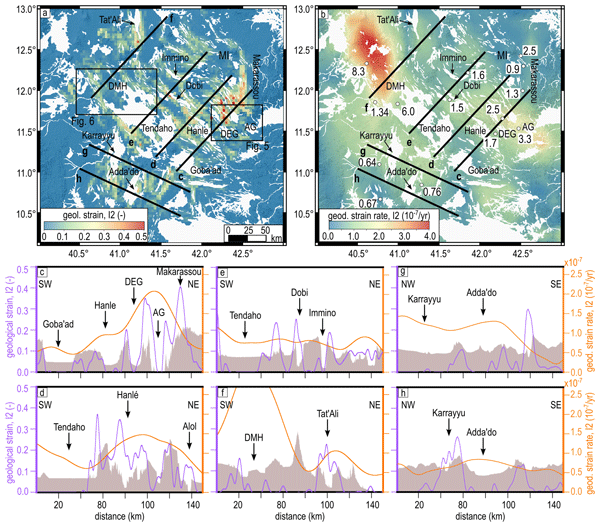
Alessandro La Rosa, Pauline Gayrin, Sascha Brune, Carolina Pagli, Ameha A. Muluneh, Gianmaria Tortelli, and Derek Keir
Solid Earth, 16, 929–945, https://doi.org/10.5194/se-16-929-2025, https://doi.org/10.5194/se-16-929-2025, 2025
Short summary
Short summary
We propose a new method to map faults automatically in digital elevation models (DEMs) and measure long-term crustal deformation in rift contexts. By combining our data with rock ages, we reconstruct rift evolution in Afar during the last 4.5 Myr. We show that the rift axis is most active, with rifting propagating north-west over time. Here magma promotes crustal deformation and faulting caused by dike opening. In the southern sector Afar, two fault systems respond to different motions of diverging tectonic plates.
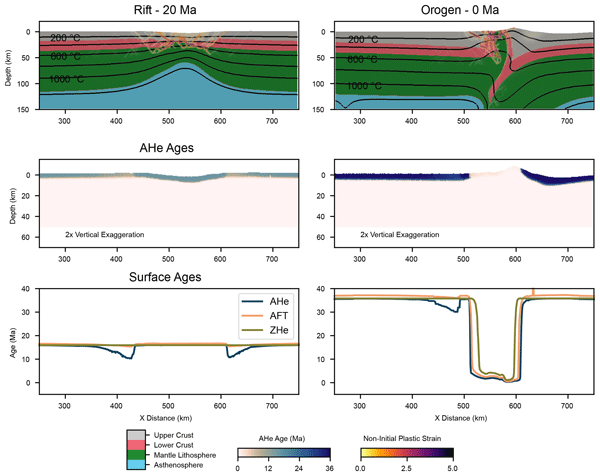
Dylan A. Vasey, Peter M. Scully, John B. Naliboff, and Sascha Brune
Geochronology, 8, 209–222, https://doi.org/10.5194/gchron-8-209-2026, https://doi.org/10.5194/gchron-8-209-2026, 2026
Short summary
Short summary
We present an open-access Python package (GDTchron) designed to forward model apatite (U-Th)/He, apatite fission track, and zircon (U-Th)/He ages using temperatures output by geodynamic numerical models. The software can be used in a parallelized workflow to calculate large numbers of ages. We present two examples of potential applications of GDTchron: a simple model of exhumation and a complex model of continental rifting followed by mountain building.
Alessandro La Rosa, Pauline Gayrin, Sascha Brune, Carolina Pagli, Ameha A. Muluneh, Gianmaria Tortelli, and Derek Keir
Solid Earth, 16, 929–945, https://doi.org/10.5194/se-16-929-2025, https://doi.org/10.5194/se-16-929-2025, 2025
Short summary
Short summary
We propose a new method to map faults automatically in digital elevation models (DEMs) and measure long-term crustal deformation in rift contexts. By combining our data with rock ages, we reconstruct rift evolution in Afar during the last 4.5 Myr. We show that the rift axis is most active, with rifting propagating north-west over time. Here magma promotes crustal deformation and faulting caused by dike opening. In the southern sector Afar, two fault systems respond to different motions of diverging tectonic plates.
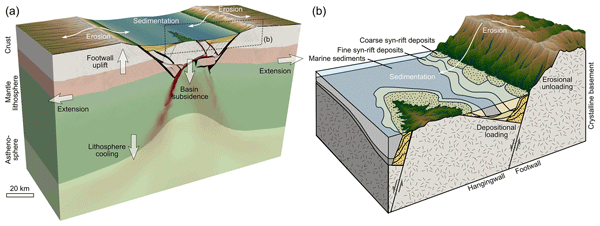
Frank Zwaan, Tiago M. Alves, Patricia Cadenas, Mohamed Gouiza, Jordan J. J. Phethean, Sascha Brune, and Anne C. Glerum
Solid Earth, 15, 989–1028, https://doi.org/10.5194/se-15-989-2024, https://doi.org/10.5194/se-15-989-2024, 2024
Short summary
Short summary
Rifting and the break-up of continents are key aspects of Earth’s plate tectonic system. A thorough understanding of the geological processes involved in rifting, and of the associated natural hazards and resources, is of great importance in the context of the energy transition. Here, we provide a coherent overview of rift processes and the links with hazards and resources, and we assess future challenges and opportunities for (collaboration between) researchers, government, and industry.
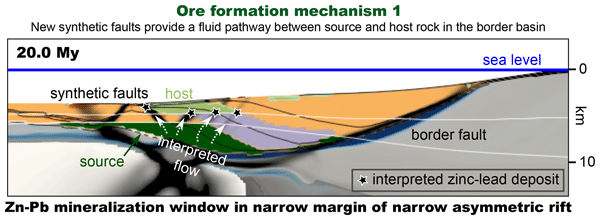
Anne C. Glerum, Sascha Brune, Joseph M. Magnall, Philipp Weis, and Sarah A. Gleeson
Solid Earth, 15, 921–944, https://doi.org/10.5194/se-15-921-2024, https://doi.org/10.5194/se-15-921-2024, 2024
Short summary
Short summary
High-value zinc–lead deposits formed in sedimentary basins created when tectonic plates rifted apart. We use computer simulations of rifting and the associated sediment erosion and deposition to understand why they formed in some basins but not in others. Basins that contain a metal source, faults that focus fluids, and rocks that can host deposits occurred in both narrow and wide rifts for ≤ 3 Myr. The largest and the most deposits form in narrow margins of narrow asymmetric rifts.
Thilo Wrona, Indranil Pan, Rebecca E. Bell, Christopher A.-L. Jackson, Robert L. Gawthorpe, Haakon Fossen, Edoseghe E. Osagiede, and Sascha Brune
Solid Earth, 14, 1181–1195, https://doi.org/10.5194/se-14-1181-2023, https://doi.org/10.5194/se-14-1181-2023, 2023
Short summary
Short summary
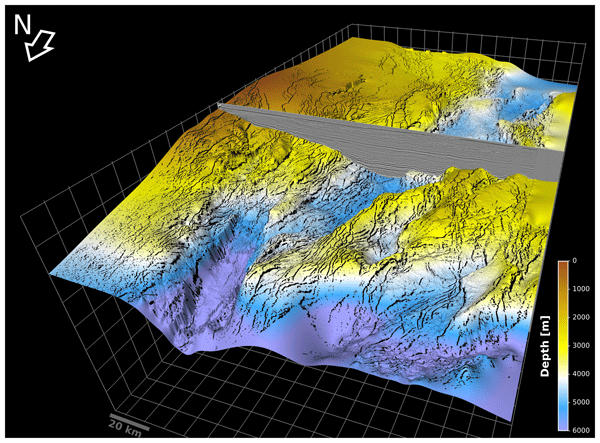
We need to understand where faults are to do the following: (1) assess their seismic hazard, (2) explore for natural resources and (3) store CO2 safely in the subsurface. Currently, we still map subsurface faults primarily by hand using seismic reflection data, i.e. acoustic images of the Earth. Mapping faults this way is difficult and time-consuming. Here, we show how to use deep learning to accelerate fault mapping and how to use networks or graphs to simplify fault analyses.
Timothy Chris Schmid, Sascha Brune, Anne Glerum, and Guido Schreurs
Solid Earth, 14, 389–407, https://doi.org/10.5194/se-14-389-2023, https://doi.org/10.5194/se-14-389-2023, 2023
Short summary
Short summary
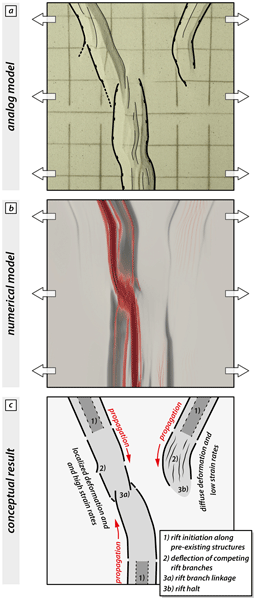
Continental rifts form by linkage of individual rift segments and disturb the regional stress field. We use analog and numerical models of such rift segment interactions to investigate the linkage of deformation and stresses and subsequent stress deflections from the regional stress pattern. This local stress re-orientation eventually causes rift deflection when multiple rift segments compete for linkage with opposingly propagating segments and may explain rift deflection as observed in nature.

Thomas B. Phillips, John B. Naliboff, Ken J. W. McCaffrey, Sophie Pan, Jeroen van Hunen, and Malte Froemchen
Solid Earth, 14, 369–388, https://doi.org/10.5194/se-14-369-2023, https://doi.org/10.5194/se-14-369-2023, 2023
Short summary
Short summary
Continental crust comprises bodies of varying strength, formed through numerous tectonic events. When subject to extension, these areas produce distinct rift and fault systems. We use 3D models to examine how rifts form above
strongand
weakareas of crust. We find that faults become more developed in weak areas. Faults are initially stopped at the boundaries with stronger areas before eventually breaking through. We relate our model observations to rift systems globally.

Nicolás Molnar and Susanne Buiter
Solid Earth, 14, 213–235, https://doi.org/10.5194/se-14-213-2023, https://doi.org/10.5194/se-14-213-2023, 2023
Short summary
Short summary
Progression of orogenic wedges over pre-existing extensional structures is common in nature, but deciphering the spatio-temporal evolution of deformation from the geological record remains challenging. Our laboratory experiments provide insights on how horizontal stresses are transferred across a heterogeneous crust, constrain which pre-shortening conditions can either favour or hinder the reactivatation of extensional structures, and explain what implications they have on critical taper theory.
Susanne J. H. Buiter, Sascha Brune, Derek Keir, and Gwenn Peron-Pinvidic
EGUsphere, https://doi.org/10.5194/egusphere-2022-139, https://doi.org/10.5194/egusphere-2022-139, 2022
Preprint archived
Short summary
Short summary
Continental rifts can form when and where continents are stretched. Rifts are characterised by faults, sedimentary basins, earthquakes and/or volcanism. If rifting can continue, a rift may break a continent into conjugate margins such as along the Atlantic and Indian Oceans. In some cases, however, rifting fails, such as in the West African Rift. We discuss continental rifting from inception to break-up, focussing on the processes at play, and illustrate these with several natural examples.
Cited articles
Adam, R. N., Scott, C., Arrowsmith, J. R., Reano, D., Madugo, C., Koehler, R. D., Zuckerman, M. G., Gray, B., Kozaci, O., González, T., AbramsonWard, H., Rockwell, T. K., Gath, E., Kottke, A. R., and Leuchter, E.: A systematic approach to mapping tectonic faults and documenting supporting geomorphology, Geosphere, 21, 227–244, https://doi.org/10.1130/GES02767.1, 2025.
Ahmadi, H. and Pekkan, E.: Fault-Based Geological Lineaments Extraction Using Remote Sensing and GIS – A Review, Geosciences, 11, 183, https://doi.org/10.3390/geosciences11050183, 2021.
Allken, V., Huismans, R. S., and Thieulot, C.: Three-dimensional numerical modeling of upper crustal extensional systems, J. Geophys. Res.-Sol. Ea., 116, https://doi.org/10.1029/2011JB008319, 2011.
Baker, B. H. and Wohlenberg, J.: Structure and Evolution of the Kenya Rift Valley, Nature, 229, 538–542, https://doi.org/10.1038/229538a0, 1971.
Bangerth, W., Dannberg, J., Fraters, M., Gassmoeller, R., Glerum, A., Heister, T., Myhill, R., and Naliboff, J.: ASPECT v3.0.0, Zenodo [code], https://doi.org/10.5281/zenodo.14371679, 2024.
Bond, C. E.: Uncertainty in structural interpretation: Lessons to be learnt, J. Struct. Geol., 74, 185–200, https://doi.org/10.1016/j.jsg.2015.03.003, 2015.
Braun, J. and Willett, S. D.: A very efficient O(n), implicit and parallel method to solve the stream power equation governing fluvial incision and landscape evolution, Geomorphology, 180–181, 170–179, https://doi.org/10.1016/j.geomorph.2012.10.008, 2013.
Brune, S., Heine, C., Pérez-Gussinyé, M., and Sobolev, S. V.: Rift migration explains continental margin asymmetry and crustal hyper-extension, Nat. Commun., 5, 4014, https://doi.org/10.1038/ncomms5014, 2014.
Bürgmann, R. and Dresen, G.: Rheology of the Lower Crust and Upper Mantle: Evidence from Rock Mechanics, Geodesy, and Field Observations, Annu. Rev. Earth Planet. Sc., 36, 531–567, https://doi.org/10.1146/annurev.earth.36.031207.124326, 2008.
Canny, J.: A computational approach to edge detection, IEEE Trans. Pattern Anal. Mach. Intell., 8, 679–698, 1986.
Chaipornkaew, L., Elston, H., Cooke, M., Mukerji, T., and Graham, S. A.: Predicting Off-Fault Deformation From Experimental Strike-Slip Fault Images Using Convolutional Neural Networks, Geophys. Res. Lett., 49, e2021GL096854, https://doi.org/10.1029/2021GL096854, 2022.
Claringbould, J. S., Bell, R. E., Jackson, C. A.-L., Gawthorpe, R. L., and Odinsen, T.: Pre-breakup Extension in the Northern North Sea Defined by Complex Strain Partitioning and Heterogeneous Extension Rates, Tectonics, 39, e2019TC005924, https://doi.org/10.1029/2019TC005924, 2020.
Coltice, N., Larrouturou, G., Debayle, E., and Garnero, E. J.: Interactions of scales of convection in the Earth's mantle, Tectonophysics, 746, 669–677, https://doi.org/10.1016/j.tecto.2017.06.028, 2018.
Copernicus ESA: Copernicus DEM – Global and European Digital Elevation Model, Copernicus, https://doi.org/10.5270/ESA-c5d3d65, 2019.
Corti, G.: Evolution and characteristics of continental rifting: Analog modeling-inspired view and comparison with examples from the East African Rift System, Tectonophysics, 522–523, 1–33, https://doi.org/10.1016/j.tecto.2011.06.010, 2012.
Davis, R. O. and Selvadurai, A. P. S.: Plasticity and Geomechanics, Cambridge University Press, Cambridge, https://doi.org/10.1017/CBO9780511614958, 2002.
Dirnberger, M., Kehl, T., and Neumann, A.: NEFI: Network Extraction From Images, Sci. Rep., 5, 15669, https://doi.org/10.1038/srep15669, 2015.
Duclaux, G., Huismans, R. S., and May, D. A.: Rotation, narrowing, and preferential reactivation of brittle structures during oblique rifting, Earth Planet. Sc. Lett., 531, 115952, https://doi.org/10.1016/j.epsl.2019.115952, 2020.
Faulkner, D. R., Jackson, C. A. L., Lunn, R. J., Schlische, R. W., Shipton, Z. K., Wibberley, C. A. J., and Withjack, M. O.: A review of recent developments concerning the structure, mechanics and fluid flow properties of fault zones, J. Struct. Geol., 32, 1557–1575, https://doi.org/10.1016/j.jsg.2010.06.009, 2010.
Fossen, H.: Structural Geology, 2nd edn., Cambridge University Press, https://doi.org/10.1017/9781107415096, 2016.
Frondini, F., Caliro, S., Cardellini, C., Chiodini, G., Morgantini, N., and Parello, F.: Carbon dioxide degassing from Tuscany and Northern Latium (Italy), Global Planet. Change, 61, 89–102, https://doi.org/10.1016/j.gloplacha.2007.08.009, 2008.
Gabriel, A., Elston, H., Cooke, M., and Sanchez, C. R.: Impact of Material Strength on Releasing Bend Evolution, Tektonika, 3, 64–81, https://doi.org/10.55575/tektonika2025.3.1.81, 2025.
Gassmöller, R., Lokavarapu, H., Heien, E., Puckett, E. G., and Bangerth, W.: Flexible and Scalable Particle-in-Cell Methods With Adaptive Mesh Refinement for Geodynamic Computations, Geochem. Geophys. Geosyst., 19, 3596–3604, https://doi.org/10.1029/2018GC007508, 2018.
Gayrin, P., Wrona, T., and Brune, S.: Fatbox, the fault analysis toolbox (1.1), Zenodo [software], https://doi.org/10.5281/zenodo.15716080 (last access: 16 February 2026), 2025.
Giampietro, T., Manighetti, I., Leclerc, F., and Gaudemer, Y.: Distributions of throws, widths and scarp slopes on normal faults and their relations to fault growth: Insights from Auto_Throw code, J. Struct. Geol., 196, 105393, https://doi.org/10.1016/j.jsg.2025.105393, 2025.
Glerum, A., Thieulot, C., Fraters, M., Blom, C., and Spakman, W.: Nonlinear viscoplasticity in ASPECT: benchmarking and applications to subduction, Solid Earth, 9, 267–294, https://doi.org/10.5194/se-9-267-2018, 2018.
Guo, Z. and Hall, R. W.: Fast fully parallel thinning algorithms, CVGIP: Image Understanding, Science Direct, 55, 317–328, https://doi.org/10.1016/1049-9660(92)90029-3, 1992.
Hagberg, A. A., Schult, D. A., and Swart, P. J.: Exploring Network Structure, Dynamics, and Function using NetworkX, in: SciPy 2008, the 7th annual Scientific Computing with Python conference, 19–24 August 2008, Pasadena, California, https://doi.org/10.25080/TCWV9851, 2008.
Hatem, A. E., Cooke, M. L., and Toeneboehn, K.: Strain localization and evolving kinematic efficiency of initiating strike-slip faults within wet kaolin experiments, J. Struct. Geol., 101, 96–108, https://doi.org/10.1016/j.jsg.2017.06.011, 2017.
Healy, D., Rizzo, R. E., Cornwell, D. G., Farrell, N. J. C., Watkins, H., Timms, N. E., Gomez-Rivas, E., and Smith, M.: FracPaQ: A MATLAB™ toolbox for the quantification of fracture patterns, J. Struct. Geol., 95, 1–16, https://doi.org/10.1016/j.jsg.2016.12.003, 2017.
Heckenbach, E. L., Brune, S., Glerum, A. C., Granot, R., Hamiel, Y., Sobolev, S. V., and Neuharth, D.: 3D Interaction of Tectonics and Surface Processes Explains Fault Network Evolution of the Dead Sea Fault, Tektonika, 2, 33–51, https://doi.org/10.55575/tektonika2024.2.2.75, 2024.
Heister, T., Dannberg, J., Gassmöller, R., and Bangerth, W.: High accuracy mantle convection simulation through modern numerical methods – II: realistic models and problems, Geophys. J. Int., 210, 833–851, https://doi.org/10.1093/gji/ggx195, 2017.
Henza, A. A., Withjack, M. O., and Schlische, R. W.: Normal-fault development during two phases of non-coaxial extension: An experimental study, J. Struct. Geol., 32, 1656–1667, https://doi.org/10.1016/j.jsg.2009.07.007, 2010.
Herbert, J. W., Cooke, M. L., Oskin, M., and Difo, O.: How much can off-fault deformation contribute to the slip rate discrepancy within the eastern California shear zone?, Geology, 42, 71–75, https://doi.org/10.1130/G34738.1, 2014.
Hirth, G. and Kohlstedt, D.: Rheology of the Upper Mantle and the Mantle Wedge: A View from the Experimentalists, in: Inside the Subduction Factory, American Geophysical Union (AGU), 83–105, https://doi.org/10.1029/138GM06, 2004.
Jolie, E., Scott, S., Faulds, J., Chambefort, I., Axelsson, G., Gutiérrez-Negrín, L. C., Regenspurg, S., Ziegler, M., Ayling, B., Richter, A., and Zemedkun, M. T.: Geological controls on geothermal resources for power generation, Nat. Rev. Earth Environ., 2, 324–339, https://doi.org/10.1038/s43017-021-00154-y, 2021.
Jourdon, A., Le Pourhiet, L., Mouthereau, F., and May, D.: Modes of Propagation of Continental Breakup and Associated Oblique Rift Structures, J. Geophys. Res.-Sol. Ea., 125, e2020JB019906, https://doi.org/10.1029/2020JB019906, 2020.
Jourdon, A., May, D. A., Hayek, J. N., and Gabriel, A.-A.: 3D Reconstruction of Complex Fault Systems From Volumetric Geodynamic Shear Zones Using Medial Axis Transform, Geochemistry, Geophysics, Geosystems, 26, e2025GC012169, https://doi.org/10.1029/2025GC012169, 2025.
Kronbichler, M., Heister, T., and Bangerth, W.: High accuracy mantle convection simulation through modern numerical methods, Geophys. J. Int., 191, 12–29, https://doi.org/10.1111/j.1365-246X.2012.05609.x, 2012.
La Rosa, A., Pagli, C., Hurman, G. L., and Keir, D.: Strain Accommodation by Intrusion and Faulting in a Rift Linkage Zone: Evidences From High-Resolution Topography Data of the Afrera Plain (Afar, East Africa), Tectonics, 41, e2021TC007115, https://doi.org/10.1029/2021TC007115, 2022.
La Rosa, A., Gayrin, P., Brune, S., Pagli, C., Muluneh, A. A., Tortelli, G., and Keir, D.: Cross-scale strain analysis in the Afar rift (East Africa) from automatic fault mapping and geodesy, Solid Earth, 16, 929–945, https://doi.org/10.5194/se-16-929-2025, 2025.
Lathrop, B. A., Jackson, C. A.-L., Bell, R. E., and Rotevatn, A.: Displacement/Length Scaling Relationships for Normal Faults; a Review, Critique, and Revised Compilation, Front. Earth Sci., 10, 907543, https://doi.org/10.3389/feart.2022.907543, 2022.
Li, K., Brune, S., Erdős, Z., Neuharth, D., Mohn, G., and Glerum, A.: From Orogeny to Rifting: The Role of Inherited Structures During the Formation of the South China Sea, J. Geophys. Res.-Sol. Ea., 129, e2024JB029006, https://doi.org/10.1029/2024JB029006, 2024.
Maestrelli, D., Sani, F., Keir, D., Pagli, C., Rosa, A. L., Muluneh, A. A., Brune, S., and Corti, G.: Reconciling plate motion and faulting at a rift-rift-rift triple junction, Geology, 52, 362–366, https://doi.org/10.1130/G51909.1, 2024.
Martí, A., Queralt, P., Marcuello, A., Ledo, J., Rodríguez-Escudero, E., Martínez-Díaz, J. J., Campanyà, J., and Meqbel, N.: Magnetotelluric characterization of the Alhama de Murcia Fault (Eastern Betics, Spain) and study of magnetotelluric interstation impedance inversion, Earth Planets Space, 72, 16, https://doi.org/10.1186/s40623-020-1143-2, 2020.
Mattéo, L., Manighetti, I., Tarabalka, Y., Gaucel, J.-M., van den Ende, M., Mercier, A., Tasar, O., Girard, N., Leclerc, F., Giampetro, T., Dominguez, S., and Malavieille, J.: Automatic Fault Mapping in Remote Optical Images and Topographic Data With Deep Learning, J. Geophys. Res.-Sol. Ea., 126, e2020JB021269, https://doi.org/10.1029/2020JB021269, 2021.
Molnar, N. E., Cruden, A. R., and Betts, P. G.: Interactions between propagating rotational rifts and linear rheological heterogeneities: Insights from three-dimensional laboratory experiments, Tectonics, 36, 420–443, https://doi.org/10.1002/2016TC004447, 2017.
Muirhead, J. D., Kattenhorn, S. A., Lee, H., Mana, S., Turrin, B. D., Fischer, T. P., Kianji, G., Dindi, E., and Stamps, D. S.: Evolution of upper crustal faulting assisted by magmatic volatile release during early-stage continental rift development in the East African Rift, Geosphere, 12, 1670–1700, https://doi.org/10.1130/GES01375.1, 2016.
Muirhead, J. D., Fischer, T. P., Oliva, S. J., Laizer, A., Van Wijk, J., Currie, C. A., Lee, H., Judd, E. J., Kazimoto, E., Sano, Y., Takahata, N., Tiberi, C., Foley, S. F., Dufek, J., Reiss, M. C., and Ebinger, C. J.: Displaced cratonic mantle concentrates deep carbon during continental rifting, Nature, 582, 67–72, https://doi.org/10.1038/s41586-020-2328-3, 2020.
Naliboff, J. B., Buiter, S. J. H., Péron-Pinvidic, G., Osmundsen, P. T., and Tetreault, J.: Complex fault interaction controls continental rifting, Nat. Commun., 8, 1179, https://doi.org/10.1038/s41467-017-00904-x, 2017.
Naliboff, J. B., Glerum, A., Brune, S., Péron-Pinvidic, G., and Wrona, T.: Development of 3-D Rift Heterogeneity Through Fault Network Evolution, Geophys. Res. Lett., 47, e2019GL086611, https://doi.org/10.1029/2019GL086611, 2020.
Neuharth, D., Brune, S., Wrona, T., Glerum, A., Braun, J., and Yuan, X.: Evolution of Rift Systems and Their Fault Networks in Response to Surface Processes, Tectonics, 41, e2021TC007166, https://doi.org/10.1029/2021TC007166, 2022.
Nyberg, B., Nixon, C. W., and Sanderson, D. J.: NetworkGT: A GIS tool for geometric and topological analysis of two-dimensional fracture networks, Geosphere, 14, 1618–1634, https://doi.org/10.1130/GES01595.1, 2018.
Osagiede, E. E., Nixon, C. W., Gawthorpe, R., Rotevatn, A., Fossen, H., Jackson, C. A. -L., and Tillmans, F.: Topological Characterization of a Fault Network Along the Northern North Sea Rift Margin, Tectonics, 42, e2023TC007841, https://doi.org/10.1029/2023TC007841, 2023.
Pan, S., Naliboff, J., Bell, R., and Jackson, C.: Bridging Spatiotemporal Scales of Normal Fault Growth During Continental Extension Using High-Resolution 3D Numerical Models, Geochem. Geophys. Geosyst. 23, e2021GC010316, https://doi.org/10.1029/2021GC010316, 2022.
Pan, S., Naliboff, J., Bell, R., and Jackson, C.: How Do Rift-Related Fault Network Distributions Evolve? Quantitative Comparisons Between Natural Fault Observations and 3D Numerical Models of Continental Extension, Tectonics, 42, e2022TC007659, https://doi.org/10.1029/2022TC007659, 2023.
Panza, E., Ruch, J., and Oestreicher, N.: Rift obliquity in the Northern Volcanic Zone in Iceland using UAV-based structural data, J. Volcanol. Geoth. Res., 450, 108072, https://doi.org/10.1016/j.jvolgeores.2024.108072, 2024.
Pérez-Gussinyé, M., Andrés-Martínez, M., Araújo, M., Xin, Y., Armitage, J., and Morgan, J. P.: Lithospheric Strength and Rift Migration Controls on Synrift Stratigraphy and Breakup Unconformities at Rifted Margins: Examples From Numerical Models, the Atlantic and South China Sea Margins, Tectonics, 39, e2020TC006255, https://doi.org/10.1029/2020TC006255, 2020.
Philippon, M., Willingshofer, E., Sokoutis, D., Corti, G., Sani, F., Bonini, M., and Cloetingh, S.: Slip re-orientation in oblique rifts, Geology, 43, 147–150, https://doi.org/10.1130/G36208.1, 2015.
Polun, S. G., Gomez, F., and Tesfaye, S.: Scaling properties of normal faults in the central Afar, Ethiopia and Djibouti: Implications for strain partitioning during the final stages of continental breakup, J. Struct. Geol., 115, 178–189, https://doi.org/10.1016/j.jsg.2018.07.018, 2018.
Pons, M., Sobolev, S. V., Liu, S., and Neuharth, D.: Hindered Trench Migration Due To Slab Steepening Controls the Formation of the Central Andes, J. Geophys. Res.-Sol. Ea., 127, e2022JB025229, https://doi.org/10.1029/2022JB025229, 2022.
Pousse-Beltran, L., Lallemand, T., Audin, L., Lacan, P., Nunez-Meneses, A. D., and Giffard-Roisin, S.: ScarpLearn: an automatic scarp height measurement of normal fault scarps using convolutional neural networks, Seismica, 4, https://doi.org/10.26443/seismica.v4i2.1387, 2025.
Purinton, B. and Bookhagen, B.: Beyond Vertical Point Accuracy: Assessing Inter-pixel Consistency in 30 m Global DEMs for the Arid Central Andes, Front. Earth Sci., 9, https://doi.org/10.3389/feart.2021.758606, 2021.
Riedl, S., Melnick, D., Mibei, G. K., Njue, L., and Strecker, M. R.: Continental rifting at magmatic centres: structural implications from the Late Quaternary Menengai Caldera, central Kenya Rift, JGS, 177, 153–169, https://doi.org/10.1144/jgs2019-021, 2020.
Riedl, S., Melnick, D., Njue, L., Sudo, M., and Strecker, M. R.: Mid-Pleistocene to Recent Crustal Extension in the Inner Graben of the Northern Kenya Rift, Geochem. Geophys. Geosyst., 23, e2021GC010123, https://doi.org/10.1029/2021GC010123, 2022.
Rotevatn, A., Jackson, C. A.-L., Tvedt, A. B. M., Bell, R. E., and Blækkan, I.: How do normal faults grow?, J. Struct. Geol., 125, 174–184, https://doi.org/10.1016/j.jsg.2018.08.005, 2019.
Saha, P. K., Borgefors, G., and Sanniti di Baja, G.: A survey on skeletonization algorithms and their applications, Pattern Recogn. Lett., 76, 3–12, https://doi.org/10.1016/j.patrec.2015.04.006, 2016.
Schlagenhauf, A., Manighetti, I., Malavieille, J., and Dominguez, S.: Incremental growth of normal faults: Insights from a laser-equipped analog experiment, Earth Planet. Sc. Lett., 273, 299–311, https://doi.org/10.1016/j.epsl.2008.06.042, 2008.
Scholz, C. H.: The Mechanics of Earthquakes and Faulting, 3rd edn., Cambridge University Press, https://doi.org/10.1017/9781316681473, 2019.
Shipton, Z. K., Roberts, J. J., Comrie, E. L., Kremer, Y., Lunn, R. J., and Caine, J. S.: Fault fictions: systematic biases in the conceptualization of fault-zone architecture, Geological Society, London, Special Publications, 496, 125–143, https://doi.org/10.1144/SP496-2018-161, 2020.
Shmela, A. K., Paton, D. A., Collier, R. E., and Bell, R. E.: Normal fault growth in continental rifting: Insights from changes in displacement and length fault populations due to increasing extension in the Central Kenya Rift, Tectonophysics, 814, 228964, https://doi.org/10.1016/j.tecto.2021.228964, 2021.
Stewart, N., Gaudemer, Y., Manighetti, I., Serreau, L., Vincendeau, A., Dominguez, S., Mattéo, L., and Malavieille, J.: “3D_Fault_Offsets,” a Matlab Code to Automatically Measure Lateral and Vertical Fault Offsets in Topographic Data: Application to San Andreas, Owens Valley, and Hope Faults, J. Geophys. Res.-Sol. Ea., 123, 815–835, https://doi.org/10.1002/2017JB014863, 2018.
Strak, V. and Schellart, W. P.: Control of slab width on subduction-induced upper mantle flow and associated upwellings: Insights from analog models, J. Geophys. Res.-Sol. Ea., 121, 4641–4654, https://doi.org/10.1002/2015JB012545, 2016.
Strak, V., Dominguez, S., Petit, C., Meyer, B., and Loget, N.: Interaction between normal fault slip and erosion on relief evolution: Insights from experimental modelling, Tectonophysics, 513, 1–19, https://doi.org/10.1016/j.tecto.2011.10.005, 2011.
Styron, R. and Pagani, M.: The GEM Global Active Faults Database, Earthquake Spectra, 36, 160–180, https://doi.org/10.1177/8755293020944182, 2020.
Tamburello, G., Pondrelli, S., Chiodini, G., and Rouwet, D.: Global-scale control of extensional tectonics on CO2 earth degassing, Nat. Commun., 9, 4608, https://doi.org/10.1038/s41467-018-07087-z, 2018.
Tewksbury, B. J., Hogan, J. P., Kattenhorn, S. A., Mehrtens, C. J., and Tarabees, E. A.: Polygonal faults in chalk: Insights from extensive exposures of the Khoman Formation, Western Desert, Egypt, Geology, 42, 479–482, https://doi.org/10.1130/G35362.1, 2014.
Visage, S., Souloumiac, P., Cubas, N., Maillot, B., Antoine, S., Delorme, A., and Klinger, Y.: Evolution of the off-fault deformation of strike-slip faults in a sand-box experiment, Tectonophysics, 847, 229704, https://doi.org/10.1016/j.tecto.2023.229704, 2023.
Willingshofer, E. and Sokoutis, D.: Decoupling along plate boundaries: Key variable controlling the mode of deformation and the geometry of collisional mountain belts, Geology, 37, 39–42, https://doi.org/10.1130/G25321A.1, 2009.
Wrona, T., Pan, I., Bell, R. E., Gawthorpe, R. L., Fossen, H., and Brune, S.: 3D seismic interpretation with deep learning: A brief introduction, The Leading Edge, 40, 524–532, https://doi.org/10.1190/tle40070524.1, 2021.
Wrona, T., Whittaker, A. C., Bell, R. E., Gawthorpe, R. L., Fossen, H., Jackson, C. A.-L., and Bauck, M. S.: Rift kinematics preserved in deep-time erosional landscape below the northern North Sea, Basin Res., 35, 744–761, https://doi.org/10.1111/bre.12732, 2023.
Young, E. K., Oskin, M. E., and Rodriguez Padilla, A. M.: Reproducibility of Remote Mapping of the 2019 Ridgecrest Earthquake Surface Ruptures, Seismol. Res. Lett., 95, 288–298, https://doi.org/10.1785/0220230095, 2023.
Yuan, X. P., Braun, J., Guerit, L., Rouby, D., and Cordonnier, G.: A New Efficient Method to Solve the Stream Power Law Model Taking Into Account Sediment Deposition, J. Geophys. Res.-Earth Surf., 124, 1346–1365, https://doi.org/10.1029/2018JF004867, 2019.
Zielke, O., Arrowsmith, J. R., Ludwig, L. G., and Akçiz, S. O.: Slip in the 1857 and Earlier Large Earthquakes Along the Carrizo Plain, San Andreas Fault, Science, 327, 1119–1122, https://doi.org/10.1126/science.1182781, 2010.
Zielke, O., Arrowsmith, J. R., Grant Ludwig, L., and Akciz, S. O.: High-Resolution Topography-Derived Offsets along the 1857 Fort Tejon Earthquake Rupture Trace, San Andreas Fault, B. Seismol. Soc. Am., 102, 1135–1154, https://doi.org/10.1785/0120110230, 2012.
Zwaan, F., Chenin, P., Erratt, D., Manatschal, G., and Schreurs, G.: Complex rift patterns, a result of interacting crustal and mantle weaknesses, or multiphase rifting? Insights from analogue models, Solid Earth, 12, 1473–1495, https://doi.org/10.5194/se-12-1473-2021, 2021.
Short summary
When in extension, the Earth's crust accommodates deformation by breaking. Through time, faults grow into an intricate network that can be detected by changes in topography, or through modelling (numerical or analogue). This study demonstrates how the Python library Fatbox, the Fault Analysis Toolbox, can extract the network pattern automatically from said datasets and measure the geometry and kinematics of the fault network.
When in extension, the Earth's crust accommodates deformation by breaking. Through time, faults...


