
Articles | Volume 16, issue 12
https://doi.org/10.5194/se-16-1473-2025
© Author(s) 2025. This work is distributed under
the Creative Commons Attribution 4.0 License.
the Creative Commons Attribution 4.0 License.
https://doi.org/10.5194/se-16-1473-2025
© Author(s) 2025. This work is distributed under
the Creative Commons Attribution 4.0 License.
the Creative Commons Attribution 4.0 License.
Research article
| 
02 Dec 2025
Research article |
| 02 Dec 2025
| 02 Dec 2025
New paleoseismological and morphotectonic investigations along the 2018 surface ruptures of the Fiandaca Fault, eastern flank of Etna volcano (Italy)
Giorgio Tringali
CORRESPONDING AUTHOR
Università degli Studi dell'Insubria, Dipartimento di Scienza e Alta Tecnologia, Como, Italy
Domenico Bella
Registered Geologist, Acireale, Italy
Franz A. Livio
Università degli Studi dell'Insubria, Dipartimento di Scienza e Alta Tecnologia, Como, Italy
Anna Maria Blumetti
Istituto Superiore per la Protezione e la Ricerca Ambientale (ISPRA), Roma, Italy
Gianluca Groppelli
Consiglio Nazionale delle Ricerche (CNR), Istituto di Geologia Ambientale e Geoingegneria (IGAG), Milano, Italy
Luca Guerrieri
Istituto Superiore per la Protezione e la Ricerca Ambientale (ISPRA), Roma, Italy
Marco Neri
Istituto Nazionale di Geofisica e Vulcanologia (INGV), Sezione Osservatorio Etneo, Catania, Italy
Vincenzo Adorno
Registered Geologist, Zafferana Etnea, Italy
Rosario Pettinato
Registered Geologist, Acireale, Italy
Sara Trotta
Università degli Studi dell'Insubria, Dipartimento di Scienza e Alta Tecnologia, Como, Italy
Alessandro M. Michetti
Università degli Studi dell'Insubria, Dipartimento di Scienza e Alta Tecnologia, Como, Italy
Istituto Nazionale di Geofisica e Vulcanologia (INGV), Sezione Osservatorio Vesuviano, Napoli, Italy
Related authors
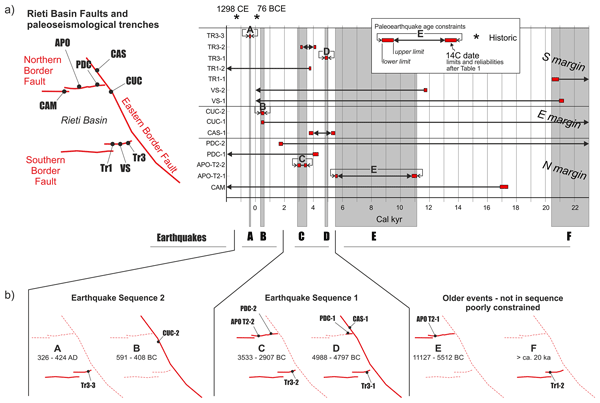
Franz A. Livio, Anna M. Blumetti, Valerio Comerci, Maria F. Ferrario, Gilberto Binda, Marco Caciagli, Michela Colombo, Pio Di Manna, Fernando Ferri, Fiorenzo Fumanti, Roberto Gambillara, Maurizio Guerra, Luca Guerrieri, Paolo Lorenzoni, Valerio Materni, Francesco Miscione, Rosa Nappi, Rosella Nave, Kathleen Nicoll, Alba Peiro, Marco Pizza, Roberto Pompili, Luca M. Puzzilli, Mauro Roma, Aurora Rossi, Valerio Ruscito, Vincenzo Sapia, Argelia Silva Fragoso, Emanuele Scaramuzzo, Frank Thomas, Giorgio Tringali, Stefano Urbini, Andrea Zerboni, and Alessandro M. Michetti
Nat. Hazards Earth Syst. Sci., 26, 131–162, https://doi.org/10.5194/nhess-26-131-2026, https://doi.org/10.5194/nhess-26-131-2026, 2026
Short summary
Short summary
The Rieti Basin in Central Italy, though surrounded by active faults, has been largely overlooked in earthquake studies. To better understand its seismic past, we dug 17 trenches and discovered evidence of 15 ancient earthquakes over the past ca. 20 000 years. The findings show that earthquakes in this area tend to cluster in time, likely due to stress shifting between nearby faults, and can reach a magnitude of 6.5.
Alberto Mariani, Jacopo Borsotti, Mattia Gatti, Gianna Giovanoli, Paula Spannring, Martin Metzger, Luca Dellarole, Franz Livio, Ignazio Gallo, and Fabiano Monti
EGUsphere, https://doi.org/10.5194/egusphere-2026-3551, https://doi.org/10.5194/egusphere-2026-3551, 2026
This preprint is open for discussion and under review for The Cryosphere (TC).
Short summary
Short summary
Snow avalanches are difficult to document in mountain regions, limiting risk assessment and forecasting. We used satellite SAR images and a deep learning model to detect avalanche deposits over ten years, assessing capabilities and main cause of failure under variable snow conditions. We firstly USE a SAR-based avalanche dataset to probabilistic runout distance modelling.
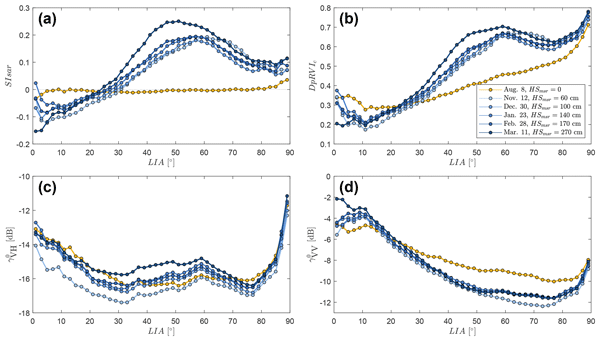
Alberto Mariani, Jacopo Borsotti, Franz Livio, Giacomo Villa, Martin Metzger, and Fabiano Monti
The Cryosphere, 20, 963–980, https://doi.org/10.5194/tc-20-963-2026, https://doi.org/10.5194/tc-20-963-2026, 2026
Short summary
Short summary
We developed a new model to estimate snow depth using radar satellite data. By correcting for how the viewing angle affects signal reflection, we reduced errors by nearly 40 %. Tested in the Alps and Norway, the method improves fine-scale snow monitoring, supporting avalanche forecasting and water management.
Franz A. Livio, Anna M. Blumetti, Valerio Comerci, Maria F. Ferrario, Gilberto Binda, Marco Caciagli, Michela Colombo, Pio Di Manna, Fernando Ferri, Fiorenzo Fumanti, Roberto Gambillara, Maurizio Guerra, Luca Guerrieri, Paolo Lorenzoni, Valerio Materni, Francesco Miscione, Rosa Nappi, Rosella Nave, Kathleen Nicoll, Alba Peiro, Marco Pizza, Roberto Pompili, Luca M. Puzzilli, Mauro Roma, Aurora Rossi, Valerio Ruscito, Vincenzo Sapia, Argelia Silva Fragoso, Emanuele Scaramuzzo, Frank Thomas, Giorgio Tringali, Stefano Urbini, Andrea Zerboni, and Alessandro M. Michetti
Nat. Hazards Earth Syst. Sci., 26, 131–162, https://doi.org/10.5194/nhess-26-131-2026, https://doi.org/10.5194/nhess-26-131-2026, 2026
Short summary
Short summary
The Rieti Basin in Central Italy, though surrounded by active faults, has been largely overlooked in earthquake studies. To better understand its seismic past, we dug 17 trenches and discovered evidence of 15 ancient earthquakes over the past ca. 20 000 years. The findings show that earthquakes in this area tend to cluster in time, likely due to stress shifting between nearby faults, and can reach a magnitude of 6.5.
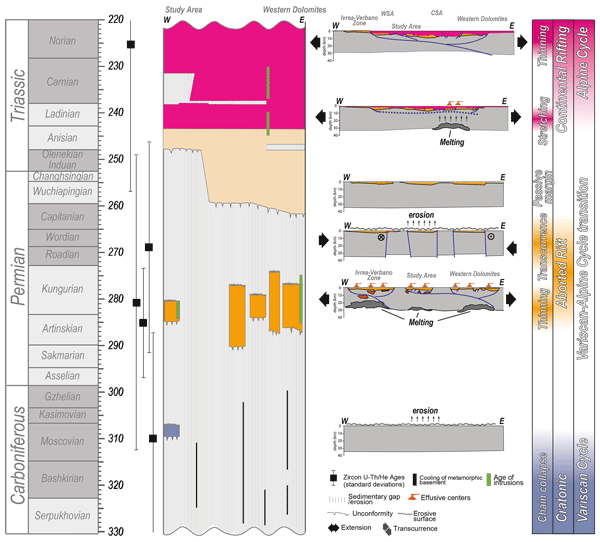
Emanuele Scaramuzzo, Franz A. Livio, Maria Giuditta Fellin, and Colin Maden
Solid Earth, 16, 619–640, https://doi.org/10.5194/se-16-619-2025, https://doi.org/10.5194/se-16-619-2025, 2025
Short summary
Short summary
We address the transition between the Paleozoic Variscan and Alpine Mesozoic–Cenozoic cycles using tectono-stratigraphy and thermochronology. This transition unfolds through a multi-phase rifting history. An initial rifting stage occurred in the early Permian, followed in the early–middle Permian by a phase of transcurrent tectonics. This was succeeded by a period of erosion/non-deposition in the middle Permian. Crustal stretching in the Middle Triassic marked the onset of the Alpine cycle.
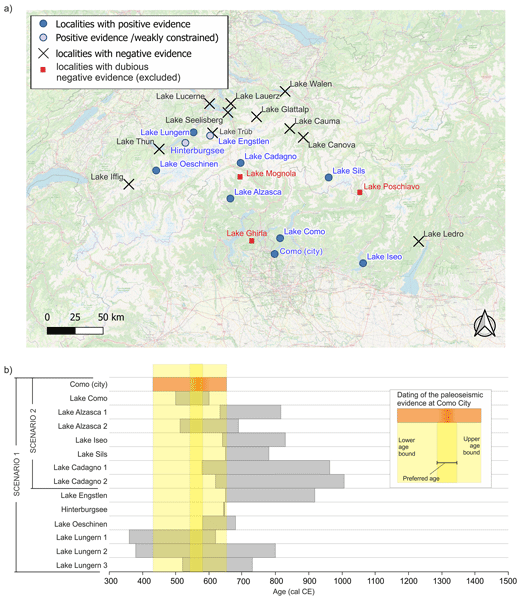
Franz Livio, Maria Francesca Ferrario, Elisa Martinelli, Sahra Talamo, Silvia Cercatillo, and Alessandro Maria Michetti
Nat. Hazards Earth Syst. Sci., 23, 3407–3424, https://doi.org/10.5194/nhess-23-3407-2023, https://doi.org/10.5194/nhess-23-3407-2023, 2023
Short summary
Short summary
Here we document the occurrence of an historical earthquake that occurred in the European western Southern Alps in the sixth century CE. Analysis of the effects due to earthquake shaking in the city of Como (N Italy) and a comparison with dated offshore landslides in the Alpine lakes allowed us to make an inference about the possible magnitude and the location of the seismic source for this event.
Cited articles
Acocella, V. and Neri, M.: Structural features of an active strike-slip fault on the sliding flank of Mt. Etna (Italy), J. Structural Geology, 27/2, 343–355, https://doi.org/10.1016/j.jsg.2004.07.006, 2005.
Acocella, V., Neri, M., and Norini, G.: An overview of analogue models to understand a complex volcanic instability: application to Etna, Italy, J. of Volcanology and Geothermal Research, 251, 98–111, https://doi.org/10.1016/j.jvolgeores.2012.06.003, 2013.
Acocella, V., Neri, N., Behncke, B., Bonforte, A., Del Negro, C. and Ganci, G.: Why does a mature volcano need new vents? The case of the New Southeast Crater at Etna, Front. Earth Sci. 4, 67, https://doi.org/10.3389/feart.2016.00067, 2016.
Allmendinger, R. W.: Inverse and forward numerical modeling of trishear fault-propagation folds, Tectonics, 17, 640–656, https://doi.org/10.1029/98TC01907, 1998.
Azzaro, R.: Earthquake surface faulting at Mount Etna volcano (Sicily) and implications for active tectonics, J. of Geodynamics, 28, 193–213, https://doi.org/10.1016/S0264-3707(98)00037-4, 1999.
Azzaro, R. and Castelli, V.: Materiali per un catalogo di terremoti etnei dal 1600 al 1831, Quaderni di Geofisica, 123, 284 pp., https://doi.org/10.13127/qdg/123, 2015.
Azzaro, R. and D'Amico, S.: Catalogo Macrosismico dei Terremoti Etnei (CMTE), 1633–2023, Istituto Nazionale di Geofisica e Vulcanologia (INGV) [data set], https://doi.org/10.13127/cmte, 2014.
Azzaro, R., Bella, D., Ferreli, L., Michetti, A. M., Santagati, F., Serva, L., and Vittori, E.: First study of fault trench stratigraphy at Mt. Etna volcano, Southern Italy: understanding Holocene surface faulting along the Moscarello fault, J. of Geodynamics, 29, 187–210, https://doi.org/10.1016/S0264-3707(99)00055-1, 2000.
Azzaro, R., Branca, S., Gwinner, K., and Coltelli, M.: The volcano-tectonic map of Etna volcano, 1:100.000 scale: an integrated approach based on a morphotectonic analysis from high-resolution DEM constrained by geologic, active faulting and seismotectonic data, Italian Journal of Geosciences, 131, 153–170, https://doi.org/10.3301/IJG.2011.29, 2012.
Azzaro, R., Bonforte, A., Branca, S. and Guglielmino, F.: Geometry and kinematics of the fault systems controlling the unstable flank of Etna volcano (Sicily), J. of Volcanology and Geothermal Research, 251, 5–15, https://doi.org/10.1016/j.jvolgeores.2012.10.001, 2013.
Azzaro, R., Barberi, G., D'Amico, S., Pace, B., Peruzza, L., and Tuvè, T.: When probabilistic seismic hazard climbs volcanoes: the Mt. Etna case, Italy – Part 1: Model components for sources parameterization, Nat. Hazards Earth Syst. Sci., 17, 1981–1998, https://doi.org/10.5194/nhess-17-1981-2017, 2017.
Azzaro, R., Pucci, S., Villani, F., Civico, R., Branca, S., Cantarero, M., De Beni, E., De Martini P. M., Cinti, F. R., Caciagli, M., Cucci, L., and Pantosti, D.: Surface faulting of the 26 December 2018, Mw 5 earthquake at Mt. Etna volcano (Italy): Geological source model and implications for the seismic potential of the Fiandaca fault, Tectonics, 41, e2021TC007182, https://doi.org/10.1029/2021TC007182, 2022.
Barreca, G., Bonforte, A., and Neri, M.: A pilot GIS database of active faults of Mt. Etna (Sicily): A tool for integrated hazard evaluation, J. of Volcanology and Geothermal Research, 251, 170–186, https://doi.org/10.1016/j.jvolgeores.2012.08.013, 2013.
Benina, A., Imposa, S., Gresta, S., and Patanè, G.: Studio macrosismico e strumentale di due terremoti tettonici avvenuti sul versante meridionale dell'Etna, in: Proc. 3th Conv. GNGTS, CNR, Rome, 1984, 3, 934–940, 1984.
Bonforte, A., Guglielmino, F., Coltelli, M., Ferretti, A., and Puglisi, G.: Structural assessment of Mount Etna volcano from Permanent Scatterers analysis, Geochemistry, Geophysics, Geosystems, 12, https://doi.org/10.1029/2010GC003213, 2011.
Bonforte, A., Federico, C., Giammanco, S., Guglielmino, F., Liuzzo, M., and Neri M.: Soil gases and SAR data reveal hidden faults on the sliding flank of Mt. Etna (Italy), J. of Volcanology and Geothermal Research, 251, 27–40, https://doi.org/10.1016/j.jvolgeores.2012.08.010, 2013.
Bonforte, A., Guglielmino, F., and Puglisi, G.: Large dyke intrusion and small eruption: The December 24, 2018 Mt. Etna eruption imaged by Sentinel-1 data, Terra Nova, 31, 405–412, https://doi.org/10.1111/ter.12403, 2019.
Borgia, A., Ferrari, L., and Pasquarè, G.: Importance of gravitational spreading in the tectonic and volcanic evolution of Mount Etna, Nature, 357, 231–235, https://doi.org/10.1038/357231a0,1992.
Branca, S. and Abate, T.: Current knowledge of Etna's flank eruptions (Italy) occurring over the past 2500 years. From the iconographies of the XVII century to modern geological cartography, J. of Volcanology and Geothermal Research, 385, 159–178, https://doi.org/10.1016/j.jvolgeores.2017.11.004, 2019.
Branca, S. and Ferrara, V.: The morphostructural setting of Mount Etna sedimentary basement (Italy): Implications for the geometry and volume of the volcano and its flank instability, Tectonophysics, 586, 46–64, https://doi.org/10.1016/j.tecto.2012.11.011, 2013.
Branca, S., Coltelli, M., and Groppelli, G.: Geological evolution of a complex basaltic stratovolcano: Mount Etna, Italy, Ital. J. Geosci., 130, 306–317, https://doi.org/10.3301/IJG.2011.13, 2011a.
Branca, S., Coltelli, M., Groppelli, G., and Lentini, F.: Geological map of Etna volcano,
Calvari, S. and Groppelli, G.: Relevance of the Chiancone volcaniclastic deposit in the recent history of Etna Volcano (Italy), J. of Volcanology and Geothermal Research, 72, 239–258, https://doi.org/10.1016/0377-0273(96)00012-1, 1996.
Calvari, S., Tanner, L. H., and Groppelli, G.: Debris-avalanche deposits of the Milo Lahar sequence and the opening of the Valle del Bove on Etna volcano (Italy), J. of Volcanology and Geothermal Research, 87, 193–209, https://doi.org/10.1016/S0377-0273(98)00089-4, 1998.
Calvari, S., Tanner, L. H., Groppelli, G., and Norini, G.: Valle del Bove, eastern flank of Etna volcano: a comprehensive model for the opening of the depression and implications for future hazards, In Etna Volcano Laboratory edited by: Bonaccorso, A., Calvari, S., Coltelli, M., Del Negro, C., and Falsaperla, S., American Geophysical Union, https://doi.org/10.1029/143GM05, 2004.
Cardozo, N., Bhalla, K., Zehnder, A. T., and Allmendinger, R. W.: Mechanical models of fault propagation folds and comparison to the trishear kinematic model, Journal of Structural Geology, 25, 1–18, https://doi.org/10.1016/S0191-8141(02)00013-5, 2003.
Carveni, P. and Bella, D.: Aspetti geomorfologici legati ad attività sismica su vulcani attivi: il basso versante orientale dell'Etna come modello di studio, Boll. Acc. Gioenia Sc. Nat., 27, 253–285, 1994.
Chiocci, F. L., Coltelli, M., Bosman, A., and Cavallaro, D.: Continental margin large-scale instability controlling the flank sliding of Etna volcano, Earth and Planetary Science Letters, 305, 57–64, https://doi.org/10.1016/j.epsl.2011.02.040, 2011.
Civico, R., Pucci, S., Nappi, R., Azzaro, R., Villani, F., Pantosti, D., Cinti, F. R., Pizzimenti, L., Branca, S., Brunori, C. A., Caciagli, M., Catarero, M., Cucci, L., D'Amico, S., De Beni, E., De Martini, P. M., Mariucci, M. T., Montone, P., Nave, R., Ricci, T., Sapia, V., Smedile, A., Tarabusi, G., Vallone, R., and Venuti, A.: Surface ruptures following the 26 December 2018, Mw 4.9, Mt. Etna earthquake, Sicily (Italy): EMERGEO Working Group (Etna 2018), J. of Maps, 15, 831–837, https://doi.org/10.1080/17445647.2019.1683476, 2019.
Coltelli, M., Del Carlo, P., and Vezzoli, L.: Discovery of a Plinian basaltic eruption of Roman age at Etna volcano, Italy, Geology, 26, 1095–1098, https://doi.org/10.1130/0091-7613(1998)026<1095:DOAPBE>2.3.CO;2, 1998.
D'Amato, D., Pace, B., Di Nicola, L., Stuart, F. M., Visini, F., Azzaro, R., Branca, S., and Barfod, D. N.: Holocene slip rate variability along the Pernicana fault system (Mt. Etna, Italy): Evidence from offset lava flows, GSA Bulletin, 129, 304–317, https://doi.org/10.1130/B31510.1, 2017.
De Novellis, V., Atzori, S., De Luca, C., Manzo, M., Valerio, E., Bonano, M., Cardaci, C., Castaldo, R., Di Bucci, D., Manunta, M., Onorato, G., Pepe, S., Solaro, G., Tizzani, P., Zinno, I., Neri, M., Lanari, R., and Casu, F.: DInSAR analysis and analytical modeling of Mount Etna displacements: The December 2018 volcano-tectonic crisis, Geophysical Research Letters, 46, https://doi.org/10.1029/2019GL082467, 2019.
Doglioni, C., Innocenti, F., and Mariotti, G.: Why Mt Etna?, Terra Nova, 13, 25–31, https://doi.org/10.1046/j.1365-3121.2001.00301.x, 2001.
Erslev, E. A.: Trishear fault-propagation folding, Geology, 19, 617–620, https://doi.org/10.1130/0091-7613(1991)019<0617:TFPF>2.3.CO;2, 1991.
Ferreli, L., Michetti, A., Serva, L., and Vittori, E.: Stratigraphic evidence of coseismic faulting and aseismic fault creep from exploratory trenches at Mt. Etna volcano (Sicily, Italy), Geological Society Of America Bulletin, 359, 49–62, https://doi.org/10.1130/0-8137-2359-0.49, 2002.
Grant, J. V. and Kattenhorn, S. A.: Evolution of vertical faults at an extensional plate boundary, southwest Iceland, Journal of Structural Geology, 26, 537–557, https://doi.org/10.1016/j.jsg.2003.07.003, 2004.
Gresta, S., Bella, D., Musumeci, C., and Carveni, P.: Some efforts on active faulting processes (earthquakes and aseismic creep) acting on the eastern flank of Mt. Etna (Sicily), Acta Vulcanologica, 9, 101–108, 1997.
Gross, F., Krastel, S., Geersen, J., Behrmann, J. H., Ridente, D., Chiocci, F. L., Bialas, J., Papenber, C., Cukur, D., Urlaub, M., and Micallef, A.: The limits of seaward spreading and slope instability at the continental margin offshore Mt Etna, imaged by high-resolution 2D seismic data, Tectonophysics, 667, 63–76, https://doi.org/10.1016/j.tecto.2015.11.011, 2016.
Guest, J. E., Chester, D. K., and Duncan, A. M.: The Valle del Bove, Mount Etna: its origin and relation to the stratigraphy and structure of the volcano, J. of Volcanology and Geothermal Research, 21, 1–23, https://doi.org/10.1016/0377-0273(84)90013-1, 1984.
Guidoboni, E., Ferrari, G., Tarabusi, G., Sgattoni, G., Comastri, A., Mariotti, D., Ciuccarelli, C., Bianchi, M. G., and Valensise, G.: CFTI5Med, the new release of the catalogue of strong earthquakes in Italy and in the Mediterranean area, Scientific Data, 6, 80, https://doi.org/10.1038/s41597-019-0091-9, 2019.
Hardy, S.: Propagation of blind normal faults to the surface in basaltic sequences: Insights from 2D discrete element modelling, Marine and Petroleum Geology, 48, 149–159, https://doi.org/10.1016/j.marpetgeo.2013.08.012, 2013.
Hardy, S. and Ford, M.: Numerical modeling of trishear fault propagation folding, Tectonics, 16, 841–854, https://doi.org/10.1029/97TC01171, 1997.
Holland, M., Urai, J. L., and Martel, S.: The internal structure of fault zones in basaltic sequences, Earth and Planetary Science Letters, 248, 301–315, https://doi.org/10.1016/j.epsl.2006.05.035, 2006.
ITHACA Working Group: ITHACA (ITaly HAzard from CApable faulting), A database of active capable faults of the Italian territory, Version December 2019, ISPRA Geological Survey of Italy [data set], https://sgi.isprambiente.it/ithaca/viewer/index.html (last access: 20 September 2024), 2019.
Jin, G. and Groshong Jr., R. H.: Trishear kinematic modeling of extensional fault-propagation folding, J. of Structural Geology, 28, 170–183, https://doi.org/10.1016/j.jsg.2005.09.003, 2006.
Kettermann, M., Weismüller, C., von Hagke, C., Reicherter, K., and Urai, J. L.: Large near-surface block rotations at normal faults of the Iceland rift: Evolution of tectonic caves and dilatancy, Geology, 47, 781–785, https://doi.org/10.1130/G46158.1, 2019.
Lanzafame, G., Neri, M., and Rust, D.: A preliminary structural evaluation of recent tectonic activity on the eastern flank of Mount Etna, Sicily, West London Papers in Environmental Studies, 3, 73–90, 1996.
Lo Giudice, E. and Rasà, R.: Very shallow earthquakes and brittle deformation in active volcanic areas: The Eatnean region as an example, Tectonophysics, 202, 257–268, https://doi.org/10.1016/0040-1951(92)90111-I, 1992.
Malaguti, A. B., Branca, S., Speranza, F., Coltelli, M., Del Carlo, P., and Renzulli, A.: Age of the Valle del Bove formation and chronology of the post-collapse flank eruptions, Etna volcano (Italy), J. of Volcanology and Geothermal Research, 434, 107752, https://doi.org/10.1016/j.jvolgeores.2023.107752, 2023.
McCalpin, J. P.: Paleoseismology, International Geophysics, vol. 95, 615 pp., ISBN 9780080919980, 2009.
McCalpin, J., Ferrario, F., Figueiredo, P., Livio, F., Grützner, C., Pisarska-Jamroży, M., Quigley, M., Reicherter, K., Rockwell, T., Štěpančíková, P., and Tábořík, P.: New developments in onshore paleoseismic methods, and their impact on Quaternary tectonic studies, Quaternary International, 664, 59–76, https://doi.org/10.1016/j.quaint.2023.03.008, 2023.
Michetti, A. M., Audemard, F., and Marco, S.: Future trends in paleoseismology: Integrated study of the seismic landscape as a vital tool in seismic hazard analyses, in: Paleoseismology, integrated study of the Quaternary geological record for earthquake deformation and faulting, edited by: Michetti, A. M., Audemard, F., and Marco, S., Tectonophysics, 408, 3–21, https://doi.org/10.1016/j.tecto.2005.05.035, 2005.
Monaco, C., Tapponnier, P., Tortorici, L., and Gillot, P. Y.: Late Quaternary slip rates on the Acireale-Piedimonte normal faults and tectonic origin of Mt. Etna (Sicily), Earth and Planetary Science Letters, 147, 125–139, https://doi.org/10.1016/S0012-821X(97)00005-8, 1997.
Monaco, C., Barreca, G., Bella, D., Brighenti, F., Bruno, V., Carnemolla, F., De Guidi, G., Mattia, M., Menichetti, M., Roccheggiani, M., and Scarfì, L.: The seismogenic source of the 2018 December 26th earthquake (Mt. Etna, Italy): A shear zone in the unstable eastern flank of the volcano, J. of Geodynamics, 143, 101807, https://doi.org/10.1016/j.jog.2020.101807, 2021.
Neri, M. and Neri, E.: Etna 2018 earthquake: rebuild or relocate? Applying geoethical principles to natural disaster recovery planning, J. of Geoethics and Social Geosciences, 2, 1–28, https://doi.org/10.13127/jgsg-49, 2024.
Neri, M., Garduño, V. H., Pasquarè, G., and Rasà, R.: Studio strutturale e modello cinematico della Valle del Bove e del settore nord-orientale etneo, Acta Vulcanol., 1, 17–24, 1991.
Neri, M., Acocella, V., and Behncke, B.: The role of the Pernicana Fault System in the spreading of Mt. Etna (Italy) during the 2002–2003 eruption, Bulletin of Volcanology, 66, 417–430, https://doi.org/10.1007/s00445-003-0322-x, 2004.
Neri, M., Acocella, V., Behncke, B., Giammanco, S., Mazzarini, F., and Rust, D.: Structural analysis of the eruptive fissures at Mount Etna (Italy), Annals of Geophysics, 54, 464–479, https://doi.org/10.4401/ag-5332, 2011.
Palano, M., Sparacino, F., Gambino, P., D'Agostino, N., and Calcaterra, S.: Slow slip events and flank instability at Mt. Etna volcano (Italy), Tectonophysics, 836, 229414, https://doi.org/10.1016/j.tecto.2022.229414, 2022.
Patanè, G. and Imposa, S.: Atlante delle isosiste dei terremoti etnei dal 1971 al 1991, Univ. Studi di Catania e CNR-Gr. Naz. geofisica della Terra Solida, 89, 1995.
Platania, G.: Il terremoto del 7 Dicembre 1907, Mem. Cl. Sci. R. Acc. Zelanti, 5, 13–20, 1908.
Platania, G.: Sul periodo sismico del Maggio 1914 nella regione orientale dell'Etna, Mem. Cl. Sci. R. Acc. Zelanti, 7, 48 pp., 1915.
Rasà, R., Azzaro, R., and Leonardi, O.: Aseismic creep on faults and flank instability at Mount Etna volcano, Sicily, Geological Society, London, Special Publications, 110, 179–192, https://doi.org/10.1144/GSL.SP.1996.110.01.14, 1996.
Rockwell, T., Barka, A., Dawson, T., Akyuz, S., and Thorup, K.: Paleoseismology of the Gazikoy-Saros segment of the North Anatolia fault, northwestern Turkey: Comparison of the historical and paleoseismic records, implications of regional seismic hazard, and models of earthquake recurrence, Journal of Seismology, 5, 433–448, https://doi.org/10.1023/A:1011435927983, 2001.
Romagnoli, G., Pavano, F., Tortorici, G., and Catalano, S.: The 2018 Mount Etna earthquake (Mw 4.9): Depicting a natural model of a composite fault system from coseismic surface breaks, Tectonics, 40, e2020TC006286, https://doi.org/10.1029/2020TC006286, 2021.
Rovida A., Locati M., Camassi R., Lolli B., and Gasperini P.: The Italian earthquake catalogue CPTI15, Bulletin of Earthquake Engineering, 18, 2953–2984, https://doi.org/10.1007/s10518-020-00818-y, (2020).
Rust, D. and Neri, M.: The boundaries of large-scale collapse on the flanks of Mount Etna, Sicily, Geological Society, London, Special Publications, 110, 193–208, https://doi.org/10.1144/GSL.SP.1996.110.01.15, 1996.
Siniscalchi, A., Tripaldi,S., Neri, M., Balasco, M., Romano, G., Ruch, J., and Schiavone D.: Flank instability structure of Mt Etna inferred by a magnetotelluric survey, J. Geophys. Res., 117, B03216, https://doi.org/10.1029/2011JB008657, 2012.
Solaro, G., Acocella, V., Pepe, S., Ruch, J., Neri, M., and Sansosti, E.: Anatomy of an unstable volcano from InSAR: Multiple processes affecting flank instability at Mt. Etna, 1994–2008, J. of Geophysical Research: Solid Earth, 115, https://doi.org/10.1029/2009JB000820, 2010.
Tanguy, J. C., Condomines, M., Branca, S., La Delfa, S., and Coltelli, M.: New archeomagnetic and 226Ra-230Th dating of recent lavas for the Geological map of Etna volcano, Italian Journal of Geosciences, 131, 241–257, https://doi.org/10.3301/IJG.2012.01, 2012.
Tibaldi, A. and Groppelli, G.: Volcano-tectonic activity along structures of the unstable NE flank of Mt. Etna (Italy) and their possible origin, J. of Volcanology and Geothermal Research, 115, 277–302, https://doi.org/10.1016/S0377-0273(01)00305-5, 2002.
Tibaldi, A., Corti, N., De Beni, E., Bonali, F. L., Falsaperla, S., Langer, H., Neri, M., Cantarero, M., Reitano, D., and Fallati, L.: Mapping and evaluating kinematics and the stress and strain field at active faults and fissures: a comparison between field and drone data at the NE rift, Mt Etna (Italy), Solid Earth, 12, 801–816, https://doi.org/10.5194/se-12-801-2021, 2021.
Tortorici, G., Pavano, F., Romagnoli, G., and Catalano, S.: The effect of recent resurfacing in volcanic areas on the distribution of co-seismic ground deformation due to strike-slip earthquakes: New insights from the 12/26/2018 seismic event at Mt. Etna, Journal of Structural Geology, 145, 104308, https://doi.org/10.1016/j.jsg.2021.104308, 2021.
Tringali, G.: Earthquake surface faulting and aseismic creep on Etna volcano: role of the pre-volcanic basement, relationships with flank instability and magmatic intrusions, implications for future hazard scenarios, PhD thesis, Università degli Studi dell'Insubria, Italy, https://hdl.handle.net/11383/2165092 (last access: 5 December 2024), 2023a.
Tringali, G.: 26 December 2018 surface ruptures along the eastern flank of Mt. Etna, Zenodo [data set], https://doi.org/10.5281/zenodo.8414945, 2023b.
Tringali, G., Bella, D., Livio, F. A., Ferrario, M. F., Groppelli, G., Blumetti, A. M., Di Manna, P., Vittori, E., Guerrieri, L., Porfido, S., Boso, D., Pettinato, R., Paradiso, G., and Michetti, A. M.: Fault rupture and aseismic creep accompanying the December 26, 2018, Mw 4.9 Fleri earthquake (Mt. Etna, Italy): Factors affecting the surface faulting in a volcano-tectonic environment, Quaternary International, 651, 25–41, https://doi.org/10.1016/j.quaint.2021.12.019, 2023a.
Tringali, G., Bella, D., Livio, F., Ferrario, M. F., Groppelli, G., Pettinato, R., and Michetti, A. M.: Aseismic creep and gravitational sliding on the lower eastern flank of Mt. Etna: Insights from the 2002 and 2022 fault rupture events between Santa Venerina and Santa Tecla, Tectonophysics, 856, 229829, https://doi.org/10.1016/j.tecto.2023.229829, 2023b.
Urlaub, M., Petersen, F., Gross, F., Bonforte, A., Puglisi, G., Guglielmino, F., Krastel, S., Lange, D., and Kopp, H.: Gravitational collapse of Mount Etna's southeastern flank, Science Advances, 4, eaat9700, https://doi.org/10.1126/sciadv.aat9700, 2018.
Von Hagke, C., Kettermann, M., Bitsch, N., Bücken, D., Weismüller, C., and Urai, J. L.: The effect of obliquity of slip in normal faults on distribution of open fractures, Frontiers in Earth Science, 7, 18, https://doi.org/10.3389/feart.2019.00018, 2019.
Zehnder, A. T. and Allmendinger, R. W.: Velocity field for the trishear model, Journal of Structural Geology, 22, 1009–1014, https://doi.org/10.1016/S0191-8141(00)00037-7, 2000.
Short summary
Trenches were excavated along the Fiandaca Fault providing data for relocating buildings damaged by the 2018 Mt. Etna earthquake. The paleoseismological results revealed 3 surface faulting events occurred in: 2018, 1894 and an unknown one in the Early Middle Ages. To verify a possible increase in seismicity, fault scarps were analysed conceptualizing a kinematic model and obtaining throw rate growth in the last 2 kyrs.
Trenches were excavated along the Fiandaca Fault providing data for relocating buildings damaged...


