
Articles | Volume 17, issue 5
https://doi.org/10.5194/se-17-803-2026
© Author(s) 2026. This work is distributed under
the Creative Commons Attribution 4.0 License.
the Creative Commons Attribution 4.0 License.
https://doi.org/10.5194/se-17-803-2026
© Author(s) 2026. This work is distributed under
the Creative Commons Attribution 4.0 License.
the Creative Commons Attribution 4.0 License.
Research article
| 
28 May 2026
Research article |
| 28 May 2026
| 28 May 2026
Statistical characteristics of non-volcanic tremor distributions along the Mexican Subduction Zone
Quetzalcoatl Rodríguez-Pérez
CORRESPONDING AUTHOR

Secretaría de Ciencia, Humanidades, Tecnología e Innovación, Mexico City, Mexico
Instituto de Geociencias, Universidad Nacional Autónoma de México, Juriquilla, Querétaro, Mexico
Víctor Hugo Márquez-Ramírez
Instituto de Geociencias, Universidad Nacional Autónoma de México, Juriquilla, Querétaro, Mexico
Francisco Ramón Zúñiga
Instituto de Geociencias, Universidad Nacional Autónoma de México, Juriquilla, Querétaro, Mexico
Related authors
Quetzalcoatl Rodríguez-Pérez and F. Ramón Zúñiga
Nat. Hazards Earth Syst. Sci. Discuss., https://doi.org/10.5194/nhess-2024-92, https://doi.org/10.5194/nhess-2024-92, 2024
Preprint withdrawn
Short summary
Short summary
Seismic intensity reflects earthquake damage, although this parameter is often subjective. On the other hand, peak acceleration values are a direct measure of earthquake effects. Seismic intensity was used to describe historical earthquakes, and its use is rare today. For this reason, it is important to have a relationship between these parameters of strong movements in order to predict the acceleration of historical earthquakes.
Quetzalcoatl Rodríguez-Pérez and F. Ramón Zúñiga
Solid Earth, 15, 229–249, https://doi.org/10.5194/se-15-229-2024, https://doi.org/10.5194/se-15-229-2024, 2024
Short summary
Short summary
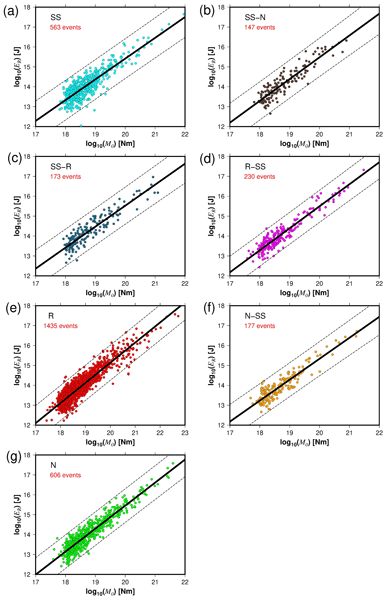
The behavior of seismic energy parameters and their possible dependence on the type of fault for globally detected earthquakes were studied. For this purpose, different energy estimation methods were used. Equations were obtained to convert energies obtained in different ways. The dependence of the seismic energy on the focal mechanism was confirmed up to depths close to 180 km. The results will help to explain the seismic rupture of earthquakes generated at greater depth.
Quetzalcoatl Rodríguez-Pérez and F. Ramón Zúñiga
Earth Syst. Sci. Data, 15, 4781–4801, https://doi.org/10.5194/essd-15-4781-2023, https://doi.org/10.5194/essd-15-4781-2023, 2023
Short summary
Short summary
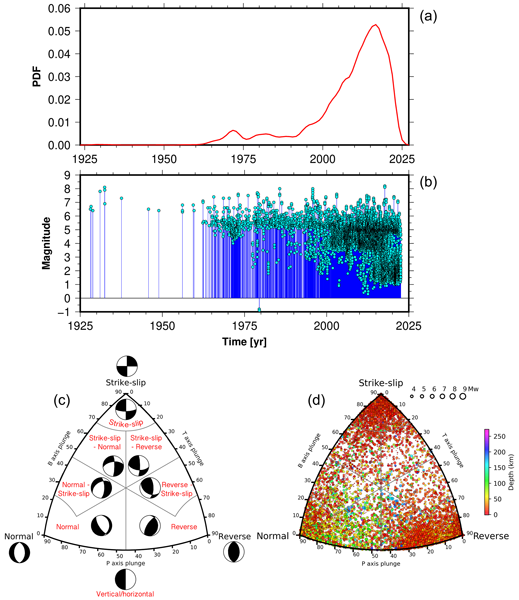
We present a comprehensive catalog of focal mechanisms for earthquakes in Mexico and neighboring areas spanning February 1928 to July 2022. The catalog comprises a wide range of earthquake magnitudes and depths and includes data from diverse geological environments. We collected and revised focal mechanism data from various sources and methods. The catalog is a valuable resource for future studies on earthquake source mechanisms, tectonics, and seismic hazard in the region.
Daniel Martinez-Jaramillo, Sreeram-Reddy Kotha, F. Ramón Zúñiga, and Pierre Lacan
Earth Syst. Sci. Data, 18, 7403–7415, https://doi.org/10.5194/essd-18-7403-2026, https://doi.org/10.5194/essd-18-7403-2026, 2026
Short summary
Short summary
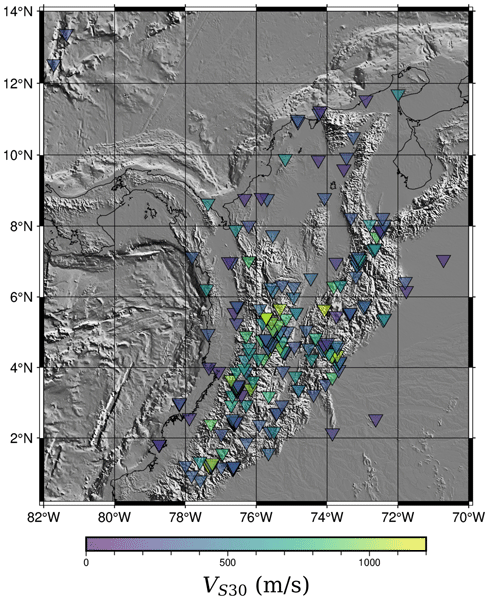
Colombia is regularly struck by damaging earthquakes. We gathered and uniformly processed 7550 recordings from 667 shallow earthquakes into a single open collection describing each earthquake, recording site and level of shaking. Comparison with widely used prediction methods confirmed its quality. The collection can help engineers design safer buildings and improve earthquake hazard maps in Colombia and similar regions.
Quetzalcoatl Rodríguez-Pérez and F. Ramón Zúñiga
Nat. Hazards Earth Syst. Sci. Discuss., https://doi.org/10.5194/nhess-2024-92, https://doi.org/10.5194/nhess-2024-92, 2024
Preprint withdrawn
Short summary
Short summary
Seismic intensity reflects earthquake damage, although this parameter is often subjective. On the other hand, peak acceleration values are a direct measure of earthquake effects. Seismic intensity was used to describe historical earthquakes, and its use is rare today. For this reason, it is important to have a relationship between these parameters of strong movements in order to predict the acceleration of historical earthquakes.
Quetzalcoatl Rodríguez-Pérez and F. Ramón Zúñiga
Solid Earth, 15, 229–249, https://doi.org/10.5194/se-15-229-2024, https://doi.org/10.5194/se-15-229-2024, 2024
Short summary
Short summary
The behavior of seismic energy parameters and their possible dependence on the type of fault for globally detected earthquakes were studied. For this purpose, different energy estimation methods were used. Equations were obtained to convert energies obtained in different ways. The dependence of the seismic energy on the focal mechanism was confirmed up to depths close to 180 km. The results will help to explain the seismic rupture of earthquakes generated at greater depth.
Quetzalcoatl Rodríguez-Pérez and F. Ramón Zúñiga
Earth Syst. Sci. Data, 15, 4781–4801, https://doi.org/10.5194/essd-15-4781-2023, https://doi.org/10.5194/essd-15-4781-2023, 2023
Short summary
Short summary
We present a comprehensive catalog of focal mechanisms for earthquakes in Mexico and neighboring areas spanning February 1928 to July 2022. The catalog comprises a wide range of earthquake magnitudes and depths and includes data from diverse geological environments. We collected and revised focal mechanism data from various sources and methods. The catalog is a valuable resource for future studies on earthquake source mechanisms, tectonics, and seismic hazard in the region.
Cited articles
Aki, K.: Maximum likelihood estimate of b in the formula
Alam, A., Nikolopoulos, D., Cantzos, D., Tahir, M., Iqbal, T., Petraki, E., and Rafique, M.: Regional multifractal variability of overall seismic activity in Pakistan from 1820 to 2020 via the application of MDFA on earthquake catalogs, Fractal and Fractional, 7, 857, https://doi.org/10.3390/fractalfract7120857, 2023.
Bantidi, T. M.: Inter-occurrence time statistics of successive large earthquakes: analyses of the global CMT dataset, Acta Geophys., 70, 2603–2619, https://doi.org/10.1007/s11600-022-00908-2, 2022.
Bostock, M. G., Thomas, A. M., Savard, G., Chuang, L., and Rubin, A. M.: Magnitudes and moment-duration scaling of low-frequency earthquakes beneath southern Vancouver Island, J. Geophys. Res., 120, 6329–6350, https://doi.org/10.1002/2015JB012195, 2015.
Brudzinski, M. R., Hinojosa-Prieto, H. R., Schlanser, K. M., Cabral-Cano, E., Arciniega-Ceballos, A., Diaz-Molina, O., and DeMets, C.: Nonvolcanic tremor along the Oaxaca segment of the Middle America subduction zone, J. Geophys. Res., 115, B00A23, https://doi.org/10.1029/2008JB006061, 2010.
Chen, C.-C., Lee, Y.-T., and Chang, Y.-F.: A relationship between Hurst exponents of slip and waiting time data of earthquakes, Physica A, 387, 4643–4648, https://doi.org/10.1016/j.physa.2007.08.063, 2008.
Chen, Y., Ito, Y., Plata-Martinez, R., Dominguez, L. A., Ohyanagi, S., Garcia, E. S., Flores, K., Cruz-Atienza, V. M., Shinohara, M., and Yamashita., Y.: New insight into slow earthquake activities from continuous ocean bottom seismometers at the Guerrero seismic gap, Mexico, Geophys. J. Int., 241, 511–525, https://doi.org/10.1093/gji/ggaf057, 2025.
Cisternas, A., Polat, O., and Rivera, L.: The Marmara Sea region: Seismic behaviour in time and the likelihood of another large earthquake near Istanbul (Turkey), J. Seismol., 8, 427–437, https://doi.org/10.1023/B:JOSE.0000038451.04626.18, 2004.
Corral, A.: Dependence of earthquake recurrence times and independence of magnitudes on seismicity history, Tectonophysics, 424, 177–193, https://doi.org/10.1016/j.tecto.2006.03.035, 2006.
Cruz-Atienza, V. M., Husker, A., Legrand, D., Caballero, E., and Kostoglodov, V.: Nonvolcanic tremor locations and mechanisms in Guerrero, Mexico, from energy-based and particle motion polarization analysis, J. Geophys. Res., 120, 275–289, https://doi.org/10.1002/2014JB011389, 2015.
Davidsen, J. and Kwiatek, G.: Earthquake interevent time distribution for induced micro-, nano-, and picoseismicity, Phys. Rev. Lett., 110, 1–5, https://doi.org/10.1103/PhysRevLett.110.068501, 2013.
De Freitas, D. B. and De Medeiros, J. R.: Nonextensivity in the solar magnetic activity during the increasing phase of the solar cycle 23, EPL-Europhys. Lett., 88, 19001, https://doi.org/10.1209/0295-5075/88/19001, 2009.
De Freitas, D. B. and França, G. S.: Analyzing the intrinsic multifractal nature of seismic sequences distributed along the Pacific Ring of Fire, EPL-Europhys. Lett., 146, 60002, https://doi.org/10.1209/0295-5075/ad5101, 2024.
De Freitas, D. B., França, G. S., Scherrer, T. M., Vilar, C. S., and Silva, R.: Nonextensive triplet in a geological faults system, EPL-Europhys. Lett., 102, 39001, https://doi.org/10.1209/0295-5075/102/39001, 2013.
DeMets, C., Gordon, R., Argus, D., and Stein, S.: Effect of recent revisions to the geomagnetic reversal time scale on estimates of current plate motions, Geophys. Res. Lett., 21, 2191–2194, https://doi.org/10.1029/94GL02118, 1994.
Gallego, A., Russo, R. M., Comte, D., Mocanu, V., Murdie, R. E., and VanDecat, J. C.: Tidal modulation of continuous nonvolcanic seismic tremor in the Chile triple junction region, Geochem. Geophy. Geosy., 14, 851–863, https://doi.org/10.1002/ggge.20091, 2013.
Gkarlaouni, C., Lasocki, S., Papadimitriou, E., and George, T.: Hurst analysis of seismicity in Corinth rift and Mygdonia graben (Greece), Chaos Soliton. Fract., 96, 30–42, https://doi.org/10.1016/j.chaos.2017.01.001, 2017.
Gomberg, J., Wech, A., Creager, K., Obara, K., and Agnew, D.: Reconsidering earthquake scaling. Geophys. Res. Lett., 43, 6243–6251, https://doi.org/10.1002/2016GL069967, 2016a.
Gomberg, J., Agnew, D. C., and Schwartz, S. Y.: Alternative source models of very low frequency events, J. Geophys. Res., 121, 6722–6740, https://doi.org/10.1002/2016JB013001, 2016b.
Gu, G-F. and Zhou, W-X.: Detrend moving average algorithm for multifractals, Phys. Rev. E, 82, 011136, https://doi.org/10.1103/PhysRevE.82.011136, 2010.
Gutenberg, B. and Richter, C. F.: Frequency of earthquakes in California, B. Seismol. Soc. Am., 34, 185–188, https://doi.org/10.1785/BSSA0340040185, 1944.
Hampson, K. M. and Mallen, E. A. H.: Multifractal nature of ocular aberration dynamics of the human eye, Biomed. Opt. Express, 2, 464, https://doi.org/10.1364/BOE.2.000464, 2011.
Hayes, G. P., Wald, D. J., and Johnson, R. L.: Slab1.0: a three-dimensional model of global subduction zone geometries, J. Geophys. Res., 117, B01302, https://doi.org/10.1029/2011JB008524, 2012.
Henderson, J., Main, I. G., Pearce, R. G., and Takeya, M.: Seismicity in north-eastern Brazil – Fractal clustering and the evolution of the b-value, Geophys. J. Int., 116, 217–226, https://doi.org/10.1111/j.1365-246X.1994.tb02138.x, 1994.
Husker, A., Frank, W. B., Gonzalez, G., Avila, L., Kostoglodov, V., and Kazachkina, E.: Characteristic tectonic tremor activity observed over multiple slow slip cycles in the Mexican subduction zone, J. Geophys. Res., 124, 599–608, https://doi.org/10.1029/2018JB016517, 2019.
Ide, S.: Variety and spatial heterogeneity of tectonic tremor worldwide, J. Geophys. Res., 117, B03302, https://doi.org/10.1029/2011JB008840, 2012.
Idehara, K., Yabe, S., and Ide, S.: Regional and global variations in the temporal clustering of tectonic tremor activity, Earth Planets Space, 66, 66, https://doi.org/10.1186/1880-5981-66-66, 2014.
Ihlen, E. A. F.: Introduction to multifractal detrended fluctuation analysis in Matlab, Front. Physiol., 3, 141, https://doi.org/10.3389/fphys.2012.00141, 2012.
Jiang Z.-Q., Xie, W.-J., Zhou, W.-X., and Sornette, D.: Multifractal analysis of financial markets, Rep. Prog. Phys., 82, 125901, https://doi.org/10.1088/1361-6633/ab42fb, 2019.
Kantelhardt, J. W.: Fractal and multifractal time series, in: Encyclopedia of Complexity and Systems Science, edited by: Meyers, R., Springer, New York, NY, https://doi.org/10.1007/978-0-387-30440-3_221, 2009.
Kantelhardt, J. W., Zschiegner, S. A., Koscielny-Bunde, E., Havlin, S., Bunde, A., and Stanley, H. E.: Multifractal detrended fluctuation analysis of nonstationary time series, Physica A, 316, 87–114, https://doi.org/10.1016/S0378-4371(02)01383-3, 2002.
Kao, H., Wang, K., Dragert, H., Kao, J. Y., and Rogers, G.: Estimating seismic moment magnitude (MW) of tremor bursts in northern Cascadia: Implications for the “seismic efficiency” of episodic tremor and slip, Geophys. Res. Lett., 37, L19306, https://doi.org/10.1029/2010GL044927, 2010.
Lay, T. and Wallace, T.: Modern global seismology, ISBN: 012732870X, 521 pp., 1995.
Leontitsis, A.: Chaotic Systems Toolbox, GitHub [code], https://github.com/nmitrou/Simulations/tree/master/matlab_codes (last access: September 2025), 2001.
Mesimeri, M.: Qks_statistics: Utils for earthquake statistics, GitHub [code], https://github.com/mmesim/qks_statistics (last access: September 2025), 2021.
Mesimeri, M., Karakostas, V., Papadimitriou, E., and Tsaklidis, G.: Characteristics of earthquake clusters: Application to western Corinth Gulf (Greece), Tectonophysics, 767, 228160, https://doi.org/10.1016/j.tecto.2019.228160, 2019.
Michas, G., Sammonds, P., and Vallianatos, F.: Dynamic multifractality in earthquakes time series: insights from Corinth Rift, Greece, Pure Appl. Geophys., 172, 1909–1921, https://doi.org/10.1007/s00024-014-0875-y, 2015.
Miyazawa, M. and Mori, J.: Detection of triggered deep low-frequency events from the 2003 Tokachi-oki earthquake, Geophys. Res. Lett., 32, L10307, https://doi.org/10.1029/2005GL022539, 2005.
Mogi, K.: Some discussions on aftershocks, foreshocks and earthquake swarms: The fracture of a semi-infinite body caused by an inner stress origin and its relation to the earthquake phenomena, B. Earthq. Res. Inst., 41, 615–658, 1963.
Monterrubio-Velasco, M., Lana, X., Martínez, M. D., Zúñiga, F. R., and Puente, J. D. L.: Evolution of the multifractal parameters along different steps of a seismic activity. The example of Canterbury 2000–2018 (New Zealand), AIP Adv., 10, https://doi.org/10.1063/5.0010103, 2020.
Nadeau, R. M. and Dolenc, D.: Nonvolcanic tremors deep beneath the San Andreas Fault, Science, 307, 389, https://doi.org/10.1126/science.1107142, 2005.
Nishikawa, T. and Ide, S.: Earthquake size distribution in subduction zones linked to slab buoyancy, Nat. Geosci., 7, 904–908, https://doi.org/10.1038/ngeo2279, 2014.
Obara, K.: Nonvolcanic deep tremor associated with subduction in southwest Japan, Science, 296, 1679–1681, https://doi.org/10.1126/science.1070378, 2002.
Pardo, M. and Suárez, G.: Shape of the subducted Rivera and Cocos plates in southern Mexico: Seismic and tectonic implications, J. Geophys. Res., 100, 12357–12373, https://doi.org/10.1029/95JB00919, 1995.
Passarelli, L., Hainzl, S., Cesca S., Maccaferri, F., Mucciarelli, M., Roessler, D., Corbi, F., and Dahm, T.: Aseismic transient driving the swarm-like seismic sequence in the Pollino range, Southern Italy, Geophys. J. Int., 201, 1553–1567, https://doi.org/10.1093/gji/ggv111, 2015.
Payero, J. S., Kostoglodov, V., Shapiro, N., Mikumo, T., Iglesias, A., Pérez-Campos, X., and Clayton, R. W.: Nonvolcanic tremor observed in the Mexican subduction zone, Geophys. Res. Lett., 35, L07305, https://doi.org/10.1029/2007GL032877, 2008.
Peacock, S. M.: Thermal and metamorphic environment of subduction zone episodic tremor and slip, J. Geophys. Res., 114, B00A07, https://doi.org/10.1029/2008JB005978, 2009.
Pérez-Campos, X., Kim, Y. H., Husker, A., Davis, P. M., Clayton, R. W., Iglesias, A., Pacheco, J. F., Singh, S. K., Manea, V. C., and Gurnis, M.: Horizontal subduction and truncation of the Cocos Plate beneath central Mexico, Geophys. Res. Lett., 35, L18303, https://doi.org/10.1029/2008GL035127, 2008.
Plata-Martinez, R., Ide, S., Shinohara, M., Garcia, E. S., Mizuno, N., Dominguez, L. A., Taira, T., Yamashita, Y., Toh, A., Yamada, T., Real, J., Husker, A., Cruz-Atienza, V. M., and Ito, Y.: Shallow slow earthquakes to decipher future catastrophic earthquakes in the Guerrero seismic gap, Nat. Commun., 12, 3976, https://doi.org/10.1038/s41467-021-24210-9, 2021.
Post, R. A. J., Michels, M. A. J., Ampuero, J.-P., Candela, T., Fokker, P. A., Van Wees, J.-D., Van der Hofstad, R. W., and Van den Heuvel, E. R.: Interevent time distribution and aftershock frequency in non-stationary induced seismicity, Sci. Rep., 11, 3540, https://doi.org/10.1038/s41598-021-82803-2, 2021.
Rabbel, W., Thorwart, M. M., and Taylor, W.: Non-volcanic tremor in Costa Rica: b-values, moment release and tidal modulation, AGU Fall Meeting 2011, Online, 5–9 December 2011, S23B-2245, https://ui.adsabs.harvard.edu/abs/2011AGUFM.S23B2245R/abstract (last access: September 2025), 2011.
Rogers, G. and Dragert, H.: Episodic tremor and slip on the Cascadia subduction zone: the chatter of silent slip, Science, 300, 1942–19443, https://doi.org/10.1126/science.1084783, 2003.
Rubinstein, J. L., Vidale, J. E., Gomberg, J., Bodin, P., Creager, K. C., and Malone, S. D.: Non-volcanic tremor driven by large transient shear stresses, Nature, 448, 579–582, https://doi.org/10.1038/nature06017, 2007.
Saichev, A. and Sornette, D.: Generic multifractality in exponentials of long memory processes, Phys. Rev. E, 74, 011111, https://doi.org/10.1103/PhysRevE.74.011111, 2006.
Sarlis, N. V., Skordas, E. S., and Varotsos, P. A.: Nonextensivity and natural time: the case of seismicity, Phys. Rev. E, 82, 021110, https://doi.org/10.1103/PhysRevE.82.021110, 2010.
Scherrer, T. M., França, G. S., Silva, R., de Freitas, D. B., and Vilar, C. S.: Nonextensivity at the Circum-Pacific subduction zones – Preliminary studies, Physica A, 426, 63–71, https://doi.org/10.1016/j.physa.2014.12.038, 2015.
Scholz, C. H.: On the stress dependence of the earthquake b-value, Geophys. Res. Lett., 42, 1399–1402, https://doi.org/10.1002/2014GL062863, 2015.
Schorlemmer, D., Wiemer, S., and Wyss, M.: Variations in earthquake-size distribution across different stress regimes, Nature, 437, 539–542, https://doi.org/10.1038/nature04094, 2005.
Schreiber, T. and Schmitz, A.: Improved surrogate data for nonlinearity tests, Phys. Rev. Lett., 77, 635–638, https://doi.org/10.1103/PhysRevLett.77.635, 1996.
Schreiber, T. and Schmitz, A.: Surrogate time series, Physica D, 142, 346–382, https://doi.org/10.1016/S0167-2789(00)00043-9, 2000.
Schwartz, S. Y. and Rokosky, J. M.: Slow slip events and seismic tremor at circum-Pacific subduction zones, Rev. Geophys., 45, RG3004, https://doi.org/10.1029/2006RG000208, 2007.
Shelly, D. R.: Migrating tremor illuminates deformation beneath the seismogenic San Andreas fault, Nature, 463, 648–652, https://doi.org/10.1038/nature08755, 2010.
Shelly, D. R., Beroza, G. C., Ide, S., and Nakamula, S.: Low-frequency earthquakes in Shikoku, Japan, and their relationship to episodic tremor and slip, Nature, 442, 188–191, https://doi.org/10.1038/nature04931, 2006.
Shelly, D. R., Beroza, G. C., and Ide, S.: Non-volcanic tremor and low-frequency earthquake swarms, Nature, 446, 305–307, https://doi.org/10.1038/nature05666, 2007.
Silva, R., Franca, G. S., Vilar, C. S., and Alcaniz, J. S.: Nonextensive models for earthquakes, Phys. Rev. E, 7, 026102, https://doi.org/10.1103/PhysRevE.73.026102, 2006.
Singh, S. K. and Mortera, F.: Source time functions of large Mexican subduction earthquakes, morphology of the Benioff Zone, age of the plate, and their tectonic implications, J. Geophys. Res., 96, 21487–21502, https://doi.org/10.1029/91JB02047, 1991.
Sotolongo-Costa, O. and Posadas, A.: Fragment-asperity interaction model for earthquakes, Phys. Rev. Lett., 92, 048501, https://doi.org/10.1103/PhysRevLett.92.048501, 2004.
Staudenmaier, N., Tormann, T., Edwards, B., Mignan, A., and Wiemer, S.: The frequency-size scaling of non-volcanic tremors beneath the San Andreas Fault at Parkfield: Possible implications for seismic energy release, Earth Planet. Sc. Lett., 516, 77–107, https://doi.org/10.1016/j.epsl.2019.04.006, 2019.
Sweet, J. R., Creager, K. C., and Houston, H.: A family of repeating low-frequency earthquakes at the downdip edge of tremor and slip, Geochem. Geophy. Geosy., 15, 3713–3721, https://doi.org/10.1002/2014GC005449, 2014.
Tang, C.-C., Peng, Z., Chao, K., Chen, C.-H., and Lin, C.-H.: Detecting low-frequency earthquakes within non-volcanic tremor in southern Taiwan triggered by the 2005 MW 8.6 Nias earthquake, Geophys. Res. Lett., 37, L16307, https://doi.org/10.1029/2010GL043918, 2010.
Telesca, L. and Lapenna, V.: Measuring multifractality in seismic sequences, Tectonophysics, 423, 115–123, https://doi.org/10.1016/j.tecto.2006.03.023, 2006.
Telesca, L., Cuomo, V., and Lapenna, V.: A new approach to investigate the correlation between geoelectrical time fluctuations and earthquakes in a seismic area of southern Italy, Geophys. Res. Lett., 28, 4375–4378, https://doi.org/10.1029/2001GL013467, 2001.
Theiler, J., Eubank, S., Longtin, A., Galdrikian, B., and Farmer, J. D.: Testing for nonlinearity in time series: the method of surrogate data, Physica D, 58, 77–94, https://doi.org/10.1016/0167-2789(92)90102-S, 1992.
Traversa, P. and Grasso, J.-R.: How is volcano seismicity different from tectonic seismicity?, B. Seismol. Soc. Am., 100, 1755–1769, https://doi.org/10.1785/0120090214, 2010.
Tsallis, C.: Introduction to nonestensive statistical mechanics. Approaching a Complex World, Springer, New York, 382 pp., https://doi.org/10.1007/978-0-387-85359-8, 2009.
Villafuerte, C. and Cruz-Atienza, V. M.: Insights into the causal relationship between slow slip and tectonic tremor in Guerrero, Mexico, J. Geophys. Res., 122, 6642–6656, https://doi.org/10.1002/2017JB014037, 2017.
Virtanen, P., Gommers, R., Oliphant, T. E., Haberland, M., Reddy, T., Cournapeau, D., Burovski, E., Peterson, P., Weckesser, W., Bright, J., Van der Walt, S. J., Brett, M., Wilson, J., Millman, K. J., Mayorov, N., Nelson, A. R. J., Jones, E., Kern, R., Larson, E., Carey, C. J., Polat, I., Feng, Y., Moore, E. W., and VanderPlas, J.: SciPy 1.0: Fundamental algorithms for scientific computing in Python, Nat. Methods, 17, 261–272, https://doi.org/10.1038/s41592-019-0686-2, 2020.
Wada, I., Wang, K., He, J., and Hyndman, R. D.: Weakening of the subduction interface and its effects on surface heat flow, slab dehydration, and mantle wedge serpentinization, J. Geophys. Res., 113, B04402, https://doi.org/10.1029/2007JB005190, 2008.
Wang, L., Gao, X.-L., and Zhou, W.-X.: Testing for intrinsic multifractality in the global grain spot market indices: a multifractal detrended fluctuation analysis, Fractals, 31, 2350090, https://doi.org/10.1142/S0218348X23500901, 2023.
Warren, N. W. and Latham, G. V.: An experimental study of thermally induced microfracturing and its relation to volcanic seismicity, J. Geophys. Res., 75, 4455–4464, https://doi.org/10.1029/JB075i023p04455, 1970.
Wessel, P., Luis, J. F., Uieda, L. A., Scharroo, R., Wobbe, F., Smith, W. H., and Tian, D.: The generic mapping tools version 6, Geochem. Geophy. Geosy., 20, 5556–5564, https://doi.org/10.1029/2019GC008515, 2019.
Wetzler, N.: Calc_gr_ks.py: A program to calculate the b-value Gutenberg-Richter magnitude distribution using the Kolmogorov–Smirnov test, GitHub [code], https://github.com/nadavwetzler/b-value (last access: September 2025), 2022.
Woessner, J. and Wiemer, S.: Assessing the quality of earthquake catalogues: estimating the magnitude of completeness and Its uncertainty, B. Seismol. Soc. Am., 95, 684–698, https://doi.org/10.1785/0120040007, 2005.
Yoshioka, S., Toda, M., and Nakajima, J.: Regionality of deep low-frequency earthquakes associated with subduction of the Philippine Sea plate along the Nankai Trough, southwest Japan, Earth Planet. Sc. Lett., 272, 189–198, https://doi.org/10.1016/j.epsl.2008.04.039, 2008.
Short summary
We studied the statistical properties of weak signals known as non-volcanic tremors along the Mexican coast to understand how the earth moves deep underground. By analyzing the timing and size of these faint tremors, we discovered they behave similarly to regular earthquakes but follow complex, persistent patterns. Our findings suggest these movements are influenced by underground fluids and nonlinear forces. This work clarifies how energy builds up, improving our grasp of earthquake risks.
We studied the statistical properties of weak signals known as non-volcanic tremors along the...


