
the Creative Commons Attribution 4.0 License.
the Creative Commons Attribution 4.0 License.
 | 25 Jun 2026
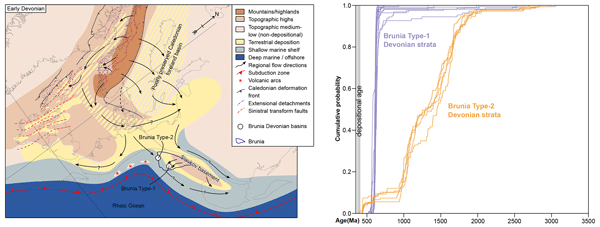
A vast Caledonian fan and an Ediacaran arc: the contrasting provenance of Devonian clastics of Brunia (Bohemian Massif)
Stephen Collett
Igor Soejono
Tomáš Kumpan
Pavel Hanžl
Jitka Míková
Nikol Novotná
Jiří Sláma
Brunia is a distinctive crustal block within the European Variscides, composed of a late Neoproterozoic arc complex overlain by Ediacaran–early Cambrian cover sequences. Sparse preservation of early Paleozoic strata obscures its pre-Variscan paleogeography. Proposed models suggest Brunia either shared a crustal domain with adjacent parts of the Bohemian Massif, represented a far-eastern extension of Avalonia accreted to Baltica in the early Paleozoic, or maintained long-term connections to Baltica since the late Ediacaran.
To address these uncertainties, we present the first systematic study of detrital zircons (both U–Pb and Lu–Hf isotopic data) from Devonian strata overlying Brunia's Neoproterozoic basement. Two distinct age-spectral patterns are identified. Type-1, widespread across Brunia, exhibit a near-unimodal late Neoproterozoic peak corresponding to locally preserved arc magmatism. Type-2, display a multimodal spectrum with significant Late Ordovician–Silurian and Paleoproterozoic–early Neoproterozoic age peaks, and only minor late Neoproterozoic input.
The Type-1 pattern reflects predominant recycling of local Brunia sources. Nearly-uniformly positive εHf(t) values in Neoproterozoic zircons contrast with the wide isotopic range typical of other Variscan terranes in Central and Western Europe, but are comparable with values from Avalonian strata in Newfoundland, supporting a Neoproterozoic link between West Avalonia and Brunia.
The Type-2 pattern broadly matches Devonian detrital zircon signatures from the British Isles, the Rhenish and Harz Mountains and parts of the Mid-German Crystalline Rise, the Dobrogea region of Romania, and NW Turkey delineating the northern margin of the Rheic Ocean. Strong similarity to Ordovician–Silurian Scandinavian datasets suggests original derivation from the Caledonides and confirms an Early Devonian connection between Brunia and Baltica.
- Article
(12255 KB) - Full-text XML
-
Supplement
(5267 KB) - BibTeX
- EndNote


The eastern termination of the European Variscan Belt is most prominently marked by the Brunia Terrane (also referred to as Brunovistulia) in the Bohemian Massif (Fig. 1a). Like the internal parts of the Bohemian Massif (Moldanubia, Teplá–Barrandia, and Saxo–Thuringia), Brunia is composed predominantly of a late Neoproterozoic magmatic arc and its (meta-)sedimentary cover (see recent review in Hanžl et al., 2025). Its western portion (Moravo–Silesian Zone) was deformed and metamorphosed during the Variscan Orogeny in the Carboniferous and now forms allochthonous nappe units thrust over a relatively undeformed para-autochthonous pre-Variscan basement to the east. The boundary between Brunia and the rest of the Bohemian Massif is represented by the Moldanubian Thrust Zone (Fig. 1b), which has long been recognized as a significant crustal-scale boundary (Suess, 1912). However, its paleogeographic significance remains the subject of ongoing debate (e.g., Soejono et al., 2010; Jastrzębski et al., 2015; Collett et al., 2021).
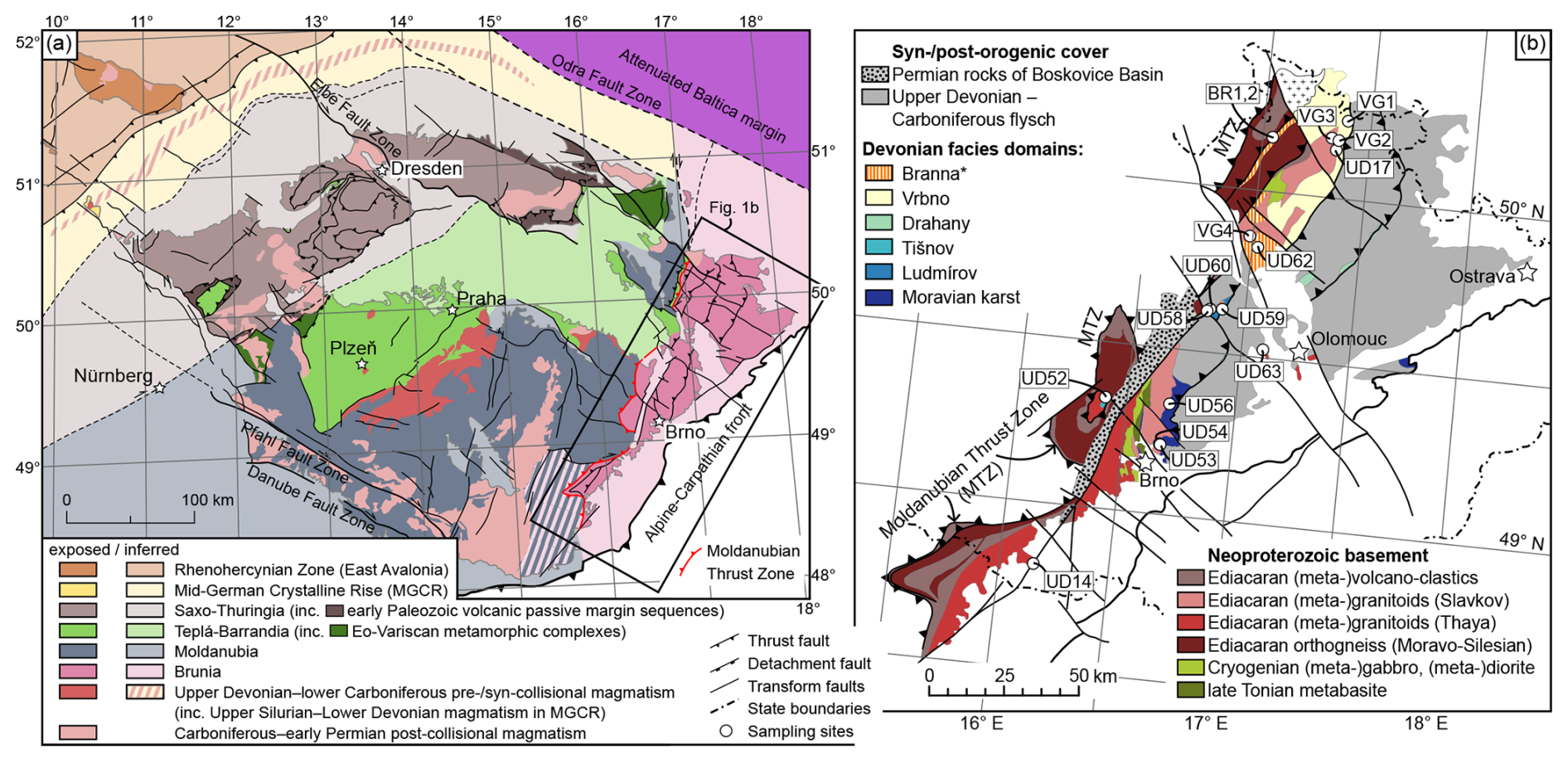
Figure 1(a) Geological map of the Bohemian Massif and adjacent parts of the Rhenohercynian Zone (modified from Martinez Catalan et al., 2021). Striped area in southern Moldanubia represents area of suspect underthrust Brunia-derived crust in the form of the Drosendorf Unit in Lower Austria. (b) Sample position in detailed view of the exposed part of Brunia highlighting the different Devonian facies domains (modified after Hanžl et al., 2019 and Kalvoda et al., 2025).
Geodynamically, Brunia acted as a rigid backstop against which the high-grade units of the internal Bohemian Massif were exhumed during the early Carboniferous (e.g., Schulmann et al., 2009, 2014). Mafic rocks are documented within the Moldanubian Thrust Zone; however, these lack true ophiolitic assemblages, and their early Cambrian age (Soejono et al., 2010; Collett et al., 2021) precludes an origin in the late Cambrian–Devonian Rheic Ocean (sensu Nance et al., 2012), which separated Laurussia from Gondwana prior to the Variscan Orogeny. These findings have led to paleogeographic models proposing that Brunia, Moldanubia, and Teplá–Barrandia formed a single crustal domain already in the late Neoproterzoic (e.g., Schulmann et al., 2009, 2014; Soejono et al., 2022). This view is tentatively supported by similarities in detrital zircon spectra from Ediacaran (meta-)sedimentary rocks across these three units (Košler et al., 2014; Soejono et al., 2022) as well as stratigraphic correlations between Devonian–Carboniferous successions in Brunia and those of the southern Variscan foreland in the Massif Central and Pyrenees (e.g., Matte et al., 1990). This concept would seemingly place Brunia on the southern (Gondwana) side of the Rheic Ocean prior to Variscan owing to the established Gondwana affinity of Teplá–Barrandia (e.g., Krs et al., 2001).
However, this interpretation is somewhat challenged by paleomagnetic and faunal data, which suggest an Ediacaran to early Cambrian connection between Brunia and Baltica (e.g., Belka et al., 2002; Nawrocki et al., 2004, 2021). However, the Neoproterozoic arc magmatism that forms the bulk of Brunia's basement is difficult to reconcile with the coeval rift-to-passive-margin evolution observed in the adjacent Polish–Ukrainian sector of Baltica (e.g., Poprawa et al., 1999, 2018).
Recent geochronological and isotopic studies have highlighted strong affinities between Neoproterozoic magmatism in Brunia and that in the West Avalonian terranes of Atlantic North America (see Krmíčková et al., 2025 and references therein). Collett et al. (2022a) and Collett (2025) further argue that detrital zircon spectra from Ediacaran parageniss and migmatites in Brunia correlate more closely with West Avalonia than with other components of the Bohemian Massif. West Avalonia was part of the Paleozoic Avalonian microcontinent, which is characterized by its late Ediacaran to Ordovician overstep sequence, its drift from Gondwana, and accretion to Baltica/Laurentia during the Ordovician to Silurian (Murphy et al., 2023 and references therein). However, in Brunia early Paleozoic strata are largely absent, with notable exception of the latest Ediacaran–early Cambrian clastics from which Baltica-affiliated trilobites have been documented (Belka et al., 2002).
Based on this, some tectonic models propose that Brunia represents a fragment of a Neoproterozoic volcanic arc that also included West Avalonia and developed near the Amazonian margin of northern Gondwana (e.g. Finger et al., 2000; Friedl et al., 2004). In one scenario, the Brunia segment of this arc was accreted to Baltica in the Late Neoproterozoic to early Cambrian as Baltica was translated along the Gondwanan margin during the opening of the Iapetus Ocean (e.g., Lindner et al., 2021). An alternative hypothesis suggests that Brunia (and West Avalonia) had Neoproterozoic affinities with the Timanide–Uralide margin of Baltica and was displaced around this margin in response to the early Paleozoic rotation of Baltica. This model is illustrated in the paleogeographic reconstructions of Nawrocki et al. (2004) and Collett et al. (2022a).
Yet another possibility is that the allochthonous and autochthonous parts of Brunia have contrasting paleogeographic origins: the former being derived from Avalonia, and the latter representing a long-term component of Baltica. These domains may have been juxtaposed along transform faults following the Silurian docking of Avalonia with Baltica (e.g., Oczlon et al., 2007).
Resolving these competing interpretations is complicated by the limited early Paleozoic record in Brunia. Apart from the upper Ediacaran–lower Cambrian clastics, Ordovician strata preserved in deep boreholes along Brunia's eastern margin, and an exotic Silurian slice within Carboniferous flysch nappes, the succession is largely absent up to the Lower Devonian (Kalvoda et al., 2025, and references therein). Devonian strata are regionally extensive, deposited in disconnected, extensional basins, and begin with clastic successions (the so-called “Basal Clastics”). These are followed by the development of a Middle Devonian to early Carboniferous carbonate platform in more proximal parts of the basin (Hladil, 1994; Kalvoda et al. 2008, 2025). In the northern allochthonous units, the distal parts of the Devonian–Carboniferous basin are characterized by deep-marine shales and volcanic rocks of either back-arc or within-plate affinity (Janoušek et al., 2014).
Even the interpretation of these Basal Clastics is controversial. Recent geochronological studies (Jastrzębski et al., 2021; Timmerman et al., 2023) suggest that some deposits mapped as Devonian may actually be late Neoproterozoic–early Cambrian in age. Jastrzębski et al. (2021) argued that allochthonous quartzites lacking fossils in northern Brunia have maximum depositional ages in the late Neoproterozoic and detrital zircon spectra comparable to known Ediacaran units. Timmerman et al. (2023), in contrast, dated ash layer in the lowermost parts of the Basal Clastics from the southern (par-autochthonous) part of Brunia, obtaining single-age zircon populations of ca. 550 Ma.
In this study, we present a comprehensive U–Pb and Lu–Hf isotopic analysis of detrital zircon from the Devonian clastic strata of Brunia. Our sampling targeted not only biostratigraphically constrained Devonian Basal Clastics and those with hypothesised Devonian age, but also clastic intercalations within the overlying carbonate deposits. These data are integrated with compiled data from Brunia and surrounding regions (Collett, 2025) in order to test if Devonian and late Neoproterozoic–early Cambrian strata can be distinguished on the basis of detrital zircon data and for potential links in the provenance of the Devonian strata of Brunia to the internal parts of the Bohemian Massif, Avalonia, and/or Baltica.
Brunia is a late Neoproterozoic volcanic arc terrane currently located between Baltica to the east and the highly deformed Gondwana-derived blocks of the Paleozoic Variscan orogenic belt to the west. At its western margin, parts of Brunia, specifically the Moravian and Silesian nappes, were metamorphosed during the Carboniferous Variscan Orogeny and thrust eastwards over a (para-)autochthonous Neoproterozoic basement (Suess, 1912; Schulmann et al., 1991). In the far eastern part of the terrane, borehole intersections reveal a horst structure containing Archean and Paleoproterozoic basement (Żelázniewicz and Fanning, 2020); however, it remains unclear whether this represents Brunia's basement or underthrust crust of Baltica. Paleoproterozoic gneiss is also documented in allochthonous units of the Silesian part of Brunia (Collett et al., 2021), and Mesoproterozoic gneiss in the Drosendorf Unit in Lower Austria has been attributed to Brunia despite occurring in the hanging wall of the Moldanubian Thrust Zone (Lindner et al., 2021).
Elsewhere, the crystalline basement of Brunia is dominated by Neoproterozoic magmatic rocks. The oldest of these crops out in a narrow north–south trending belt known as the Central Basic Belt, which includes a meta-volcanic segment (the Metabasite Zone) to the east and a dominantly plutonic segment (the Diorite Zone) to the west (Fig. 1b). The Metabasite Zone contains late Tonian (∼ 730 Ma) tholeiitic basalts alongside sporadic primitive rhyolitic lavas and tuffs (Finger et al., 2000; Hanžl et al., 2019; Timmerman et al., 2023). In contrast, the Diorite Zone is composed of Cryogenian (∼ 650 Ma) primitive magmatic rocks with volcanic arc affinities (Hanžl et al., 2019).
The Central Basic Belt divides two late Neoproterozoic magmatic domains with contrasting isotopic signatures: to the east, the Slavkov Domain is dominated by primitive arc-related granitoids (Finger et al., 2000; Krmíčková et al., 2025), whereas the Thaya Domain to the west consists of isotopically evolved granitoids (Finger et al., 2000; Soejono et al., 2017). Magmatism in both domains is broadly coeval, spanning the early Ediacaran (ca. 630–580 Ma) and are interpreted to reflect different segments of an Andean-type arc (see recent review in Hanžl et al., 2025).
Ordovician to Carboniferous volcano-sedimentary sequences unconformably cover the Neoproterozoic–Cambrian basement. Siliciclastic Ordovician strata are documented only from a single borehole along Brunia's northern boundary in Poland (Buła et al. 2015), while Silurian rocks are known solely from a single tectonic fragment within Carboniferous flysch (Kalvoda et al., 2025, and references therein). In contrast, Devonian to lower Carboniferous strata are widespread, deposited in rift basins typically beginning with coarse-grained clastic deposits that grade into fine-grained clastics, cherts, and limestone associations (Kalvoda et al. 2008; Fig. 2). Some of these rift basins are associated with magmatic rocks displaying supra-subduction signatures, suggesting rifting occurred in a back-arc setting (Janoušek et al., 2014). The clastic components of these Devonian basins are the primary focus of this study and are described in more detail below. During the early Carboniferous, a transition to a compressional regime associated with the Variscan Orogeny is recorded, with the latest Tournaisian to earliest Serpukhovian deep-marine siliciclastics of the Moravo–Silesian Culm Basin being deposited (Kumpera and Martinec, 1995).
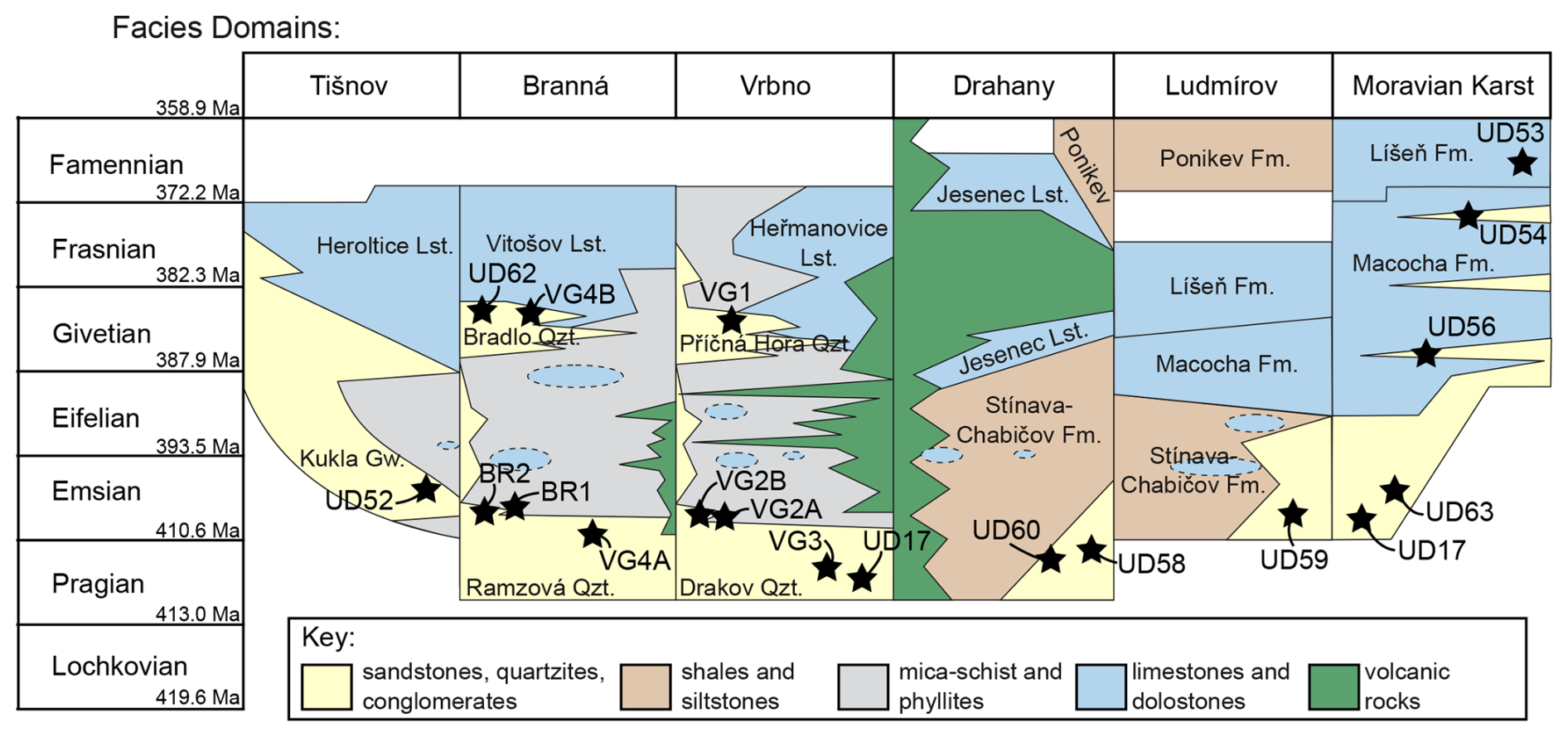
Figure 2Lithostratigraphic chart of the Devonian facies domains of Brunia with approximate stratigraphic position of the studied samples marked by black stars. Modified from Kalvoda et al. (2025).
The migmatized host rocks of the Thaya Domain granitoids contain abundant inherited zircons with Paleoproterozoic to early Neoproterozoic ages (Soejono et al., 2022), which also appear as xenocrysts in the late Neoproterozoic Bíteš orthogneiss of the Moravian nappes (Friedl et al., 2004; Soejono et al., 2017). The Bíteš orthogneiss is even more isotopically evolved than the Thaya Domain granitoids (Soejono et al., 2017); whereas orthogneiss in the Silesian nappes show isotopic and geochronological range overlapping both the Thaya and Slavkov domains granitoids (Hegner and Kröner, 2000; Hanžl et al., 2007). Ediacaran paragneisses encountered in boreholes in southern and eastern Brunia and in outcrop in the Silesian nappes in northern Brunia yield nearly unimodal detrital zircon age spectra centred on the late Neoproterozoic (Jastrzębski et al., 2021; Soejono et al., 2022; Timmerman et al., 2023). Upper Ediacaran–Cambrian siliciclastics found in boreholes in NE part of Brunia (Silesia, SE Poland) record early terrestrial deposition followed by later marine sedimentation (Moczydłowska, 1997). Early Cambrian trilobites within this succession have apparent Baltica affintity (Belka et al., 2002) and detrital zircon spectra are similar to those recorded in the Ediacaran paragneisses with late Neoproterozoic maxima (Habryn et al., 2020).
2.1 Stratigraphy and depositional settings of siliciclastics in Brunia Devonian basins
The Devonian volcano-sedimentary cover of the Brunia basement occurs in several distinct tectonic units and outcrop areas (Fig. 1b). Each of these units represents record of specific settings in basin-depth transect. The shallowest marine environments are represented by the Moravian Karst and Tišnov facies domains, which are dominated by carbonate platform deposits and preserved as (para)autochthonous units (Figs. 1 and 2). In contrast, the platform-to-basin transition Ludmírov Facies Domain together with the more distal Vrbno and Drahany facies domains are preserved in allochthonous units incorporated into the Culm nappe structures, which crop out in narrow tectonic belts (Zukalová and Chlupáč, 1982; Kalvoda et al., 2025).
2.1.1 Moravian Karst Facies Domain
The clastic formation situated between the Neoproterozoic Brno Massif and the carbonates of the shallow marine Devonian Macocha Formation was traditionally interpreted as Devonian continental deposits and referred to as the Devonian Basal clastic formation (Zukalová and Chlupáč, 1982). However, subsequent analysis of drill cores from subsurface occurrences beneath the Western Carpathians revealed deposits containing marine Ediacaran to early Cambrian acritarchs, overlain by clastics with Devonian acritarchs and palynomorphs (Mikuláš et al., 2008; Vavrdová and Dašková, 2011).
Sedimentological and ichnological evidence has led to a reinterpretation of both of these deposits as representing alluvial and braided delta systems prograding into a marine basin. This interpretation explains the observed alternation of continental, brackish, and marine facies (Mikuláš et al., 2008; Vavrdová and Dašková, 2011). The majority of the drilled strata are now considered lower Cambrian in age, consisting of less mature clastics compared to the thinner, overlying Devonian succession (Mikuláš et al., 2008).
A late Neoproterozoic age for the lowermost part of the clastic strata within the Moravian Karst is supported by radiometric dating of a tuffitic interbed (551 ± 1 Ma; Timmerman et al., 2023). Additionally, the lower portions (Neoproterozoic to Cambrian?) of the exposed clastic strata are generally less mature than the upper parts (Devonian?). Exceptionally large outcrops of clastic strata along the Metabasite Zone in the central Brno Massif (Babí lom Zone) exhibit sedimentological features indicative of deposition in an alluvial environment, including debris flow, braided river, and meandering river facies (Nehyba et al., 2001; Wojewoda et al., 2015). The presence of meandering river deposits and mature quartzose conglomerates tentatively supports a Devonian age, as meandering rivers are considered rare in the largely unvegetated pre-Devonian landscape (Gibling and Davies, 2012).
Consequently, similarly mature facies sampled from the Moravian Karst Facies Domain outcrop at Skalky in the Čelechovice area (sample UD63, Fig. 3a) are also assigned to the Devonian. With a considerable degree of reservation, we also assign the clastic formation overlying the Dyje Massif at Tasovice near Znojmo (sample UD14) to the Moravian Karst Facies Domain and to the Devonian. However, distinguishing between Ediacaran–Cambrian and Devonian clastic strata in the Moravian Karst, Čelechovice and Tasovice outcrops remains challenging due to the lack of definitive paleontological evidence. The age of the upper boundary of the basal clastic formation is inferred based on the surrounding earliest limestone beds, which yield Late Emsian to Early Eifelian corals in the Moravian Karst and Čelechovice (Hladil, 1994).
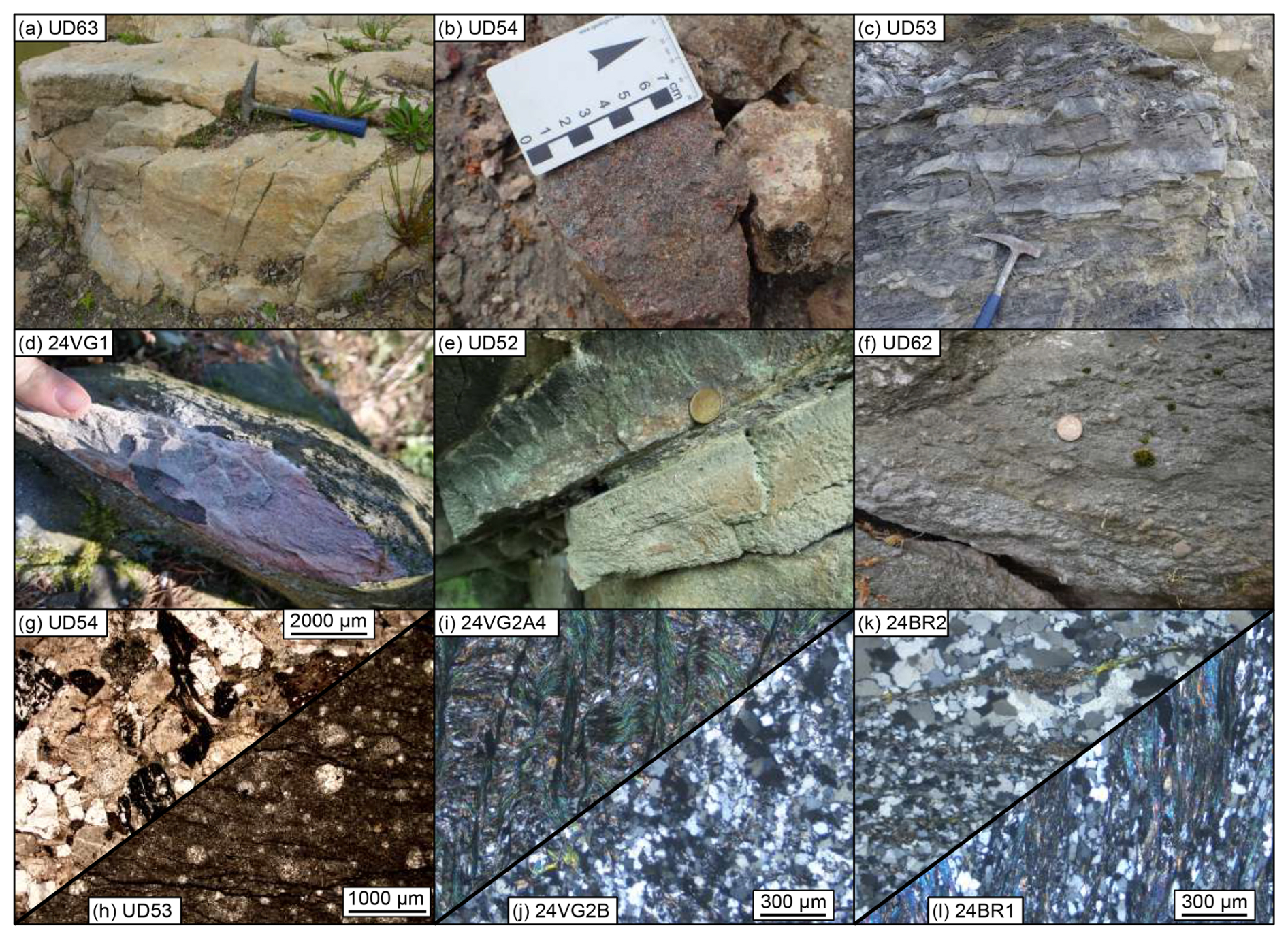
Figure 3Selected field photographs and thin section photographs from representative samples. Refer to Table 1 for location and description of each sample.
A more reliable chronostratigraphic framework is available for clastic wedges within the fossiliferous limestones of the Macocha Formation. In this study, we sampled Lower Givetian immature sandstone between the 1st and 2nd megacycles (Lažánky–Za Zrcadlem, UD56) and Upper Frasnian petromictic conglomerate between the 3rd and 4th megacycles (Brno–Hády, UD54, Fig. 3b and g). These clastic wedges reflect the progradation of continental facies into the carbonate platform during regression phases. The clastic intercalations between the 1st and 2nd megacycles show upward coarsening from shales to sandstones, likely indicating a transition from marginal marine to continental environments (Hladil et al., 1999). The reddish petromictic Hády conglomerate at the base of the 4th megacycle contains diverse association of magmatic, metamorphic and sedimentary rocks, including Devonian limestones (Krmíček and Přichystal, 2007), and represents an alluvial breccia.
The stratigraphically youngest sample (UD53) comes from the lowermost part of the Líšeň Formation, where marlstones to silty limestones alternate with conodont-bearing limestones of Lower Famennian age (Fig. 3c and h). Paleontological and sedimentological evidence consistently indicate a deep-marine lower slope setting, characterized by distal turbidite deposition (Kumpan et al., 2021).
2.1.2 Ludmírov Facies Domain
The Ludmírov Facies Domain consists of a shaly succession of the Stínava–Chabičov Formation, which laterally transitions from basal clastic strata in its lower part into limestones of the Macocha Formation in its upper part. Sample UD59 was collected at Jalovčí (Fig. 1), where quartzose conglomerates and sandstones provided Late Emsian fauna, including brachiopods, crinoids, and corals (Chlupáč and Svoboda, 1963), indicating nearshore marine conditions. Overlying parts of the Stínava–Chabičov Formation yields a biostratigraphically well-constrained Late Emsian to Early Eifelian marine fauna, documenting a progressive marine transgression (Havlíček and Mergl, 1990).
2.1.3 Drahany Facies Domain
The Drahany Facies Domain is dominated by shales and slates of the Stínava–Chabičov Formation, which interfinger with basaltic volcanoclastics and the Jesenec Limestone associated with volcanic elevations. The basal clastics consist of relatively immature conglomerates and sandstones deposited under marine conditions, as evidenced by the presence of brachiopods, corals, and crinoids (Chlupáč and Svoboda, 1963). Coarser siliciclastic deposits at the base of the succession were sampled at Šubířov (UD58, Fig. 1) and Liškovy Skály (UD60, Fig. 1). The stratigraphic position beneath the overlying Stínava–Chabičov Formation suggests an Early Emsian or possibly Pragian age for these basal clastics (Chlupáč 1961, 2000).
2.1.4 Vrbno Facies Domain
In the Vrbno Facies Domain, the basal Drakov Quartzite is recognized as a regionally significant correlative horizon. Brachiopods and other macrofauna constrain its depositional age to the Pragian–Emsian interval (Chlupáč, 1989). The protolith consists of mature quartzose sandstone (UD17, 24VG3, 24VG2B; Fig. 3j). Marine fauna–including bivalves, brachiopods, and trilobites confirm deposition in nearshore settings above the fair-weather wave base, an interpretation further supported by the presence of the ichnofossil Arenicolites. Intervals containing abundant chlorite–muscovite phyllite (24VG2A, Fig. 3i) intercalations likely represent more distal environments situated between the fair-weather and storm wave bases.
The overlying succession of schists, metabasites, and quartzites is assigned to the Middle and Upper Devonian based on its stratigraphic position and the occurrence of sparse conodonts and microfossils within carbonate intercalations (Koverdynský and Zikmundová, 1966; Hladil et al., 1987). The Heřmanovice Limestone, found in the upper part of the sequence, is dated as Givetian–Frasnian in age (Hladil et al., 1999), which places the underlying Příčná Hora Quartzite (24VG1; Fig. 3d) in the Givetian. This age assignment is further corroborated by its correlation with the Bradlo Quartzites of the Branná Facies Domain (Fig. 2 and below).
2.1.5 Tišnov Facies Domain
Sample UD52 (Fig. 3e) was taken from the thick Kukla Greywacke, which is biostratigraphically constrained to the Emsian, Eifelian, and Givetian based on palynomorphs and brachiopods (Hladil et al., 1999). The Kukla Greywacke consists of immature, matrix-rich sandstones interbedded with slates and petromictic conglomerates that also contain limestone clasts. Petrological and paleontological evidence indicate a marine origin, with deposition likely occurring as slope sediments from submarine gravity flows.
Higher up in the sequence, the thinner successions exhibit features indicative of shallow marine or even supratidal environments (Dvořák and Skoček, 1997). This clastic sequence is overlain by carbonate rocks, which appear from the Givetian onwards, as evidenced by the presence of stromatoporoids (Koverdynský and Hladil, 1985).
2.1.6 Branná Facies Domain
The Branná Facies Domain is discriminated for the purposes of this study in light of our detrital zircon isotopic data. It shows transitional features between the distal Vrbno Facies Domain (lower part of the succession; Koverdynský, 1993) and the proximal Tišnov Facies Domain (the upper part of the succession with limestones; Koverdynský and Hladil, 1985). The basal Ramzová Quartzite (24BR1, 2; 24VG4B) of the Branná Group is unfossiliferous and has been correlated with the Lower Devonian Drakov Quartzite based on lithostratigraphic relationships (Fig. 3k and l) and regional mapping near Jeseník (Koverdynský, 1993). Similarly, the stratigraphically higher Bradlo Quartzite also lacks fossils but interfingers with the Vitošov Limestone. Givetian macrofauna identified within the Vitošov Limestone and other undifferentiated limestone bodies of the Branná Group (Koverdynský and Hladil, 1985) suggest a Givetian age for the Bradlo Quartzite (24VG4B, UD62; Fig. 3f).
The correlation of the Ramzová Quartzite with the marine Drakov Quartzite, along with the interfingering relationship between the Bradlo Quartzite and the Givetian Vitošov Limestone, strongly supports marine deposition for these quartzite units. The Bradlo Quartzite was likely deposited in nearshore marine settings along the platform margin or as siliciclastic wedges intercalated within the carbonate platform. Its high textural maturity reflects prolonged reworking in wave-dominated high-energy shallow marine environments.
Table 1Summary description of studied samples and their location. n/a = not applicable.
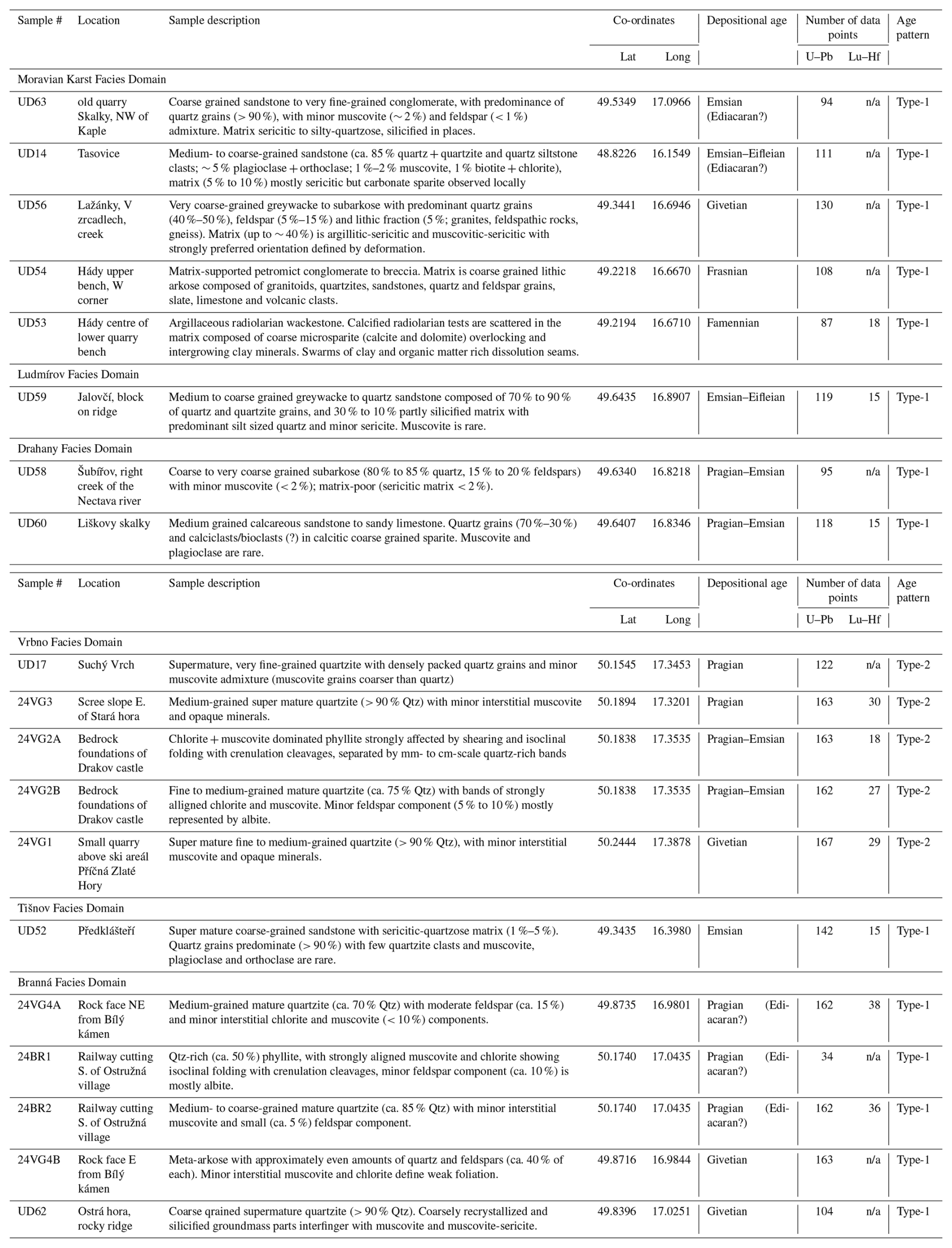
A total of 19 samples were prepared for zircon separation, the locations and summary petrographic descriptions of these samples are provided in Table 1. Zircon grains were extracted using conventional methods, including crushing, Wilfley concentration table, magnetic, and heavy liquid separations. The majority of the zircon separates were abundant (n > 1000 grains) and highly pure (> 90 % zircon). Given the high quality of the separates and to avoid unintentional biases from hand-picking, zircons were mass-mounted onto acrylic discs.
The mounted zircon grains were imaged by both back-scattered electron (BSE) and cathodoluminescence (CL) techniques using a scanning electron microscope at the Czech Geological Survey in Prague. These images guided the localization of U–Pb isotopic spots within coherent zircon domains larger than 25 µm in diameter. Lu–Hf isotopic spots (45 µm in diameter) have been located within zircon domains that yielded concordant U–Pb ages. A selection of CL images from each sample is provided in Fig. 4. Uranium–Pb zircon dating was carried out at the University of Bergen, Norway (UD14 and UD17 only) and at the laboratories of the Czech Geological Survey (all remaining samples). Lu–Hf isotopic analyses were acquired at the laboratories of the Czech Geological Survey. The methodology and analytical conditions largely follow that reported in Soejono et al. (2022) and are detailed in Sect. S1 in the Supplement. Complete reporting of isotopic data including that of reference material is given in Sect. S2.
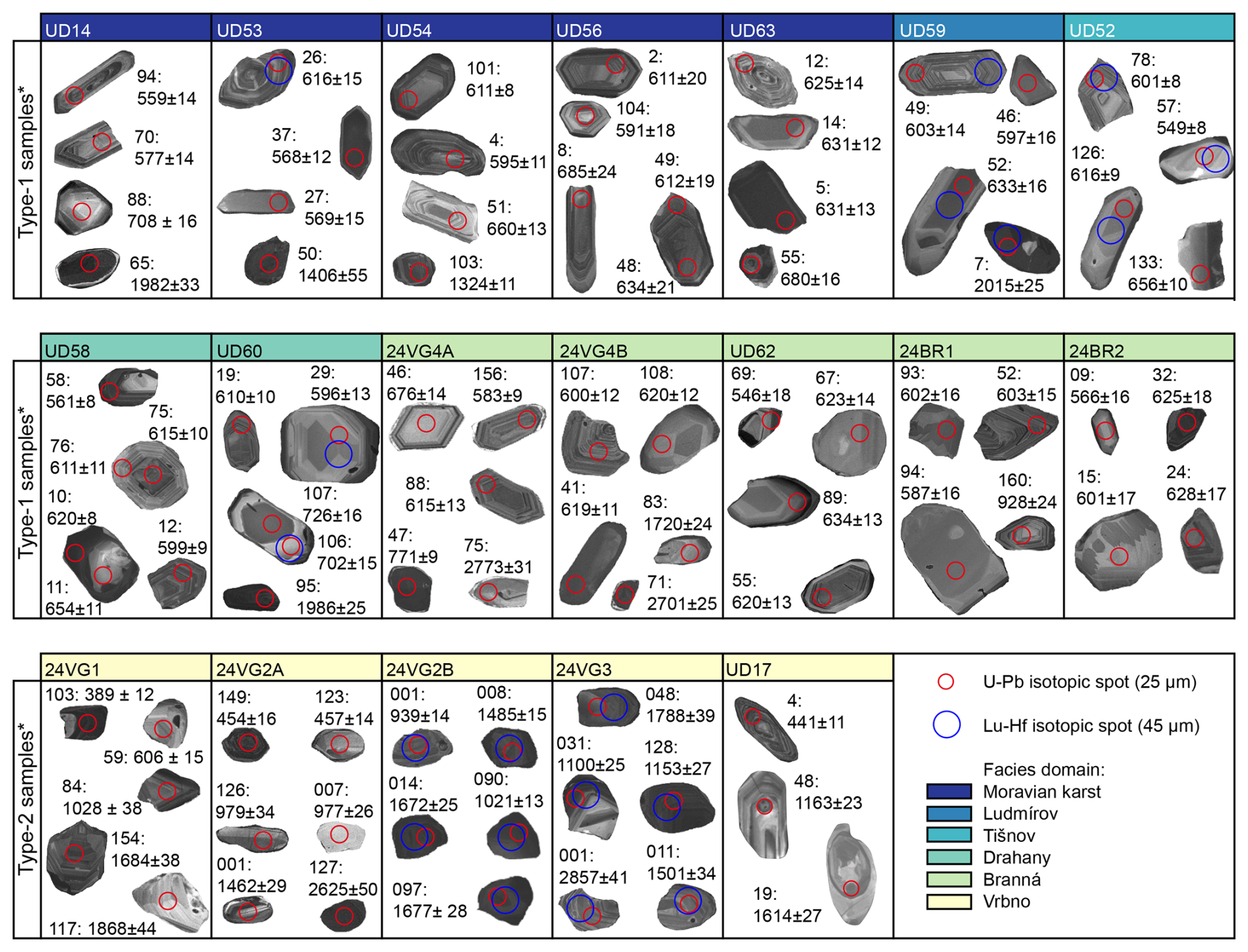
Figure 4Cathodoluminescence images of representative zircons from each sample, with positions of laser spots for U–Pb and Lu–Hf isotope analyses. All zircons in the figure gave concordant (concordia distance < 5) ages and the given age is the iterative single-grain concordia age quoted with 2s uncertainty. ∗ classification into Type-1 and Type-2 samples according to results section.
A total of 2407 U–Pb isotopic analyses were conducted on the 19 studied samples. Concordant U–Pb ages (n = 2184) are presented in both this section and Sect. 5 in the form of a cumulative age distribution plot and kernel density distribution plots. In this section and all comparative data, we follow the recommendations of Vermeesch (2021) whereby concordance is calculated from the log ratio distance to the maximum likelihood composition on the concordia line (concordia distance) and iterative single grain concordia ages are preferred for reported ages. In this study, concordant data are defined as those with a concordia distance < 5 as also applied in the zircon database established in Collett (2025).
4.1 U–Pb isotopic data
The U–Pb isotopic data reveal two internally consistent but highly contrasting datasets, which are graphically depicted in a cumulative age distribution plot (Fig. 5).
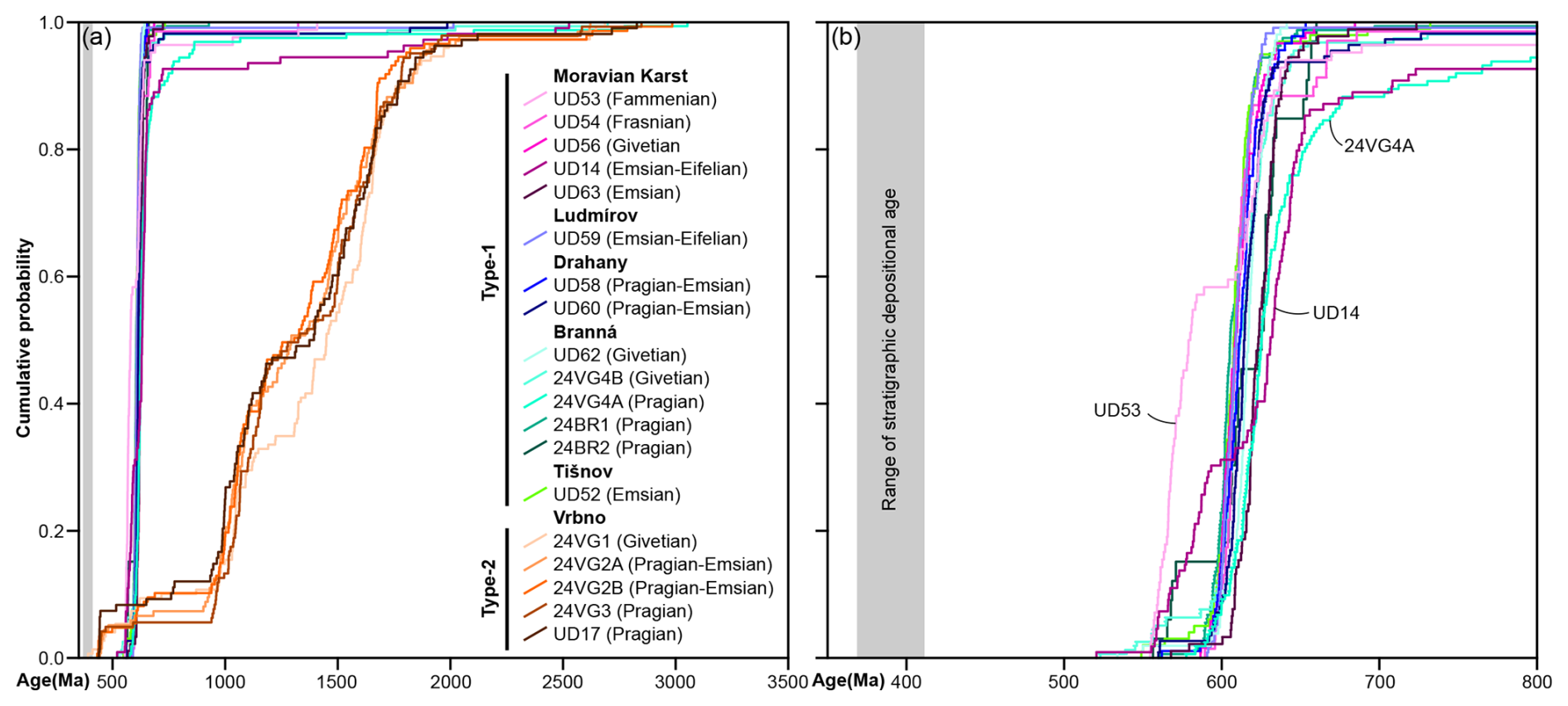
Figure 5(a) Cumulative age distribution plot of the studied samples highlighting the difference in the Type-1 and Type-2 age distributions. (b) Close-up view of the distribution of late Neoproterozoic zircons in the Type-1 group, selected samples with slightly non-standard distributions are highlighted.
Fourteen samples display nearly unimodal age distributions dominated by late Neoproterozoic zircons. Fewer than 3 % of concordant analyses yielded Tonian or older ages (> 720 Ma), and none are younger than the Terreneuvian Series of the Cambrian (< 521 Ma). These are hereafter referred to as Type-1 samples. This spectral signature occurs throughout Brunia and across all facies domains, except in the restricted Vrbno Facies Domain defined here.
Type-1 samples show minimal variation, with most ages clustering between 590–620 Ma. The main exception is the youngest sample, UD53 (Famennian, Moravian Karst), which is dominated by a 550–560 Ma population and a subordinate 590–620 Ma group. The 550–560 Ma population occurs to a lesser extent in samples UD14 (Moravian Karst), 24BR2, and 24VG4B (both Branná Group).
Samples UD14 and 24VG4A (Branná Group) stand out for a significant Cryogenian population (> 20 %), which is also present in smaller amounts across the other Type-1 samples. Additionally, 24VG4A includes a unique subset (n=10) of Tonian ages, forming minor peaks at ∼ 765 and ∼ 850 Ma. Mesoproterozoic and older grains are rare, occurring in just 7 of the 14 samples and totalling 23 analyses, with reproduced ages at ∼ 1060, 1330, 1730, 2000, 2490, and 2740 Ma (Fig. 6f).
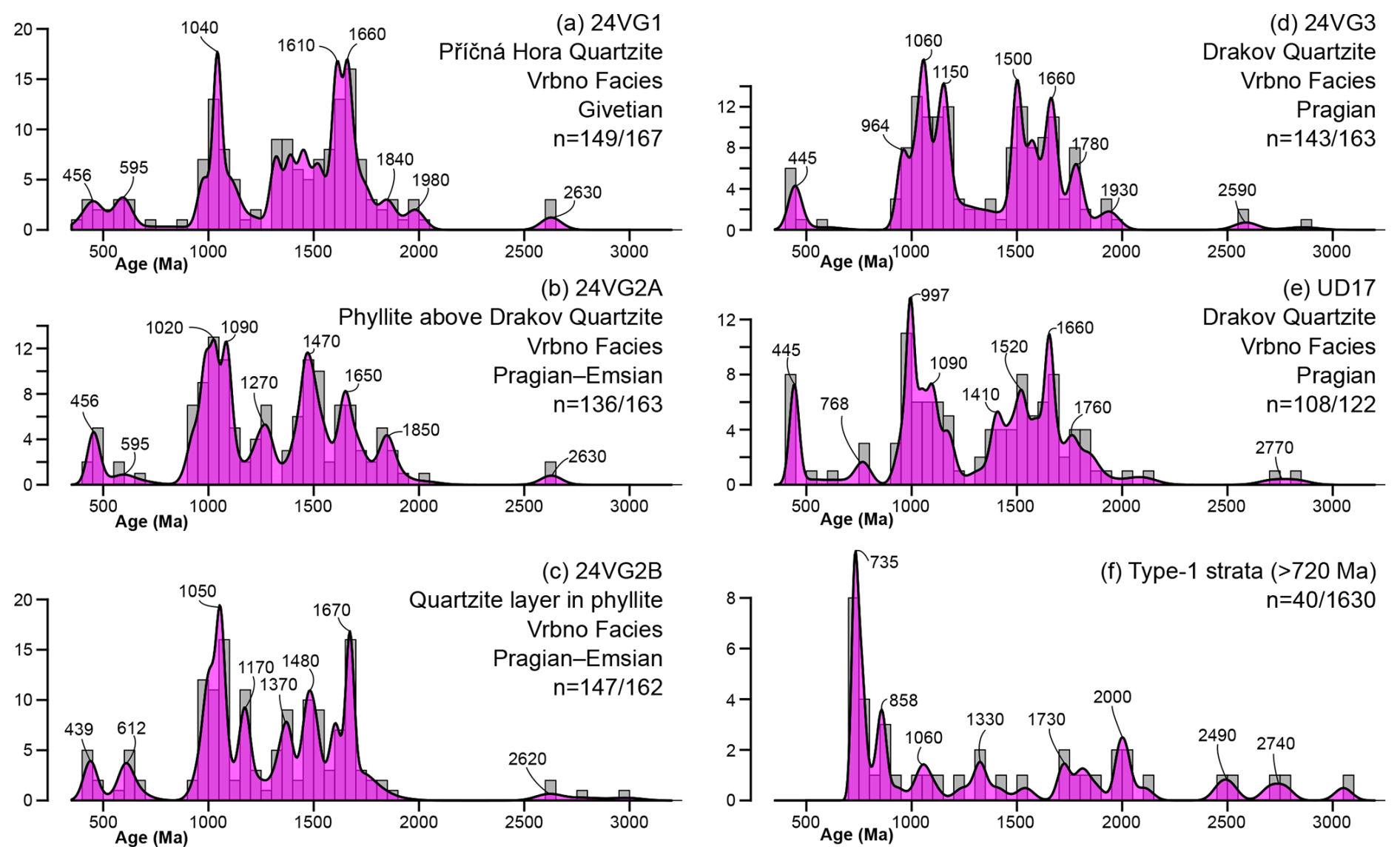
Figure 6Kernel Density Estimates and histograms for the Type-2 samples (a–e) and compiled > 720 Ma zircons in the Type-1 strata (f) for comparison.
The remaining five samples (Type-2) exhibit multimodal age distributions, with the majority of data yielding late Paleoproterozoic to early Neoproterozoic ages (Fig. 6). A total of 89 % of all concordant data points fall within the 2100–900 Ma range. These Type-2 samples are restricted to the Vrbno Facies Domain, specifically in the northern part of the Silesian Domain of Brunia.
The oldest zircons in the Type-2 samples are Mesoarchean, with a minor Neoarchean population (∼ 2600 Ma) present in all samples except UD17. A distinct age gap follows, with the next oldest grains appearing around 2100 Ma. Small age maxima occur between 1980 and 1760 Ma, followed by a significant ∼ 1670–1650 Ma peak present in all samples. Similar, consistent peaks are observed in the early Mesoproterozoic (1600–1400 Ma), whereas mid Mesoproterozoic (1400–1200 Ma) zircons are more sparsely distributed except for discrete maxima in sample 24VG2B (∼ 1370 Ma) and 24VG2A (∼ 1270 Ma). All samples contain abundant Stenian to early Tonian zircons (1200–900 Ma), with distinct peaks between 1170 and 960 Ma.
Only 20 out of 678 concordant analyses in Type-2 samples fall within the Terreneuvian to end-Cryogenian range (521–720 Ma) that dominates the Type-1 samples. Type-2 samples also include a notable Paleozoic component (n=38), mainly spanning the Late Ordovician to the Llandovery Epoch of the Silurian (458–433 Ma). Only one concordant grain, from the Givetian Příčná Hora Quartzite (24VG1), yielded a Devonian age (389 ± 12 Ma) approximating the inferred stratigraphic age.
4.2 Lu–Hf isotopic data
Zircon grains from ten representative samples were further studied using Lu–Hf isotopic analyses. These samples cover a diverse range of facies domains and stratigraphic ages. In total, 241 spot analyses were performed. Notably, the Type-2 samples are characterized by small (20–50 µm), commonly fractured zircons, which limit the grains available for the 45 µm laser spot size required in Lu–Hf isotopic analysis.
In each of the Type-1 samples, late Neoproterozoic zircons predominantly yield positive εHf(t) values, mostly within the range of +4 to +10 (Fig. 7). The main exception is sample 24VG4A, which contains a cluster of six analyses with εHf(t) values between −7.5 and −10. However, the majority of data from this sample (n=22) share positive εHf(t) values consistent with other type-1 samples. Additionally, single Late Neoproterozoic zircons in both 24BR1 and UD53 show overlapping negative εHf(t) values with the outliers from 24VG4A. Although, sample UD53 has a higher abundance of late Ediacaran (560–550 Ma) zircons compared to other samples, these late Ediacaran zircons exhibit a similar range of positive εHf(t) values as the older Ediacaran zircons in this and the other samples.
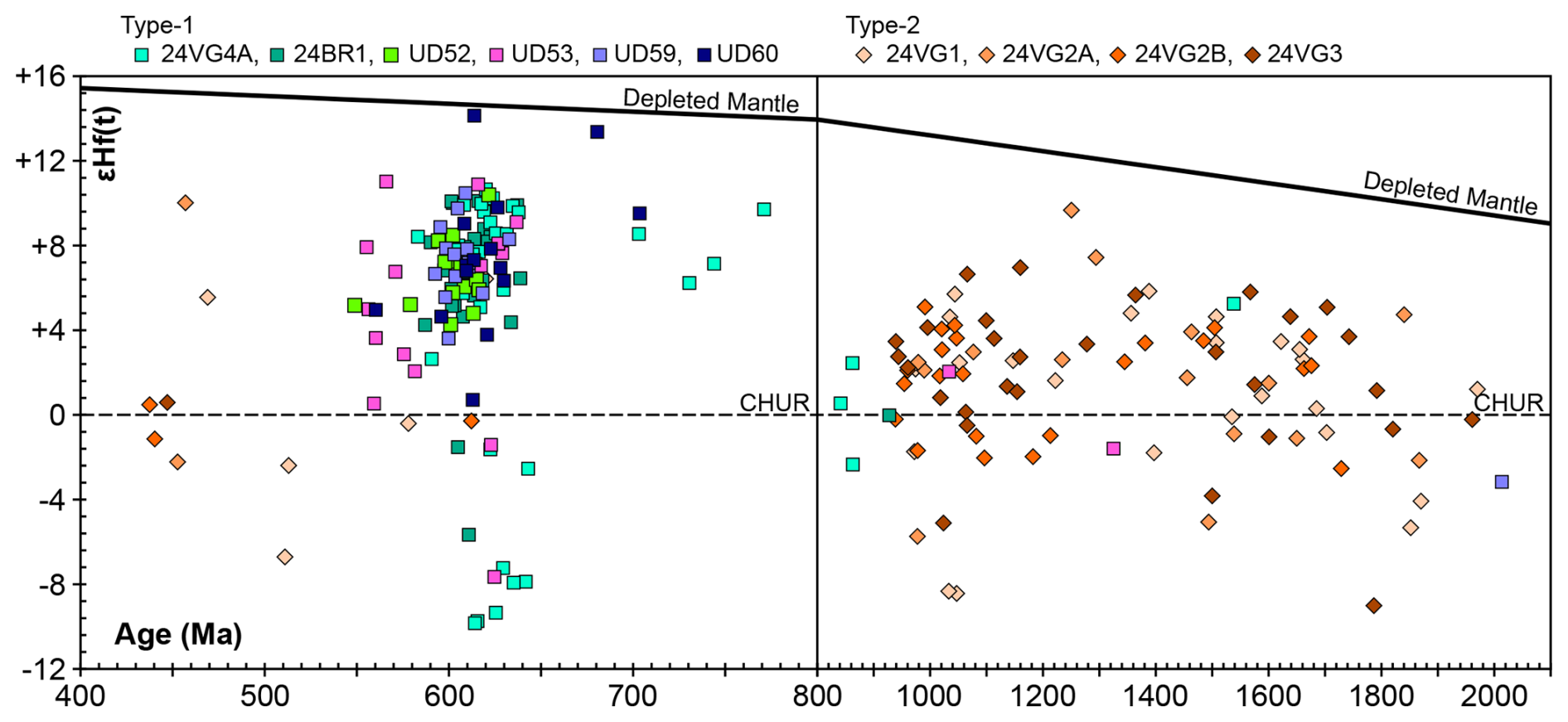
Figure 7Age versus εHf(t) plot for the studied zircons from the Brunia Devonian clastic rocks. CHUR = CHondritic Uniform Resevoir (after Blichert-Toft and Albarede, 1997), Depleted Mantle values after Chauvel and Blichert-Toft (2001).
Cryogenian zircons in sample UD60 exhibit highly positive εHf(t) values (+9.3 and +13.1), as do Cryogenian and Late Tonian zircons (n=4) in 24VG4A (+6 to +9.5). In contrast, mid-Tonian zircons in 24VG4A (∼ 850 Ma, n=3) have both weakly positive and negative εHf(t) values (−2.3 to +2.5), while a single early Tonian (∼ 930 Ma) zircon in 24BR1 has a similar εHf(t) value of −0.2. Older scattered data points from the Type-1 samples cluster near and on both sides of the CHUR line.
In the Type-2 samples, approximately 70 % of zircons aged between 2000 and 900 Ma yield positive εHf(t) values. The overall range encompasses values of −8.9 to +9.6 and the distribution forms a slight crescent shape, with the most negative εHf(t) values among the oldest and youngest populations, and the highest positive values observed in intermediate-aged zircons (1300–1250 Ma).
Two Neoarchean data points (not shown in Fig. 7) yield CHUR-like εHf(t) values (−0.2 and −0.5). Among three late Neoproterozoic zircons, one has a positive εHf(t) value (+6.1) similar to the Type-1 strata, while the other two show CHUR-like values (−0.6 and −0.7). Two Cambrian (∼ 510 Ma) zircons display negative εHf(t) values (−2.7 and −7), two Middle Ordovician zircons exhibit positive values (+5.2 and +9.7), and four Late Ordovician to Silurian zircons have CHUR-like values ranging from −2.5 to +0.3.
5.1 Sources and significance of Type-1 zircon spectra
The Type-1 zircon spectra display a nearly unimodal population centred in the late Neoproterozoic, with most Hf-in-zircon isotopic data showing highly superchondritic εHf(t) values (+4 to +10). Although a few older zircons are scattered across the early Neoproterozoic, Mesoproterozoic, Paleoproterozoic, and Archean, they are statistically insignificant. This distribution suggests that the zircon source is relatively local, with limited mixing from external sources.
The late Neoproterozoic zircon ages correspond well with granitoids and their metamorphosed equivalents widespread in the Slavkov and Thaya domains, as well as the Moravian and Silesian nappes (see Sect. 2 and Fig. 1b). However, the narrow age range and consistently positive εHf(t) values strongly point to the Slavkov Domain and Desná Dome (par-autochthonous part of Silesian nappes) as the most plausible sources. This is supported by the juvenile isotopic signatures of (meta-)granitoids in these areas ( = 0.703–0.705; εNd(580 Ma) = −1 to +4; Finger et al., 2000; Hanžl et al., 2007; Krmíčková et al., 2025).
In contrast, granitoids of the Thaya Terrane have more mature crustal signatures ( = 0.708–0.712; εNd(580 Ma) = −1 to −7; Finger et al., 2000; Soejono et al., 2017), making them less likely sources. Similarly, allochthonous meta-granitoids in the Moravian and Silesian nappes exhibit mature crustal signatures ( ≈ 0.7101; εNd(580 Ma) = −5 to −11) and contain significant xenocrystic Mesoproterozoic zircons (Hegner and Kröner, 2000; Friedl et al., 2004; Soejono et al., 2017), further excluding them as contributors.
5.1.1 Discriminating Ediacaran and Devonian clastics
Surface clastic strata of the pre-Variscan Brunia units have traditionally been assigned to Devonian basal clastics, based on limited faunal evidence and stratigraphic continuity with Devonian limestones (Zukalová and Chlupáč, 1982). However, the discovery of marine Ediacaran to early Cambrian acritarchs in borehole-derived clastics suggests some may be older (Mikuláš et al., 2008; Vavrdová and Dašková, 2011). Recent detrital zircon studies have revisited this issue. Jastrzębski et al. (2021), Soejono et al. (2022), and Timmerman et al. (2023) presented zircon age spectra from Brunia, including samples from confirmed Ediacaran units and clastics previously mapped as Devonian. Jastrzębski et al. (2021) studied samples from the Silesian nappes, while Timmerman et al. (2023) focused on the Moravian Karst Facies Domain. In both cases, strata previously mapped as Devonian clastics (Zukalová and Chlupáč, 1982) were reinterpreted as Ediacaran based on the absence of Paleozoic zircons and similarity to Ediacaran age spectra also citing earlier findings by Košler et al. (2014), who reported Cambrian zircons from a single sample. Timmerman et al. (2023) further supported their interpretation with ash layers dated to ∼ 550 Ma, though the dated samples were limited to basal part of the clastic succession in areas east of the Slavkov granitoids.
Our new data contest these reinterpretations. Paleontologically constrained Devonian clastics and interbeds within Devonian limestones consistently show unimodal zircon age spectra peaking in the late Ediacaran. To assess the reliability of distinguishing Ediacaran–Cambrian from Devonian units via zircon geochronology, we compiled and compared all published Brunia detrital zircon datasets (Fig. 8).
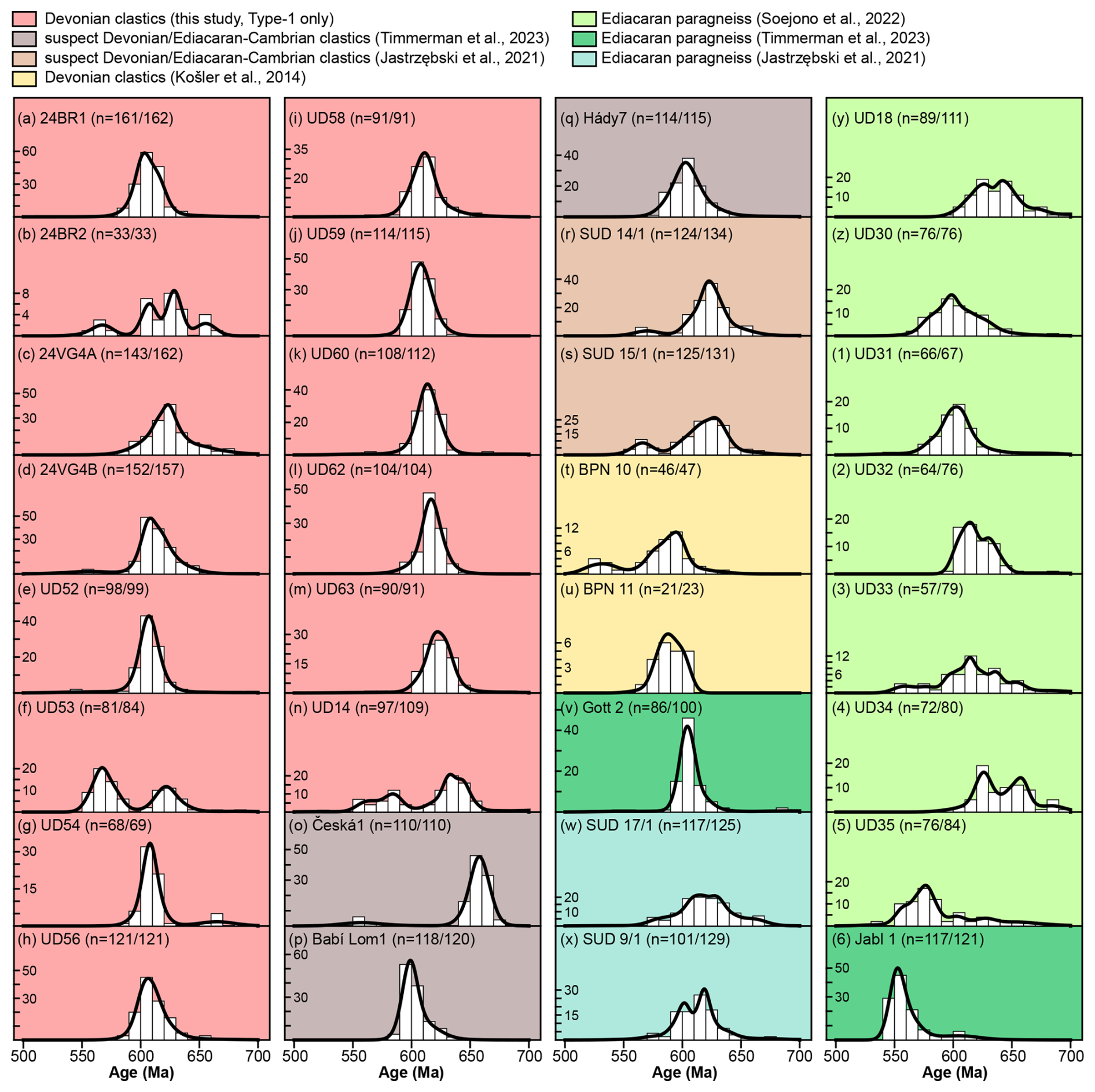
Figure 8Compiled detrital zircon data in the 700–500 Ma range from Brunia (meta-)sedimentary rocks that exhibit a near unimodal late Neoproterozoic age peak. N value represents the number of concordant (concordia distance < 5) zircons in the 700–500 Ma range versus total number of concordant grains. The data used in the construction of this figure was compiled in Collett (2025).
The compiled data clearly show that both Ediacaran paragneiss and Devonian strata are characterized by nearly identical unimodal zircon age spectra, with peaks in the late Neoproterozoic. While the Ediacaran amphibolite-facies meta-sedimentary samples typically exhibit broader age distributions and a slightly higher proportion of older zircons, these differences are minor and insufficient for reliable stratigraphic differentiation. Some variation in peak ages exists. For example, sample Česká1 (Timmerman et al., 2023) is from thin belt of clastic strata (Babí lom Zone) between the Central Basic Belt and the Slavkov Domain granitoids, detrital zircon data from this sample peaks near ∼ 650 Ma, likely reflecting proximity to ∼ 650 Ma meta-igneous rocks (Hanžl et al., 2019). Sample Jabl1, an Ediacaran paragneiss from the Brunia basement has a distinct ∼ 550 Ma peak, but its interpretation is uncertain, as Timmerman et al. (2023) did not examine hand specimens or thin sections. Thus, it appears from the data compilation that U–Pb detrital zircon isotopic data alone is not able to discriminate between Ediacaran–early Cambrian and Devonian strata.
Nonetheless, potential subtle differences can be discerned from Hf-in-zircon isotopic data (Fig. 9). Ediacaran meta-sedimentary rocks (Soejono et al., 2022) include ∼ 600 Ma zircons with both positive and slightly negative (centred around −2) εHf(t) values, while Devonian strata analyzed here generally lack this slightly negative component (Fig. 9a). In addition, the group of ca. 600 Ma zircons with even more negative εHf(t) values in sample 24VG4A are not represented in the data from Ediacaran meta-sedimentary rocks. Tentatively, the former finding may indicate that both Slavkov and Thaya terrane granitoids (or isotopically similar sources) were exposed to erosion during the Ediacaran, with only Slavkov sources contributing detritus during the Devonian. However, further Hf isotope data are needed to test this hypothesis.
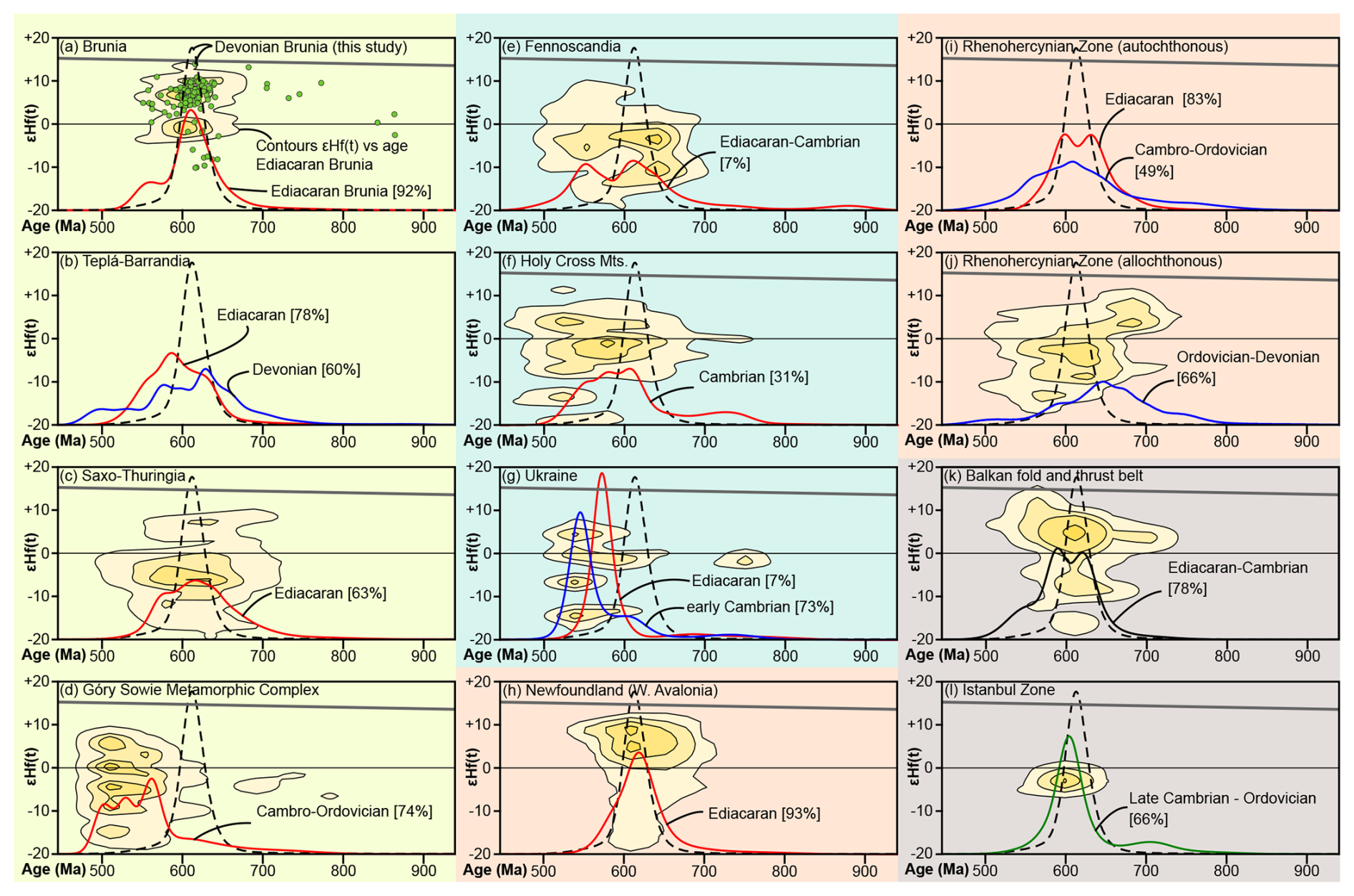
Figure 9Compiled U–Pb and Lu–Hf isotopic data from Neoproterozoic–early Paleozoic zircons in the Bohemian Massif (a–d), SW marginal Baltica (e–g) and Avalonian (h–j) and Far-East Avalonia (k, l) Ediacaran – Devonian strata. Number in parantheses equals the percentage of all concordant zircon analyses in the range 900–485 Ma. Contours of εHf(t) vs. age constructed using detzrcr software of Andersen et al. (2018). Data sources: (a) Brunia: Devonian: this study only; Ediacaran: Jastrzębski et al. (2021); Soejono et al. (2022); Timmerman et al. (2023). (b) Teplá–Barrandia: Devonian: Drost et al. (2011); Strnad and Mihaljevič (2005); Žák and Sláma (2018); Ediacaran: Drost et al. (2011); Hajná et al. (2017, 2018, 2019); Kurzweil et al. (2015); Pašava et al. (2021); Žák et al. (2020, 2025). (c) Saxo–Thuringia: Linnemann et al. (2007, 2014, 2018); Collett et al. (2020); Kühnemann et al. (2025). (d) Góry Sowie Metamorphic Complex U–Pb: Tabaud et al. (2021); Jastrzębski et al. (2025). (e) Fennoscandian shield: Sláma (2016); Lorentzen et al. (2018); Linnemann et al. (2024); Slater et al. (2025); Ziemniak et al. (2025). (f) Holy Cross Mts.: Callegari et al. (2025); Dörr et al. (2022); Żelaźniewicz et al. (2020). (g) Ukraine: Ediacaran: Francovschi et al. (2023); Paszkowski et al. (2021); early Cambrian: Paszkowski et al. (2021). (h) Newfoundland: Beranek et al. (2023); Gomez et al. (2025); Mills et al. (2024); Ortiz and Lowe (2024); Pollock et al. (2009). (i) Rhenish Massif: Ediacaran: Dörr et al. (2019); Linnemann et al. (2024); Cambro-Ordovician: Herbosch et al. (2020); Linnemann et al. (2012); Willner et al. (2013). (j) Rhenohercynian allochthon: Eckelmann et al. (2014); Mende et al. (2019); Linnemann et al. (2024). (k) Balkan Fold and Thrust Belt: Žák et al. (2026). (l) Istanbul Zone: Ustaömer et al. (2011); Yılmazer et al. (2025).The compiled data used to construct this figure are provided in Sect. S3.
5.1.2 Regional paleogeographic significance
Since it is interpreted that the Type-1 zircon spectra predominantly reflect erosion of local sources within the Slavkov Domain (or isotopically equivalent units), these data provide limited direct constraints on the Devonian paleogeography of Brunia. Nonetheless, the detrital zircon record offers insights into Neoproterozoic correlations with other terranes, particularly the internal Bohemian Massif, Baltica's SW margin, and Avalonian terranes (see Sect. 1).
Previous studies (e.g., Košler et al., 2014; Soejono et al., 2022) suggested links between late Neoproterozoic magmatism in Brunia and thick Ediacaran to early Cambrian successions within the internal Bohemian Massif, known for their abundance of late Neoproterozoic zircons. However, when comparing detrital zircon data from Brunia to other units in the Bohemian Massif, a key distinction arises: Ediacaran to Cambrian strata elsewhere in the Bohemian Massif exhibit more diverse detrital sources, characterized by broader Neoproterozoic age maxima and significant (> 20 %) contributions of Paleoproterozoic zircons (Fig. 9b–d). Where hafnium isotopic data exist; for example, from Ediacaran strata in Saxo–Thuringia (Linnemann et al., 2014, 2018) and Cambro–Ordovician paragneiss of the Góry Sowie Metamorphic Complex (Tabaud et al., 2021), a significantly wider range of εHf(t) values is observed, including abundant zircons with negative εHf(t) signatures (Fig. 9b and d). This contrasts with the more restricted and generally positive εHf(t) values observed in Brunia samples.
These differences suggest that, while Brunia may have contributed some late Neoproterozoic detrital material to Saxo–Thuringia or Teplá–Barrandia, these regions also received detritus from additional sources beyond the Brunia catchment. Consequently, and in contrast to the model proposed by Soejono et al. (2022), if Brunia and the internal Bohemian Massif domains (Teplá–Barrandia, Saxo–Thuringia) shared a Neoproterozoic relationship, it is more plausible that Brunia occupied an oceanward (fore-arc) position relative to the cratonward (back-arc) position of Teplá–Barrandia and Saxo–Thuringia.
Alternatively, recent U–Pb zircon data from southwestern Baltica indicate a significant input from a source region characterized by late Neoproterozoic primitive magmatism, with Brunia considered one of the more plausible candidates. However, these late Neoproterozoic zircons; identified across a broad region from the Fennoscandian Shield (Sláma, 2016; Fig. 9e), through the Holy Cross Mountains in Poland (Callegari et al., 2025; Fig. 9f), to the western margin of the Ukrainian Shield (Paszkowski et al., 2021; Fig. 9g), show more diverse sources than those found in either the Ediacaran or Devonian of Brunia. In particular, Baltica's marginal strata contain a significant component of latest Ediacaran to Cambrian zircons with varied εHf(t) signatures notably absent in Brunia. The isotopic and age similarities between these zircons and those from the Góry Sowie Metamorphic Complex in the Bohemian Massif (Fig. 9d) led Collett et al. (2022a) to propose a paleogeographic link between Baltica and the Góry Sowie Metamorphic Complex.
Recent chronological and isotopic work on the Neoproterozoic Brunia basement has led to discussion on the similarity between arc magmatism in Brunia and West Avalonia (e.g. Krmíčková et al., 2025). This correlation is re-emphasized by comparison of our detrital zircon data with both U–Pb and Lu–Hf detrital zircon data from late Neoproterozoic strata of the Avalon Peninsula, Newfoundland (e.g., Beranek et al., 2023; Gómez et al., 2025). The West Avalonia late Neoproterozoic strata exhibit strikingly similar detrital zircon spectra to Brunia's, with over 90 % of all zircons in the 900–485 Ma range and dominance of positive εHf(t) values within these zircons (Fig. 9h).
Ediacaran strata are rare in the East Avalonian terranes of Central Europe, but detrital zircon data from the Ediacaran Wartenstein Gneiss in the southern part of the Rhenish Massif (Dörr and Stein, 2019; Linnemann et al. 2024) exhibit a concentrated ∼ 600 Ma maxima (Fig. 9i) resembling the data from Brunia (Fig. 9a). However, Cambrian–Ordovician strata differ in that they display a broader range of Neoproterozoic ages and considerably greater proportion of older than Neoproterozoic zircons. Autochthonous Devonian strata from the Rhenohercynian zone yield spectra comparable to Brunia's Type-2 Devonian strata and are discussed in the next section (Sect. 5.2). Limited Hf-in-zircon isotopic data are available for autochthonous Rhenohercynian strata. Significant data are available from allochthonous Ordovician–Devonian units (in Mende et al., 2019), however, these reveal isotopic diversity similar to Saxo–Thuringia (Fig. 9j), suggesting Brunia is unlikely to be a source for these units.
Avalonian-associated terranes are thought to also continue SE from Brunia around the Moesian Platform and in the Istanbul Zone in NW Turkey. Recent U–Pb and Lu–Hf zircon isotopic data (in Žák et al., 2026) from the Balkan Fold and Thrust Belt (southern margin of the Moesian Platform) reveal similar ca. 600 Ma maxima and positive εHf(t) values to those observed in Brunia (Fig. 9k). In the Dobrogea region (north-eastern part of the Moesian Platform) late Neoproterozoic–early Cambrian turbidites with ∼ 600 Ma maxima are also present, but these also contain significant proportions (> 75 %) of older detrital components (not depicted in Fig. 9). Nonetheless, some Paleozoic strata with unimodal ∼ 600 Ma maxima have also been identified in boreholes in this region (e.g., GM-087 in Balintoni and Balica, 2016), though the stratigraphic age of this sample is poorly constrained. In the Istanbul Zone, late Cambrian–Ordovician strata also show ∼ 600 Ma maxima, but Hf isotopic data (in Yılmazer et al., 2025) cluster near slightly negative εHf(t) values (Fig. 9l), contrasting with the positive values in the Brunia Devonian strata. Nonetheless, these data overlap with the slightly negative εHf(t) values in Brunia's Ediacaran strata, which suggests an isotopic equivalent of the Thaya Terrane was exposed near the Istanbul Zone in the early Paleozoic.
Overall, these comparisons support Brunia as a segment of the Neoproterozoic Avalonian arc, fragments of which are today scattered along Baltica's southwestern margin. While Avalonia's Neoproterozoic provenance is debated (Baltica vs. Amazonian Gondwana affinity; see Murphy et al., 2023 or Beranek et al., 2023), its Paleozoic drift from Gondwana and accretion to Baltica/Laurentia are better constrained. Thus, if there was a Neoproterozoic link between Brunia and West Avalonia this was likely already broken by the early Cambrian since faunal and paleomagnetic data suggest that Brunia was already accreted to Baltica by this time (Belka et al., 2002; Nawrocki et al., 2004, 2021). Nonetheless, it is important to highlight that Brunia was probably not the primary source of late Neoproterozoic and early Cambrian detrital zircons found in Baltica's Cambrian strata as was previously suggested in Collett et al. (2022a).
5.2 Sources and significance of Type-2 zircon spectra
5.2.1 An internal Brunia-derived source?
The Type-2 zircon spectra are dominated by zircons with isotopic ages between 1800 and 900 Ma, with minor contributions of Neoarchean (∼ 2600 Ma), Ediacaran (∼ 600 Ma), and Late Ordovician–Silurian (460–430 Ma) zircons. Samples with similar abundances of late Paleoproterozoic to early Neoproterozoic zircons have previously been documented from Brunia (e.g., Soejono et al., 2022). These include the migmatitic host rocks of the Thaya Domain granitoids, which must predate the ca. 630–580 Ma emplacement of these granitoids, as well as the Bílý Potok Group of uncertain age, exposed above the Dřínová Thrust in the Moravian Nappes. This Variscan thrust separates the Devonian cover (Tišnov Facies Domain, sample UD52, this study) of the Neoproterozoic basement from the allochthonous Moravian nappes.
Additional samples rich in 1800–900 Ma zircons include a mica-schist from the Velké Vrbno Dome, the westernmost nappe of the Silesian Domain (Jastrzębski et al., 2021), and a paragneiss from the Drosendorf Unit in Lower Austria (Sorger et al., 2020). While the Drosendorf Unit lies in the hanging wall of the Moldanubian Thrust, Sorger et al. (2020) consider it an underthrust segment of Brunia and notably, it also contains exotic Mesoproterozoic (∼ 1400 Ma) meta-igneous rocks (Lindner et al., 2021). Clasts rich in 1800–900 Ma zircons are also documented by Timmerman et al. (2023) within their Basal Clastics, and similar-aged zircons occur as xenocrysts in Ediacaran meta-igneous rocks, most prominently within the Bíteš orthogneiss (Soejono et al., 2017). Though a minor component, 1800–900 Ma zircons are also present in the Ediacaran paragneiss and in Type-1 Devonian samples analyzed in this study.
Crucially, the distribution of these 1800–900 Ma zircons is not uniform across all samples, enabling the identification of three distinct provenance signatures. This classification was first proposed by Collett (2025) and is further refined here using Multi-Dimensional Scaling (MDS), a statistical technique that visualizes similarities in age distributions by plotting samples with similar spectra closer together and dissimilar ones further apart (Vermeesch, 2013).
In the resulting MDS plot (Fig. 10), the combined > 800 Ma components of the Type-1 strata and the Ediacaran paragneiss cluster closely with the Bílý Potok Group (sample UD11) and a clast from Timmerman et al. (2023)'s Basal Clastics (Hády-1), collectively referred to as Cluster-1. A second cluster (Cluster-2) includes the host rocks of the Thaya Domain granitoids (UD16 and UD23), the Velké Vrbno Dome sample (SUD42/3), the Drosendorf Unit (DR), xenocrystic components in the Bíteš orthogneiss, and a second clast from Timmerman et al. (2023)'s Basal Clastics (Bil-4). Notably, the Type-2 strata analyzed in this study form a distinct third cluster (Cluster-3), isolated from the other two groups in MDS space.
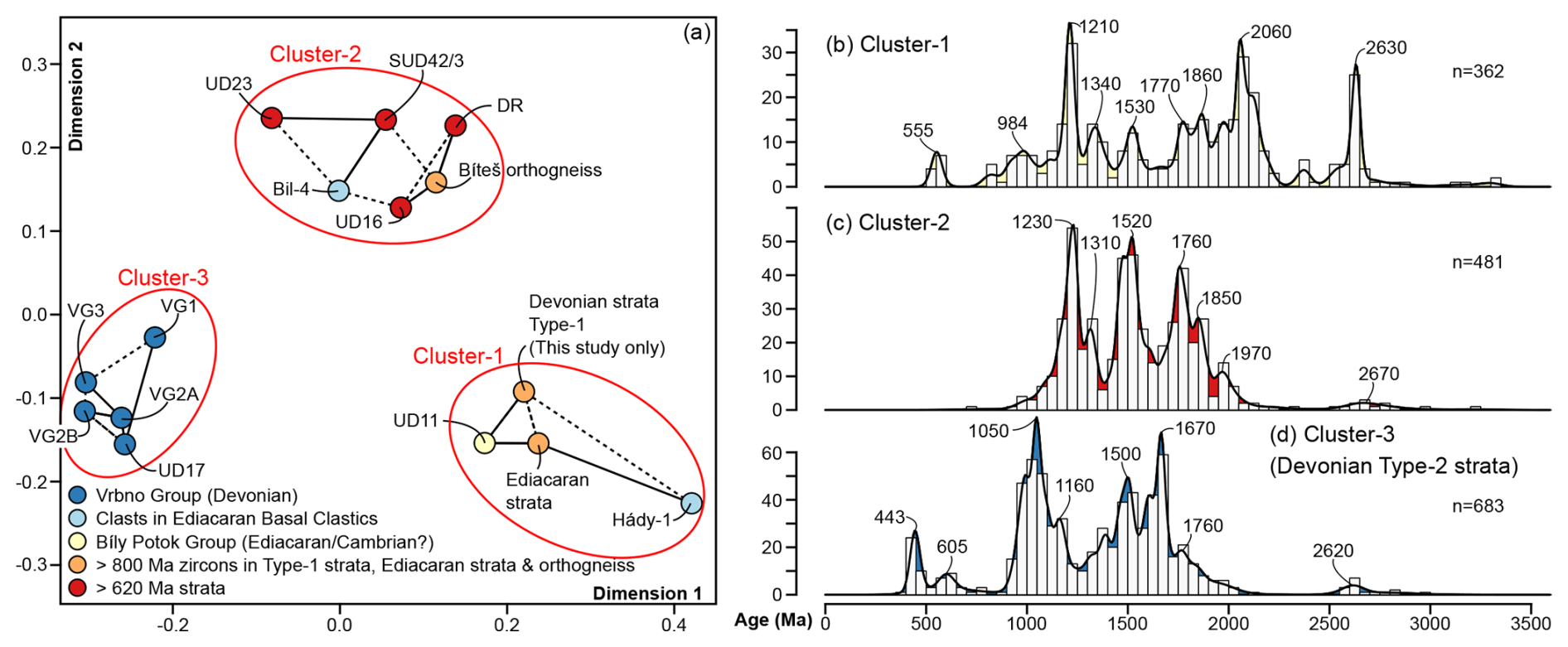
Figure 10(a) Multi-dimensional scaling plot for selected samples from Brunia as well as compiled data from > 800 Ma zircons from Type-1 strata, Ediacaran paragneiss and the Bíteš orthogneiss. Note that only > 800 Ma zircons are used so as not to overwhelm the statistical comparison with late Neoproterozoic zircons that are minor component in other samples. (b–d) Representative histograms and KDE plots of the data included in each cluster. Data used in construction of this figure was compiled in Collett (2025).
To further explore intra-cluster differences, KDE plots of the compiled data from each cluster were generated. Cluster-1 (Fig. 10b) is notable for significant peaks at ∼ 2630 and 2060 Ma, features that are relatively minor in the other clusters, as well as a prominent maximum at ∼ 1210 Ma, which coincides with a relative minimum in the Type-2 Devonian strata (Cluster-3). Cluster-2 (Fig. 10c) is characterized by a three-pronged maximum at ∼ 1800, 1500, and 1230 Ma. Notably, the late Mesoproterozoic to early Neoproterozoic zircons that dominate the Type-2 Devonian spectra are largely absent in Cluster-2. Additionally, the significant ∼ 1670 Ma maximum in the Type-2 Devonian strata (Cluster-3, Fig. 10d) corresponds to a general minimum in Cluster-2 samples.
Given the geological context of each sample, we speculate that Cluster-1 represents the provenance signature of the Slavkov Domain basement, whereas Cluster-2 reflects a provenance signal from the Thaya Domain and the Moravian and Silesian Nappes. Regardless, the distinctiveness of Cluster-3 suggests that our Type-2 zircon spectra do not represent a provenance signal sourced from within Brunia. As such, it is necessary to look beyond Brunia to identify the likely sources of these zircons.
5.2.2 Similar sources in the Devonian of the Bohemian Massif
As a first-order comparison, data from the Type-2 strata are evaluated against published zircon data from the Bohemian Massif (Fig. 11). Although data from the crucial Early Devonian time interval are relatively sparse, an increasing number of datasets are now available for Middle to Upper Devonian strata. Samples from Famennian strata of the Bardo Basin (A in Fig. 11) and Frasnian (?) strata of the (B) Kłodzko Complex (both from Jastrzębski et al., 2025), as well as Givetian strata from the (C) Prague Basin (Strnad and Mihaljevič, 2005; Drost et al., 2011) and the (D) Sedlčany–Krásná hora roof pendant (Žák and Sláma, 2018); all belonging to Teplá–Barrandia or its Sudetes equivalent, are very dissimilar to the Type-2 spectra. These samples also show limited resemblance to the Type-1 spectra, primarily due to either significant Paleozoic zircon components or a greater abundance of Paleoproterozoic zircons.
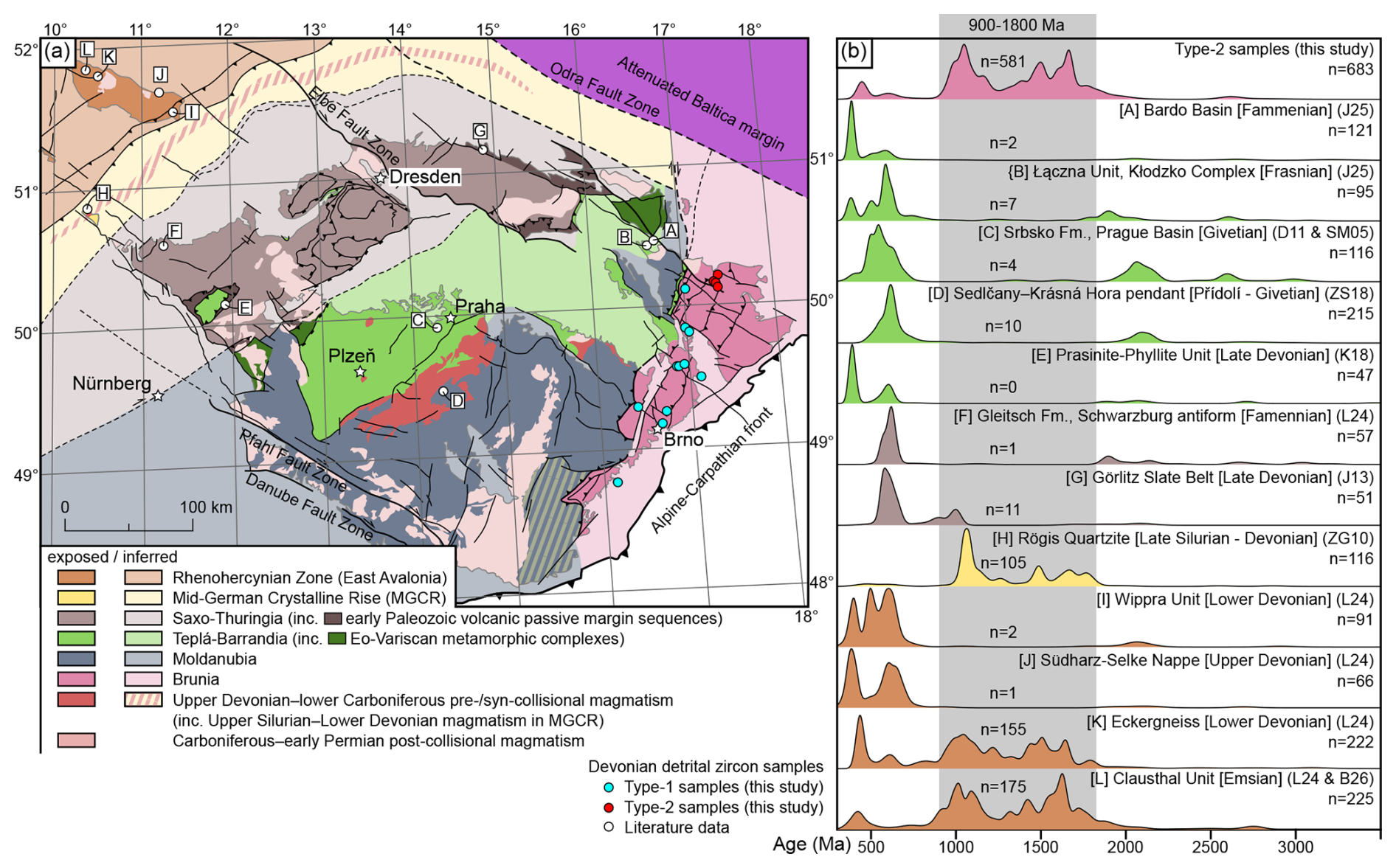
Figure 11Comparison of published zircon U–Pb data from Devonian strata in the Bohemian Massif and adjacent smaller massifs. (a) Geological map (modified from Martinez Catalan et al., 2021) as in Fig. 1a including sample locations. (b) KDE plots of compiled data. J25: Jastrzębski et al. (2025); D11: Drost et al. (2011); SM05: Strnad and Mihaljevič (2005); ZS: Žák and Sláma (2018); K18: Koglin et al. (2018); L24: Linnemann et al. (2024); J13: Jähne et al. (2013); ZG10: Zeh and Gerdes (2010); B26: Beck et al. (2026). Shaded area in (b) represents principal range of ages observed in type-2 Brunia samples.
Upper Devonian strata of Saxo–Thuringia (F, G) also show strong dissimilarity to the Type-2 spectra. Although a sample from the Görlitz Slate Belt (G, Jähne et al., 2013) contains a significant population of Stenian zircons, these are interpreted to differ from the Stenian zircons characteristic of the Type-2 spectra; a point elaborated upon later (see Sect. 5.2.4). A more promising correlation is found with the Late Silurian to Lower Devonian Rögis quartzite (H) from the Mid-German Crystalline Rise (Zeh and Gerdes, 2010), which contains similar abundances of 1800–900 Ma zircons. The Mid-German Crystalline Rise is a composite terrane with complex relationship to both Saxo–Thuringia to the south and the Rhenohercynian Zone to the north (e.g. Zeh and Gerdes, 2010; Dörr et al., 2021; Beck et al., 2026) and the Rögis quartzite is spatially associated with meta-sedimentary rocks with combined U–Pb and Lu–Hf isotopic data (Gerdes and Zeh, 2006) that most closely resembles those of the Góry Sowie Metamorphic Complex from the data compiled in Fig. 8.
More robust correlations emerge from recent data published by Linnemann et al. (2024) on Devonian strata in the Harz Mountains, part of the Rhenohercynian Zone north of the Mid-German Crystalline Rise. Here, the upper allochthonous strata in the south (Wippra Unit (I), Sudharz Selke Nappe (J)) bear no resemblance to the Type-2 spectra; instead, their zircon age distributions more closely resemble those of Teplá–Barrandia in that they contain significant component of Paleozoic zircons alongside late Neoproterozoic maxima (Fig. 11). In contrast, autochthonous Lower Devonian rocks from the lowermost nappe unit (Ecker Gneiss, K) and autochthonous strata in the north (Clausthal Unit, L) exhibit an almost identical distribution of 1800–900 Ma zircons to that found in the Type-2 spectra.
5.2.3 A vast Caledonian fan?
Linnemann et al. (2024) argue that the source of the 1800–900 Ma zircons in the Lower Devonian strata of the Harz Mountains is uplifted Baltica crust within the Caledonian Mountains. Zeh and Gerdes (2010) reached a similar conclusion for the Rögis Quartzite. While both studies equivocate regarding the source of Late Ordovician and Silurian zircons, they are generally assumed to have been derived from local arc magmatism associated with the closure of the Rheic Ocean.
A potential original source for the 1800–900 Ma zircons in Brunia Type-2 strata within Fennoscandia is supported by the close similarity in detrital zircon spectra (Fig. 12a) and Hf-in-zircon isotopic data (Fig. 12b) between Brunia Type-2 samples and Late Ordovician–Silurian strata from the Oslo Rift (Kristoffersen et al., 2014; Sláma, 2016). The only age population in the Brunia Type-2 samples not well represented in the Fennoscandian strata are late Neoproterozoic zircons, which may indicate some admixture from the Brunia basement in the Type-2 strata. Notably, Ordovician–Silurian zircons of broadly similar isotopic composition are well represented in Fennoscandian strata, suggesting these also may potentially have originated from Fennoscandia.
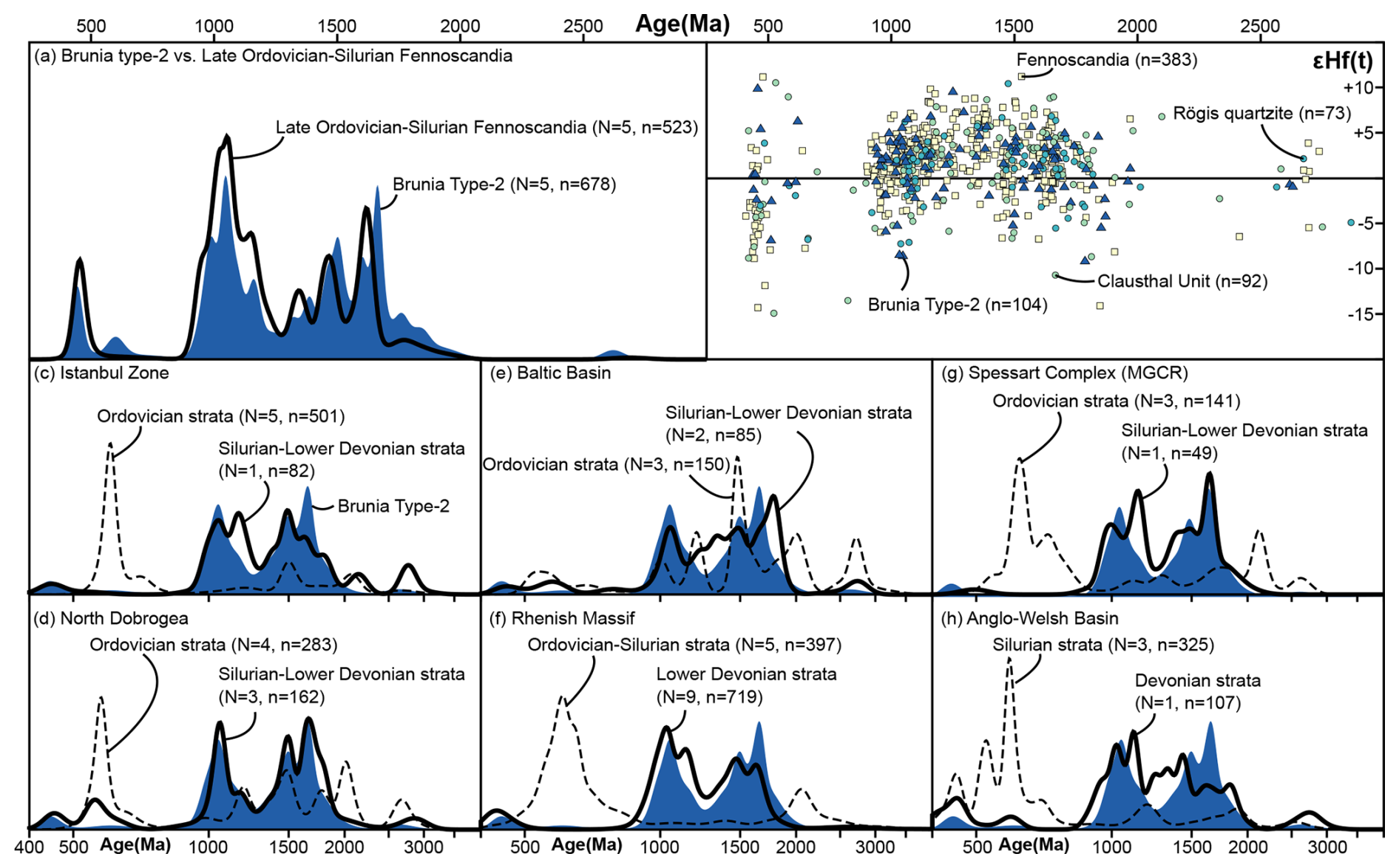
Figure 12(a) Comparison of Brunia Type-2 detrital zircon data with compiled published data from Late Ordovician–Silurian strata of Fennoscandia (Kristoffersen et al., 2014; Sláma, 2016). (b) Comparison of Hf-in-zircon isotopic data from the Fennoscandian strata and data from Brunia Type-2 strata, also included are data from the Clausthal Unit (data in Beck et al. 2026) and Rögis quartzite (Zeh and Gerdes, 2010). (c–h) Further comparison of the Brunia Type-2 strata with Late Silurian – Lower Devonian strata from the (c) Istanbul Zone (Akdoğan et al., 2021), (d) North Dobrogea region (Beştepe and Cerna formations in Balintoni and Balica, 2016), (e) Baltic Basin in Estonia (Põldvere et al., 2014), (f) Rhenish Massif (Eckelmann et al., 2014; Linnemann et al., 2024; Dörr et al., 2025), (g) Spessart Complex in the Mid-German Crystalline Rise (Kirchner and Albert, 2021), and (h) Anglo-Welsh Basin (Waldron et al., 2025). Data used in the construction of this figure is compiled in Collett (2025).
On a broader scale, Upper Silurian to Lower Devonian strata with strikingly similar detrital zircon spectra are documented across diverse terranes in northern and central Europe, extending into Anatolia. Examples depicted in Fig. 12 include the Istanbul Zone (Akdoğan et al., 2021); the North Dobrogea region (Beştepe and Cerna formations in Balintoni and Balica, 2016); the Baltic Basin in Estonia (Põldvere et al., 2014); the Rhenish Massif (Eckelmann et al., 2014; Dörr et al., 2025); the Spessart Complex of the Mid-German Crystalline Rise (Kirchner and Albert, 2021); and the Anglo-Welsh Basin (Waldron et al., 2025). In each of these regions, the detrital zircon spectra of Upper Silurian–Devonian strata represent a marked shift from those recorded in older units (Fig. 12).
At an even greater scale, similar spectra are also reported from the Orcadian Basin in NE Scotland (Strachan et al., 2021); Givetian–Famennian strata in East Greenland (Sláma et al., 2011); Silurian–Devonian Sandstones from Svalbard (Beranek et al., 2020; Anfinson et al., 2022) and northern Novaya Zemlya (Lorenz et al., 2013); and the Devonian parts of the Acadian foreland basin in North America (Bradley and O'Sullivan, 2017; Perrot et al., 2025). This similarity in detrital zircon spectra should not be taken to imply a single vast interconnected basin, but rather a network of detrital pathways likely reflecting multiple erosional–depositional cycles with limited in-transit mixing, and originally derived from a relatively restricted source region; most likely in Baltica-derived crust within the Caledonian Mts. (Fig. 13).
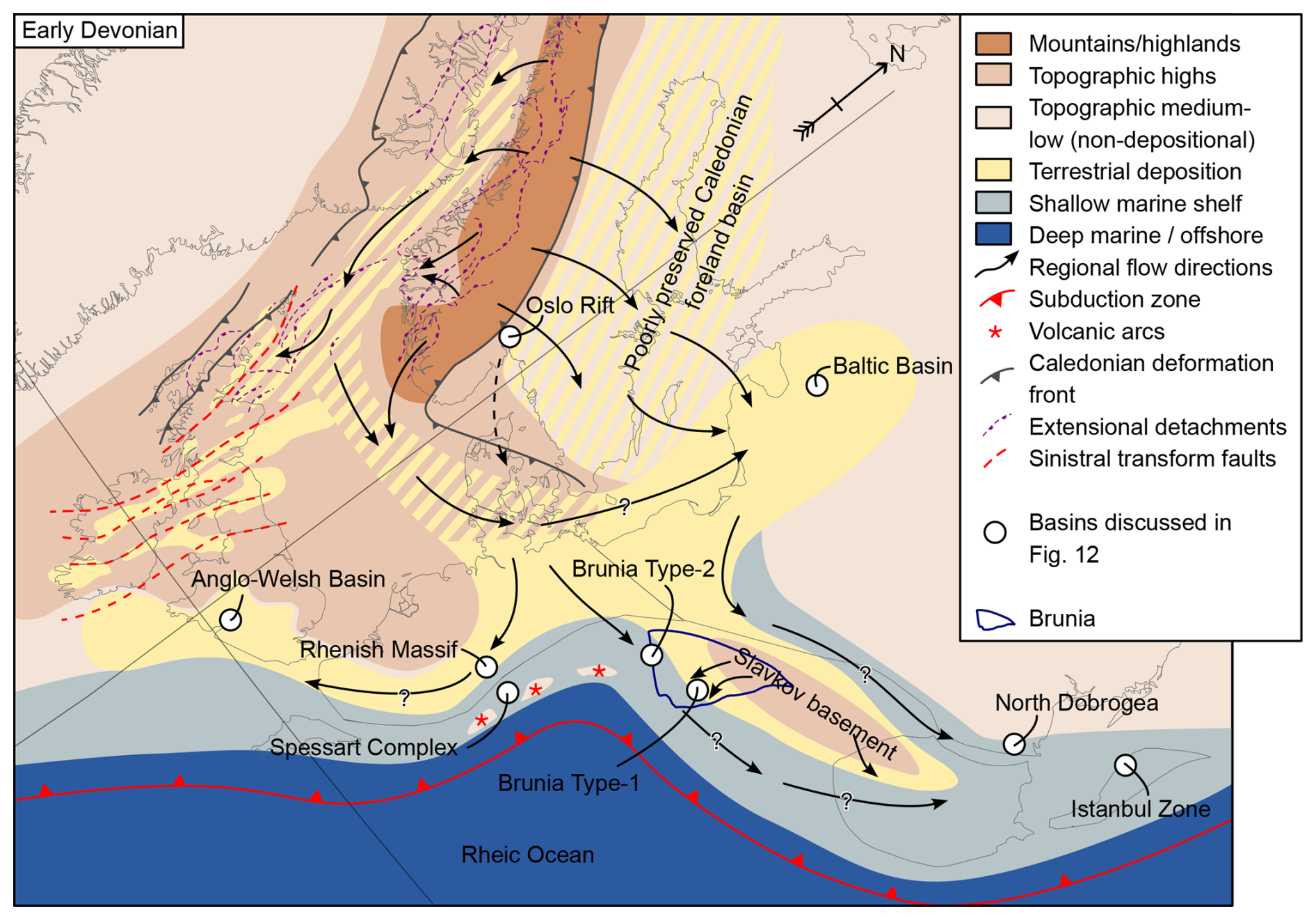
Figure 13Conceptual paleogeographic map for the Lower Devonian indicating the distribution pattern of detritus from the Scandinavian Caledonian Mountains into Devonian terrestrial and shallow marine basins discussed in this work. Note that sediment dispersal was likely significantly more complex and involved multiple erosional-depositional cycles. Also highlighted is the exposed Slavkov Terrane basement in the east of Brunia that fed the Type-1 samples. Hatched areas in the figure imply uncertainty based on either limited preservation or access to Early Devonian deposits. Basemap, topography and regional flow directions adapted from Davies et al. (2024), structural patterns in Caledonides from Fossen (2010), and easterly flow of Caledonian material into poorly preserved foreland basins following Cederbom et al. (2000).
5.2.4 Implications for continuation of the Rheic Ocean in the Devonian
Not depicted in Figs. 11 and 12 are data from Lower Devonian strata of Saxo–Thuringia recently reported by Linnemann et al. (2025). These preliminary results, published without supporting raw data, show abundant Stenian (1200–1000 Ma) zircons. Linnemann et al. (2025) suggest that these zircons derive from a source region similar to that of the Stenian zircons found in the Lower Devonian Harz Mountains strata and the Rögis Quartzite. Their interpretation is based on a paleogeographic model assuming the complete closure of the Rheic Ocean during the late Silurian–Early Devonian and a Laurussian provenance for the Stenian zircons. It is hard to evaluate this properly without the supporting raw data; however, we are sceptical of this conclusion. Notably, the Lower Devonian Saxo–Thuringian strata appear to contain virtually no zircons in the 1700–1500 Ma range but do include appreciable Neoproterozoic (900–550 Ma) and Paleoproterozoic (2100–1800 Ma) components, with no detectable Ordovician or Silurian zircons. In these respects, the Lower Devonian Saxo–Thuringian strata differ from either the Baltica or Laurentia detrital signals depicted in Fig. 13. Instead, the influx of Stenian zircons more closely resembles that reported from Gondwanan regions, including Iberia, Armorica, the Alps, and the Western Carpathians (see more detailed discussions on this topic in Soejono et al., 2024; Collett, 2025).
A potential test of this hypothesis lies in Hf-in-zircon isotopic data. Stenian zircons in this study, as well as those from the Rögis Quartzite (Zeh and Gerdes, 2010), Clausthal Unit (Beck et al., 2026), and Fennoscandia (Kristoffersen et al., 2014), exhibit a relatively limited spread in Hf isotopic values clustering near or above chondritic values (εHf(t) = −8 to +6, Fig. 12b). In contrast, Stenian zircons from Devonian strata in Iberia, Armorica, and the Western Carpathians (as well as recent Nile River sands) show a much wider range of Hf isotopic values (εHf(t) = −25 to +10), with a tendency toward more negative εHf(t) values (see figures in Soejono et al., 2024 and references therein).
If our interpretation is correct; that the Stenian zircons in Saxo–Thuringia derive from Gondwana, while the 1800–900 Ma zircons in the Type-2 Brunia strata originate from Laurussia, then the apparent lack of mixing between these two provenance signals in Devonian strata of the Bohemian Massif (Fig. 11) strongly suggests that either the Rheic Ocean remained open as a barrier to detritus throughout the Devonian or some other orographic barrier existed between Brunia and the internal parts of the Bohemian Massif. In the case that the Rheic Ocean remained open, Brunia would have been situated on its northern margin, with Saxo–Thuringia (and likely also Teplá–Barrandia) lying to its south. This interpretation aligns with paleogeographic models proposed by Collett et al. (2022b), but leaves unresolved the position of the Rheic Suture within the Bohemian Massif. It is unlikely to coincide strictly with the Moldanubian Thrust, the traditional western boundary of Brunia (Fig. 1b), because the Drosendorf Unit within the Moldanubian Thrust hanging wall has a demonstrably Brunia-derived character (e.g., Sorger et al., 2020). Recent reports of Mesoproterozoic (∼ 1.3 Ga) crustal material deeper within Moldanubia (Soejono et al., 2025) further challenge the long-held assumption of a purely Gondwanan provenance for this domain. Consequently, the Rheic Suture may lie internally within Moldanubia, at the Moldanubia–Teplá–Barrandia boundary (now largely obscured by the Central Bohemian Plutonic Complex), or may yet equate to the Saxothuringian Suture. Resolving this question will require carefully targeted provenance analyses of the complex, high-grade metamorphic rocks that constitute the Moldanubian basement.
-
Detrital zircon isotopic data from Devonian (pre-orogenic) strata of Brunia (easternmost European Variscides) reveal two distinctly contrasting provenance signatures. Most samples exhibit unimodal populations of late Neoproterozoic zircons with positive εHf(t) values (Type-1 spectra), indicating erosion from a local source within the Brunia basement. In contrast, a subset of samples from northern Brunia (Type-2 spectra) display broader age distributions, with prominent peaks spanning the late Paleoproterozoic to early Neoproterozoic (ca. 1800–900 Ma), alongside minor populations of Neoarchean, Ediacaran, and Ordovician–Silurian zircons.
-
The Type-1 spectra closely resemble detrital zircon populations from Ediacaran paragneiss in Brunia. The stratigraphic (Ediacaran vs. Devonian) age of some clastic strata remains uncertain and zircon U–Pb data alone cannot fully resolve these age relationships. However, differences in Hf-in-zircon isotopic signatures may provide additional potential for stratigraphic discrimination.
-
When combined, the Devonian and Ediacaran zircon datasets from Brunia show striking similarities to those from Ediacaran strata in West Avalonia supporting a shared Late Neoproterozoic provenance. Our findings do not support a shared Neoproterozoic history with other parts of the Bohemian Massif, nor do they suggest that Brunia was the primary source of Late Neoproterozoic zircon grains found in southwestern Baltica.
-
The Type-2 spectra differ significantly from all previously reported detrital zircon datasets from Brunia, instead exhibiting strong similarity to Lower Devonian strata across Laurussia. The most plausible source for these zircons is erosion of the Caledonian mountains in Fennoscandia.
-
This Caledonian-derived detritus was dispersed widely during the late Silurian to early Devonian, covering regions of the modern Arctic Ocean, eastern Greenland, Atlantic North America, and extensive parts of Northern and Central Europe, extending into Anatolia. Notably, this spectral signature has not been credibly identified within the internal domains of the European Variscides, implying that the Rheic Ocean remained an effective barrier to such detrital material well into the Devonian.
-
Consequently, the Rheic Suture must lie within the Bohemian Massif, although its precise location remains unresolved. A renewed focus on the provenance of high-grade rocks in the Moldanubian Zone is therefore essential to better constrain the position and nature of this suture.
All new data generated as part of this study are included in data tables in supplement. Data used for data comparisons are provided in supplement or can be found in the cited Collett (2025) database accessible at figshare (https://doi.org/10.6084/m9.figshare.27730677).
The supplement related to this article is available online at https://doi.org/10.5194/se-17-867-2026-supplement.
SC: Conceptualization, Data curation, Investigation, Visualization, Writing (original draft preparation). IS: Conceptualization, Investigation, Writing (review and editing). TK: Resources, Investigation, Writing (review and editing). PH: Resources, Investigation, Writing (review and editing). JM: Methodology, Formal analysis. NN: Formal analysis. JS: Methodology, Formal analysis.
The contact author has declared that none of the authors has any competing interests.
Publisher's note: Copernicus Publications remains neutral with regard to jurisdictional claims made in the text, published maps, institutional affiliations, or any other geographical representation in this paper. The authors bear the ultimate responsibility for providing appropriate place names. Views expressed in the text are those of the authors and do not necessarily reflect the views of the publisher.
Martin Štrba is thanked for help with preparing zircon separates for this study. Martin Timmerman, Armin Zeh, and Brendan Murphy all provided useful feedback that improved the final version of this manuscript. Sylvia Gardin is thanked for editorial handling.
This study was funded by the Grant Agency of the Czech Republic (GAČR 24-12999S to S. Collett) and by Research Project no. 311300 (Strategic Research Plan of the Czech Geological Survey – DKRVO/ČGS 2023–2027).
This paper was edited by Silvia Gardin and reviewed by Martin Jan Timmerman and Brendan Murphy.
Akdoğan, R., Hu, X., Okay, A. I., Topuz, G., and Xue, W.: Provenance of the Paleozoic to Mesozoic Siliciclastic Rocks of the Istanbul Zone Constrains the Timing of the Rheic Ocean Closure in the Eastern Mediterranean Region, Tectonics, 40, https://doi.org/10.1029/2021tc006824, 2021.
Andersen, T., Kristoffersen, M., and Elburg, M. A.: Visualizing, interpreting and comparing detrital zircon age and Hf isotope data in basin analysis – a graphical approach, Basin Res., 30, 132–147, https://doi.org/10.1111/bre.12245, 2018.
Anfinson, O. A., Odlum, M. L., Piepjohn, K., Poulaki, E. M., Shephard, G. E., Stockli, D. F., Levang, D., Jensen, M. A., and Pavlovskaia, E. A.: Provenance Analysis of the Andrée Land Basin and Implications for the Paleogeography of Svalbard in the Devonian, Tectonics, 41, https://doi.org/10.1029/2021tc007103, 2022.
Balintoni, I. and Balica, C.: Peri-Amazonian provenance of the Euxinic Craton components in Dobrogea and of the North Dobrogean Orogen components (Romania): A detrital zircon study, Precambrian Res., 278, 34–51, https://doi.org/10.1016/j.precamres.2016.03.008, 2016.
Beck, M., Zeh, A., Hinderer, M., Meinaß, H. P., Scheuvens, D., and Gerdes, A.: A juvenile arc terrane in the Mid-German Crystalline Zone: constraints from zircon U–Pb–Hf isotope data and implications for pre- to syn-Variscan evolution, Int. J. Earth Sci. (Geol. Rundsch.), 115, https://doi.org/10.1007/s00531-026-02577-8, 2026.
Belka, Z., Valverde-Vaquero, P., Dörr, W., Ahrendt, H., Wemmer, K., Franke, W., and Schäfer, J.: Accretion of first Gondwana-derived terranes at the margin of Baltica, GSL Special Publications, 201, 19–36, https://doi.org/10.1144/gsl.sp.2002.201.01.02, 2002.
Beranek, L. P., Gee, D. G., and Fisher, C. M.: Detrital zircon U-Pb-Hf isotope signatures of Old Red Sandstone strata constrain the Silurian to Devonian paleogeography, tectonics, and crustal evolution of the Svalbard Caledonides, GSA Bulletin, 132, 1987–2003, https://doi.org/10.1130/b35318.1, 2020.
Beranek, L. P., Hutter, A. D., Pearcey, S., James, C., Langor, V., Pike, C., Goudie, D., and Oldham, L.: New evidence for the Baltican cratonic affinity and Tonian to Ediacaran tectonic evolution of West Avalonia in the Avalon Peninsula, Newfoundland, Canada, Precambrian Res., 390, 107046, https://doi.org/10.1016/j.precamres.2023.107046, 2023.
Blichert-Toft, J. and Albarède, F.: The Lu-Hf isotope geochemistry of chondrites and the evolution of the mantle-crust system, Earth Pl. Sc. Lett., 148, 243–258, https://doi.org/10.1016/s0012-821x(97)00040-x, 1997.
Bradley, D. C. and O'Sullivan, P.: Detrital zircon geochronology of pre- and syncollisional strata, Acadian orogen, Maine Appalachians, Basin Res., 29, 571–590. https://doi.org/10.1111/bre.12188, 2017.
Callegari, R., Mazur, S., McClelland, W. C., Barnes, C. J., Ziemniak, G., Kośmińska, K., and Majka, J.: Middle Cambrian convergence at the southwestern Baltica margin, Holy Cross Mts., Poland, and its significance for reconstructions of early Gondwana, Geosci. Front., 16, 101972. https://doi.org/10.1016/j.gsf.2024.101972, 2025.
Cederbom, C., Larson, S. Å., Tullborg, E.-L., and Stiberg, J.-P.: Fission track thermochronology applied to Phanerozoic thermotectonic events in central and southern Sweden, Tectonophysics, 316, 153–167, https://doi.org/10.1016/s0040-1951(99)00230-9, 2000.
Chauvel, C. and Blichert-Toft, J.: A hafnium isotope and trace element perspective on melting of the depleted mantle, Earth Pl. Sc. Lett., 190, 137–151, https://doi.org/10.1016/s0012-821x(01)00379-x, 2001.
Chlupáč, I.: Orientační výzkum některých menších výskytů devonu na Drahanské vysočině, Zpr. Geol. Výzk v Roce 1960, 89–95, 1961.
Chlupáč, I.: Fossil communities in the metamorphic Lower Devonian of the Hrubý Jeseník Mts., Czechoslovakia, Neues Jahrb. Geol. P.-A., 177, 367–392, 1989.
Chlupáč, I.: Devonští trilobiti Moravy a Slezska, jejich výskyt a význam, Přírodovědné Studie Muzea Prostějovska, 3, 1–26, 2000.
Chlupáč, I. and Svoboda, J.: Geological conditions of the Konice-Mladec Devonian in the Drahany Upland, Sbor. Ustr. Ust. Geol., 28, 347–418, 1963.
Collett, S.: Detrital zircon tales between the Rodinia and Pangaea supercontinents; exploring connections between Avalonia, Cadomia and Central Asia, J. Geol. Soc. London, 182, https://doi.org/10.1144/jgs2024-026, 2025.
Collett, S., Schulmann, K., Štípská, P., and Míková, J.: Chronological and geochemical constraints on the pre-variscan tectonic history of the Erzgebirge, Saxothuringian Zone, Gondwana Res., 79, 27–48, https://doi.org/10.1016/j.gr.2019.09.009, 2020.
Collett, S.: Supp 1: Detrital zircon tales between the Rodinia and Pangea supercontinents: exploring connections between Avalonia, Cadomia and Central Asia, Geological Society of London, figshare [data set], https://doi.org/10.6084/m9.figshare.27730677.v1, 2024.
Collett, S., Štípská, P., Schulmann, K., Míková, J., and Kröner, A.: Tectonic significance of the Variscan suture between Brunovistulia and the Bohemian Massif, J. Geol. Soc. London, 178, https://doi.org/10.1144/jgs2020-176, 2021.
Collett, S., Mazur, S., Schulmann, K., and Soejono, I.: Significance of a late neoproterozoic – Early Cambrian southern Baltica active margin in late-stage Rodinian and early Gondwanan reconstructions, Precambrian Res., 383, 106918, https://doi.org/10.1016/j.precamres.2022.106918, 2022a.
Collett, S., Schulmann, K., Deiller, P., Štípská, P., Peřestý, V., Ulrich, M., Jiang, Y., de Hoÿm de Marien, L., and Míková, J.: Reconstruction of the mid-Devonian HP-HT metamorphic event in the Bohemian Massif (European Variscan belt), Geosci. Front., 13, 101374, https://doi.org/10.1016/j.gsf.2022.101374, 2022b.
Davies, N. S., McMahon, W. J., and Berry, C. M.: Earth's earliest forest: fossilized trees and vegetation-induced sedimentary structures from the Middle Devonian (Eifelian) Hangman Sandstone Formation, Somerset and Devon, SW England, J. Geol. Soc. London, 181, https://doi.org/10.1144/jgs2023-204, 2024.
Dörr, W. and Stein, E.: Precambrian basement in the Rheic suture zone of the Central European Variscides (Odenwald), Int. J. Earth Sci. (Geol. Rundsch.), 108, 1937–1957, https://doi.org/10.1007/s00531-019-01741-7, 2019.
Dörr, W., Stein, E., Kirchner, F., Meinaß, H. P., and Velledits, F.: Provenance of lower Palaeozoic metasediments of the East Odenwald (Mid-German-Crystalline Zone, Variscides)—a correlation with the East European Platform (Poland), Int. J. Earth Sci. (Geol. Rundsch.), 111, 3–25, https://doi.org/10.1007/s00531-021-02103-y, 2022.
Dörr, W., Blau, J., Marko, L., Petschick, P., Petschick, R., Prinz-Grimm, P., Schastok, J., and Velledits, F.: Provenance analysis of the Rhenohercynian Basin and its southern collision zone: transition from a Silurian volcanic arc to the Rhenohercynian shelf (Central European Variscides), Int. J. Earth Sci., 114, 55–74, https://doi.org/10.1007/s00531-024-02480-0, 2025.
Drost, K., Gerdes, A., Jeffries, T., Linnemann, U., and Storey, C.: Provenance of Neoproterozoic and early Paleozoic siliciclastic rocks of the Teplá–Barrandian unit (Bohemian Massif): Evidence from U–Pb detrital zircon ages, Gondwana Res., 19, 213–231, https://doi.org/10.1016/j.gr.2010.05.003, 2011.
Dvořák, J. and Skoček, V.: Evidence of coastal sabkha in the Early Devonian sequence at Tišnov, Western Moravia, Czech Geol. Survey Bull., 72, 273-276, 1997.
Eckelmann, K., Nesbor, H.-D., Königshof, P., Linnemann, U., Hofmann, M., Lange, J.-M., and Sagawe, A.: Plate interactions of Laurussia and Gondwana during the formation of Pangaea — Constraints from U–Pb LA–SF–ICP–MS detrital zircon ages of Devonian and Early Carboniferous siliciclastics of the Rhenohercynian zone, Central European Variscides, Gondwana Res., 25, 1484–1500, https://doi.org/10.1016/j.gr.2013.05.018, 2014.
Finger, F., Hanžl, P., Pin, C., von Quadt, A., and Steyrer, H. P.: The Brunovistulian: Avalonian Precambrian sequence at the eastern end of the Central European Variscides?, GSL Special Publications, 179, 103–112, https://doi.org/10.1144/gsl.sp.2000.179.01.08, 2000.
Fossen, H.: Extensional tectonics in the North Atlantic Caledonides: a regional view, GSL Special Publications, 335, 767–793, https://doi.org/10.1144/sp335.31, 2010.
Francovschi, I., Shumlyanskyy, L., Soesoo, A., Tarasko, I., Melnychuk, V., Hoffmann, A., Kovalick, A., Love, G., and Bekker, A.: U–Pb geochronology of detrital zircon from the Ediacaran and Cambrian sedimentary successions of NE Estonia and Volyn region of Ukraine: Implications for the provenance and comparison with other areas within Baltica, Precambrian Res., 392, 107087, https://doi.org/10.1016/j.precamres.2023.107087, 2023.
Friedl, G., Finger, F., Paquette, J.-L., von Quadt, A., McNaughton, N. J., and Fletcher, I. R.: Pre-Variscan geological events in the Austrian part of the Bohemian Massif deduced from U–Pb zircon ages, Int. J. Earth Sci., 93, 802–823, https://doi.org/10.1007/s00531-004-0420-9, 2004.
Gerdes, A. and Zeh, A.: Combined U–Pb and Hf isotope LA-(MC-)ICP-MS analyses of detrital zircons: Comparison with SHRIMP and new constraints for the provenance and age of an Armorican metasediment in Central Germany, Earth Planet. Sci. Lett., 249, 47–61, https://doi.org/10.1016/j.epsl.2006.06.039, 2006.
Gibling, M. R. and Davies, N. S.: Palaeozoic landscapes shaped by plant evolution, Nat. Geosci., 5, 99–105, https://doi.org/10.1038/ngeo1376, 2012.
Gómez, N., Lowe, D., Mills, A., Kommescher, S., and Lam, R.: Interplay of Ediacaran glaciation and sediment provenance revealed by detrital zircon U-Pb geochronology and Hf isotope geochemistry in the Bonavista Peninsula (Newfoundland), Geol. Soc. Am. Bull., 138, 278–298, https://doi.org/10.1130/b38347.1, 2025.
Habryn, R., Krzemińska, E., Krzemiński, L., Markowiak, M., and Zieliński, G.: Detrital zircon age data from the conglomerates in the Upper Silesian and Małopolska blocks, and their implications for the pre-Variscan tectonic evolution (S Poland), Geol. Q., 64, 321–341, https://doi.org/10.7306/gq.1539, 2020.
Hajná, J., Žák, J., and Dörr, W.: Time scales and mechanisms of growth of active margins of Gondwana: A model based on detrital zircon ages from the Neoproterozoic to Cambrian Blovice accretionary complex, Bohemian Massif, Gondwana Res., 42, 63–83, https://doi.org/10.1016/j.gr.2016.10.004, 2017.
Hajná, J., Žák, J., Dörr, W., Kachlík, V., and Sláma, J.: New constraints from detrital zircon ages on prolonged, multiphase transition from the Cadomian accretionary orogen to a passive margin of Gondwana, Precambrian Res., 317, 159–178, https://doi.org/10.1016/j.precamres.2018.08.013, 2018.
Hajná, J., Žák, J., Ackerman, L., Svojtka, M., and Pašava, J.: A giant late Precambrian chert-bearing olistostrome discovered in the Bohemian Massif: A record of Ocean Plate Stratigraphy (OPS) disrupted by mass-wasting along an outer trench slope, Gondwana Res., 74, 173–188, https://doi.org/10.1016/j.gr.2018.10.010, 2019.
Hanžl, P., Janoušek, V., Žáček, V., Wilimský, D., Aichler, J., Erban, V., Pudilová, M., Chlupáčová, M., Buriánková, K., Mixa, P., and Pecina, V.: Magmatic history of granite-derived mylonites from the southern Desná Unit (Silesicum, Czech Republic), Miner. Petrol., 89, 45–75, https://doi.org/10.1007/s00710-006-0137-5, 2007.
Hanžl, P., Janoušek, V., Soejono, I., Buriánek, D., Svojtka, M., Hrdličková, K., Erban, V., and Pin, C.: The rise of the Brunovistulicum: age, geological, petrological and geochemical character of the Neoproterozoic magmatic rocks of the Central Basic Belt of the Brno Massif, Int. J. Earth Sci. (Geol. Rundsch.), 108, 1165–1199, https://doi.org/10.1007/s00531-019-01700-2, 2019.
Hanžl, P., Janoušek, V., Buriánek, D., Hrdličková, K., Finger, F., and Kalvoda, J.: The Brunovistulicum – the Neoproterozoic Basement of the Eastern Bohemian Massif, in: The Variscan Orogen of Central Europe, edited by: Linnemann, U., Springer, Cham, Switzerland, 223–240, https://doi.org/10.1007/978-3-031-82911-6_8, 2025.
Havlíček, V. and Mergl , M.: Lower Devonian brachiopods at Petrovice (Drahany Upland, Moravia), Journal of the Czech Geological Society, 35, 225–238, 1990.
Hegner, E. and Kröner, A.: Review of Nd isotopic data and xenocrystic and detrital zircon ages from the pre-Variscan basement in the eastern Bohemian Massif: speculations on palinspastic reconstructions, GSL Special Publications, 179, 113–129, https://doi.org/10.1144/gsl.sp.2000.179.01.09, 2000.
Herbosch, A., Liégeois, J.-P., Gärtner, A., Hofmann, M., and Linnemann, U.: The Stavelot-Venn Massif (Ardenne, Belgium), a rift shoulder basin ripped off the West African craton: Cartography, stratigraphy, sedimentology, new U-Pb on zircon ages, geochemistry and Nd isotopes evidence, Earth-Sci. Rev., 203, 103142, https://doi.org/10.1016/j.earscirev.2020.103142, 2020.
Hladil, J.: Moravian middle and late Devonian buildups: evolution in time and space with respect to the Laurussian shelf, Cour. For. Senckenb., 172, 111–125, 1994.
Hladil, J., Kalvoda, J., and Vavrdová, M.: Některé nové mikropaleontologické údaje z Nízkého Jeseníku, Knihovnička Zemního Plynu a Nafty 6a, Miscallanea micropaleontologica, II/1, 97-118, 1987.
Hladil, J., Melichar, R., Otava, J., Galle, A., Krs, M., Man, O., Pruner, P., Cejchan, P., and Orel, P.: The Devonian in the Easternmost Variscides, Moravia; a holistic analysis directed towards comprehension of the original context, Abhandlungen der Geologischen Bundesanstalt, 54, 27–47, 1999.
Jähne, B., Jeffries, T., Linnemann, U., and Ullrich, B.: The provenance of the Caminaberg Quartzite constrained by U-Pb LA-ICP-MS ages of detrital zircons (Görlitz Schist Belt, Saxo-Thuringian Zone), Geologica Saxonica, 59, 141–147, 2013.
Janoušek, V., Aichler, J., Hanžl, P., Gerdes, A., Erban, V., Žáček, V., Pecina, V., Pudilová, M., Hrdličková, K., Mixa, P., and Žáčková, E.: Constraining genesis and geotectonic setting of metavolcanic complexes: a multidisciplinary study of the Devonian Vrbno Group (Hrubý Jeseník Mts., Czech Republic), Int. J. Earth Sci., 103, 455–483. https://doi.org/10.1007/s00531-013-0975-4, 2014.
Jastrzębski, M., Żelaźniewicz, A., Murtezi, M., Larionov, A. N., and Sergeev, S.: The Moldanubian Thrust Zone – A terrane boundary in the Central European Variscides refined based on lithostratigraphy and U–Pb zircon geochronology, Lithos, 220–223, 116–132, https://doi.org/10.1016/j.lithos.2015.01.023, 2015.
Jastrzębski, M., Żelaźniewcz, A., Sláma, J., Machowiak, K., Śliwiński, M., Jaźwa, A., and Kocjan, I.: Provenance of Precambrian basement of the Brunovistulian Terrane: New data from its Silesian part (Czech Republic, Poland), central Europe, and implications for Gondwana break-up, Precambrian Res., 355, 106108, https://doi.org/10.1016/j.precamres.2021.106108, 2021.
Jastrzębski, M., Żelaźniewicz, A., Sláma, J., Krzemińska, E., and Śliwiński, M.: The Eo-Variscan domain in the Variscan belt: New data from the Sudetes, southern Poland, Lithos, 504–505, 108058, https://doi.org/10.1016/j.lithos.2025.108058, 2025.
Kalvoda, J., Babek, O., Fatka, O., Leichmann, J., Melichar, R., Nehyba, S., and Spacek, P.: Brunovistulian terrane (Bohemian Massif, Central Europe) from late Proterozoic to late Paleozoic: a review, Int. J. Earth Sci. (Geol. Rundsch.), 97, 497–518, https://doi.org/10.1007/s00531-007-0183-1, 2008.
Kalvoda, J., Kumpan, T., Bábek, O., Buriánek, D., and Melichar, R.: Palaeozoic Cover of the Brunovistulian Unit, in: The Variscan Orogen of Central Europe, edited by: Linnemann, U., Springer, Cham, Switzerland, 241–260, https://doi.org/10.1007/978-3-031-82911-6_9, 2025.
Kirchner, F. and Albert, R.: New detrital zircon age data reveal the location of the Rheic suture in the Mid-German Crystalline Zone (Spessart and Odenwald Crystalline Complexes), Int. J. Earth Sci. (Geol. Rundsch.), 109, 2287–2305, https://doi.org/10.1007/s00531-020-01899-5, 2021.
Koglin, N., Zeh, A., Franz, G., Schüssler, U., Glodny, J., Gerdes, A., and Brätz, H.: From Cadomian magmatic arc to Rheic ocean closure: The geochronological-geochemical record of nappe protoliths of the Münchberg Massif, NE Bavaria (Germany), Gondwana Res., 55, 135–152, https://doi.org/10.1016/j.gr.2017.11.001, 2018.
Košler, J., Konopásek, J., Sláma, J., and Vrána, S.: U–Pb zircon provenance of Moldanubian metasediments in the Bohemian Massif, J. Geol. Soc. London, 171, 83–95, https://doi.org/10.1144/jgs2013-059, 2014.
Koverdynský, B.: Geologické problémy silezika [Geological problems of Silesia], in: Geologie Moravy a Slezska [Geology of Moravia and Silesia], edited by: Přichystal, A., Obstová, V., and Suk, M., Moravské zemské muzeum a Sekce geologických věd PřF MU Brno, 31–40, ISBN 80-7028-050-6, 1993.
Koverdynský, B. and Hladil, J.: Stáří vitošovských vápenců (devon, severozápadní Morava), Věstník Ústředního Ústavu geologického, 60, 1–7, 1985.
Koverdynský, B. and Zikmundová, J.: K stratigrafické příslušnosti vrbenské série a andělskohorských vrstev v oblasti Jeseníků, Věstník Ústředního Ústavu geologického, 61, 367–373, 1966.
Kristoffersen, M., Andersen, T., and Andresen, A.: U–Pb age and Lu–Hf signatures of detrital zircon from Palaeozoic sandstones in the Oslo Rift, Norway, Geol. Mag., 151, 816–829, https://doi.org/10.1017/s0016756813000885, 2014.
Krmíček, L. and Přichystal, A.: Petrology of the oldest polymict conglomerate at the eastern margin of the Rhenohercynian Zone: evidence for initial rifting of the Brunovistulian terrane in Moravia, in: 5th Meeting of the Central European Tectonic Studies Group, 11–14 April 2007, Teplá, Czech Republic, 49–50, ISBN 978-80-7075-695, 2007.
Krmíčková, S., Krmíček, L., Timmerman, M. J., Sláma, J., and Míková, J.: Origin of the Brunovistulian microcontinent: Geochemical and Sr–Nd–Pb–Hf isotope evidence, Precambrian Res., 428, 107902, https://doi.org/10.1016/j.precamres.2025.107902, 2025.
Krs, M., Pruner, P., and Man, O.: Tectonic and paleogeographic interpretation of the paleomagnetism of Variscan and pre-Variscan formations of the Bohemian Massif, with special reference to the Barrandian terrane, Tectonophysics, 332, 93–114, https://doi.org/10.1016/s0040-1951(00)00251-1, 2001.
Kumpan, T., Kalvoda, J., Bábek, O., Matys Grygar, T., and Frýda, J.: The Devonian-Carboniferous boundary in the Moravian Karst (Czech Republic), Palaeobio. Palaeoenv., 101, 473–485, https://doi.org/10.1007/s12549-019-00409-z, 2021.
Kumpera, O. and Martinec, P.: The development of the Carboniferous accretionary wedge in the Moravian-Silesian Paleozoic Basin, Journal of the Czech Geological Society, 4011, 47–64, 1995.
Kurzweil, F., Drost, K., Pašava, J., Wille, M., Taubald, H., Schoeckle, D., and Schoenberg, R.: Coupled sulfur, iron and molybdenum isotope data from black shales of the Teplá–Barrandian unit argue against deep ocean oxygenation during the Ediacaran, Geochim. Cosmochim. Ac., 171, 121–142, https://doi.org/10.1016/j.gca.2015.08.022, 2015.
Kühnemann, V., Meinhold, G., Zeh, A., and Weber, S.: New insights into Cadomian basin evolution and stratigraphic affiliation of sedimentary units of Saxo-Thuringia, Germany: Part 2—detrital zircon U–Pb ages, Int. J. Earth Sci. (Geol. Rundsch.), 114, 1005–1027, https://doi.org/10.1007/s00531-025-02533-y, 2025.
Lindner, M., Dörr, W., Reither, D., and Finger, F.: The Dobra Gneiss and the Drosendorf Unit in the southeastern Bohemian Massif, Austria: West Amazonian crust in the heart of Europe, GSL Special Publications, 503, 185–207, https://doi.org/10.1144/sp503-2019-232, 2021.
Linnemann, U., Gerdes, A., Drost, K., and Buschmann, B.: The continuum between Cadomian orogenesis and opening of the Rheic Ocean: Constraints from LA-ICP-MS U-Pb zircon dating and analysis of plate-tectonic setting (Saxo-Thuringian zone, northeastern Bohemian Massif, Germany), in: The Evolution of the Rheic Ocean: From Avalonian-Cadomian Active Margin to Alleghenian-Variscan Collision, https://doi.org/10.1130/2007.2423(03), 2007.
Linnemann, U., Herbosch, A., Liégeois, J.-P., Pin, C., Gärtner, A., and Hofmann, M.: The Cambrian to Devonian odyssey of the Brabant Massif within Avalonia: A review with new zircon ages, geochemistry, Sm–Nd isotopes, stratigraphy and palaeogeography, Earth-Sci. Rev., 112, 126–154, https://doi.org/10.1016/j.earscirev.2012.02.007, 2012.
Linnemann, U., Gerdes, A., Hofmann, M., and Marko, L.: The Cadomian Orogen: Neoproterozoic to Early Cambrian crustal growth and orogenic zoning along the periphery of the West African Craton—Constraints from U–Pb zircon ages and Hf isotopes (Schwarzburg Antiform, Germany), Precambrian Res., 244, 236–278, https://doi.org/10.1016/j.precamres.2013.08.007, 2014.
Linnemann, U., Pidal, A. P., Hofmann, M., Drost, K., Quesada, C., Gerdes, A., Marko, L., Gärtner, A., Zieger, J., Ulrich, J., Krause, R., Vickers-Rich, P., and Horak, J.: A ∼ 565 Ma old glaciation in the Ediacaran of peri-Gondwanan West Africa, Int. J. Earth Sci. (Geol. Rundsch.), 107, 885–911, https://doi.org/10.1007/s00531-017-1520-7, 2018.
Linnemann, U., Zweig, M., Zieger-Hofmann, M., Vietor, T., Zieger, J., Haschke, J., Gärtner, A., Mende, K., Krause, R., and Knolle, F.: The Harz Mountains (Germany) – Cadomia meets Avalonia and Baltica: U–Pb ages of detrital and magmatic zircon as a key for the decoding of Pangaea's central suture, GSL Special Publications, 542, 403–431, https://doi.org/10.1144/sp542-2023-52, 2024.
Linnemann, U., Bartzsch, K., Zieger-Hofmann, M., Zieger, J., Gärtner, A., Rojo-Perez, E., and Mende, K.: The Saxothuringian Zone – From Cadomian Subduction to Variscan Collision, in: The Variscan Orogen of Central Europe, edited by: Linnemann, U., Springer, Cham, Switzerland, 279–345, https://doi.org/10.1007/978-3-031-82911-6_11, 2025.
Lorentzen, S., Augustsson, C., Nystuen, J. P., Berndt, J., Jahren, J., and Schovsbo, N. H.: Provenance and sedimentary processes controlling the formation of lower Cambrian quartz arenite along the southwestern margin of Baltica, Sediment. Geol., 375, 203–217, https://doi.org/10.1016/j.sedgeo.2017.08.008, 2018.
Lorenz, H., Gee, D. G., Korago, E., Kovaleva, G., McClelland, W. C., Gilotti, J. A., and Frei, D.: Detrital zircon geochronology of Palaeozoic Novaya Zemlya – a key to understanding the basement of the Barents Shelf, Terra Nova, 25, 496–503, https://doi.org/10.1111/ter.12064, 2013.
Martínez Catalán, J. R., Schulmann, K., and Ghienne, J.-F.: The Mid-Variscan Allochthon: Keys from correlation, partial retrodeformation and plate-tectonic reconstruction to unlock the geometry of a non-cylindrical belt, Earth-Sci. Rev., 220, 103700, https://doi.org/10.1016/j.earscirev.2021.103700, 2021.
Matte, Ph., Maluski, H., Rajlich, P., and Franke, W.: Terrane boundaries in the Bohemian Massif: Result of large-scale Variscan shearing, Tectonophysics, 177, 151–170, https://doi.org/10.1016/0040-1951(90)90279-h, 1990.
Mende, K., Linnemann, U., Nesbor, H.-D., Militzer, A., Jansen, U., Königshof, P., Bahlburg, H., Hofmann, M., Gerdes, A., Berndt, J., and Nawrat, J.: Provenance of exotic Ordovician and Devonian sedimentary rock units from the Rhenish Massif (Central European Variscides, Germany), Tectonophysics, 755, 127–159, https://doi.org/10.1016/j.tecto.2018.10.029, 2019.
Mikuláš, R., Gilíková, H., and Vavrdová, M.: Late Proterozoic to Early Palaeozoic platform deposits of Southern Moravia (Czech Republic), Geol. Q., 52, 335-335, 2008.
Mills, A. J., Gomez, C. N., and MacFarlane, C.: Detrital Zircon Data and Maximum Depositional Age Estimates from Sedimentary Rocks of the Connecting Point Group, Bonavista Peninsula, Avalon Zone, Newfoundland (NTS Map Sheets 2C/05 and 12), Government of Newfoundland and Labrador, Department of Industry, Energy and Technology, Geological Survey, Open File 002C/0252, 20 pp., 2024.
Moczydlowska, M.: Proterozoic and Cambrian successions in Upper Silesia: an Avalonian terrane in southern Poland, Geol. Mag., 134, 679–689. https://doi.org/10.1017/s0016756897007504, 1997.
Murphy, J. B., Nance, R. D., and Wu, L.: The provenance of Avalonia and its tectonic implications: a critical reappraisal, GSL Special Publications, 531, 207–247, https://doi.org/10.1144/sp531-2022-176, 2023.
Nance, R. D., Gutiérrez-Alonso, G., Keppie, J. D., Linnemann, U., Murphy, J. B., Quesada, C., Strachan, R. A., and Woodcock, N. H.: A brief history of the Rheic Ocean, Geosci. Front., 3, 125–135, https://doi.org/10.1016/j.gsf.2011.11.008, 2012.
Nawrocki, J., Zylinìska, A., Bula, Z., Grabowski, J., Krzywiec, P., and Poprawa, P.: Early Cambrian location and affinities of the Brunovistulian terrane (Central Europe) in the light of palaeomagnetic data, J. Geol. Soc. London, 161, 513–522, https://doi.org/10.1144/0016-764903-083, 2004.
Nawrocki, J., Leichmann, J., and Pańczyk, M.: Mid-Ediacaran bimodal magmatism and peri-Baltic affinity of the Brunovistulian terrane documented by the U-Pb isotope and palaeomagnetic data from the Brno Massif (Central Europe), Precambrian Res., 358, 106147, https://doi.org/10.1016/j.precamres.2021.106147, 2021.
Nehyba, S., Leichmann, J., and Kalvoda, J.: Depositional environment of the “Old Red” sediments in the Brno area (South-eastern part of the Rhenohercynian zone, Bohemian massif), Geol. Carpath., 52, 195–203, 2001.
Oczlon, M. S., Seghedi, A., and Carrigan, C. W.: Avalonian and Baltican terranes in the Moesian Platform (southern Europe, Romania, and Bulgaria) in the context of Caledonian terranes along the southwestern margin of the East European craton, in: The Evolution of the Rheic Ocean: From Avalonian-Cadomian Active Margin to Alleghenian-Variscan Collision, edited by: Linnemann, U., Nance, R. D., Kraft, P., and Zulauf, G., The Geological Society of America, https://doi.org/10.1130/2007.2423(18), 2007.
Ortiz, S. S. and Lowe, D. G.: Stratal evolution and provenance of a precambrian delta in a tectonically active terrane: The lower Signal Hill Group, Avalon Zone, Newfoundland, Precambrian Res., 401, 107274, https://doi.org/10.1016/j.precamres.2023.107274, 2024.
Pašava, J., Ackerman, L., Žák, J., Veselovský, F., Creaser, R. A., Svojtka, M., Luais, B., Pour, O., Šebek, O., Trubač, J., Vosáhlová, E., and Cividini, D.: Elemental and isotopic compositions of trench-slope black shales, Bohemian Massif, with implications for oceanic and atmospheric oxygenation in early Cambrian, Palaeogeogr. Palaeocl., 564, 110195, https://doi.org/10.1016/j.palaeo.2020.110195, 2021.
Paszkowski, M., Budzyń, B., Mazur, S., Sláma, J., Środoń, J., Millar, I. L., Shumlyanskyy, L., Kędzior, A., and Liivamägi, S.: Detrital zircon U-Pb and Hf constraints on provenance and timing of deposition of the Mesoproterozoic to Cambrian sedimentary cover of the East European Craton, part II: Ukraine, Precambrian Res., 362, 106282, https://doi.org/10.1016/j.precamres.2021.106282, 2021.
Perrot, M. G., Waldron, J. W. F., Luo, Y., Chiaradia, M., Dahn, D., Pearson, G. D., and Davies, J. H. F. L.: Linking detrital minerals to their source: The use of U-Pb-Hf data to untangle Laurentian and Gondwanan (Ganderian) sources, Geol. Soc. Am. Bull., 138, 429–444, https://doi.org/10.1130/b38057.1, 2025.
Põldvere, A., Isozaki, Y., Bauert, H., Kirs, J., Aoki, K., Sakata, S., and Hirata, T.: Detrital zircon ages of Cambrian and Devonian sandstones from Estonia, central Baltica: a possible link to Avalonia during the Late Neoproterozoic, GFF, 136, 214–217, https://doi.org/10.1080/11035897.2013.873986, 2014.
Pollock, J. C., Hibbard, J. P., and Sylvester, P. J.: Early Ordovician rifting of Avalonia and birth of the Rheic Ocean: U–Pb detrital zircon constraints from Newfoundland, J. Geol. Soc. London, 166, 501–515, https://doi.org/10.1144/0016-76492008-088, 2009.
Poprawa, P., Šliaupa, S., Stephenson, R., and Lazauskien, J.: Late Vendian–Early Palæozoic tectonic evolution of the Baltic Basin: regional tectonic implications from subsidence analysis, Tectonophysics, 314, 219–239, https://doi.org/10.1016/s0040-1951(99)00245-0, 1999.
Poprawa, P., Radkovets, N., and Rauball, J.: Ediacaran-Paleozoic subsidence history of the Volyn-Podillya-Moldavia Basin (W and SW Ukraine, Moldova, NE Romania), Geol. Q., https://doi.org/10.7306/gq.1418, 2018.
Schulmann, K., Ledru, P., Autran, A., Melka, R., Lardeaux, J. M., Urban, M., and Lobkowicz, M.: Evolution of nappes in the eastern margin of the Bohemian Massif: a kinematic interpretation, Geol. Rundsch., 80, 73–92, https://doi.org/10.1007/bf01828768, 1991.
Schulmann, K., Konopásek, J., Janoušek, V., Lexa, O., Lardeaux, J.-M., Edel, J.-B., Štípská, P., and Ulrich, S.: An Andean type Palaeozoic convergence in the Bohemian Massif, C. R. Geosci., 341, 266–286, https://doi.org/10.1016/j.crte.2008.12.006, 2009.
Schulmann, K., Lexa, O., Janoušek, V., Lardeaux, J. M., and Edel, J. B.: Anatomy of a diffuse cryptic suture zone: An example from the Bohemian Massif, European Variscides, Geology, 42, 275–278, https://doi.org/10.1130/g35290.1, 2014.
Sláma, J.: Rare late Neoproterozoic detritus in SW Scandinavia as a response to distant tectonic processes, Terra Nova, 28, 394–401, https://doi.org/10.1111/ter.12232, 2016.
Sláma, J., Walderhaug, O., Fonneland, H., Kosler, J., and Pedersen, R. B.: Provenance of Neoproterozoic to upper Cretaceous sedimentary rocks, eastern Greenland: Implications for recognizing the sources of sediments in the Norwegian Sea, Sediment. Geol., 238, 254–267, https://doi.org/10.1016/j.sedgeo.2011.04.018, 2011.
Slater, B. J., Kenny, G. G., Budd, G. E., and Whitehouse, M. J.: Vast sediment dispersal in an inland sea: detrital zircon geochronology of the lower Cambrian Mickwitzia Sandstone (southern Sweden) indicates a Timanian source, J. Geol. Soc. London, 182, https://doi.org/10.1144/jgs2024-044, 2025.
Soejono, I., Žáčková, E., Janoušek, V., Machek, M., and Košler, J.: Vestige of an Early Cambrian incipient oceanic crust incorporated in the Variscan orogen: Letovice Complex, Bohemian Massif, J. Geol. Soc. London, 167, 1113–1130, https://doi.org/10.1144/0016-76492009-180, 2010.
Soejono, I., Janoušek, V., Žáčková, E., Sláma, J., Konopásek, J., Machek, M., and Hanžl, P.: Long-lasting Cadomian magmatic activity along an active northern Gondwana margin: U–Pb zircon and Sr–Nd isotopic evidence from the Brunovistulian Domain, eastern Bohemian Massif, Int. J. Earth Sci., 106, 2109–2129, https://doi.org/10.1007/s00531-016-1416-y, 2017.
Soejono, I., Schulmann, K., Sláma, J., Hrdličková, K., Hanžl, P., Konopásek, J., Collett, S., and Míková, J.: Pre-collisional crustal evolution of the European Variscan periphery: Constraints from detrital zircon U–Pb ages and Hf isotopic record in the Precambrian metasedimentary basement of the Brunovistulian Domain, Precambrian Res., 372, 106606, https://doi.org/10.1016/j.precamres.2022.106606, 2022.
Soejono, I., Collett, S., Kohút, M., Janoušek, V., Schulmann, K., Bukovská, Z., Novotná, N., Zelinková, T., Míková, J., Hora, J. M., and Veselovský, F.: Paleogeography of the Gondwana passive margin fragments involved in the Variscan and Alpine collisions: Perspectives from metavolcanic-sedimentary basement of the Western Carpathians, Earth-Sci. Rev., 253, 104763, https://doi.org/10.1016/j.earscirev.2024.104763, 2024.
Soejono, I., Janoušek, V., Trubač, J., Konopásek, J., Sláma, J., Míková, J., Collett, S., Schulmann, K., and Vrána, S.: Ancient magmatic basement of the Bohemian Massif as a possible paleogeographic tracer, in: Proceedings of the 21st Meeting of the Central European Tectonic Studies Groups, CETEG25. Nové Hamry, Czech Republic, 23–26 April 2025, 2025.
Sorger, D., Hauzenberger, C. A., Finger, F., and Linner, M.: Two generations of Variscan garnet: Implications from a petrochronological study of a high-grade Avalonia-derived paragneiss from the Drosendorf unit, Bohemian Massif, Gondwana Res., 85, 124–148, https://doi.org/10.1016/j.gr.2020.04.004, 2020.
Strachan, R. A., Olierook, H. K. H., and Kirkland, C. L.: Evidence from the U–Pb–Hf signatures of detrital zircons for a Baltican provenance for basal Old Red Sandstone successions, northern Scottish Caledonides, J. Geol. Soc. London, 178, https://doi.org/10.1144/jgs2020-241, 2021.
Strnad, L. and Mihaljevič, M.: Sedimentary provenance of Mid-Devonian clastic sediments in the Teplá–Barrandian Unit (Bohemian Massif): U–Pb and Pb–Pb geochronology of detrital zircons by laser ablation ICP-MS, Miner. Petrol., 84, 47–68, https://doi.org/10.1007/s00710-004-0057-1, 2005.
Suess, F. E.: Die moravischen Fenster und ihre Beziehung zum Grundgebirge des Hohen Gesenke, Denkschriften der öster. Akad. der Wiss. Math. Nat., 88, 541–631, 1912.
Tabaud, A. S., Štípská, P., Mazur, S., Schulmann, K., Míková, J., Wong, J., and Sun, M.: Evolution of a Cambro-Ordovician active margin in northern Gondwana: Geochemical and zircon geochronological evidence from the Góry Sowie metasedimentary rocks, Poland, Gondwana Res., 90, 1–26, https://doi.org/10.1016/j.gr.2020.10.011, 2021.
Timmerman, M. J., Krmíček, L., Krmíčková, S., Sláma, J., Sudo, M., and Sobel, E.: Tonian–Ediacaran evolution of the Brunovistulian microcontinent (Czech Republic) deciphered from LA-ICP-MS U–Pb zircon and muscovite ages, Precambrian Res., 387, 106981, https://doi.org/10.1016/j.precamres.2023.106981, 2023.
Ustaömer, P. A., Ustaömer, T., Gerdes, A., and Zulauf, G.: Detrital zircon ages from a Lower Ordovician quartzite of the İstanbul exotic terrane (NW Turkey): evidence for Amazonian affinity, Int. J. Earth Sci. (Geol. Rundsch.), 100, 23–41, https://doi.org/10.1007/s00531-009-0498-1, 2011.
Vavrdová, M. and Dašková, J.: Middle Devonian palynomorphs from southern Moravia: an evidence of rapid change from terrestrial deltaic plain to carbonate platform conditions, Geol. Carpath., 62, 109–119, https://doi.org/10.2478/v10096-011-0010-2, 2011.
Vermeesch, P.: Multi-sample comparison of detrital age distributions, Chem. Geol., 341, 140–146, https://doi.org/10.1016/j.chemgeo.2013.01.010, 2013.
Vermeesch, P.: On the treatment of discordant detrital zircon U–Pb data, Geochronology, 3, 247–257, https://doi.org/10.5194/gchron-3-247-2021, 2021.
Waldron, J. W. F., DuFrane, S. A., Schofield, D. I., and Barr, S. M.: Is Britain divided by an Acadian suture?, Geology, 53, 847–852, https://doi.org/10.1130/g53431.1, 2025.
Willner, A. P., Barr, S. M., Gerdes, A., Massonne, H.-J., and White, C. E.: Origin and evolution of Avalonia: evidence from U–Pb and Lu–Hf isotopes in zircon from the Mira terrane, Canada, and the Stavelot–Venn Massif, Belgium, J. Geol. Soc. London, 170, 769–784, https://doi.org/10.1144/jgs2012-152, 2013.
Wojewoda, J., Nehyba, S., Gilíkova, H., and Burianek, D.: The sedimentary environment of Devonian siliciclastics in the Babí lom locality (Brunovistulian Platform cover, Southern Moravia, Czech Republic), Geol. Q., 59, 229-238. https://doi.org/10.7306/gq.1205, 2015.
Yılmazer, S., Topuz, G., Guillong, M., Okay, A. I., Demirkaya, İ., and Uzun, F.: Revealing the early geological history of the Istanbul Zone (Far-East Avalonia) through zircon U-Pb-Hf isotopic data, Precambrian Res., 427, 107855, https://doi.org/10.1016/j.precamres.2025.107855, 2025.
Žák, J. and Sláma, J.: How far did the Cadomian ?terranes' travel from Gondwana during early Palaeozoic? A critical reappraisal based on detrital zircon geochronology, Int Geol. Rev., 60, 319–338, https://doi.org/10.1080/00206814.2017.1334599, 2018.
Žák, J., Svojtka, M., Hajná, J., and Ackerman, L.: Detrital zircon geochronology and processes in accretionary wedges, Earth-Sci. Rev., 207, 103214, https://doi.org/10.1016/j.earscirev.2020.103214, 2020.
Žák, J., Svojtka, M., Damian Nance, R., and Brendan Murphy, J.: Detrital zircon record of shutdown and migration of Cadomian volcanic arcs in the Bohemian Massif, with implications for Ediacaran to early Cambrian plate kinematics, Precambrian Res., 422, 107786, https://doi.org/10.1016/j.precamres.2025.107786, 2025.
Žák, J., Svojtka, M., Gerdjikov, I., Ackerman, L., Kachlík, V., Sláma, J., Vangelov, D. A., Kounov, A., Nance, R. D., Murphy, J. B., and Míková, J.: Enigmatic granite–gneiss domes within the Balkan fold-and-thrust belt, Bulgaria: Tracers of Gondwana–Baltica proximity and large-scale terrane displacement during the waning stages of the Cadomian orogeny?, Gondwana Res., 151, 36–57, https://doi.org/10.1016/j.gr.2025.10.007, 2026.
Zeh, A. and Gerdes, A.: Baltica- and Gondwana-derived sediments in the Mid-German Crystalline Rise (Central Europe): Implications for the closure of the Rheic ocean, Gondwana Res., 17, 254–263, https://doi.org/10.1016/j.gr.2009.08.004, 2010.
Żelazniewicz, A. and Fanning, C. M.: Neoarchean to Paleoproterozoic fragments in the Brunovistulia terrane, S Poland: a component of the Columbia Supercontinent?, Geol. Q., 64, https://doi.org/10.7306/gq.1515, 2020.
Żelaźniewicz, A., Oberc-Dziedzic, T., and Slama, J.: Baltica and the Cadomian orogen in the Ediacaran–Cambrian: a perspective from SE Poland, Int. J. Earth Sci. (Geol. Rundsch.), 109, 1503–1528, https://doi.org/10.1007/s00531-020-01858-0, 2020.
Ziemniak, G., Klonowska, I., McClelland, W. C., Lehnert, O., Cuthbert, S., Carter, I., Callegari, R., and Walczak, K.: Detrital zircon geochronology of lower Palaeozoic sedimentary rocks from the COSC-2 borehole, Scandinavian Caledonides, Geosci. Front., 16, 102077, https://doi.org/10.1016/j.gsf.2025.102077, 2025.
Zukalová, V. and Chlupac, I.: Stratigraphic classification of nonmetamorphic Devonian of the Moravo–Silesian region, Cas. Mineral. Geol., 9, 225-247, 1982.