
Articles | Volume 16, issue 2
https://doi.org/10.5194/se-16-197-2025
© Author(s) 2025. This work is distributed under
the Creative Commons Attribution 4.0 License.
the Creative Commons Attribution 4.0 License.
https://doi.org/10.5194/se-16-197-2025
© Author(s) 2025. This work is distributed under
the Creative Commons Attribution 4.0 License.
the Creative Commons Attribution 4.0 License.
Research article
| 
27 Feb 2025
Research article |
| 27 Feb 2025
| 27 Feb 2025
Quaternary surface ruptures of the inherited mature Yangsan Fault: implications for intraplate earthquakes in southeastern Korea
Sangmin Ha
Department of Geological Sciences, Pusan National University, Busan 46241, South Korea
Department of Geography Education, Korea University, Seoul 02841, South Korea
Hee-Cheol Kang
Department of Geological Sciences, Pusan National University, Busan 46241, South Korea
Institute of Geohazard Research, Pusan National University, Busan 46241, South Korea
Seongjun Lee
Department of Geological Sciences, Pusan National University, Busan 46241, South Korea
Department of Geotechnology & Infrastructure, Byucksan Engineering, Seoul 08380, South Korea
Yeong Bae Seong
Department of Geography Education, Korea University, Seoul 02841, South Korea
Jeong-Heon Choi
Research Center of Earth and Environmental Sciences, Korea Basic Science Institute, Chungbuk 28119, South Korea
Seok-Jin Kim
Research Center of Earth and Environmental Sciences, Korea Basic Science Institute, Chungbuk 28119, South Korea
Conservation Science Division, National Research Institute of Cultural Heritage, Daejeon 34122, South Korea
Moon Son
CORRESPONDING AUTHOR
Department of Geological Sciences, Pusan National University, Busan 46241, South Korea
Related authors
Cho-Hee Lee, Yeong Bae Seong, John Weber, Sangmin Ha, Dong-Eun Kim, and Byung Yong Yu
Earth Surf. Dynam., 12, 1091–1120, https://doi.org/10.5194/esurf-12-1091-2024, https://doi.org/10.5194/esurf-12-1091-2024, 2024
Short summary
Short summary
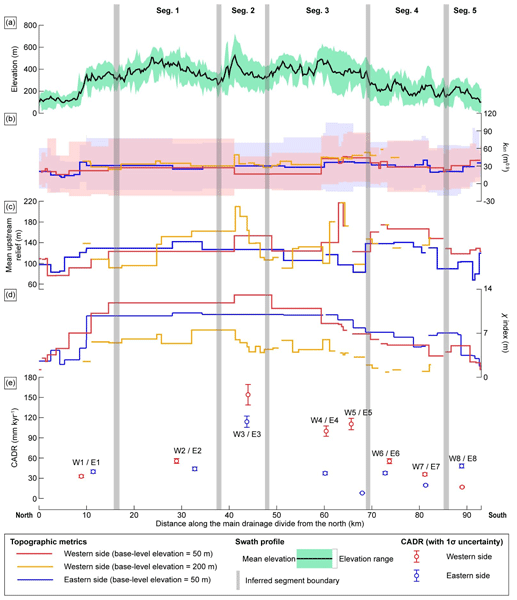
Topographic metrics were used to understand changes due to tectonic activity. We evaluated the relative tectonic activity along the Ulsan Fault Zone (UFZ), one of the most active fault zones in South Korea. We divided the UFZ into five segments, based on the spatial variation in activity. We modeled the landscape evolution of the study area and interpreted tectono-geomorphic history during which the northern part of the UFZ experienced asymmetric uplift, while the southern part did not.
Cho-Hee Lee, Yeong Bae Seong, John Weber, Sangmin Ha, Dong-Eun Kim, and Byung Yong Yu
Earth Surf. Dynam., 12, 1091–1120, https://doi.org/10.5194/esurf-12-1091-2024, https://doi.org/10.5194/esurf-12-1091-2024, 2024
Short summary
Short summary
Topographic metrics were used to understand changes due to tectonic activity. We evaluated the relative tectonic activity along the Ulsan Fault Zone (UFZ), one of the most active fault zones in South Korea. We divided the UFZ into five segments, based on the spatial variation in activity. We modeled the landscape evolution of the study area and interpreted tectono-geomorphic history during which the northern part of the UFZ experienced asymmetric uplift, while the southern part did not.
Chinmay Dash, Yeong Bae Seong, Ajay Kumar Singh, Min Kyung Lee, Jae Il Lee, Kyu-Cheul Yoo, Hyun Hee Rhee, and Byung Yong Yu
Clim. Past Discuss., https://doi.org/10.5194/cp-2024-38, https://doi.org/10.5194/cp-2024-38, 2024
Revised manuscript not accepted
Short summary
Short summary
This study explores sediment core RS15-LC47 from the Ross Sea over the past 800,000 years, examining changes in sea-ice dynamics and deposition environments. It integrates various data to reveal shifts related to Circumpolar Deep Water influx and Antarctic currents, particularly during significant climate transitions. Results highlight potential West Antarctic Ice Sheet collapses in warmer periods, offering new insights into the area's paleoclimate and sedimentary processes.
Purevmaa Khandsuren, Yeong Bae Seong, Hyun Hee Rhee, Cho-Hee Lee, Mehmet Akif Sarikaya, Jeong-Sik Oh, Khadbaatar Sandag, and Byung Yong Yu
The Cryosphere, 17, 2409–2435, https://doi.org/10.5194/tc-17-2409-2023, https://doi.org/10.5194/tc-17-2409-2023, 2023
Short summary
Short summary
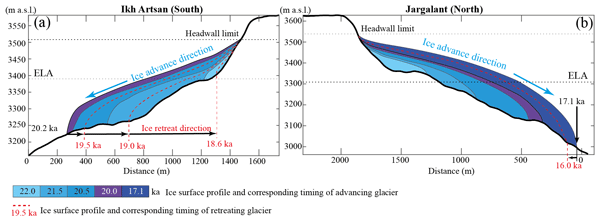
Moraine is an awe-inspiring landscape in alpine areas and stores information on past climate. We measured the timing of moraine formation on the Ih Bogd Massif, southern Mongolia. Here, glaciers move synchronously as a response to changing climate; however, our glacier on the northern slope reached its maximum extent 3 millennia after the southern one. We ran a 2D ice surface model and found that the diachronous behavior of glaciers was real. Aspect also controls the mass of alpine glaciers.
Jamey Stutz, Andrew Mackintosh, Kevin Norton, Ross Whitmore, Carlo Baroni, Stewart S. R. Jamieson, Richard S. Jones, Greg Balco, Maria Cristina Salvatore, Stefano Casale, Jae Il Lee, Yeong Bae Seong, Robert McKay, Lauren J. Vargo, Daniel Lowry, Perry Spector, Marcus Christl, Susan Ivy Ochs, Luigia Di Nicola, Maria Iarossi, Finlay Stuart, and Tom Woodruff
The Cryosphere, 15, 5447–5471, https://doi.org/10.5194/tc-15-5447-2021, https://doi.org/10.5194/tc-15-5447-2021, 2021
Short summary
Short summary
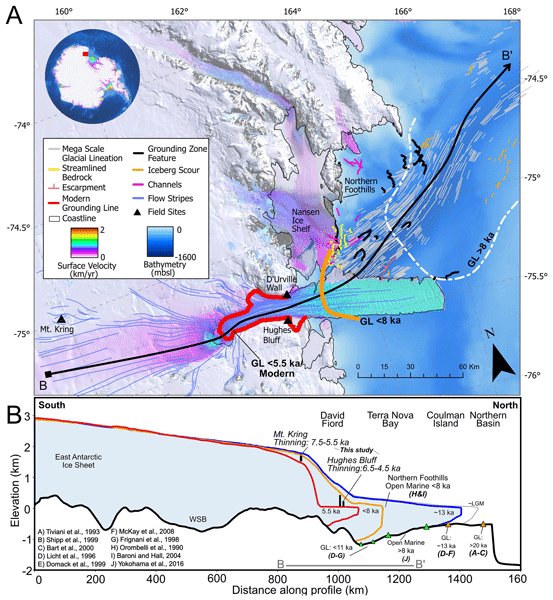
Understanding the long-term behaviour of ice sheets is essential to projecting future changes due to climate change. In this study, we use rocks deposited along the margin of the David Glacier, one of the largest glacier systems in the world, to reveal a rapid thinning event initiated over 7000 years ago and endured for ~ 2000 years. Using physical models, we show that subglacial topography and ocean heat are important drivers for change along this sector of the Antarctic Ice Sheet.
Cited articles
Ansari, K. and Bae, T. S.: Contemporary deformation and strain analysis in South Korea based on long-term (2000–2018) GNSS measurements, Int. J. Earth Sci., 109, 391–405, https://doi-org-ssl.oca.korea.ac.kr/10.1007/s00531-019-01809-4, 2020.
Argus, D. F., Gordon, R. G., Heflin, M. B., Ma, C., Eanes, R. J., Willis, P., Peltier, W. R., and Owen, S. E.: The angular velocities of the plates and the velocity of the Earth's centre from space geodesy, Geophys. J. Int., 18, 1–48, https://https://doi.org/10.1111/j.1365-246X.2009.04463.x, 2010.
Ashurkov, S. V., San'kov, V. A., Miroschnichenko, A. I., Lukhnev, A. V., Sorokin, A. P., Serov, M. A., and Byzov, L. M.: GPS geodetic constrains on the kinematics of the Amurian Plate, Russ. Geol. Geophys+., 52, 239–249, https://doi.org/10.1016/j.rgg.2010.12.017, 2011.
Atkinson, G. M., Finn, W. D. L., and Charlwood, R. G.: Simple computation of liquefaction probability for seismic hazard applications, Earthq. Spectra, 1, 107–123, https://doi.org/10.1193/1.1585259, 1984.
Balco, G. and Rovey, C. W.: An isochron method for cosmogenic-nuclide dating of buried soils and sediments, Am. J. Sci., 308, 1083–1114, https://doi.org/10.2475/1 0.2008.02, 2008.
Bird, P.: An updated digital model of plate boundaries, Geochem. Geophy. Geosy., 4, 1027, https://doi.org/10.1029/2001GC000252, 2003.
Bonilla, M. G., Mark, R. K., and Lienkaemper, J. J.: Statistical relations among earthquake magnitude, surface rupture length, and surface fault displacement, B. Seismol. Soc. Am., 74, 2379–2411, https://pubs.geoscienceworld.org/ssa/bssa/article/74/6/2379/118679/Statistical-relations-among-earthquake-magnitude (last access: 6 February 2025), 1984.
Bronk Ramsey, C.: Methods for summarizing radiocarbon datasets, Radiocarbon, 59, 1809–1833, https://doi.org/10.1017/RDC.2017.108, 2017.
Buylaert, J. P., Murray, A. S., Thomsen, K. J., and Jain, M.: Testing the potential of an elevated temperature IRSL signal from K-feldspar, Radiat. Meas., 44, 560–565, https://doi.org/10.1016/j.radmeas.2009.02.007, 2009.
Buylaert, J. P., Jain, M., Murray, A. S., Thomsen, K. J., Thiel, C., and Sohbati, R.: A robust feldspar luminescence dating method for Middle and Late Pleistocene sediments, Boreas, 41, 435–451, https://doi.org/10.1111/j.1502-3885.2012.00248.x, 2012.
Calais, E., Dong, L., Wang, M., Shen, Z., and Vergnolle, M.: Continental deformation in Asia from a combined GPS solution, Geophys. Res. Lett., 33, L24319, https://doi.org/10.1029/2006GL028433, 2006.
Chang, C.-J.: Structural characteristics and evolution of the Yangsan fault, SE Korea, PhD thesis, Kyungpook National University, Korea, https://www.riss.kr/link?id=T8233956 (last access: 6 February 2025), 2002.
Chang, C.-J. and Chang, T. W.: Movement History of the Yangsan Fault based on Paleostress Analysis, J. Eng. Geo., 8, 35–49, 1998.
Chang, K. H., Woo, B. G., Lee, J. H., Park, S. O., and Yao, A.: Cretaceous and early Cenozoic stratigraphy and history of eastern Kyongsang Basin, S. Korea, J. Geol. Soc. Korea, 26, 471–487, 1990.
Cheon, Y., Ha, S., Lee, S., Cho, H, and Son, M.: Deformation features and history of the Yangsan Fault Zone in the Eonyang-Gyeongju area, SE Korea, J. Geol. Soc. Korea, 53, 95–114, https://doi.org/10.14770/jgsk.2017.53.1.95, 2017.
Cheon, Y., Cho, H., Ha., S., Kang, H.-C., Kim, J.-S., and Son, M.: Tectonically controlled multiple stages of deformation along the Yangsan Fault Zone, SE Korea, since Late Cretaceous, J. Asian Earth Sci., 170, 188–207, https://doi.org/10.1016/j.jseaes.2018.11.003, 2019.
Cheon, Y., Choi, J.-H., Choi, Y., Bae, H., Han, K.-H., Son, M., Choi, S.-J., and Ryoo, C.-R.: Understanding the distribution and internal structure of the main core of the Yangsan Fault Zone: Current trends and future work, J. Geol. Soc. Korea, 56, 61–640, https://doi.org//10.14770/jgsk.2020.56.5.619, 2020a.
Cheon, Y., Choi, J.-H., Kim, N., Lee, H., Choi, I., Bae, H., Rockwell, T. K., Lee, S. R., Ryoo, C.-R., and Choi, H.: Late Quaternary transpressional earthquakes on a long-lived intraplate fault: A case study of the Southern Yangsan Fault, SE Korea, Quatern. Int., 553, 132–143, https://doi.org/10.1016/j.quaint.2020.07.025, 2020b.
Choi, J.-H., Yang, S.-J., and Kim, Y.-S.: Fault zone classification and structural characteristics of the southern Yangsan fault in the Sangcheon-ri area, SE Korea, J. Geol. Soc. Korea, 45, 9–28, 2009.
Choi, J.-H., Kim, Y.-S., and Klinger, Y.: Recent progress in studies on the characteristics of surface rupture associated with large earthquakes, J. Geol. Soc. Korea, 53, 129–157, https://doi.org/10.14770/jgsk.2017.53.1.129, 2017.
Choi, S.-J., Ghim, Y. S., Cheon, Y., and Ko, K.: The First Discovery of Quaternary Fault in the Western Part of the South Yangsan Fault-Sinwoo Site, Econ. Environ. Geol., 52, 251–258, https://doi.org/10.9719/EEG.2019.52.3.251, 2019.
Choi, S.-J., Jeon, J. S., Song, G. Y., Kim, H. C., Kim, Y. H., Choi, B. Y., Chwae, W. C., Han, J. G., Ryoo, C.-R., Sun, C.-G., Jun, M.-S., Kim, G.-Y., Kim, Y. B., Lee, H. J., Shin, J. S., Lee, Y. S., and Kee, W.-S.: Active fault map and seismic hazard map, domestic report, National Emergency Management Agency, Seoul, Seoul, 939 pp., 2012.
Crampin, S. and Gao, Y.: Earthquakes can be stress-forecast, Geophy. J. Int., 180, 1124–1127, https://doi.org/10.1111/j.1365-246X.2009.04475.x, 2010.
Delvaux, D. and Sperner, B.: New aspects of tectonic stress inversion with reference to the TENSOR program, in: New Insights into Structural Interpretation and Modelling, edited by: Nieuwland, D. A., Geol. Soc., London Spec. Publ., 212, 75–100, https://doi.org/10.1144/GSL.SP.2003.212.01.06, 2003.
Delvaux, D., Moeys, R., Stapel, G., Petit, C., Levi, K., Miroshnichenko, A., Ruzhich, V., and San'kov, V.: Paleostress reconstructions and geodynamics of the Baikal region, Central Asia, Part 2. Cenozoic rifting, Tectonophysics, 282, 1–38, https://doi.org/10.1016/S0040-1951(97)00210-2, 1997.
DeMets, C., Gordon, R. G., Argus, D. F., and Stein, S.: Current plate motions, Geophys. J. Int., 101, 425–478, https://doi.org/10.1111/j.1365-246X.1990.tb06579.x, 1990.
DeMets, C., Gordon, R. G., Argus, D. F., and Stein, S.: Effect of recent revisions to the geomagnetic reversal time scale on estimates of current plate motions, Geophys. Res. Lett., 21, 2191–2194, https://doi.org/10.1029/94GL02118, 1994.
England, P. and Jackson, J.: Uncharted seismic risk, Nat. Geosci., 4, 348–349, https://doi.org/10.1038/ngeo1168, 2011.
Erlanger, E. D., Granger, D. E., and Gibbon, R. J.: Rock uplift rates in South Africa from isochron burial dating of fluvial and marine terraces, Geology, 40, 1019–1022, https://doi.org/10.1130/G33172.1, 2012.
Ge, J., Shi, X., Chen, H., Weldon, R., Walker, R., Li, T., Yang, H., Chen, J., Li, F., Wei, X., Yang, X., Bai, Z., Zhang, Y., Shu, Y., Liu, X., and Yan, Y.: Paleoseismology of the northern Kongur Shan Extensional System, NE Pamir: Implications for potential irregular earthquake recurrence, J. Geophys. Res.-Sol. Ea., 129, e2023JB028371, https://doi.org/10.1029/2023JB028371, 2024.
Geller, R. J., Jackson, D. D., Kagan, Y. Y., and Mulargia, F.: Earthquakes Cannot Be Predicted, Science, 275, 1616–1616, https://doi.org/10.1126/science.275.5306.1616, 1997.
Granger, D. E.: A review of burial dating methods using 26Al and 10Be, in: In Situ-Produced Cosmogenic Nuclides and Quantification of Geological Processes: Geological Society of America Special Paper 415, edited by: Siame, L. L., Bourlès, D. L., and Brown, 1–16, https://doi.org/10.1130/2006.2415(01), 2006.
Granger, D. E. and Muzikar, P. F.: Dating sediment burial with in situ-produced cosmogenic nuclides: Theory, techniques, and limitations, Earth Planet. Sc. Lett., 188, 269–281, https://doi.org/10.1016/S0012-821X(01)00309-0, 2001.
Gurpinar, A.: The importance of paleoseismology in seismic hazard studies for critical facilities, Tectonophysics, 408, 23–28, https://doi.org/10.1016/j.tecto.2005.05.042, 2005.
Gwon, O., Park, K., Naik, S. P., Shin, H.-C., and Kim, Y. -S.: A study on the characteristics of fault activity in the southern part of the Ulsan fault using paleoseismic method, J. Geol. Soc. Korea, 57, 109–121, https://doi,org/10.14770/jgsk.2021.57.2.109, 2021.
Gwon, S., Cho, S., Park, D., Choi, W.-H., Nakao, R., Tanaka, T., and Inoue, D.: Microscopic analysis of fault rock using X-ray computed tomography from the Wolsan trench in the middle part of Yangsan fault, SE Korea, J. Geol. Soc. Korea, 56, 273–284, https://doi.org/10.14770/jgsk.2020.56.2.273, 2020.
Ha, S., Son, M., and Seong, Y. B.: Active Fault Trace Identification Using a LiDAR High-Resolution DEM: A Case Study of the Central Yangsan Fault, Korea, Remote Sens., 14, 4838, https://doi.org/10.3390/rs14194838, 2022.
Han, J.-W., Lee, S., Ha, S., Lee, C. H., Seong, Y. B., Kang, H.-C., Kim, M.-C., Gil, T., and Son, M.: A preliminary study on the Quaternary faulting along the northern part of Yangsan Fault and Yeongdeok Fault, in: 76th Annual Meeting of the Geological Society of Korea and 2021 Fall Joint Conference of the Geological Sciences, Jeju, Korea, 26–28 October 2021, 317, https://www.gskorea.or.kr/ (last access: 6 February 2025), 2021.
Han, M., Kim, K.-H., Son, M., Kang, S. Y., and Park, J.-H.: Location of recent micro earthquakes in the Gyeongju area, Geophysics and Geophysical Exploration, 19, 97–104, https://doi.org/10.7582/GGE.2016.19.2.097, 2016.
Hansen, V., Murray, A., Buylaert, J.-P., Yeo, E. Y., and Thomsen, K.: A new irradiated quartz for beta source calibration, Radiat. Meas., 81, 123–127, https://doi.org/10.1016/j.radmeas.2015.02.017, 2015.
Heki, K., Miyazaki, S., Takahashi, H., Kasahara, M., Kimata, F., Miura, S., Vasilenko, N. F., Ivashchenko, A., and An, K.-D.: The Amurian Plate motion and current plate kinematics in eastern Asia, J. Geophys. Res., 104, 29147–29155, https://doi.org/10.1029/1999JB900295, 1999.
Hong, T. K., Lee, J., and Houng, S. E.: Long-term evolution of intraplate seismicity in stress shadows after a megathrust, Phys. Earth Planet. In., 245, 59–70, https://doi.org/10.1016/j.pepi.2015.05.009, 2015.
Hong, T. K., Lee, J., Park, S., and Kim, W.: Time-advanced occurrence of moderate-size earthquakes in a stable intraplate region after a megathrust earthquake and their seismic properties, Sci. Rep., 8, 13331, https://doi.org/10.1038/s41598-018-31600-5, 2018.
Hong, Y., Oh, J.-S., Hong, S.-C., and Shin, J.: Geomorphological Development and Fault Activity of the Central-Southern Yangsan Fault (I): Developmental Characteristics and Distribution of the Quaternary Landforms, J. Korean Geomorphological Assoc., 28, 67–81, https://doi.org/10.16968/JKGA.28.1.67, 2021.
Hough, S. and Page, M.: Toward a consistent model for strain accrual and release for the New Madrid seismic zone, central United States, J. Geophys. Res., 116, B03311, https://doi.org/10.1029/2010JB007783, 2011.
Hough, S. E., Armbruster, J. G., Seeber, L., and Hough, J. F.: On the modified Mercalli intensities and magnitudes of the 1811–1812 New Madrid earthquakes, J. Geophys. Res., 105, 23839–23864, https://doi.org/10.1029/2000JB900110, 2000.
Hwang, B.-H., Lee, J. D., and Yang, K.: Petrological study of the granitic rocks around the Yangsan Fault: Lateral displacement of the Yangsan Fault, J. Geol. Soc. Korea, 40, 161–178, 2004.
Hwang, B. H., Lee, J. D., Yang, K., and McWilliams, M.: Cenozoic strike-slip displacement along the Yangsan Fault, southeast Korean Peninsula, Int. Geol. Rev., 49, 768–775, https://doi.org/10.2747/0020-6814.49.8.768, 2007a.
Hwang, B. H., McWilliams, M., Son, M., and Yang, K.: Tectonic implication of A-type granites across the Yangsan Fault, Gigye and Gyeongju areas, southeast Korean Peninsula, Int. Geol. Rev., 49, 1094–1102, https://doi.org/10.2747/0020-6814.49.12.1094, 2007b.
Ikeya, M., Miki, T., and Tanaka, K.: Dating of a Fault by Electron Spin Resonance on Intrafault Materials, Science, 215, 1392–1393, https://doi.org/10.1126/science.215.4538.1392, 1982.
Jin, K., Kim, Y.-S., Kang, H. C., and Shin, H. C.: Study on developing characteristics of the Quaternary Gusan Fault in Uljin, Gyeongbuk, Korea, J. Geol. Soc. Korea, 49, 197–207, https://doi.org/10.14770/jgsk.2013.49.2.197, 2013.
Johnston, A. C. and Schweig, E. S.: The enigma of the New Madrid earthquakes of 1811–1812, Annu. Rev. Earth Pl. Sc., 24, 339–384, https://doi.org/10.1146/annurev.earth.24.1.339, 1996.
Kanamori, H.: The energy release in great earthquakes, J. Geophys. Res., 82, 2981–2987, https://doi.org.10.1029/JB082i020p02981, 1977.
Kang, H.-C., Cheon, Y., Ha, S., Seo, K., Kim, J.-S., Shin, H. C., and Son, M.: Geology and U-Pb Age in the Eastern Part of Yeongdeok-gun, Gyeongsangbuk-do, Korea, J. Petrological Soc. Korea, 27, 153–171, https://doi.org/10.7854/JPSK.2018.27.3.153, 2018.
Kee, W.-S., Kim, Y.-H., Lee, H.-J., Choi, D.-L., Kim, B.-C., Song, K.-Y., Koh, H.-J., Lee, S. R., Yeon, Y. G., Hwang, S.-H., and Sung, N.-H.: South eastern fault variable research and DB Construction, Korea Institute of Geoscience and Mineral Resources, Daejeon, 327 pp., 2009.
Khromovskikh, V. S.: Determination of magnitudes of ancient earthquakes from dimensions of observed seismodislocations, Tectonophysics, 166, 269–280, https://doi.org/10.1016/0040-1951(89)90219-9, 1989.
Kim, C.-M., Jeong, J. O., Gu, D., and Han, H.: Identification of materials in principal slip zones of faults by X-ray diffraction analysis using a small amount of sample, J. Geol. Soc. Korea, 53, 873–883, https://doi.org/10.14770/jgsk.2017.53.6.873, 2017a.
Kim, C.-M., Ha, S., and Son, M.: Evidence of coseismic slip recorded by Quaternary fault materials and microstructures, Naengsuri, Pohang, J. Geol. Soc. Korea, 56, 175–192, https://doi.org/10.14770/jgsk.2020.56.2.175, 2020a.
Kim, C.-M., Cheon, Y., Lee, T.-H., Choi, J.-H., Ha, S., and Jeong, J. O.: Long-Term Weakening Processes and Short-Term Seismic Slip Behavior of an Intraplate Mature Fault Zone: A Case Study of the Yangsan Fault, SE Korea, J. Geophys. Res.-Sol. Ea., 127, e2021JB023154, https://doi.org/10.1029/2021JB023154, 2022.
Kim, D. E. and Oh, J.-S.: Landform Classification Using Geomorphons on the Middle Yangsan Fault System, Southeastern Korea, J. Korean Geogr. Soc., 54, 493–505, 2019.
Kim, D.-E. and Seong. Y. B.: Cumulative Slip Rate of the Southern Yangsan Fault from Geomorphic Indicator and Numerical Dating, J. Korean Geogr. Soc., 56, 201–213. https://doi.org/10.22776/KGS.2021.56.2.201, 2021.
Kim, D. H., Hwang, J. H., Park, K. H., and Song, K. Y.: Explanatory Note of The Pusan Sheet,
Kim, H.-U. and Bae, T.-S.: Monitoring of Possible Activities of Yangsan Fault Zone Using GNSS, Appl. Sci., 13, 1862, https://doi.org/10.3390/app13031862, 2023.
Kim, I.-S.: Origin and tectonic evolution of the East Sea (Sea of Japan) and the Yangsan fault system: a new synthetic interpretation, J. Geol. Soc. Korea, 28, 84–109, 1992.
Kim, K.-H., Ree, J.-H., Kim, Y., Kim, S., Kang, S. Y., and Seo, W.: Assessing whether the 2017 Mw 5.4 Pohang earthquake in South Korea was an induced event, Science, 360, 1007–1009, https://doi.org/10.1126/science.aat6081, 2018.
Kim, K.-H., Seo, W., Hang, J., Kwon, J., Kang, S. Y., Ree, J.-H., Kim, S., and Liu, K.: The 2017 ML 5.4 Pohang earthquake sequence, Korea, recorded by a dense seismic network, Tectonophysics, 774, 228306, https://doi.org/10.1016/j.tecto.2019.228306, 2020b.
Kim, M.-C., Jung, S., Yoon, S., Jeong, R.-Y., Song, C. W., and Son, M.: Neotectonic crustal deformation and current stress field in the Korean Peninsula and Their Tectonic Implications: a review, J. Petrological Soc. Korea, 25, 169–193, https://doi.org/10.7854/JPSK.2016.25.3.169, 2016.
Kim, M.-J. and Lee, H.-K.: Long-term patterns of earthquakes influenced by climate change: Insights from earthquake recurrence and stress field changes across the Korean Peninsula during interglacial periods, Quaternary Sci. Rev., 321, 108369, https://doi.org/10.1016/j.quascirev.2023.108369, 2023.
Kim, M.-J. and Lee, H.-W.: ESR dating of fault gouge – review, J. Geol. Soc. Korea, 56, 175–192, https://doi.org/10.14770/jgsk.2020.56.2.211, 2020.
Kim, N., Choi, J.-H., Park, S.-I., Lee, T.-H. and Choi, Y.: Cumulative offset analysis of the Central-Southern Yangsan Fault based on topography of Quaternary fluvial terrace, J. Geol. Soc. Korea, 56, 135–154, https://doi.org/10.14770/jgsk.2020.56.2.135, 2020c.
Kim, N., Park, S.-I., and Choi, J.-H.: Internal architecture and earthquake rupture behavior of a long-lived intraplate strike–slip fault: A case study from the Southern Yangsan Fault, Korea, Tectonophysics, 816, 229006, https://doi.org/10.1016/j.tecto.2021.229006, 2021.
Kim, T., Choi, J.-H., Cheon, Y., Lee, T.-H., Kim, N., Lee, H., Kim, C.-M., Choi, Y., Bae, H., Kim, S.-G., Ryoo, C.-R., and Klinger, Y.: Correlation of paleoearthquake records at multiple sites along the southern Yangsan Fault, Korea: Insights into rupture scenarios of intraplate strike-slip earthquakes, Tectonophysics, 854, 229817, https://doi.org/10.1016/j.tecto.2023.229817, 2023.
Kim, T., Lee, H., Kim, D. E., Choi, J. H., Choi, Y., Han, M., and Kim, Y. S.: Determination of the long-term slip rate of a fault in a slowly deforming region based on a reconstruction of the landform and provenance, Geomorphology, 461, 109286, https://doi.org/10.1016/j.geomorph.2024.109286, 2024.
Kim, Y.-S., Jin, K., Choi, W.-H., and Kee, W.-S.: Understanding of active faults: A review for recent researches, J. Geol. Soc. Korea, 47, 723–752, 2011.
Kim, Y.-S., Kim, T., Kyung, J. B., Cho, C. S., Choi, J.-H., and Choi, C. U.: Preliminary study on rupture mechanism of the 9.12 Gyeongju Earthquake, J. Geol. Soc. Korea, 53, 407–422, https://doi.org.10.14770/jgsk.2017.53.3.407, 2017b.
Ko, K., Choi, S.-J., Lee, T.-H., Gihm, Y. S., Kim, C.-M., Kim, K., and Cheon, Y.: A multidisciplinary approach to characterization of the mature northern Yangsan fault in Korea and its active faulting, Mar. Geophys. Res., 43, 21, https://doi.org/10.1007/s11001-022-09486-w, 2022.
Korea Meteorological Administration: 2022 yearbook, Korea Meteorological Administration, Seoul, 416 pp., https://www.kma.go.kr (last access: 6 February 2025), 2022.
Kreutzer, S.: calc_FadingCorr(): Apply a fading correction according to Huntley and Lamothe (2001) for a given g-value and a given tc. Function version 0.4.3, in: Luminescence, edited by: Kreutzer, S., Burow, C., Dietze, M., Fuchs, M. C., Schmidt, C., Fischer, M., Friedrich, J., Mercier, N., Philippe, A., Riedesel, S., Autzen, M., Mittelstrass, D., Gray, H. J., and Galharret, J., Comprehensive Luminescence Dating Data Analysis R package version 0.9.23, https://CRAN.R-project.org/package=Luminescence (last access: 28 January 2024), 2023.
Kuwahara, Y., Choi, J.-H., Cheon, Y., and Imanishi, K.: Dependence of earthquake faulting type on fault strike across the Korean Peninsula: Evidence for weak faults and comparison with the Japanese Archipelago, Tectonophysics, 804, 228757, https://doi.org/10.1016/j.tecto.2021.228757, 2021.
Kyung, J. B.: Paleoseismology of the Yangsan Fault, southeastern part of the Korean Peninsula, Ann. Geophys., 46, 983–996, http://hdl.handle.net/2122/999 (last access: 6 February 2025), 2003.
Lal, D.: Cosmic ray labeling of erosion surfaces: in situ nuclide production rates and erosion models, Earth Planet. Sc. Lett., 104, 424–439, https://doi.org/10.1016/0012-821X(91)90220-C, 1991.
Lee, C. H., Seong Y. B., Oh, J.-S., and Kim. D. E.: Tectonic Geomorphology on Yugye-Bogyeongsa Area of Yangsan Fault Zone, J. Korean Geomorphological Assoc., 26, 93–106, https://doi.org/10.16968/JKGA.26.1.93, 2019.
Lee, H. K. and Schwarcz, H. P.: Criteria for complete zeroing of ESR signals during faulting of the San Gabriel fault zone, southern California, Tectonophysics, 235, 317–337, https://doi.org/10.1016/0040-1951(94)90192-9, 1994.
Lee, H. K. and Yang, J. S.: ESR dating of the Eupchon fault, south Korea, Quat. Geochronol., 2, 392–397, https://doi.org/10.1016/j.quageo.2006.04.009, 2003.
Lee, J., Rezaei, S., Hong, Y., Choi, J.-H., Choi, J.-H., Choi, W.-H., Rhee, K.-W., and Kim, Y.-S.: Quaternary fault analysis through a trench investigation on the northern extension of the Yangsan fault at Dangu-ri, Gyungju-si, Gyeongsangbuk-do, J. Geol. Soc. Korea, 51, 471–485, https://doi.org.10.14770/jgsk.2015.51.5.471, 2015.
Lee, K.: Historical earthquake data of Korean, Journal of the Korean Geophysical Society, 1, 3–22, 1998.
Lee, K. and Yang, W.-S.: Historical Seismicity of Korea, B. Seismol. Soc. Am., 96, 846–855, https://doi.org/10.1785/0120050050, 2006.
Lee, S.: Characteristics of the Quaternary Faults in SE Korea: Insight from the Yangsan Fault and Gokgang Fault, PhD thesis, Pusan National University, Korea, 184 pp., https://www.riss.kr/link?id=T16857309 (last access: 6 February 2025), 2023.
Lee, S., Han, J., Ha, S., Lim, H., Seong, Y. B., Choi, J.-H., Lee, C. H., Kim, S.-J., Kang, H.-C., Kim, M.-C., Lim, H., and Son, M.: Characteristics of the Quaternary faulting detected along the Yangsan Fault in Yugye- and Jungsan-ri, northern Pohang City, J. Geol. Soc. Korea, 58, 427–443, https://doi.org/10.14770/jgsk.2022.58.4.427, 2022.
Lee, Y., Cheon, Y., Ha, S., Kang, H.-C., Choi, J.-H., and Son, M.: Geometric and kinematic characteristics of the Quaternary fault at Seooe site, in Goseong-gun, Gyeongsangnam-do, J. Geol. Soc. Korea, 53, 115–127, https://doi.org/10.14770/jgsk.2017.53.1.115, 2017.
Lim, H., Ha, S., Ryoo, C.-R., Lee, T.-H., and Son, M.: Evidence of surface rupture in the southernmost part of the Yangsan fault and deterministic seismic hazard assessment: in the Busan metropolitan area, in: 76th Annual Meeting of the Geological Society of Korea and 2021 Fall Joint Conference of the Geological Sciences, Jeju, Korea, 26–28 October 2021, 275, https://www.gskorea.or.kr/ (last access: 6 February 2025), 2021.
Liritzis, I., Stamoulis, K., Papachristodoulou, C., and Ioannides, K.: A re-evaluation of radiation dose-rate conversion factors, Mediterr. Archaeol. Ar., 13, 1–15, https://www.maajournal.com/index.php/maa/article/view/1012 (last access: 6 February 2025), 2013.
Liu, J., Ren, Z., Min, W., Ha, G., and Lei, J.: The advance in obtaining fault slip rate of strike slip fault-A review, Earthq. Res. Adv., 1, 100032, https://doi.org/10.1016/j.eqrea.2021.100032, 2021.
Liu, M. and Stein, S.: Mid-continental earthquakes: Spatiotemporal occurrences, causes, and hazards, Earth-Sci. Rev., 162, 364–386, https://doi.org/10.1016/j.earscirev.2016.09.016, 2016.
Mason, D. B.: Earthquake magnitude potential of the Intermountain Seismic Belt, USA, from surface-parameter scaling of late Quaternary faults, B. Seismol. Soc. Am., 86, 1487–1506, https://doi.org/10.1785/BSSA0860051487, 1996.
McCalpin, J. P.: Application of Paleoseismic Data to Seismic Hazard Assessment and Neotectonic Research, in: Paleoseismology, 2nd edn., edited by: McCalpin, J. P., Academic Press-Elsevier, Burlington, USA, 106 pp., https://doi.org/10.1016/S0074-6142(09)95009-4, 2009.
Mejdahl, V.: Internal radioactivity in quartz and feldspar grains, Ancient TL, 5, 10–17, https://doi.org/10.26034/la.atl.1987.119, 1987.
Min, Z., Hu, G., Jiang, X., Liu, S., and Yang, Y.: Catalog of Chinese Historic Strong Earthquakes From 23 AD to 1911, Seismological Press, Beijing, China, 514 pp., 1995.
Murray, A. S. and Wintle, A. G.: Luminescence dating of quartz using an improved single-aliquot regenerative-dose protocol, Radiat. Meas., 32, 57–73, https://doi.org/10.1016/S1350-4487(99)00253-X, 2000.
Murray, J. and Langbein, J.: Slip on the San Andreas Fault at Parkfield, California, over Two Earthquake Cycles, and the Implications for Seismic Hazard, B. Seismol. Soc. Am., 96, S283–S303, https://doi.org/10.1785/0120050820, 2006.
Naik, S. P., Rockwell, T. K., Jeong, S. H., Kim, Y. S., Shin, H. C., Choi, J. H., Ha, S., and Son, M.: Evidence for large Holocene earthquakes along the Yangsan fault in the SE Korean Peninsula revealed in three-dimensional paleoseismic trenches, Geol. Soc. Am. Bull., 137, 427–446, https://doi.org/10.1130/B37275.1, 2024.
O'Neill, C., Müller, D., and Steinberger, B.: On the uncertainties in hot spot reconstructions and the significance of moving hot spot reference frames, Geochem. Geophy. Geosy., 6, Q04003, https://doi.org/10.1029/2004GC000784, 2005.
Obara, K. and Kato, A.: Connecting slow earthquakes to huge earthquakes, Science, 353, 6296, https://doi.org/10.1126/science.aaf1512, 2016.
Park, C. and Lee, G.: Analysis on Fault-Related Landforms in the Gyeongju Area of the Yangsan Fault Valley, J. Korean Geomorphological Assoc., 25, 19–30, https://doi.org./10.16968/JKGA.25.1.19, 2018.
Park, J. C., Kim, W., Chung, T. W., Baag, C. E., and Ree, J. H.: Focal mechanism of recent earthquakes in the Southern Korean Peninsula, Geophys. J. Int., 169, 1103–1114, https://doi.org/10.1111/j.1365-246X.2007.03321.x, 2007.
Park, Y., Ree, J.-H., and Yoo, S.-H.: Fault slip analysis of Quaternary faults in southeastern Korea, Gondwana Res., 9, 118–125, https://doi.org/10.1016/j.gr.2005.06.007, 2006.
Patyniak, M., Landgraf, A., Dzhumabaeva, A., Abdrakhmatov, K. E., Rosenwinkel, S., Korup, O., Preusser, F., Fohmeister, J., Arrowsmith, J. R., and Strecker, M. R.: Paleoseismic record of three Holocene earthquakes rupturing the Issyk-Ata fault near Bishkek, North Kyrgyzstan, B. Seismol. Soc. Am., 107, 2721–2737, https://doi.org/10.1785/0120170083, 2017.
Powell, R. E. and Weldon II, R. J.: Evolution of the San Andreas fault, Annu. Rev. Earth Pl. Sc., 20, 431–468, https://doi.org/10.1146/annurev.ea.20.050192.002243, 1992.
Prescott, J. R. and Hutton, J. T.: Cosmic ray contributions to dose rates for luminescence and ESR dating: large depths and long-term time variations, Radiat. Meas., 23, 497–500, https://doi.org/10.1016/1350-4487(94)90086-8, 1994.
Readhead, M. L.: Absorbed dose fraction for 87Rb beta particles, Ancient TL, 20, 25–28, https://doi.org/10.26034/la.atl.2002.342, 2002.
Reimer, P., Austin, W., Bard, E., Bayliss, A., Blackwell, P., Bronk Ramsey, C., and Talamo, S.: The IntCal20 Northern Hemisphere Radiocarbon Age Calibration Curve (0–55 cal kBP), Radiocarbon, 62, 725–757, https://doi.org/10.1017/RDC.2020.41, 2020.
Reiter, L.: Earthquake Hazard Analysis: Issue and Insights, Columbia University Press, New York, USA, 254 pp., ISBN 0231065345, 1990.
Ryoo, C.-R. and Cheon, Y.: Characteristics of the Main Fault Zone Developed Along Yangsan Fault: On the Outcrop of Cheonjeon-ri, Dudong-myeon, Ulju-gun, Ulsan, Korea, J. Petrological Soc. Korea, 28, 347–357, https://doi.org/10.7854/JPSK.2019.28.4.347, 2019.
Ryoo, C.-R., Lee, B.-J., Cho, D.-L., Chwae, U.-C., Choi, S.-J., and Kim, J.-Y.: Quaternary fault of Dangu-ri in Gyeongju Gangdong-myeon: Byeokgye Fault, in: Spring Joint Conference on East-North Asia Ore deposit of Cause of Formation, The Korean Society of Economic and Environmental Geology/The Korean Society of Mineral and Energy Resources Engineers/Korean Society of Earth and Exploration Geophysicists, 1999.
Schellart, W. P. and Rawlinson, N.: Convergent plate margin dynamics: New perspectives from structural geology, geophysics and geodynamic modelling, Tectonophysics, 483, 4–19, https://doi.org/10.1016/j.tecto.2009.08.030, 2010.
Seno, T., Stein, S., and Gripp, A. E.: A model for the motion of the Philippine Sea plate consistent with NUVEL-1 and geological data, J. Geophys. Res.-Sol. Ea., 98, 17941–17948, https://doi.org/10.1029/93JB00782, 1993.
Seno, T., Sakurai, T., and Stein, S.: Can the Okhotsk plate be discriminated from the North American plate?, J. Geophys. Res.-Sol. Ea., 101, 11305–11315, https://doi.org/10.1029/96JB00532, 1996.
Shimazaki, K. and Nakata, T.: Time-predictable recurrence model for large earthquakes, Geophys. Res. Lett., 7, 279–282, https://doi.org/10.1029/GL007i004p00279, 1980.
Sim, H., Song, Y., Son, M., Park, C., and Choi, W.: Reactivated Timings of Yangsan Fault in the Northern Pohang Area, Korea, Econ. Environ. Geol., 50, 97–104, https://doi.org/10.9719/EEG.2017.50.2.97, 2017.
Smith, B. R. and Sandwell, D. T.: A model of the earthquake cycle along the San Andreas Fault System for the past 1000 years, J. Geophys. Res., 111, B01405, https://doi.org/10.1029/2005JB003703, 2006.
Soh, I., Chang, C., Lee, J., Hong, T.-K., and Park, E.-S.: Tectonic stress orientations and magnitudes, and friction of faults, deduced from earthquake focal mechanism inversions over the Korean Peninsula, Geophys. J. Int., 123, 1360–1373, https://doi.org/10.1093/gji/ggy061, 2018.
Sohn, D.-H., Choi, B.-K., Kim, S., Park, S.-C., Lee, W.-J., and Park, P.-H.: Decaying Post-Seismic Deformation Observed on the Korean Peninsula Following the 2011 Tohoku-Oki Earthquake, Sensors, 21, 4493, https://doi.org/10.3390/s21134493, 2021.
Son, M., Song, C. W., Kim, M.-C., Cheon, Y., Cho, H., and Sohn, Y. K.: Miocene tectonic evolution of the basins and fault systems, SE Korea: dextral, simple shear during the East Sea (Sea of Japan) opening, J. Geol. Soc. London, 172, 664–680, https://doi.org/10.1144/jgs2014-079, 2015.
Song, C. W.: Study on the evolution of the Miocene Pohang Basin based on its structural characteristics, PhD thesis, Pusan National University, Korea, 146 pp., https://www.riss.kr/link?id=T13864370 (last access: 6 February 2025), 2015.
Song, Y., Ha, S., Lee, S., Kang, H.-C., Choi, J.-H., and Son, M.: Quaternary structural characteristics and paleoseismic interpretation of the Yangsan Fault at Dangu-ri, Gyeongju-si, SE Korea, through trench survey, J. Geol. Soc. Korea, 56, 155–173, https://doi.org/10.14770/jgsk.2020.56.2.155, 2020.
Song, Y., Park, C., Sim, H., Choi, W., and Son, M.: Reactivated Timings of Yangsan Fault in the Sangcheon-ri Area, Korea, Econ. Environ. Geol., 49, 97–104, https://doi.org/10.9719/EEG.2016.49.2.97, 2016.
Song, Y., Sim, H., Hong, S., and Son, M.: K-Ar Age-dating Results of Some Major Faults in the Gyeongsang Basin: Spatio-temporal Variability of Fault Activations during the Cenozoic Era, Econ. Environ. Geol., 52, 449–457, https://doi.org/10.9719/EEG.2019.52.5.449, 2019.
Suzuki, Y., Nakata, T., Watanabe, M., Battulga, S., Enkhtaivan, D., Demberel, S., Odonbaatar, C., Bayasgalan, A., and Badral, T.: Discovery of Ulaanbaatar Fault: A new earthquake threat to the capital of Mongolia, Seismol. Soc. Am., 92, 437–447, https://doi.org/10.1785/0220200109, 2021.
Talwani, P.: On the nature of intraplate earthquakes, J. Seismol., 21, 47–68, https://doi.org/10.1007/s10950-016-9582-8, 2017.
Uchida, N. and Burgmann, R.: Repeating Earthquakes, Annu. Rev. Earth Pl. Sc., 47, 305–332, https://doi.org/10.1146/annurev-earth-053018-060119, 2019.
Wallace, R. E.: Earthquake recurrence intervals on the San Andreas fault, Geol. Soc. Am. Bull., 81, 2875–2890, https://doi.org/10.1130/0016-7606(1970)81[2875:ERIOTS]2.0.CO;2, 1970.
Wells, D. L. and Coppersmith, K. J.: New empirical relationships among magnitude, rupture length, rupture width, rupture area, and surface displacement, B. Seismol. Soc. Am., 84, 974–1002, https://doi.org/10.1785/BSSA0840040974, 1994.
Woith, H., Petersen G.M., Hainzl, S., and Dahm, T.: Review: Can Animals Predict Earthquakes?, B. Seismol. Soc. Am., 108, 1031–1045, https://doi.org/10.1785/0120170313, 2018.
Wolin, E., Stein, S., Pazzaglia, F., Meltzer, A., Kafka, A., and Berti, C.: Mineral, Virginia, earthquake illustrates seismicity of a passive-aggressive margin, Geophys. Res. Lett., 39, L02305, https://doi.org/10.1029/2011GL050310, 2012.
Woo, J.-U., Rhie, J., Kim, S., Kang, T.-S., Kim, K.-H., and Kim, Y. H.: The 2016 Gyeongju earthquake sequence revisited: aftershock interactions within a complex fault system, Geophys. J. Int., 217, 58–74, https://doi.org/10.1093/gji/ggz009, 2019.
Woo, S., Lee, H., Han, R., Chon, C.-M., Son, M., and Song, I.: Frictional properties of gouges collected from the Yangsan Fault, SE Korea, J. Geol. Soc. Korea, 51, 569–584, https://doi.org//10.14770/jgsk.2015.51.6.569, 2015.
Wyss, M.: Cannot Earthquakes Be Predicted?, Science, 278, 487–490, https://doi.org/10.1126/science.278.5337.487, 1997.
Xu, S., Nieto-Samaniego, A. F., and Alaniz-Àlvarez, S. A.: Quantification of true displacement using apparent displacement along an arbitrary line on a fault plane, Tectonophysics, 467, 107–118, https://doi.org/10.1016/j.tecto.2008.12.004, 2009.
Yang, J.-S. and Lee, H.-K.: ESR dating of fault gouge from the Gacheon 1 site on the Yangsan fault zone, J. Geol. Soc. Korea, 48, 459–472, 2012.
Short summary
Unlike episodic plate boundary earthquakes, their randomness makes predicting intraplate earthquakes challenging. This study aids in understanding intraplate earthquake behavior by analyzing paleo-earthquake records of the Yangsan Fault in Korea. Five trench sites revealed six Quaternary earthquakes, the latest 3000 years ago, with Mw 6.7–7.1. The right-lateral fault has a 0.13 mm yr-1 slip rate and a recurrence interval of over 13000 years; it has been continuously active since the Quaternary.
Unlike episodic plate boundary earthquakes, their randomness makes predicting intraplate...


