
Articles | Volume 14, issue 8
https://doi.org/10.5194/se-14-859-2023
© Author(s) 2023. This work is distributed under
the Creative Commons Attribution 4.0 License.
the Creative Commons Attribution 4.0 License.
https://doi.org/10.5194/se-14-859-2023
© Author(s) 2023. This work is distributed under
the Creative Commons Attribution 4.0 License.
the Creative Commons Attribution 4.0 License.
Research article
| 
18 Aug 2023
Research article |
| 18 Aug 2023
| 18 Aug 2023
The impact of seismic noise produced by wind turbines on seismic borehole measurements
Fabian Limberger
CORRESPONDING AUTHOR
Institute of Geosciences, Goethe University Frankfurt, 60438 Frankfurt
am Main, Germany
Institute for Geothermal Resource Management (IGEM), 55411 Bingen,
Germany
Georg Rümpker
Institute of Geosciences, Goethe University Frankfurt, 60438 Frankfurt
am Main, Germany
Frankfurt Institute for Advanced Studies (FIAS), 60438 Frankfurt am
Main, Germany
Michael Lindenfeld
Institute of Geosciences, Goethe University Frankfurt, 60438 Frankfurt
am Main, Germany
Hagen Deckert
Institute for Geothermal Resource Management (IGEM), 55411 Bingen,
Germany
Related authors
Josefine Umlauft, Karin Mora, Fabian Limberger, Kilian Gerberding, Stefanie Dumberger, Simon Haberstroh, Markus Sulzer, Lea Dedden, Markus Weiler, Christian Wirth, Christiane Werner, and Teja Kattenborn
EGUsphere, https://doi.org/10.5194/egusphere-2026-6435, https://doi.org/10.5194/egusphere-2026-6435, 2026
This preprint is open for discussion and under review for Biogeosciences (BG).
Short summary
Short summary
Can we tell when trees lack water by listening to the ground? Over three growing seasons in a German forest, we recorded vibrations generated by trees swaying in the wind and compared them with changes in trunk thickness, weather and soil moisture. These signals helped predict how much water trees lacked, providing information beyond weather and soil measurements alone. Our findings suggest that ground sensors could offer a new way to monitor water conditions in forests.
Wei Li, Megha Chakraborty, Jonas Köhler, Claudia Quinteros-Cartaya, Georg Rümpker, and Nishtha Srivastava
Solid Earth, 15, 197–213, https://doi.org/10.5194/se-15-197-2024, https://doi.org/10.5194/se-15-197-2024, 2024
Short summary
Short summary
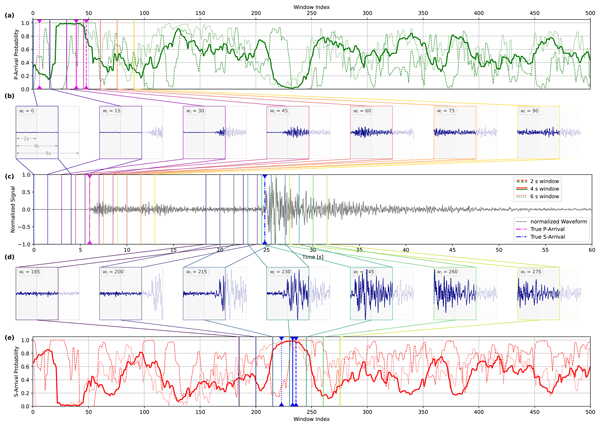
Seismic phase picking and magnitude estimation are crucial components of real-time earthquake monitoring and early warning. Here, we test the potential of deep learning in real-time earthquake monitoring. We introduce DynaPicker, which leverages dynamic convolutional neural networks for event detection and arrival-time picking, and use the deep-learning model CREIME for magnitude estimation. This workflow is tested on the continuous recording of the Turkey earthquake aftershock sequences.

Megha Chakraborty, Wei Li, Johannes Faber, Georg Rümpker, Horst Stoecker, and Nishtha Srivastava
Solid Earth, 13, 1721–1729, https://doi.org/10.5194/se-13-1721-2022, https://doi.org/10.5194/se-13-1721-2022, 2022
Short summary
Short summary
Earthquake magnitude is a crucial parameter in defining its damage potential, and hence its speedy determination is essential to issue an early warning in regions close to the epicentre. This study summarises our findings in an attempt to apply deep-learning-based classifiers to earthquake waveforms, particularly with respect to finding an optimum length of input data. We conclude that the input length has no significant effect on the model accuracy, which varies between 90 %–94 %.
Carola Leva, Georg Rümpker, and Ingo Wölbern
Solid Earth, 13, 1243–1258, https://doi.org/10.5194/se-13-1243-2022, https://doi.org/10.5194/se-13-1243-2022, 2022
Short summary
Short summary
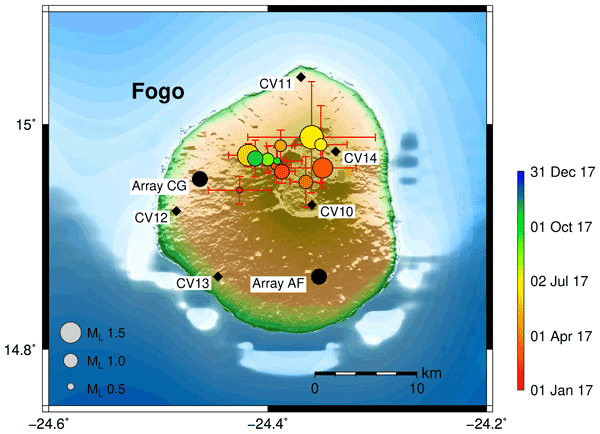
The seismicity of Fogo and Brava, Cape Verde, is dominated by volcano-tectonic earthquakes in the area of Brava and volcanic seismic signals, such as hybrid events, on Fogo. We locate these events using a multi-array analysis, which allows the localization of seismic events occurring outside the network and of volcanic signals lacking clear phases. We observe exceptionally high apparent velocities for the hybrid events located on Fogo. These velocities are likely caused by a complex ray path.
Steffen Abe and Hagen Deckert
Solid Earth, 12, 2407–2424, https://doi.org/10.5194/se-12-2407-2021, https://doi.org/10.5194/se-12-2407-2021, 2021
Short summary
Short summary
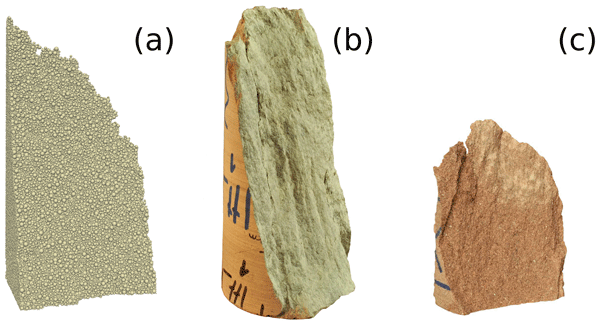
We use numerical simulations and laboratory experiments on rock samples to investigate how stress conditions influence the geometry and roughness of fracture surfaces. The roughness of the surfaces was analyzed in terms of absolute roughness and scaling properties. The results show that the surfaces are self-affine but with different scaling properties between the numerical models and the real rock samples. Results suggest that stress conditions have little influence on the surface roughness.
Cited articles
Abreu, R., Peter, D., and Thomas, C.: Reduction of wind-turbine-generated seismic noise with structural measures, Wind Energ. Sci., 7, 1227–1239, https://doi.org/10.5194/wes-7-1227-2022, 2022.
Afanasiev, M., Boehm, C., van Driel, M., Krischer, L., Rietmann, M., May, D.
A., Knepley, M. G., and Fichtner, A.: Modular and flexible spectral-element waveform modelling in two
and three dimensions, Geophys. J. Int., 216, 1675–1692,
https://doi.org/10.1093/gji/ggy469, 2019 (code available at: https://mondaic.com/docs/0.12.13/installation).
Barkan, D. D.: Dynamics of bases and foundations, McGraw-Hill, p. 325, ISBN 1391637461,
1962.
Boese, C. M., Wotherspoon, L., Alvarez, M., and Malin, P.: Analysis of
Anthropogenic and Natural Noise from Multilevel Borehole Seismometers in an
Urban Environment, Auckland, New Zealand, B. Seismol.
Soc. Am., 105, 285–299, https://doi.org/10.1785/0120130288, 2015.
Colombi, A., Roux, P., Guenneau, S., Gueguen, P., and Craster, R. V.:
Forests as a natural seismic metamaterial: Rayleigh wave bandgaps induced by
local resonances, Sci. Rep., 6, 19238, https://doi.org/10.1038/srep19238, 2016.
Eulenfeld, T. and Wegler, U.: Measurement of intrinsic and scattering
attenuation of shear waves in two sedimentary basins and comparison to
crystalline sites in Germany, Geophys. J. Int., 205,
744–757, 2016.
Gaßner, L. and Ritter, J.: Ground motion emissions due to wind turbines: observations, acoustic coupling, and attenuation relationships, Solid Earth, 14, 785–803, https://doi.org/10.5194/se-14-785-2023, 2023.
Gortsas, T. V., Triantafyllidis, T., Chrisopoulos, S., and Polyzos, D.:
Numerical modelling of micro-seismic and infrasound noise radiated by a wind
turbine, Soil Dyn. Earthq. Eng., 99, 108–123,
https://doi.org/10.1016/j.soildyn.2017.05.001, 2017.
Harris, C. R., Millman, K. J., van der Walt, S. J., Gommers, R., Virtanen, P., Cournapeau, D., Wieser, E., Taylor, J., Berg, S., Smith, N. J., Kern, R., Picus, M., Hoyer, S., van Kerkwijk, M. H., Brett, M., Haldane, A., del Río, J. F., Wiebe, M., Peterson, P., Gérard-Marchant, P., Sheppard, K., Reddy, T., Weckesser, W., Abbasi, H., Gohlke, C., and Oliphant, T. E.: Array programming with NumPy, Nature, 585, 357–362 https://doi.org/10.1038/s41586-020-2649-2, 2020 (code available at: https://numpy.org/install/).
Hayashi, K.: Development of the Surface-wave Methods and Its Application to
Site Investigations, PhD thesis, Kyoto University, Japan, https://doi.org/10.14989/doctor.k13774, 2008.
Heuel, J. and Friederich, W.: Suppression of wind turbine noise from
seismological data using nonlinear thresholding and denoising
autoencoder, J. Seismol., 26, 913–934,
https://doi.org/10.1007/s10950-022-10097-6, 2022.
Kumagai, T., Yanagibashi, T., Tsutsumi, A., Konishi, C., and Ueno, K.:
Efficient surface wave method for investigation of the seabed, Soils Found.,
60, 648–667, 2020.
Larose, E.: Lunar subsurface investigated from correlation of seismic noise,
Geophys. Res. Lett., 32, L16201, https://doi.org/10.1029/2005GL023518, 2005.
Lerbs, N., Zieger, T., Ritter, J., and Korn, M.: Wind turbine induced
seismic signals: the large-scale SMARTIE1 experiment and a concept to define
protection radii for recording stations, Near Surf. Geophys., 18,
467–482, https://doi.org/10.1002/nsg.12109, 2020.
Limberger, F., Lindenfeld, M., Deckert, H., and Rümpker, G.: Seismic radiation from wind turbines: observations and analytical modeling of frequency-dependent amplitude decays, Solid Earth, 12, 1851–1864, https://doi.org/10.5194/se-12-1851-2021, 2021.
Limberger, F., Rümpker, G., Lindenfeld, M., and Deckert, H.: Development
of a numerical modelling method to predict the seismic signals generated by
wind farms, Sci. Rep., 12, 15516, https://doi.org/10.21203/rs.3.rs-1621492/v1, 2022.
Malin, P. E., Bohnhoff, M., Blümle, F., Dresen, G., Martıìnez-Garzón, P., Nurlu, M., Ceken, U., Kadirioglu, F. T., Kartal, R. F., Kilic, T., and Yanik, K.: Microearthquakes preceding a M4.2
Earthquake Offshore Istanbul, Sci. Rep., 8, 16176,
https://doi.org/10.1038/s41598-018-34563-9, 2018.
Neuffer, T. and Kremers, S.: How wind turbines affect the performance of
seismic monitoring stations and networks, Geophys. J. Int., 211, 1319–1327, https://doi.org/10.1093/gji/ggx370, 2017.
Saccorotti, G., Piccinini, D., Cauchie, L., and Fiori, I.: Seismic Noise by
Wind Farms: A Case Study from the Virgo Gravitational Wave Observatory,
Italy, B. Seismol. Soc. Am., 101, 568–578,
https://doi.org/10.1785/0120100203, 2011.
Spies, T., Schlittenhardt, J., and Schmidt, B.: Abschlussbericht für das
Verbundprojekt MAGS2: Mikroseismische Aktivität geothermischer Systeme 2
(MAGS2) – Vom Einzelsystem zur großräumigen Nutzung, Bundesanstalt
für Geowissenschaften und Rohstoffe, https://www.bgr.bund.de/MAGS/DE/Home/MAGS_node.html (last access; 15 August 2023), 2017.
Stammler, K. and Ceranna, L.: Influence of Wind Turbines on Seismic Records
of the Gräfenberg Array, Seismol. Res. Lett., 87, 1075–1081,
https://doi.org/10.1785/0220160049, 2016.
Virtanen, P., Gommers, R., Oliphant, T. E., Haberland, M., Reddy, T., Cournapeau, D., Burovski, E., Peterson, P., Weckesser, W., Bright, J., van der Walt, S. J., Brett, M., Wilson, J., Millman, K. J., Mayorov, N., Nelson, A. R. J., Jones, E., Kern, R., Larson, E., Carey, C. J., Polat, I., Feng, Y., Moore, E. W., Vanderplas, J., Laxalde, D., Perktold, J., Cimrman, R., Henriksen, I., Quintero, E. A., Harris, C. R., Archibald, A. M., Ribeiro, A. H., Pedregosa, F., van Mulbregt, P., and SciPy 1.0 Contributors: SciPy 1.0: Fundamental Algorithms for Scientific Computing in Python, Nat. Methods, 17, 261–272, https://doi.org/10.1038/s41592-020-0772-5, 2020 (code available at: https://scipy.org/install/).
Withers, M. M., Aster, R. C., Young, C. J., and Chael, E. P.: High-frequency
analysis of seismic background noise as a function of wind speed and shallow
depth, B. Seismol. Soc. Am., 86, 1507–1515,
https://doi.org/10.1785/bssa0860051507, 1996.
Zieger, T. and Ritter, J. R. R.: Influence of wind turbines on seismic
stations in the upper rhine graben, SW Germany, J. Seismol., 22,
105–122, https://doi.org/10.1007/s10950-017-9694-9, 2018.
Zieger, T., Nagel, S., Lutzmann, P., Kaufmann, I., Ritter, J., Ummenhofer,
T., Knödel, P., and Fischer, P.: Simultaneous identification of wind turbine vibrations by using
seismic data, elastic modeling and laser Doppler vibrometry, Wind
Energy, 23, 1145–1153, https://doi.org/10.1002/we.2479, 2020.
Short summary
Wind turbines that are located close to a seismometer produce ground tremors that can increase the noise level at the seismic station. Using numerical models, we analyse the effectivity of borehole installations to reduce this impact. We study effects of geophysical parameters on the borehole effectivity and validate our modelling approach with data from real boreholes. Boreholes are effective in reducing the impact of wind turbines; however, this depends on the wavelength of the seismic wave.
Wind turbines that are located close to a seismometer produce ground tremors that can increase...


